List of Psittaciformes by population
| The population of birds |
|---|
 |

This is a list of Psittaciformes species by global population. While numbers are estimates, they have been made by the experts in their fields. For more information on how these estimates were ascertained, see Wikipedia's articles on population biology and population ecology.
This list is not comprehensive, as not all Psittaciformes have had their numbers quantified. All numbers, unless explicitly stated in the notes, only count individuals in the wild; IUCN does not consider species held in captivity in its population estimates.[1]
The IOC World Bird List (version 15.1) recognizes 406 species of Psittaciformes, 14 of which are extinct.[2]
This list follows IUCN classifications for species names and taxonomy. Where IUCN classifications differ from other ornithological authorities, alternative names and taxonomies are noted.
Some members of Psittaciformes are extinct:
- Norfolk Island kākā (Nestor productus) - extinct by 1850s due to habitat destruction and hunting.[3]
- Carolina parakeet (Conuropsis carolinensis) - last recorded in 1910.[4]
- Cuban macaw (Ara tricolor) - last reported in 1885; extinct due to hunting pressures.[5]
- Puerto Rican parakeet (Psittacara maugei) - extinct by 1892.[6] Considered a subspecies of the Hispaniolan parakeet (P. chloropterus) by IUCN/BirdLife International.[7]
- Mascarene parrot (Mascarinus mascarin) - last reported in 1775; extinct due to hunting pressures.[8]
- Oceanic eclectus (Eclectus infectus) - last observed in 1793; extinct due to hunting and predation pressures.[9]
- Seychelles parakeet (Palaeornis wardi) - last observed in 1893; extinct due to hunting pressures.[10]
- Rodrigues parakeet, or Newton's parakeet (Psittacula exsul) - extinct by 1876, due to hunting pressures, habitat loss, and inclement weather. IUCN/BirdLife International place species in genus Alexandrinus.[11]
- Mauritius grey parrot, or Mascarene grey parakeet (Psittacula bensoni) - extinct by end of 1750s due to deforestation. IUCN/BirdLife International place species in genus Lophopsittacus.[12]
- Paradise parrot (Psephotellus pulcherrimus) - last observed in 1927; extinct due to drought and overgrazing.[13]
- Black-fronted parakeet (Cyanoramphus zealandicus) - last observed in 1844; extinct due to hunting and predation pressures, deforestation.[14]
- Raiatea parakeet (Cyanoramphus ulietanus) - likely extinct by end of 1770s due to predation by invasive species and deforestation.[15]
- Broad-billed parrot (Lophopsittacus mauritianus) - extinct ca. 1674 due to introduced predators.[16]
- Rodrigues parrot (Necropsittacus rodricanus) - last observed in 1761; extinct due to hunting and predation pressures, deforestation.[17]
Species by global population
| Common name | Binomial name | Population | Status | Trend | Notes | Image |
|---|---|---|---|---|---|---|
| Glaucous macaw | Anodorhynchus glaucus | 0-20[18] | CR[18] | ?[18] | May be extinct. Updated from "Extinct" in 2000 due to persistent unverified reports of its existence.[18] |  |
| New Caledonian lorikeet | Charmosyna diadema | 0-49[19] | CR[19] | ?[19] | May be extinct. Total population, if extant, is estimated to be less than 50 individuals.[19] |  |
| Red-throated lorikeet | Charmosyna amabilis | 0-49[20] | CR[20] | ?[20] | May be extinct. Last confirmed record is from 1965.[20] |  |
| Puerto Rican amazon | Amazona vittata | 1-49[21] | CR[21] |  [21] | At least 126-139 individuals in Río Abajo subpopulation; not counted toward total population until breeding, per IUCN policy on released captive-reared birds.[21][1] |  |
| Orange-bellied parrot | Neophema chrysogaster | 20-25[22] | CR[22] |  [22] |
Approximately 300 individuals are currently kept in captive breeding programs.[22] |  |
| Imperial amazon | Amazona imperialis | 40-60[23] | CR[23] | [23] |
 | |
| Night parrot | Pezoporus occidentalis | 40-500[24] | CR[24] | [24] | Best estimate for number of mature individuals is 200.[24] |  |
| Malherbe's parakeet | Cyanoramphus malherbi | 50-249[25] | CR[25] |  [25] | Total population is estimated to be 290-690 individuals.[25] |  |
| Sulu racquet-tail
(Blue-winged racket-tail) |
Prioniturus verticalis | 100-500[26] | CR[26] | [26] | ||
| Kākāpō | Strigops habroptilus | 116[27] | CR[27] | [27] |
Total population is 149 individuals (2018).[27] |  |
| Red-fronted macaw | Ara rubrogenys | 134-272[28] | CR[28] | [28] | Total population is estimated to be, at most, 600-800 individuals.[28] |  |
| Blue-throated macaw | Ara glaucogularis | 208-303[29] | CR[29] | [29] | Total population is estimated to be 312-455 individuals.[29] |  |
| Indigo-winged parrot
(Fuertes's parrot) |
Hapalopsittaca fuertesi | 230-300[30] | EN[30] | [30] | Total population is estimated to be 350-450 individuals.[30] |  |
| Lear's macaw | Anodorhynchus leari | 250-999[31] | EN[31] | [31] | Total population is estimated to be 1,694 individuals.[31] |  |
| Grey-breasted parakeet | Pyrrhura griseipectus | 250-999[32] | EN[32] | [32] | Total population is estimated to be 656-866 individuals.[32] |  |
| El Oro parakeet | Pyrrhura orcesi | 250-999[33] | EN[33] | [33] | Total population is estimated to be 350-1,500 individuals.[33] |  |
| Blue-backed parrot | Tanygnathus everetti | 250-999[34] | EN[34] | [34] |
Total population is estimated to be 375-1,500 individuals.[34] |  |
| Saint Vincent amazon | Amazona guildingii | 250-999[35] | VU[35] | [35] | Total population is estimated to be 730 individuals.[35] |  |
| Chatham Islands parakeet | Cyanoramphus forbesi | 250-999[36] | VU[36] | [36] |
 | |
| Yellow-faced parrotlet | Forpus xanthops | 250-999[37] | VU[37] | [37] | Total population is estimated to be 350-1,500 individuals.[37] |  |
| Green racquet-tail
(Green racket-tail) |
Prioniturus luconensis | 300-800[38] | EN[38] | [38] | 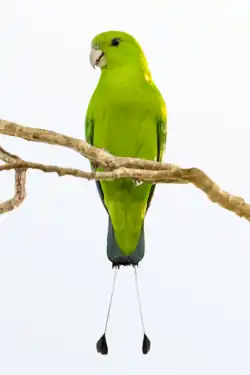 | |
| Henderson lorikeet
(Stephen's lorikeet) |
Vini stepheni | 360-2,000[39] | VU[39] | [39] | Best estimate for number of mature individuals is 500-1,000. Total population is estimated to be 554-3,014 individuals.[39] |  |
| Echo parakeet | Psittacula eques | 400-450[40] | VU[40] | [40] | Total population is estimated to be 756 individuals.[40]
IUCN/BirdLife International place species in genus Alexandrinus. |
 |
| Philippine cockatoo
(Red-vented cockatoo) |
Cacatua haematuropygia | 430-750[41] | CR[41] | [41] | Total population is estimated to be 650-1,120 individuals. |  |
| Great green macaw | Ara ambiguus | 500-1,000[42] | CR[42] | [42] |  | |
| Scarlet-breasted lorikeet
(Sunset lorikeet) |
Trichoglossus forsteni | 500-1,500[43] | EN[43] | [43] |
 | |
| Purple-naped lory | Lorius domicella | 500-5,000[44] | EN[44] | [44] |
 | |
| Seychelles parrot
(Seychelles black parrot) |
Coracopsis barklyi | 730-1,170[45] | VU[45] | [45] |
Total population is estimated to be 1,392 individuals.[45] |  |
| Cape parrot | Poicephalus robustus | 730-1,200[46] | VU[46] | [46] |
Total population is estimated to be 1,100-1,786 individuals.[46] |  |
| Golden-shouldered parrot | Psephotus chrysopterygius | 780-1,100[47] | EN[47] | [47] | Best estimate for number of mature individuals is 940.[47] |  |
| Rimatara lorikeet
(Kuhl's lorikeet) |
Vini kuhlii | 800[48] | EN[48] | [48] | Total population is estimated to be 1,220 individuals.[48] |  |
| Citron-crested cockatoo | Cacatua citrinocristata | 800-1,320[49] | CR[49] | [49] |
Best estimate for number of mature individuals is 1,320.[49] |  |
| Thick-billed parrot | Rhynchopsitta pachyrhyncha | 840-2,800[50] | EN[50] | [50] |  | |
| Red-necked amazon | Amazona arausiaca | 850-1,000[51] | VU[51] | [51] | Total population is estimated to be 1,200-1,500 individuals.[51] |  |
| Princess parrot | Polytelis alexandrae | 900-10,000[52] | NT[52] | [52] | Population varies greatly depending on drought conditions.[52] |  |
| Yellow-eared parrot | Ognorhynchus icterotis | 1,000[53] | VU[53] | [53] | Total population is estimated to be 2,600 individuals.[53] |  |
| Yellow-naped amazon | Amazona auropalliata | 1,000-2,499[54] | CR[54] | [54] |  | |
| Swift parrot | Lathamus discolor | 1,000-2,499[55] | CR[55] | [55] |  | |
| Ultramarine lorikeet | Vini ultramarina | 1,000-2,499[56] | CR[56] | [56] |  | |
| Vinaceous-breasted amazon | Amazona vinacea | 1,000-2,499[57] | EN[57] | [57] | Total population is estimated to be 2,000-2,700 individuals.[57] |  |
| Sun parakeet | Aratinga solstitialis | 1,000-2,499[58] | EN[58] | [58] |  | |
| Sumba eclectus | Eclectus cornelia | 1,000-2,499[59] | EN[59] | [59] |
 | |
| Maroon-fronted parrot | Rhynchopsitta terrisi | 1,000-2,499[60] | EN[60] | [60] | Total population is estimated to be 3,500 individuals.[60] |  |
| Comoro parrot
(Comoro black parrot) |
Coracopsis sibilans | 1,000-2,499[61] | NT[61] | [61] |
Total populstion is estimated to be 1,500-3,800 individuals.[61] | |
| Saint Lucia amazon | Amazona versicolor | 1,150-1,500[62] | VU[62] | [62] |
Total population is estimated to be 1,750-2,250 individuals.[62] |  |
| Red-faced parrot | Hapalopsittaca pyrrhops | 1,200-1,600[63] | EN[63] | [63] | Total population is estimated to be 1,800-2,400 individuals.[63] |  |
| Yellow-crested cockatoo | Cacatua sulphurea | 1,200-2,000[64] | CR[64] | [64] | Total population is estimated to be 1,800-3,140 individuals.[64] |  |
| Hispaniolan parakeet | Psittacara chloropterus | 1,500-7,000[65] | VU[65] | [65] | Total population is estimated to be 2,500-9,999 individuals.[65] |  |
| Cuban parakeet | Psittacara euops | 1,500-7,000[66] | VU[66] | [66] | Total population is estimated to be 2,500-9,999 individuals.[66] |  |
| Blue-naped parrot | Tanygnathus lucionensis | 1,500-7,000[67] | NT[67] | [67] | Total population is estimated to be 2,500-9,999 individuals.[67] |  |
| Ouvea parakeet | Eunymphicus uvaeensis | 1,700[68] | VU[68] | [68] | 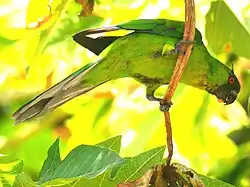 | |
| Santa Marta parakeet | Pyrrhura viridicata | 1,800-3,200[69] | EN[69] | [69] | Total population is estimated to be 2,900-4,800 individuals.[69] |  |
| Antipodes parakeet | Cyanoramphus unicolor | 2,000-3,000[70] | VU[70] | [70] |  | |
| Red-crowned amazon | Amazona viridigenalis | 2,000-4,300[71] | EN[71] | [71] |
Total population is estimated to be 3,000-6,500 individuals; this population is considered outdated.[71] | 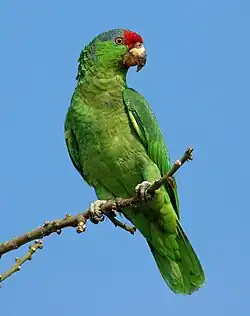 |
| Military macaw | Ara militaris | 2,000-7,000[72] | VU[72] | [72] | Total population is estimated to be 3,000-10,000 individuals.[72] |  |
| Red-and-blue lory | Eos histrio | 2,400-43,200[73] | EN[73] | [73] | Best estimate for number of mature individuals in 2,400-8,400.[73] |  |
| Baudin's black cockatoo | Zanda baudinii | 2,500-4,500[74] | CR[74] | [74] | Best estimate for number of mature individuals in 3,250. Total population is estimated to be 5,000-8,000 individuals.[74] |  |
| Red-browed amazon | Amazona rhodocorytha | 2,500-9,999[75] | VU[75] | [75] |  | |
| Flores hanging parrot
(Wallace's hanging parrot) |
Loriculus flosculus | 2,500-9,999[76] | VU[76] | [76] | Total population is estimated to be 3,500-15,000 individuals.[76] |  |
| New Zealand kaka | Nestor meridionalis | 2,500-9,999[77] | VU[77] | [77] | Total population is estimated to be 3,750-14,999 individuals.[77] |  |
| White-breasted parakeet | Pyrrhura albipectus | 2,500-9,999[78] | VU[78] | [78] |  | |
| Ochre-marked parakeet | Pyrrhura cruentata | 2,500-9,999[79] | VU[79] | [79] | Total population is estimated to be 3,500-15,000 individuals.[79] |  |
| White-eared parakeet | Pyrrhura leucotis | 2,500-9,999[80] | VU[80] | [80] |
 | |
| Black-lored parrot | Tanygnathus gramineus | 2,500-9,999[81] | VU[81] | [81] |  | |
| Golden-tailed parrotlet | Touit surdus | 2,500-9,999[82] | VU[82] | [82] |  | |
| Biak lorikeet | Trichoglossus rosenbergii | 2,500-9,999[83] | VU[83] | [83] |
Best estimate for number of mature individuals is 3,000-4,000 individuals.[83] |  |
| Yellow-shouldered amazon | Amazona barbadensis | 2,500-9,999[84] | NT[84] | [84] |  | |
| Rusty-faced parrot | Hapalopsittaca amazonina | 2,500-9,999[85] | NT[85] | [85] |  | |
| Cliff parakeet | Myiopsitta luchsi | 2,500-9,999[86] | NT[86] | [86] |
 | |
| Red-masked parakeet | Psittacara erythrogenys | 2,500-9,999[87] | NT[87] | [87] | Total population is estimated to be less than 10,000 individuals.[87] |  |
| Brown-backed parrotlet | Touit melanonotus | 2,500-9,999[88] | NT[88] | [88] |  | |
| Bismarck hanging parrot | Loriculus tener | 2,500-9,999[89] | LC[89] | [89] | Total population is estimated to be 10,000 - 15,000 individuals.[89] |  |
| Amazonian parrotlet
(Manu parrotlet) |
Nannopsittaca dachilleae | 2,500-9,999[90] | LC[90] | [90] |  | |
| Mindanao lorikeet | Saudareos johnstoniae | 2,500-20,000[91] | NT[91] | [91] |
IUCN/BirdLife International place species in genus Trichoglossus. |  |
| Mindanao racquet-tail
(Mindanao racket-tail) |
Prioniturus waterstradti | 3,000-4,500[92] | NT[92] | [92] | Total population is estimated to be 4,000-5,000 individuals.[92] |  |
| Crimson shining parrot | Prosopeia splendens | 3,000-5,000[93] | NT[93] | ?[93] | Best estimate for number of mature individuals is 4,000. Total population is estimated to be 6,000 individuals.[93] |  |
| Red-fronted parrotlet | Touit costaricensis | 3,000-12,000[94] | NT[94] | [94] | Total population is estimated to be 4,500-18,000 individuals.[94] | |
| Brown-breasted parakeet
(Flame-winged parakeet) |
Pyrrhura calliptera | 3,300-6,700[95] | VU[95] | [95] | Total population is estimated to be 5,000-10,000 individuals.[95] |  |
| Simeulue parrot | Psittinus abbotti | 3,300-31,000[96] | NT[96] | [96] |
Best estimate for number of mature individuals is 10,000-20,000. Total population is estimated to be 5,000-47,000 individuals.[96] |  |
| Kea | Nestor notabilis | 4,000[97] | EN[97] | [97] | Total population is estimated to be 6,000 individuals.[97] |  |
| Montane racquet-tail
(Montane racket-tail) |
Prioniturus montanus | 4,000-12,000[98] | NT[98] | [98] | Total population is estimated to be 7,100-14,300 individuals.[98] |  |
| Blue lorikeet | Vini peruviana | 4,300-6,300[99] | VU[99] | [99] | Best estimate for number of mature individuals is 5,300. Total population is estimated to be 6,500-9,400 individuals.[99] |  |
| Yellow-headed amazon | Amazona oratrix | 4,700[100] | EN[100] | [100] | Total population is estimated to be 7,000 individuals. Estimate dates from 1994.[100] |  |
| Lilac-crowned amazon | Amazona finschi | 4,700-6,700[101] | EN[101] | [101] | Total population is estimated to be 7,000-10,000 individuals.[101] |  |
| Hyacinth macaw | Anodorhynchus hyacinthinus | 4,700-11,000[102] | VU[102] | [102] |  | |
| Horned parakeet | Eunymphicus cornutus | 5,000-8,000[103] | VU[103] | [103] | 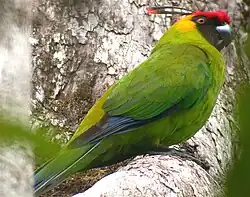 | |
| Jonquil parrot | Aprosmictus jonquillaceus | 5,000-20,000[104] | NT[104] | [104] |  | |
| Palm lorikeet | Vini palmarum | 5,000-20,000[105] | LC[105] | [105] | IUCN/Bird Life International place species in genus Charmosyna. |  |
| Spot-winged parrotlet | Touit stictopterus | 5,000-21,000[106] | NT[106] | [106] |  | |
| Sangihe hanging parrot | Loriculus catamene | 5,000-37,000[107] | NT[107] | [107] | Total population is estimated to be 10,700-46,200 individuals.[107] |  |
| Red-tailed amazon | Amazona brasiliensis | 6,000-6,700[108] | NT[108] | [108] | Total population is estimated to be 9,000-10,000 individuals.[108] |  |
| Black-billed amazon | Amazona agilis | 6,000-15,000[109] | EN[109] | [109] | Total population is estimated to be 10,000-19,999 individuals.[109] |  |
| Yellow-billed amazon | Amazona collaria | 6,000-15,000[110] | VU[110] | [110] | Total population is estimated to be 10,000-19,999 individuals.[110] |  |
| Tucumán amazon | Amazona tucumana | 6,000-15,000[111] | VU[111] | [111] | Total population is estimated to be 10,000-19,999 individuals.[111] |  |
| Hispaniolan amazon | Amazona ventralis | 6,000-15,000[112] | VU[112] | [112] | Total population is estimated to be 10,000-19,999 individuals.[112] |  |
| Nyasa lovebird
(Lilian's lovebird) |
Agapornis lilianae | 6,000-15,000[113] | NT[113] | [113] | Total population is estimated to be 10,000-19,999 individuals.[113] |  |
| Nicobar parakeet | Psittacula caniceps | 6,000-15,000[114] | NT[114] | [114] | Total population is estimated to be 10,000-19,999 individuals.[114] |  |
| Blue-cheeked amazon | Amazona dufresniana | 6,000-61,000[115] | NT[115] | [115] |
 | |
| Tanimbar eclectus | Eclectus riedeli | 6,600-10,000[116] | VU[116] | [116] |
Total population is estimated to be 10,000-15,000 individuals.[116] |  |
| Golden parakeet | Guaruba guarouba | 6,600-13,400[117] | VU[117] | [117] | Total population is estimated to be 10,000-19,999 individuals.[117] |  |
| Bald parrot | Pyrilia aurantiocephala | 6,700[118] | NT[118] | [118] | Total population is estimated to be at least 10,000 individuals.[118] | 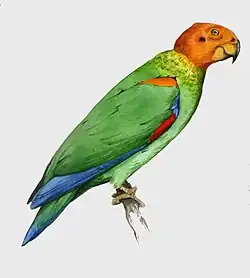 |
| Glossy black cockatoo | Calyptorhynchus lathami | 7,000-14,000[119] | VU[119] | [119] | Divided into three subspecies: C. l. lathami (7,500 individuals), C. l. halmaturinus (250), and C. l. erebus (2,000).[119] |  |
| Golden-plumed parakeet | Leptosittaca branickii | 7,300-20,000[120] | LC[120] | [120] | Total population is estimated to be 11,000-30,000 individuals.[120] |  |
| Moluccan eclectus | Eclectus roratus | 7,300-51,000[121] | LC[121] | [121] |
 | |
| Blue-winged parrot | Neophema chrysostoma | 7,500-15,000[122] | VU[122] | [122] |
Best estimate for number of mature individuals is 10,000.[122] |  |
| Iris lorikeet | Saudareos iris | 7,500-20,000[123] | NT[123] | [123] |
IUCN/BirdLife International place species in genus Trichoglossus. |  |
| Black-cheeked lovebird | Agapornis nigrigenis | 8,000-11,500[124] | VU[124] | [124] | Total population is estimated to be 9,500-11,500 individuals.[124] |  |
| Mindoro racquet-tail
(Mindoro racket-tail) |
Prioniturus mindorensis | 8,000-25,000[125] | VU[125] | [125] |
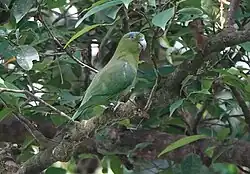 | |
| Blue-headed macaw | Primolius couloni | 9,200-46,000[126] | VU[126] | [126] |  | |
| Grey-cheeked parakeet | Brotogeris pyrrhoptera | 10,000[127] | VU[127] | [127] |
Total population is estimated to be 15,000 individuals.[127] |  |
| Blue-winged macaw | Primolius maracana | >10,000[128] | LC[128] | [128] | No exact population estimate is given, but population is expected to "comfortably exceed 10,000 mature individuals."[128] |  |
| Blue-eared lory | Eos semilarvata | 10,000-19,999[129] | NT[129] | [129] |
Total population (assuming all suitable habitat is occupied) is estimated to be 23,800-25,500 individuals.[129] |  |
| Jamaican parakeet
(Olive-throated parakeet) |
Eupsittula nana | 10,000-19,999[130] | NT[130] | [130] |  | |
| Saffron-headed parrot | Pyrilia pyrilia | 10,000-19,999[131] | NT[131] | [131] |  | |
| Superb parrot | Polytelis swainsonii | 10,000-19,999[132] | LC[132] | [132] |
 | |
| Blue-bellied parrot | Triclaria malachitacea | 10,000-19,999[133] | LC[133] | [133] |
 | |
| Yellow-fronted parakeet
(Yellow-crowned parakeet) |
Cyanoramphus auriceps | 10,000-30,000[134] | NT[134] | [134] |
 | |
| Black-winged lory | Eos cyanogenia | 11,743-67,386[135] | NT[135] | [135] | Values given are 25-75th percentile range, applying population densities for congenerics (Eos sp.) across its range.[135] |  |
| Goias parakeet
(Pfrimer's parakeet) |
Pyrrhura pfrimeri | 12,000-20,000[136] | EN[136] | [136] | Best estimate for number of mature individuals is 16,000. Total population is estimated to be 18,000-30,000 individuals.[136] |  |
| Red-spectacled amazon | Amazona pretrei | 15,600[137] | VU[137] | [137] | Total population is estimated to be 22,300 individuals.[137] |  |
| Cuban amazon | Amazona leucocephala | 16,000-27,000[138] | NT[138] | [138] |
Total population is estimated to be 24,242-40,268 individuals.[138] |  |
| Red-fronted parakeet
(Red-crowned parakeet) |
Cyanoramphus novaezelandiae | 16,500-35,300[139] | LC[139] | [139] | Total population is estimated to be 24,700-53,000 individuals.[139]
Note that IOC taxonomy splits four additional species, the Norfolk parakeet (C. cookii), New Caledonian parakeet (C. saisseti), Lord Howe parakeet (C. subflavescens), and Reischek's parakeet (C. hochstetteri) from this one.[2] IUCN/BirdLife International maintain all five species within C. novaezelandiae.[7] |
 |
| Gang-gang cockatoo | Callocephalon fimbriatum | 17,600-35,200[140] | VU[140] | [140] |
Best estimate for number of mature individuals is 25,300.[140] |  |
| Turquoise parrot | Neophema pulchella | 20,000[141] | LC[141] | [141] | Value given is for total population.[141] |  |
| Hooded parrot | Psephotus dissimilis | 20,000[142] | LC[142] | [142] | Value given is for total population.[142] |  |
| Rufous-fronted parakeet | Bolborhynchus ferrugineifrons | 20,000-49,999[143] | VU[143] | [143] | Total population is estimated to be approximately 60,000 individuals.[143] |  |
| Pesquet's parrot | Psittrichas fulgidus | 20,000-49,999[144] | VU[144] | [144] |
 | |
| Mexican parrotlet | Forpus cyanopygius | 20,000-49,999[145] | NT[145] | [145] |  | |
| Yellow-lored amazon
(Yucatan amazon) |
Amazona xantholora | 20,000-49,999[146] | LC[146] | [146] |  | |
| Salvadori's fig parrot | Psittaculirostris salvadorii | 20,000-49,999[147] | LC[147] | [147] | Total population is estimated to be 30,000-75,000 individuals.[147] |  |
| Sulphur-winged parakeet | Pyrrhura hoffmanni | 20,000-49,999[148] | LC[148] | [148] |
 | |
| Carnaby's black cockatoo | Zanda latirostris | 20,000-52,000[149] | EN[149] | [149] | Best estimate for number of mature individuals is 34,000.[149] |  |
| Salmon-crested cockatoo | Cacatua moluccensis | 20,000-62,000[150] | EN[150] | [150] | Best estimate for number of mature individuals is 26,000-53,000. Total population is estimated to be 33,000-77,000 individuals.[150] |  |
| Regent parrot | Polytelis anthopeplus | 21,500[151] | LC[151] | [151] | Values given are for total population, divided by subspecies: P. a. anthopeplusis (20,000) and P. a. monarchoides (1,500).[151] | 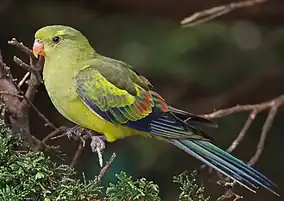 |
| Yellow-tailed black cockatoo | Zanda funerea | > 25,000[152] | LC[152] | [152] |
Value given is for total population.[152] |  |
| Diademed amazon | Amazona diadema | 30,000-74,000[153] | LC[153] | [153] |
Total population is estimated to be 46,000 - 110,000 individuals.[153] |  |
| Chattering lory | Lorius garrulus | 30,000-200,000[154] | VU[154] | [154] |
 | |
| Yellowish-breasted racquet-tail
(Yellow-breasted racket-tail) |
Prioniturus flavicans | 40,000-95,000[155] | NT[155] | [155] | Total population is estimated to be 59,000-143,000 individuals.[155] |  |
| Masked shining parrot | Prosopeia personata | 40,000-100,000[156] | NT[156] | [156] | Total population is estimated to be 65,605-108,270 individuals.[156] |  |
| White cockatoo | Cacatua alba | 43,000-183,000[157] | EN[157] | [157] | Estimate dates from 1993.[157] |  |
| Brown lory | Chalcopsitta duivenbodei | >50,000[158] | LC[158] | [158] | Value given is for total population.[158] |  |
| Pohnpei lorikeet | Trichoglossus rubiginosus | 50,000-99,999[159] | NT[159] | [159] |
Total population is estimated to be 100,803 individuals.[159] |  |
| Red-and-green macaw | Ara chloropterus | 50,000-499,999[160] | LC[160] | [160] |
 | |
| Scarlet macaw | Ara macao | 50,000-499,999[161] | LC[161] | [161] |  | |
| Barred parakeet | Bolborhynchus lineola | 50,000-499,999[162] | LC[162] | [162] |  | |
| Spectacled parrotlet | Forpus conspicillatus | 50,000-499,999[163] | LC[163] | [163] |
 | |
| White-crowned parrot | Pionus senilis | 50,000-499,999[164] | LC[164] | [164] |  | |
| Brown-hooded parrot | Pyrilia haematotis | 50,000-499,999[165] | LC[165] | [165] |  | |
| Blue-eyed cockatoo | Cacatua ophthalmica | 87,000-378,000[166] | VU[166] | [166] | Total population is estimated to be 131,000 - 568,000 individuals.[166] |  |
| Burrowing parrot | Cyanoliseus patagonus | 95,000[167] | LC[167] | [167] |
 | |
| Red-tailed black cockatoo | Calyptorhynchus banksii | >100,000[168] | LC[168] | [168] | Value given is for total population.[168] |  |
| Timneh parrot | Psittacus timneh | 100,000-499,999[169] | EN[169] | [169] |
Population likely lies toward lower band of estimate.[169] |  |
| Tanimbar corella | Cacatua goffiniana | 100,000-499,999[170] | NT[170] | [170] | Values given are for total population.[170] |  |
| Long-billed corella | Cacatua tenuirostris | 100,000-499,999[171] | LC[171] | [171] | Values given are for total population.[171] |  |
| Ground parrot | Pezoporus wallicus | 100,000-499,999[172] | LC[172] | [172] |
 | |
| Black-capped parakeet | Pyrrhura rupicola | 100,000-499,999[173] | LC[173] | [173] |
 | |
| Blue-streaked lory | Eos reticulata | 112,000-182,000[174] | NT[174] | [174] | Total population is estimated to be 168,000-272,000 individuals.[174] |  |
| Green parakeet | Psittacara holochlorus | 200,000[175] | LC[175] | [175] |
Note that IOC taxonomy splits two additional species, the Socorro parakeet (P. brevipes) and Pacific parakeet (P. streneus) from this one.[2]
IUCN/BirdLife International maintain all three species within P. holochlorus.[7] |
 |
| Caica parrot | Pyrilia caica | 250,000[176] | LC[176] | [176] |
 | |
| Palm cockatoo | Probosciger aterrimus | 260,000-640,000[177] | NT[177] | [177] |
 | |
| Fischer's lovebird | Agapornis fischeri | 290,000-1,002,000[178] | NT[178] | [178] | Values given are for total population.[178] |  |
| Orange-fronted parakeet | Eupsittula canicularis | 500,000-4,999,999[179] | VU[179] | [179] |  | |
| White-fronted amazon | Amazona albifrons | 500,000-4,999,999[180] | LC[180] | [180] | Values given are for total population.[180] |  |
| Orange-chinned parakeet | Brotogeris jugularis | 500,000-4,999,999[181] | LC[181] | [181] |  | |
| Crimson-fronted parakeet
(Finsch's parakeet) |
Psittacara finschi | 500,000-4,999,999[182] | LC[182] | [182] |
 | |
| Grey parrot | Psittacus erithacus | 560,000-12,700,000[183] | EN[183] | [183] |
Values represent a preliminary, coarse estimate for total population.[183] |  |
| Papuan eclectus | Eclectus polychloros | 990,000-1,100,000[184] | LC[184] | [184] |
 | |
| Turquoise-fronted amazon
(Blue-fronted amazon) |
Amazona aestiva | 1,000,000-10,000,000[185] | NT[185] | [185] |
 | |
| Brown-throated parakeet | Eupsittula pertinax | 5,000,000-49,999,999[186] | LC[186] | [186] |
 | |
| Blue-headed parrot | Pionus menstruus | 5,000,000-49,999,999[187] | LC[187] | [187] |
 | |
| Monk parakeet | Myiopsitta monachus | 20,000,000[188] | LC[189] | [189] |
IUCN/BirdLife International do not report a population estimate.[189]
Reported value comes from Partners in Flight database, and include introduced populations.[188] |
 |
Species without population estimates
| Common name | Binomial name | Population | Status | Trend | Notes | Image |
|---|---|---|---|---|---|---|
| Spix's macaw | Cyanopsitta spixii | unknown[190] | EW[190] | N/A[190] | Last known wild individual disappeared in 2000. A number of C. spixii are still alive in captivity, but IUCN/BirdLife International do not provide a population estimate.[190] |  |
| Blue-fronted lorikeet | Charmosyna toxopei | unknown[191] | DD[191] | ?[191] | Very small, or moderately large populations are possible given the difficulty of surveying this species. No confirmed observations since 2014.[191] |  |
| Blue-headed racquet-tail
(Blue-headed racket-tail) |
Prioniturus platenae | unknown[192] | VU[192] | [192] |  | |
| Pearly parakeet | Pyrrhura lepida | unknown[193] | VU[193] | [193] |  | |
| White-naped lory | Lorius albidinucha | unknown[194] | NT[194] | ?[194] | ||
| Red-lored amazon | Amazona autumnalis | unknown[195] | LC[195] | [195] |  | |
| Southern mealy amazon | Amazona farinosa | unknown[196] | LC[196] | [196] |  | |
| Golden-capped parakeet | Aratinga auricapillus | unknown[197] | LC[197] | [197] |  | |
| Solomons corella | Cacatua ducorpsii | unknown[198] | LC[198] | [198] |
 | |
| Sulphur-crested cockatoo | Cacatua galerita | unknown[199] | LC[199] | [199] |
 | |
| Pink cockatoo | Cacatua leadbeateri | unknown[200] | LC[200] | [200] |
 | |
| Western corella | Cacatua pastinator | unknown[201] | LC[201] | [201] |
 | |
| Little corella | Cacatua sanguinea | unknown[202] | LC[202] | [202] |
 | |
| Galah | Eolophus roseicapilla | unknown[203] | LC[203] | [203] |
 | |
| Budgerigar | Melopsittacus undulatus | unknown[204] | LC[204] | [204] |  | |
| Cockatiel | Nymphicus hollandicus | unknown[205] | LC[205] | [205] |  | |
| Niam-niam parrot | Poicephalus crassus | unknown[206] | LC[206] | [206] |
 | |
| Brown-headed parrot | Poicephalus cryptoxanthus | unknown[207] | LC[207] | [207] |
 | |
| Yellow-fronted parrot | Poicephalus flavifrons | unknown[208] | LC[208] | [208] |
 | |
| Brown-necked parrot | Poicephalus fuscicollis | unknown[209] | LC[209] | [209] |
 | |
| Red-fronted parrot | Poicephalus gulielmi | unknown[210] | LC[210] | [210] |
 | |
| Brown parrot
(Meyer's parrot) |
Poicephalus meyeri | unknown[211] | LC[211] | [211] |
 | |
| Rüppell's parrot | Poicephalus rueppellii | unknown[212] | LC[212] | [212] |
 | |
| Red-bellied parrot | Poicephalus rufiventris | unknown[213] | LC[213] | [213] |
 | |
| Senegal parrot | Poicephalus senegalus | unknown[214] | LC[214] | [214] |
 | |
| Lilac-tailed parrotlet | Touit batavicus | unknown[215] | LC[215] | [215] |
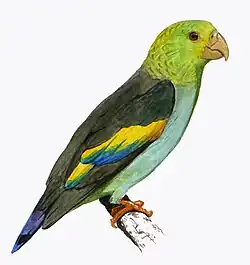 | |
| Blue-fronted parrotlet | Touit dilectissimus | unknown[216] | LC[216] | [216] |
 | |
| Scarlet-shouldered parrotlet | Touit huetii | unknown[217] | LC[217] | [217] |
 | |
| Sapphire-rumped parrotlet | Touit purpuratus | unknown[218] | LC[218] | [218] |
 | |
See also
References
- 1 2 IUCN Standards and Petitions Committee (2024). Guidelines for Using the IUCN Red List Categories and Criteria (PDF) (16th ed.).
- 1 2 3 "Parrots, cockatoos – IOC World Bird List". www.worldbirdnames.org. Retrieved 2026-01-15.
- ↑ BirdLife International (2023). "Nestor productus". IUCN Red List of Threatened Species. 2023 e.T22684834A238846083. doi:10.2305/IUCN.UK.2023-1.RLTS.T22684834A238846083.en.
- ↑ BirdLife International (2021). "Conuropsis carolinensis". IUCN Red List of Threatened Species. 2021 e.T22685776A195444267. doi:10.2305/IUCN.UK.2021-3.RLTS.T22685776A195444267.en.
- ↑ BirdLife International (2021). "Ara tricolor". IUCN Red List of Threatened Species. 2021 e.T22724513A194916284. doi:10.2305/IUCN.UK.2021-3.RLTS.T22724513A194916284.en.
- ↑ Olson, Storrs L. (2015). "History, morphology, and fossil record of the extinct Puerto Rican Parakeet Psittacara maugei Souancé". The Wilson Journal of Ornithology. 127 (1): 1–12.
- 1 2 3 Handbook of the Birds of the World and BirdLife International digital checklist of the birds of the world. Version 10. BirdLife International. 2025.
- ↑ BirdLife International (2024). "Mascarinus mascarin". IUCN Red List of Threatened Species. 2024 e.T22685258A262292291. doi:10.2305/IUCN.UK.2024-2.RLTS.T22685258A262292291.en.
- ↑ BirdLife International (2023). "Eclectus infectus". IUCN Red List of Threatened Species. 2023 e.T62307504A238086085. doi:10.2305/IUCN.UK.2023-1.RLTS.T62307504A238086085.en.
- ↑ BirdLife International (2024). "Palaeornis wardi". IUCN Red List of Threatened Species. 2024 e.T22685437A262298318. doi:10.2305/IUCN.UK.2024-2.RLTS.T22685437A262298318.en.
- ↑ BirdLife International (2024). "Alexandrinus exsul". IUCN Red List of Threatened Species. 2024 e.T22685465A262300612. doi:10.2305/IUCN.UK.2024-2.RLTS.T22685465A262300612.en.
- ↑ BirdLife International (2024). "Lophopsittacus bensoni". IUCN Red List of Threatened Species. 2024 e.T22728844A262345230. doi:10.2305/IUCN.UK.2024-2.RLTS.T22728844A262345230.en.
- ↑ BirdLife International (2023). "Psephotellus pulcherrimus". IUCN Red List of Threatened Species. 2023 e.T22685156A238869019. doi:10.2305/IUCN.UK.2023-1.RLTS.T22685156A238869019.en.
- ↑ BirdLife International (2023). "Cyanoramphus zealandicus". IUCN Red List of Threatened Species. 2023 e.T22685182A238867701. doi:10.2305/IUCN.UK.2023-1.RLTS.T22685182A238867701.en.
- ↑ BirdLife International (2023). "Cyanoramphus ulietanus". IUCN Red List of Threatened Species. 2023 e.T22728673A238086539. doi:10.2305/IUCN.UK.2023-1.RLTS.T22728673A238086539.en.
- ↑ BirdLife International (2024). "Lophopsittacus mauritianus". IUCN Red List of Threatened Species. 2024 e.T22728847A262346605. doi:10.2305/IUCN.UK.2024-2.RLTS.T22728847A262346605.en.
- ↑ BirdLife International (2024). "Necropsittacus rodricanus". IUCN Red List of Threatened Species. 2024 e.T22728851A262347522. doi:10.2305/IUCN.UK.2024-2.RLTS.T22728851A262347522.en.
- 1 2 3 4 BirdLife International (2019). "Anodorhynchus glaucus". IUCN Red List of Threatened Species. 2019 e.T22685527A154380861. doi:10.2305/IUCN.UK.2019-3.RLTS.T22685527A154380861.en. Retrieved 20 November 2021.
- 1 2 3 4 BirdLife International (2019). "Charmosyna diadema". IUCN Red List of Threatened Species. 2019 e.T22684689A156512185. doi:10.2305/IUCN.UK.2019-3.RLTS.T22684689A156512185.en. Retrieved 20 November 2021.
- 1 2 3 4 BirdLife International (2025). "Charmosyna amabilis". IUCN Red List of Threatened Species. 2025 e.T22684693A266249276. doi:10.2305/IUCN.UK.2025-2.RLTS.T22684693A266249276.en.
- 1 2 3 4 BirdLife International (2020). "Amazona vittata". IUCN Red List of Threatened Species. 2020 e.T22686239A179276011. doi:10.2305/IUCN.UK.2020-3.RLTS.T22686239A179276011.en.
- 1 2 3 4 BirdLife International (2018). "Neophema chrysogaster". IUCN Red List of Threatened Species. 2018 e.T22685203A130894893. doi:10.2305/IUCN.UK.2018-2.RLTS.T22685203A130894893.en.
- 1 2 3 BirdLife International (2021). "Amazona imperialis". IUCN Red List of Threatened Species. 2021 e.T22686411A179471135. doi:10.2305/IUCN.UK.2021-3.RLTS.T22686411A179471135.en.
- 1 2 3 4 BirdLife International (2022). "Pezoporus occidentalis". IUCN Red List of Threatened Species. 2022 e.T22685237A211825128. doi:10.2305/IUCN.UK.2022-1.RLTS.T22685237A211825128.en.
- 1 2 3 4 BirdLife International (2018). "Cyanoramphus malherbi". IUCN Red List of Threatened Species. 2018 e.T22724562A130890144. doi:10.2305/IUCN.UK.2018-2.RLTS.T22724562A130890144.en. Retrieved 20 November 2021.
- 1 2 3 BirdLife International (2025). "Prioniturus verticalis". IUCN Red List of Threatened Species. 2025 e.T22684986A271682525. doi:10.2305/IUCN.UK.2025-2.RLTS.T22684986A271682525.en.
- 1 2 3 4 BirdLife International (2018). "Strigops habroptilus". IUCN Red List of Threatened Species. 2018 e.T22685245A129751169. doi:10.2305/IUCN.UK.2018-2.RLTS.T22685245A129751169.en.
- 1 2 3 4 BirdLife International (2021). "Ara rubrogenys". IUCN Red List of Threatened Species. 2021 e.T22685572A196567391. doi:10.2305/IUCN.UK.2021-3.RLTS.T22685572A196567391.en.
- 1 2 3 4 BirdLife International (2018). "Ara glaucogularis". IUCN Red List of Threatened Species. 2018 e.T22685542A130868462. doi:10.2305/IUCN.UK.2018-2.RLTS.T22685542A130868462.en. Retrieved 20 November 2021.
- 1 2 3 4 BirdLife International (2021). "Hapalopsittaca fuertesi". IUCN Red List of Threatened Species. 2021 e.T22686163A195329192. doi:10.2305/IUCN.UK.2021-3.RLTS.T22686163A195329192.en.
- 1 2 3 4 BirdLife International (2020). "Anodorhynchus leari". IUCN Red List of Threatened Species. 2020 e.T22685521A176030480. doi:10.2305/IUCN.UK.2020-3.RLTS.T22685521A176030480.en.
- 1 2 3 4 BirdLife International (2018). "Pyrrhura griseipectus". IUCN Red List of Threatened Species. 2018 e.T22733968A132181930. doi:10.2305/IUCN.UK.2018-2.RLTS.T22733968A132181930.en. Retrieved 20 November 2021.
- 1 2 3 4 BirdLife International (2020). "Pyrrhura orcesi". IUCN Red List of Threatened Species. 2020 e.T22685851A181549899. doi:10.2305/IUCN.UK.2020-3.RLTS.T22685851A181549899.en.
- 1 2 3 4 BirdLife International (2020). "Tanygnathus everetti". IUCN Red List of Threatened Species. 2020 e.T181753148A181756316. doi:10.2305/IUCN.UK.2020-3.RLTS.T181753148A181756316.en.
- 1 2 3 4 BirdLife International (2020). "Amazona guildingii". IUCN Red List of Threatened Species. 2020 e.T22686403A179396130. doi:10.2305/IUCN.UK.2020-3.RLTS.T22686403A179396130.en. Retrieved 20 November 2021.
- 1 2 3 BirdLife International (2022). "Cyanoramphus forbesi". IUCN Red List of Threatened Species. 2022 e.T22724553A213712534. doi:10.2305/IUCN.UK.2022-2.RLTS.T22724553A213712534.en.
- 1 2 3 4 BirdLife International (2021). "Forpus xanthops". IUCN Red List of Threatened Species. 2021 e.T22685952A172154563. doi:10.2305/IUCN.UK.2021-3.RLTS.T22685952A172154563.en.
- 1 2 3 BirdLife International (2024). "Prioniturus luconensis". IUCN Red List of Threatened Species. 2024 e.T22684969A254721352. doi:10.2305/IUCN.UK.2024-2.RLTS.T22684969A254721352.en.
- 1 2 3 4 BirdLife International (2022). "Vini stepheni". IUCN Red List of Threatened Species. 2022 e.T22684636A212929157. doi:10.2305/IUCN.UK.2022-1.RLTS.T22684636A212929157.en.
- 1 2 3 4 BirdLife International (2019). "Psittacula eques". IUCN Red List of Threatened Species. 2019 e.T22685448A154065622. doi:10.2305/IUCN.UK.2019-3.RLTS.T22685448A154065622.en.
- 1 2 3 BirdLife International (2017). "Cacatua haematuropygia". IUCN Red List of Threatened Species. 2017 e.T22684795A117578604. doi:10.2305/IUCN.UK.2017-3.RLTS.T22684795A117578604.en. Retrieved 20 November 2021.
- 1 2 3 BirdLife International (2020). "Ara ambiguus". IUCN Red List of Threatened Species. 2020 e.T22685553A172908289. doi:10.2305/IUCN.UK.2020-3.RLTS.T22685553A172908289.en.
- 1 2 3 BirdLife International (2020). "Trichoglossus forsteni". IUCN Red List of Threatened Species. 2020 e.T22726303A175363770. doi:10.2305/IUCN.UK.2020-3.RLTS.T22726303A175363770.en.
- 1 2 3 BirdLife International (2024). "Lorius domicella". IUCN Red List of Threatened Species. 2024 e.T22684586A249452637. doi:10.2305/IUCN.UK.2024-2.RLTS.T22684586A249452637.en.
- 1 2 3 4 BirdLife International (2021). "Coracopsis barklyi". IUCN Red List of Threatened Species. 2021 e.T22727890A179281607. doi:10.2305/IUCN.UK.2021-3.RLTS.T22727890A179281607.en.
- 1 2 3 4 BirdLife International (2021). "Poicephalus robustus". IUCN Red List of Threatened Species. 2021 e.T119194858A179406641. doi:10.2305/IUCN.UK.2021-3.RLTS.T119194858A179406641.en.
- 1 2 3 4 BirdLife International (2022). "Psephotus chrysopterygius". IUCN Red List of Threatened Species. 2022 e.T22685150A212907505. doi:10.2305/IUCN.UK.2022-1.RLTS.T22685150A212907505.en.
- 1 2 3 4 BirdLife International (2023). "Vini kuhlii". IUCN Red List of Threatened Species. 2023 e.T22684630A209660102. doi:10.2305/IUCN.UK.2023-1.RLTS.T22684630A209660102.en.
- 1 2 3 4 BirdLife International (2021). "Cacatua citrinocristata". IUCN Red List of Threatened Species. 2021 e.T200296433A201545199. doi:10.2305/IUCN.UK.2021-3.RLTS.T200296433A201545199.en.
- 1 2 3 BirdLife International (2021). "Rhynchopsitta pachyrhyncha". IUCN Red List of Threatened Species. 2021 e.T22685766A182984346. doi:10.2305/IUCN.UK.2021-3.RLTS.T22685766A182984346.en.
- 1 2 3 4 BirdLife International (2021). "Amazona arausiaca". IUCN Red List of Threatened Species. 2021 e.T22686395A179463121. doi:10.2305/IUCN.UK.2021-3.RLTS.T22686395A179463121.en.
- 1 2 3 4 BirdLife International (2022). "Polytelis alexandrae". IUCN Red List of Threatened Species. 2022 e.T22685081A213099157. doi:10.2305/IUCN.UK.2022-1.RLTS.T22685081A213099157.en.
- 1 2 3 4 BirdLife International (2020). "Ognorhynchus icterotis". IUCN Red List of Threatened Species. 2020 e.T22685760A181190084. doi:10.2305/IUCN.UK.2020-3.RLTS.T22685760A181190084.en.
- 1 2 3 BirdLife International (2021). "Amazona auropalliata". IUCN Red List of Threatened Species. 2021 e.T22686342A180373727.
- 1 2 3 BirdLife International (2018). "Lathamus discolor". IUCN Red List of Threatened Species. 2018 e.T22685219A130886700. doi:10.2305/IUCN.UK.2018-2.RLTS.T22685219A130886700.en. Retrieved 20 November 2021.
- 1 2 3 BirdLife International (2018). "Vini ultramarina". IUCN Red List of Threatened Species. 2018 e.T22684647A132055913. doi:10.2305/IUCN.UK.2018-2.RLTS.T22684647A132055913.en. Retrieved 20 November 2021.
- 1 2 3 4 BirdLife International (2017). "Amazona vinacea". IUCN Red List of Threatened Species. 2017 e.T22686374A118954406. doi:10.2305/IUCN.UK.2017-3.RLTS.T22686374A118954406.en.
- 1 2 3 BirdLife International (2022). "Aratinga solstitialis". IUCN Red List of Threatened Species. 2022 e.T62233372A209605460. doi:10.2305/IUCN.UK.2022-1.RLTS.T62233372A209605460.en.
- 1 2 3 BirdLife International (2019). "Eclectus cornelia". IUCN Red List of Threatened Species. 2019 e.T155072216A155087823. doi:10.2305/IUCN.UK.2019-3.RLTS.T155072216A155087823.en.
- 1 2 3 4 BirdLife International (2020). "Rhynchopsitta terrisi". IUCN Red List of Threatened Species. 2020 e.T22685772A179400190. doi:10.2305/IUCN.UK.2020-3.RLTS.T22685772A179400190.en. Retrieved 20 November 2021.
- 1 2 3 4 BirdLife International (2023). "Coracopsis sibilans". IUCN Red List of Threatened Species. 2023 e.T62292583A211558926. doi:10.2305/IUCN.UK.2023-1.RLTS.T62292583A211558926.en.
- 1 2 3 4 BirdLife International (2020). "Amazona versicolor". IUCN Red List of Threatened Species. 2020 e.T22686387A179319598. doi:10.2305/IUCN.UK.2020-3.RLTS.T22686387A179319598.en.
- 1 2 3 4 BirdLife International (2023). "Hapalopsittaca pyrrhops". IUCN Red List of Threatened Species. 2023 e.T22686168A234610243. doi:10.2305/IUCN.UK.2023-1.RLTS.T22686168A234610243.en.
- 1 2 3 4 BirdLife International (2021). "Cacatua sulphurea". IUCN Red List of Threatened Species. 2021 e.T200296187A178119524. doi:10.2305/IUCN.UK.2021-3.RLTS.T200296187A178119524.en.
- 1 2 3 4 BirdLife International (2020). "Psittacara chloropterus". IUCN Red List of Threatened Species. 2020 e.T22685695A179413764. doi:10.2305/IUCN.UK.2020-3.RLTS.T22685695A179413764.en.
- 1 2 3 4 BirdLife International (2020). "Psittacara euops". IUCN Red List of Threatened Species. 2020 e.T22685690A179593400. doi:10.2305/IUCN.UK.2020-3.RLTS.T22685690A179593400.en.
- 1 2 3 4 BirdLife International (2018). "Tanygnathus lucionensis". IUCN Red List of Threatened Species. 2018 e.T22685009A132056469. doi:10.2305/IUCN.UK.2018-2.RLTS.T22685009A132056469.en.
- 1 2 3 BirdLife International (2021). "Eunymphicus uvaeensis". IUCN Red List of Threatened Species. 2021 e.T22728354A183065487. doi:10.2305/IUCN.UK.2021-3.RLTS.T22728354A183065487.en.
- 1 2 3 4 BirdLife International (2022). "Pyrrhura viridicata". IUCN Red List of Threatened Species. 2022 e.T22685836A173025725. doi:10.2305/IUCN.UK.2022-1.RLTS.T22685836A173025725.en.
- 1 2 3 BirdLife International (2022). "Cyanoramphus unicolor". IUCN Red List of Threatened Species. 2022 e.T22685162A213655486. doi:10.2305/IUCN.UK.2022-2.RLTS.T22685162A213655486.en.
- 1 2 3 4 BirdLife International (2021). "Amazona viridigenalis". IUCN Red List of Threatened Species. 2021 e.T22686259A152441187.
- 1 2 3 4 BirdLife International (2020). "Ara militaris". IUCN Red List of Threatened Species. 2020 e.T22685548A179407584. doi:10.2305/IUCN.UK.2020-3.RLTS.T22685548A179407584.en.
- 1 2 3 4 BirdLife International (2025). "Eos histrio". IUCN Red List of Threatened Species. 2025 e.T22684502A271336061. doi:10.2305/IUCN.UK.2025-2.RLTS.T22684502A271336061.en.
- 1 2 3 4 BirdLife International (2022). "Zanda baudinii". IUCN Red List of Threatened Species. 2022 e.T22684727A210840935. doi:10.2305/IUCN.UK.2022-1.RLTS.T22684727A210840935.en.
- 1 2 3 BirdLife International (2017). "Amazona rhodocorytha". IUCN Red List of Threatened Species. 2017 e.T22686288A118968809. doi:10.2305/IUCN.UK.2017-3.RLTS.T22686288A118968809.en. Retrieved 20 November 2021.
- 1 2 3 4 BirdLife International (2019). "Loriculus flosculus". IUCN Red List of Threatened Species. 2019 e.T22685428A156225653. doi:10.2305/IUCN.UK.2019-3.RLTS.T22685428A156225653.en.
- 1 2 3 4 BirdLife International (2022). "Nestor meridionalis". IUCN Red List of Threatened Species. 2022 e.T22684840A216083435. doi:10.2305/IUCN.UK.2022-2.RLTS.T22684840A216083435.en.
- 1 2 3 BirdLife International (2021). "Pyrrhura albipectus". IUCN Red List of Threatened Species. 2021 e.T22685860A195447344. doi:10.2305/IUCN.UK.2021-3.RLTS.T22685860A195447344.en.
- 1 2 3 4 BirdLife International (2025). "Pyrrhura cruentata". IUCN Red List of Threatened Species. 2025 e.T22685783A282645802. doi:10.2305/IUCN.UK.2025-2.RLTS.T22685783A282645802.en.
- 1 2 3 BirdLife International (2017). "Pyrrhura leucotis". IUCN Red List of Threatened Species. 2017 e.T45421208A118806820. doi:10.2305/IUCN.UK.2017-3.RLTS.T45421208A118806820.en.
- 1 2 3 BirdLife International (2025). "Tanygnathus gramineus". IUCN Red List of Threatened Species. 2025 e.T22685016A270320681. doi:10.2305/IUCN.UK.2025-2.RLTS.T22685016A270320681.en.
- 1 2 3 BirdLife International (2023). "Touit surdus". IUCN Red List of Threatened Species. 2023 e.T22686054A221180325. doi:10.2305/IUCN.UK.2023-1.RLTS.T22686054A221180325.en.
- 1 2 3 4 BirdLife International (2022). "Trichoglossus rosenbergii". IUCN Red List of Threatened Species. 2022 e.T22726315A210232708. doi:10.2305/IUCN.UK.2022-1.RLTS.T22726315A210232708.en.
- 1 2 3 BirdLife International (2021). "Amazona barbadensis". IUCN Red List of Threatened Species. 2021 e.T22686325A198373501. doi:10.2305/IUCN.UK.2021-3.RLTS.T22686325A198373501.en.
- 1 2 3 BirdLife International (2021). "Hapalopsittaca amazonina". IUCN Red List of Threatened Species. 2021 e.T22686158A195234208. doi:10.2305/IUCN.UK.2021-3.RLTS.T22686158A195234208.en.
- 1 2 3 BirdLife International (2022). "Myiopsitta luchsi". IUCN Red List of Threatened Species. 2022 e.T45427286A208985244. doi:10.2305/IUCN.UK.2022-1.RLTS.T45427286A208985244.en.
- 1 2 3 4 BirdLife International (2021). "Psittacara erythrogenys". IUCN Red List of Threatened Species. 2021 e.T22685672A196426252. doi:10.2305/IUCN.UK.2021-3.RLTS.T22685672A196426252.en.
- 1 2 3 BirdLife International (2022). "Touit melanonotus". IUCN Red List of Threatened Species. 2022 e.T22686037A209760646. doi:10.2305/IUCN.UK.2022-1.RLTS.T22686037A209760646.en.
- 1 2 3 4 BirdLife International (2022) [errata version of 2021 assessment]. "Loriculus tener". IUCN Red List of Threatened Species. 2021 e.T22685410A216250598.
- 1 2 3 BirdLife International (2020). "Nannopsittaca dachilleae". IUCN Red List of Threatened Species. 2020 e.T22686000A180519561. doi:10.2305/IUCN.UK.2020-3.RLTS.T22686000A180519561.en.
- 1 2 3 BirdLife International (2025). "Trichoglossus johnstoniae". IUCN Red List of Threatened Species. 2025 e.T22684559A266475481. doi:10.2305/IUCN.UK.2025-2.RLTS.T22684559A266475481.en.
- 1 2 3 4 BirdLife International (2024). "Prioniturus waterstradti". IUCN Red List of Threatened Species. 2024 e.T22684960A259149993. doi:10.2305/IUCN.UK.2024-2.RLTS.T22684960A259149993.en.
- 1 2 3 4 BirdLife International (2023). "Prosopeia splendens". IUCN Red List of Threatened Species. 2023 e.T22685029A226300785. doi:10.2305/IUCN.UK.2023-1.RLTS.T22685029A226300785.en.
- 1 2 3 4 BirdLife International (2021). "Touit costaricensis". IUCN Red List of Threatened Species. 2021 e.T22686017A194878135. doi:10.2305/IUCN.UK.2021-3.RLTS.T22686017A194878135.en.
- 1 2 3 4 BirdLife International (2020). "Pyrrhura calliptera". IUCN Red List of Threatened Species. 2020 e.T22685867A179575031. doi:10.2305/IUCN.UK.2020-3.RLTS.T22685867A179575031.en.
- 1 2 3 4 BirdLife International (2023). "Psittinus abbotti". IUCN Red List of Threatened Species. 2023 e.T22727609A223453551. doi:10.2305/IUCN.UK.2023-1.RLTS.T22727609A223453551.en.
- 1 2 3 4 BirdLife International (2017). "Nestor notabilis". IUCN Red List of Threatened Species. 2017 e.T22684831A119243358. doi:10.2305/IUCN.UK.2017-3.RLTS.T22684831A119243358.en.
- 1 2 3 4 BirdLife International (2024). "Prioniturus montanus". IUCN Red List of Threatened Species. 2024 e.T22684954A259158643. doi:10.2305/IUCN.UK.2024-2.RLTS.T22684954A259158643.en.
- 1 2 3 4 BirdLife International (2021). "Vini peruviana". IUCN Red List of Threatened Species. 2021 e.T22684641A198765127. doi:10.2305/IUCN.UK.2021-3.RLTS.T22684641A198765127.en.
- 1 2 3 4 BirdLife International (2020). "Amazona oratrix". IUCN Red List of Threatened Species. 2020 e.T22686337A179331301. doi:10.2305/IUCN.UK.2020-3.RLTS.T22686337A179331301.en.
- 1 2 3 4 BirdLife International (2020). "Amazona finschi". IUCN Red List of Threatened Species. 2020 e.T22686268A179290500. doi:10.2305/IUCN.UK.2020-3.RLTS.T22686268A179290500.en. Retrieved 20 November 2021.
- 1 2 3 BirdLife International (2025). "Anodorhynchus hyacinthinus". IUCN Red List of Threatened Species. 2025 e.T22685516A202613596. doi:10.2305/IUCN.UK.2025-2.RLTS.T22685516A202613596.en.
- 1 2 3 BirdLife International (2024). "Eunymphicus cornutus". IUCN Red List of Threatened Species. 2024 e.T22685185A253274758. doi:10.2305/IUCN.UK.2024-2.RLTS.T22685185A253274758.en.
- 1 2 3 BirdLife International (2024). "Aprosmictus jonquillaceus". IUCN Red List of Threatened Species. 2024 e.T22685063A253070974. doi:10.2305/IUCN.UK.2024-2.RLTS.T22685063A253070974.en.
- 1 2 3 BirdLife International (2025). "Charmosyna palmarum". IUCN Red List of Threatened Species. 2025 e.T22684661A212924414. doi:10.2305/IUCN.UK.2025-2.RLTS.T22684661A212924414.en.
- 1 2 3 BirdLife International (2021). "Touit stictopterus". IUCN Red List of Threatened Species. 2021 e.T22686066A194988884. doi:10.2305/IUCN.UK.2021-3.RLTS.T22686066A194988884.en.
- 1 2 3 4 BirdLife International (2025). "Loriculus catamene". IUCN Red List of Threatened Species. 2025 e.T22685399A271848685. doi:10.2305/IUCN.UK.2025-2.RLTS.T22685399A271848685.en.
- 1 2 3 4 BirdLife International (2017). "Amazona brasiliensis". IUCN Red List of Threatened Species. 2017 e.T22686296A118478685. doi:10.2305/IUCN.UK.2017-3.RLTS.T22686296A118478685.en.
- 1 2 3 4 BirdLife International (2020). "Amazona agilis". IUCN Red List of Threatened Species. 2020 e.T22686231A180748265. doi:10.2305/IUCN.UK.2020-3.RLTS.T22686231A180748265.en.
- 1 2 3 4 BirdLife International (2021). "Amazona collaria". IUCN Red List of Threatened Species. 2021 e.T22686209A179193185. doi:10.2305/IUCN.UK.2021-3.RLTS.T22686209A179193185.en.
- 1 2 3 4 BirdLife International (2022). "Amazona tucumana". IUCN Red List of Threatened Species. 2022 e.T22686246A209899956. doi:10.2305/IUCN.UK.2022-1.RLTS.T22686246A209899956.en.
- 1 2 3 4 BirdLife International (2020). "Amazona ventralis". IUCN Red List of Threatened Species. 2020 e.T22686215A179267983. doi:10.2305/IUCN.UK.2020-3.RLTS.T22686215A179267983.en.
- 1 2 3 4 BirdLife International (2018). "Agapornis lilianae". IUCN Red List of Threatened Species. 2018 e.T22685356A131916985. doi:10.2305/IUCN.UK.2018-2.RLTS.T22685356A131916985.en.
- 1 2 3 4 BirdLife International (2019). "Psittacula caniceps". IUCN Red List of Threatened Species. 2019 e.T22685508A152076509. doi:10.2305/IUCN.UK.2019-3.RLTS.T22685508A152076509.en.
- 1 2 3 BirdLife International (2020). "Amazona dufresniana". IUCN Red List of Threatened Species. 2020 e.T22686282A174107588. doi:10.2305/IUCN.UK.2020-3.RLTS.T22686282A174107588.en.
- 1 2 3 4 BirdLife International (2019). "Eclectus riedeli". IUCN Red List of Threatened Species. 2019 e.T155073764A155087808. doi:10.2305/IUCN.UK.2019-3.RLTS.T155073764A155087808.en.
- 1 2 3 4 BirdLife International (2018). "Guaruba guarouba". IUCN Red List of Threatened Species. 2018 e.T22724703A132029835. doi:10.2305/IUCN.UK.2018-2.RLTS.T22724703A132029835.en.
- 1 2 3 4 BirdLife International (2022). "Pyrilia aurantiocephala". IUCN Red List of Threatened Species. 2022 e.T22729967A209839377. doi:10.2305/IUCN.UK.2022-1.RLTS.T22729967A209839377.en.
- 1 2 3 4 BirdLife International (2016). "Calyptorhynchus lathami". IUCN Red List of Threatened Species. 2016 e.T22684749A93045002. doi:10.2305/IUCN.UK.2016-3.RLTS.T22684749A93045002.en. Retrieved 20 November 2021.
- 1 2 3 4 BirdLife International (2020). "Leptosittaca branickii". IUCN Red List of Threatened Species. 2020 e.T22685755A175279701. doi:10.2305/IUCN.UK.2020-3.RLTS.T22685755A175279701.en.
- 1 2 3 BirdLife International (2019). "Eclectus roratus". IUCN Red List of Threatened Species. 2019 e.T155072212A155636053. doi:10.2305/IUCN.UK.2019-3.RLTS.T155072212A155636053.en.
- 1 2 3 4 BirdLife International (2022). "Neophema chrysostoma". IUCN Red List of Threatened Species. 2022 e.T22685194A210989456. doi:10.2305/IUCN.UK.2022-1.RLTS.T22685194A210989456.en.
- 1 2 3 BirdLife International (2024). "Trichoglossus iris". IUCN Red List of Threatened Species. 2024 e.T22684573A261769481. doi:10.2305/IUCN.UK.2024-2.RLTS.T22684573A261769481.en.
- 1 2 3 4 BirdLife International (2025). "Agapornis nigrigenis". IUCN Red List of Threatened Species. 2025 e.T22685360A261154556. doi:10.2305/IUCN.UK.2025-2.RLTS.T22685360A261154556.en.
- 1 2 3 BirdLife International (2024). "Prioniturus mindorensis". IUCN Red List of Threatened Species. 2024 e.T22727878A253908017. doi:10.2305/IUCN.UK.2024-2.RLTS.T22727878A253908017.en.
- 1 2 3 BirdLife International (2021). "Primolius couloni". IUCN Red List of Threatened Species. 2021 e.T22685593A196738687. doi:10.2305/IUCN.UK.2021-3.RLTS.T22685593A196738687.en.
- 1 2 3 4 BirdLife International (2021). "Brotogeris pyrrhoptera". IUCN Red List of Threatened Species. 2021 e.T22685966A195043485. doi:10.2305/IUCN.UK.2021-3.RLTS.T22685966A195043485.en.
- 1 2 3 4 BirdLife International (2025). "Primolius maracana". IUCN Red List of Threatened Species. 2025 e.T22685606A234776590. doi:10.2305/IUCN.UK.2025-2.RLTS.T22685606A234776590.en.
- 1 2 3 4 BirdLife International (2019). "Eos semilarvata". IUCN Red List of Threatened Species. 2019 e.T22684524A156213405. doi:10.2305/IUCN.UK.2019-3.RLTS.T22684524A156213405.en.
- 1 2 3 BirdLife International (2020). "Eupsittula nana". IUCN Red List of Threatened Species. 2020 e.T45418540A179402014. doi:10.2305/IUCN.UK.2020-3.RLTS.T45418540A179402014.en.
- 1 2 3 BirdLife International (2021). "Pyrilia pyrilia". IUCN Red List of Threatened Species. 2021 e.T22686125A195164485. doi:10.2305/IUCN.UK.2021-3.RLTS.T22686125A195164485.en.
- 1 2 3 BirdLife International (2018). "Polytelis swainsonii". IUCN Red List of Threatened Species. 2018 e.T22685072A130018368. doi:10.2305/IUCN.UK.2018-2.RLTS.T22685072A130018368.en.
- 1 2 3 BirdLife International (2022). "Triclaria malachitacea". IUCN Red List of Threatened Species. 2022 e.T22686419A209540315. doi:10.2305/IUCN.UK.2022-1.RLTS.T22686419A209540315.en.
- 1 2 3 BirdLife International (2022). "Cyanoramphus auriceps". IUCN Red List of Threatened Species. 2022 e.T22685175A213764778. doi:10.2305/IUCN.UK.2022-2.RLTS.T22685175A213764778.en.
- 1 2 3 4 BirdLife International (2022). "Eos cyanogenia". IUCN Red List of Threatened Species. 2022 e.T22684519A210329026. doi:10.2305/IUCN.UK.2022-1.RLTS.T22684519A210329026.en.
- 1 2 3 4 BirdLife International (2021). "Pyrrhura pfrimeri". IUCN Red List of Threatened Species. 2021 e.T22733974A198480599. doi:10.2305/IUCN.UK.2021-3.RLTS.T22733974A198480599.en.
- 1 2 3 4 BirdLife International (2022). "Amazona pretrei". IUCN Red List of Threatened Species. 2022 e.T22686251A210018258. doi:10.2305/IUCN.UK.2022-2.RLTS.T22686251A210018258.en.
- 1 2 3 4 BirdLife International (2020). "Amazona leucocephala". IUCN Red List of Threatened Species. 2020 e.T22686201A179212864. doi:10.2305/IUCN.UK.2020-3.RLTS.T22686201A179212864.en.
- 1 2 3 4 BirdLife International (2018). "Cyanoramphus novaezelandiae". IUCN Red List of Threatened Species. 2018 e.T22727981A132031270. doi:10.2305/IUCN.UK.2018-2.RLTS.T22727981A132031270.en.
- 1 2 3 4 BirdLife International (2022). "Callocephalon fimbriatum". IUCN Red List of Threatened Species. 2022 e.T22684755A210869419. doi:10.2305/IUCN.UK.2022-1.RLTS.T22684755A210869419.en.
- 1 2 3 4 BirdLife International (2024). "Neophema pulchella". IUCN Red List of Threatened Species. 2024 e.T22685209A254010000. doi:10.2305/IUCN.UK.2024-2.RLTS.T22685209A254010000.en.
- 1 2 3 4 BirdLife International (2024). "Psephotus dissimilis". IUCN Red List of Threatened Species. 2024 e.T22685145A254012129. doi:10.2305/IUCN.UK.2024-2.RLTS.T22685145A254012129.en.
- 1 2 3 4 BirdLife International (2021). "Bolborhynchus ferrugineifrons". IUCN Red List of Threatened Species. 2021 e.T22685919A192098401. doi:10.2305/IUCN.UK.2021-3.RLTS.T22685919A192098401.en.
- 1 2 3 BirdLife International (2017). "Psittrichas fulgidus". IUCN Red List of Threatened Species. 2017 e.T22685025A118772050. doi:10.2305/IUCN.UK.2017-3.RLTS.T22685025A118772050.en.
- 1 2 3 BirdLife International (2020). "Forpus cyanopygius". IUCN Red List of Threatened Species. 2020 e.T22685923A179397660. doi:10.2305/IUCN.UK.2020-3.RLTS.T22685923A179397660.en.
- 1 2 3 BirdLife International (2021). "Amazona xantholora". IUCN Red List of Threatened Species. 2021 e.T22686226A140710748. doi:10.2305/IUCN.UK.2021-3.RLTS.T22686226A140710748.en.
- 1 2 3 4 BirdLife International (2024). "Psittaculirostris salvadorii". IUCN Red List of Threatened Species. 2024 e.T22684908A263970359. doi:10.2305/IUCN.UK.2024-2.RLTS.T22684908A263970359.en.
- 1 2 3 BirdLife International (2021). "Pyrrhura hoffmanni". IUCN Red List of Threatened Species. 2021 e.T22685885A140715487. doi:10.2305/IUCN.UK.2021-3.RLTS.T22685885A140715487.en.
- 1 2 3 4 BirdLife International (2022). "Zanda latirostris". IUCN Red List of Threatened Species. 2022 e.T22684733A212974328. doi:10.2305/IUCN.UK.2022-1.RLTS.T22684733A212974328.en.
- 1 2 3 4 BirdLife International (2024). "Cacatua moluccensis". IUCN Red List of Threatened Species. 2024 e.T22684784A249246064. doi:10.2305/IUCN.UK.2024-2.RLTS.T22684784A249246064.en.
- 1 2 3 4 BirdLife International (2024). "Polytelis anthopeplus". IUCN Red List of Threatened Species. 2024 e.T22685078A254011855. doi:10.2305/IUCN.UK.2024-2.RLTS.T22685078A254011855.en.
- 1 2 3 4 BirdLife International (2024). "Zanda funerea". IUCN Red List of Threatened Species. 2024 e.T22684739A253974842. doi:10.2305/IUCN.UK.2024-2.RLTS.T22684739A253974842.en.
- 1 2 3 4 BirdLife International (2020). "Amazona diadema". IUCN Red List of Threatened Species. 2020 e.T22731595A171906249. doi:10.2305/IUCN.UK.2020-3.RLTS.T22731595A171906249.en.
- 1 2 3 BirdLife International (2025). "Lorius garrulus". IUCN Red List of Threatened Species. 2025 e.T22684581A273922235. doi:10.2305/IUCN.UK.2025-2.RLTS.T22684581A273922235.en.
- 1 2 3 4 BirdLife International (2023). "Prioniturus flavicans". IUCN Red List of Threatened Species. 2023 e.T22684991A223560885. doi:10.2305/IUCN.UK.2023-1.RLTS.T22684991A223560885.en.
- 1 2 3 4 BirdLife International (2023). "Prosopeia personata". IUCN Red List of Threatened Species. 2023 e.T22685035A226271393. doi:10.2305/IUCN.UK.2023-1.RLTS.T22685035A226271393.en.
- 1 2 3 4 BirdLife International (2021). "Cacatua alba". IUCN Red List of Threatened Species. 2021 e.T22684789A178092137. doi:10.2305/IUCN.UK.2021-3.RLTS.T22684789A178092137.en.
- 1 2 3 4 BirdLife International (2018). "Chalcopsitta duivenbodei". IUCN Red List of Threatened Species. 2018 e.T22684491A130098893. doi:10.2305/IUCN.UK.2018-2.RLTS.T22684491A130098893.en.
- 1 2 3 4 BirdLife International (2021). "Trichoglossus rubiginosus". IUCN Red List of Threatened Species. 2021 e.T22684564A216252797.
- 1 2 3 BirdLife International (2021). "Ara chloropterus". IUCN Red List of Threatened Species. 2021 e.T22685566A163776409. doi:10.2305/IUCN.UK.2021-3.RLTS.T22685566A163776409.en.
- 1 2 3 BirdLife International (2022). "Ara macao". IUCN Red List of Threatened Species. 2022 e.T22685563A163778999. doi:10.2305/IUCN.UK.2022-2.RLTS.T22685563A163778999.en.
- 1 2 3 BirdLife International (2022). "Bolborhynchus lineola". IUCN Red List of Threatened Species. 2022 e.T22685913A140714291. doi:10.2305/IUCN.UK.2022-2.RLTS.T22685913A140714291.en.
- 1 2 3 BirdLife International (2021). "Forpus conspicillatus". IUCN Red List of Threatened Species. 2021 e.T22685937A163783547. doi:10.2305/IUCN.UK.2021-3.RLTS.T22685937A163783547.en.
- 1 2 3 BirdLife International (2022). "Pionus senilis". IUCN Red List of Threatened Species. 2022 e.T22686192A140712160. doi:10.2305/IUCN.UK.2022-2.RLTS.T22686192A140712160.en.
- 1 2 3 BirdLife International (2022). "Pyrilia haematotis". IUCN Red List of Threatened Species. 2022 e.T22686097A140713029. doi:10.2305/IUCN.UK.2022-1.RLTS.T22686097A140713029.en.
- 1 2 3 4 BirdLife International (2022) [errata version of 2021 assessment]. "Cacatua ophthalmica". IUCN Red List of Threatened Species. 2021 e.T22728429A216251055.
- 1 2 3 BirdLife International (2018). "Cyanoliseus patagonus". IUCN Red List of Threatened Species. 2018 e.T22685779A132255876. doi:10.2305/IUCN.UK.2018-2.RLTS.T22685779A132255876.en.
- 1 2 3 4 BirdLife International (2024). "Calyptorhynchus banksii". IUCN Red List of Threatened Species. 2024 e.T22684744A253975212. doi:10.2305/IUCN.UK.2024-2.RLTS.T22684744A253975212.en.
- 1 2 3 4 BirdLife International (2021). "Psittacus timneh". IUCN Red List of Threatened Species. 2021 e.T22736498A172286984. doi:10.2305/IUCN.UK.2021-3.RLTS.T22736498A172286984.en.
- 1 2 3 4 BirdLife International (2021). "Cacatua goffiniana". IUCN Red List of Threatened Species. 2021 e.T22684800A178109782. doi:10.2305/IUCN.UK.2021-3.RLTS.T22684800A178109782.en.
- 1 2 3 4 BirdLife International (2024). "Cacatua tenuirostris". IUCN Red List of Threatened Species. 2024 e.T22684820A254000283. doi:10.2305/IUCN.UK.2024-2.RLTS.T22684820A254000283.en.
- 1 2 3 BirdLife International (2022). "Pezoporus wallicus". IUCN Red List of Threatened Species. 2022 e.T22685226A218953796. doi:10.2305/IUCN.UK.2022-2.RLTS.T22685226A218953796.en.
- 1 2 3 BirdLife International (2020). "Pyrrhura rupicola". IUCN Red List of Threatened Species. 2020 e.T22685857A180518211. doi:10.2305/IUCN.UK.2020-3.RLTS.T22685857A180518211.en.
- 1 2 3 4 BirdLife International (2019). "Eos reticulata". IUCN Red List of Threatened Species. 2019 e.T22684515A152066747. doi:10.2305/IUCN.UK.2019-3.RLTS.T22684515A152066747.en.
- 1 2 3 BirdLife International (2018). "Psittacara holochlorus". IUCN Red List of Threatened Species. 2018 e.T62296899A132190435. doi:10.2305/IUCN.UK.2018-2.RLTS.T62296899A132190435.en.
- 1 2 3 BirdLife International (2022). "Pyrilia caica". IUCN Red List of Threatened Species. 2022 e.T22686136A209827479. doi:10.2305/IUCN.UK.2022-1.RLTS.T22686136A209827479.en.
- 1 2 3 BirdLife International (2023). "Probosciger aterrimus". IUCN Red List of Threatened Species. 2023 e.T22684723A221314898. doi:10.2305/IUCN.UK.2023-1.RLTS.T22684723A221314898.en.
- 1 2 3 4 BirdLife International (2021). "Agapornis fischeri". IUCN Red List of Threatened Species. 2021 e.T22685346A178953186. doi:10.2305/IUCN.UK.2021-3.RLTS.T22685346A178953186.en.
- 1 2 3 BirdLife International (2020). "Eupsittula canicularis". IUCN Red List of Threatened Species. 2020 e.T22685739A182075618. doi:10.2305/IUCN.UK.2020-3.RLTS.T22685739A182075618.en.
- 1 2 3 4 BirdLife International (2018). "Amazona albifrons". IUCN Red List of Threatened Species. 2018 e.T22686222A131918643. doi:10.2305/IUCN.UK.2018-2.RLTS.T22686222A131918643.en.
- 1 2 3 BirdLife International (2021). "Brotogeris jugularis". IUCN Red List of Threatened Species. 2021 e.T22685980A140713921. doi:10.2305/IUCN.UK.2021-3.RLTS.T22685980A140713921.en.
- 1 2 3 BirdLife International (2021). "Psittacara finschi". IUCN Red List of Threatened Species. 2021 e.T22685678A140714894. doi:10.2305/IUCN.UK.2021-3.RLTS.T22685678A140714894.en.
- 1 2 3 4 BirdLife International (2021). "Psittacus erithacus". IUCN Red List of Threatened Species. 2021 e.T22724813A154428817. doi:10.2305/IUCN.UK.2021-3.RLTS.T22724813A154428817.en.
- 1 2 3 BirdLife International (2019). "Eclectus polychloros". IUCN Red List of Threatened Species. 2019 e.T155073767A155087778. doi:10.2305/IUCN.UK.2019-3.RLTS.T155073767A155087778.en.
- 1 2 3 BirdLife International (2019). "Amazona aestiva". IUCN Red List of Threatened Species. 2019 e.T22686332A154573813. doi:10.2305/IUCN.UK.2019-3.RLTS.T22686332A154573813.en.
- 1 2 3 BirdLife International (2021). "Eupsittula pertinax". IUCN Red List of Threatened Species. 2021 e.T22685745A163773830. doi:10.2305/IUCN.UK.2021-3.RLTS.T22685745A163773830.en.
- 1 2 3 BirdLife International (2021). "Pionus menstruus". IUCN Red List of Threatened Species. 2021 e.T45429607A163789519. doi:10.2305/IUCN.UK.2021-3.RLTS.T45429607A163789519.en.
- 1 2 Partners in Flight (2024). "Avian Conservation Assessment and Population Estimates Databases". Bird Conservnacy of the Rockies. Retrieved 2026-01-16.
- 1 2 3 BirdLife International (2018). "Myiopsitta monachus". IUCN Red List of Threatened Species. 2018 e.T45427277A132189848. doi:10.2305/IUCN.UK.2018-2.RLTS.T45427277A132189848.en.
- 1 2 3 4 BirdLife International (2019). "Cyanopsitta spixii". IUCN Red List of Threatened Species. 2019 e.T22685533A153022606. doi:10.2305/IUCN.UK.2019-3.RLTS.T22685533A153022606.en. Retrieved 20 November 2021.
- 1 2 3 4 BirdLife International (2024). "Charmosyna toxopei". IUCN Red List of Threatened Species. 2024 e.T22684671A253389596. doi:10.2305/IUCN.UK.2024-2.RLTS.T22684671A253389596.en.
- 1 2 3 BirdLife International (2024). "Prioniturus platenae". IUCN Red List of Threatened Species. 2024 e.T22684964A254784791. doi:10.2305/IUCN.UK.2024-2.RLTS.T22684964A254784791.en.
- 1 2 3 BirdLife International (2022). "Pyrrhura lepida". IUCN Red List of Threatened Species. 2022 e.T22685797A210234914. doi:10.2305/IUCN.UK.2022-1.RLTS.T22685797A210234914.en.
- 1 2 3 BirdLife International (2024). "Lorius albidinucha". IUCN Red List of Threatened Species. 2024 e.T22684603A259600750. doi:10.2305/IUCN.UK.2024-2.RLTS.T22684603A259600750.en.
- 1 2 3 BirdLife International (2018). "Amazona autumnalis". IUCN Red List of Threatened Species. 2018 e.T22728292A132031668. doi:10.2305/IUCN.UK.2018-2.RLTS.T22728292A132031668.en.
- 1 2 3 BirdLife International (2022). "Amazona farinosa". IUCN Red List of Threatened Species. 2022 e.T45430572A210109682. doi:10.2305/IUCN.UK.2022-1.RLTS.T45430572A210109682.en.
- 1 2 3 BirdLife International (2022). "Aratinga auricapillus". IUCN Red List of Threatened Species. 2022 e.T22685710A209378080. doi:10.2305/IUCN.UK.2022-1.RLTS.T22685710A209378080.en.
- 1 2 3 BirdLife International (2018). "Cacatua ducorpsii". IUCN Red List of Threatened Species. 2018 e.T22684823A130100557. doi:10.2305/IUCN.UK.2018-2.RLTS.T22684823A130100557.en.
- 1 2 3 BirdLife International (2018). "Cacatua galerita". IUCN Red List of Threatened Species. 2018 e.T22684781A131914971. doi:10.2305/IUCN.UK.2018-2.RLTS.T22684781A131914971.en.
- 1 2 3 BirdLife International (2018). "Cacatua leadbeateri". IUCN Red List of Threatened Species. 2018 e.T22684767A131914793. doi:10.2305/IUCN.UK.2018-2.RLTS.T22684767A131914793.en.
- 1 2 3 BirdLife International (2024). "Cacatua pastinator". IUCN Red List of Threatened Species. 2024 e.T22684816A254003411. doi:10.2305/IUCN.UK.2024-2.RLTS.T22684816A254003411.en.
- 1 2 3 BirdLife International (2018). "Cacatua sanguinea". IUCN Red List of Threatened Species. 2018 e.T22684813A131915837. doi:10.2305/IUCN.UK.2018-2.RLTS.T22684813A131915837.en.
- 1 2 3 BirdLife International (2018). "Eolophus roseicapilla". IUCN Red List of Threatened Species. 2018 e.T22684758A131874469. doi:10.2305/IUCN.UK.2018-2.RLTS.T22684758A131874469.en.
- 1 2 3 BirdLife International (2018). "Melopsittacus undulatus". IUCN Red List of Threatened Species. 2018 e.T22685223A132056957. doi:10.2305/IUCN.UK.2018-2.RLTS.T22685223A132056957.en.
- 1 2 3 BirdLife International (2018). "Nymphicus hollandicus". IUCN Red List of Threatened Species. 2018 e.T22684828A132056250. doi:10.2305/IUCN.UK.2018-2.RLTS.T22684828A132056250.en.
- 1 2 3 BirdLife International (2024). "Poicephalus crassus". IUCN Red List of Threatened Species. 2024 e.T22685299A264126863. doi:10.2305/IUCN.UK.2024-2.RLTS.T22685299A264126863.en.
- 1 2 3 BirdLife International (2020). "Poicephalus cryptoxanthus". IUCN Red List of Threatened Species. 2020 e.T22685317A176961495. doi:10.2305/IUCN.UK.2020-3.RLTS.T22685317A176961495.en.
- 1 2 3 BirdLife International (2024). "Poicephalus flavifrons". IUCN Red List of Threatened Species. 2024 e.T22685308A264124962. doi:10.2305/IUCN.UK.2024-2.RLTS.T22685308A264124962.en.
- 1 2 3 BirdLife International (2017). "Poicephalus fuscicollis". IUCN Red List of Threatened Species. 2017 e.T22732670A119197072. doi:10.2305/IUCN.UK.2017-3.RLTS.T22732670A119197072.en.
- 1 2 3 BirdLife International (2024). "Poicephalus gulielmi". IUCN Red List of Threatened Species. 2024 e.T22685291A264129261. doi:10.2305/IUCN.UK.2024-2.RLTS.T22685291A264129261.en.
- 1 2 3 BirdLife International (2024). "Poicephalus meyeri". IUCN Red List of Threatened Species. 2024 e.T22685304A263728611. doi:10.2305/IUCN.UK.2024-2.RLTS.T22685304A263728611.en.
- 1 2 3 BirdLife International (2024). "Poicephalus rueppellii". IUCN Red List of Threatened Species. 2024 e.T22685321A264140496. doi:10.2305/IUCN.UK.2024-2.RLTS.T22685321A264140496.en.
- 1 2 3 BirdLife International (2024). "Poicephalus rufiventris". IUCN Red List of Threatened Species. 2024 e.T22685312A263726436. doi:10.2305/IUCN.UK.2024-2.RLTS.T22685312A263726436.en.
- 1 2 3 BirdLife International (2019). "Poicephalus senegalus". IUCN Red List of Threatened Species. 2019 e.T22685295A155304773. doi:10.2305/IUCN.UK.2019-3.RLTS.T22685295A155304773.en.
- 1 2 3 BirdLife International (2024). "Touit batavicus". IUCN Red List of Threatened Species. 2024 e.T22686006A263956899. doi:10.2305/IUCN.UK.2024-2.RLTS.T22686006A263956899.en.
- 1 2 3 BirdLife International (2018). "Touit dilectissimus". IUCN Red List of Threatened Species. 2018 e.T22686021A130104180. doi:10.2305/IUCN.UK.2018-2.RLTS.T22686021A130104180.en.
- 1 2 3 BirdLife International (2022). "Touit huetii". IUCN Red List of Threatened Species. 2022 e.T22686014A209587238. doi:10.2305/IUCN.UK.2022-1.RLTS.T22686014A209587238.en.
- 1 2 3 BirdLife International (2024). "Touit purpuratus". IUCN Red List of Threatened Species. 2024 e.T22686029A263601089. doi:10.2305/IUCN.UK.2024-2.RLTS.T22686029A263601089.en.