Portal:Scotland/Featured
The Scotland Portal



| Main Page | Selected articles 1 | Selected articles 2 | Selected biographies | Selected quotes | Selected pictures | Featured Content | Categories & Topics |
Selection of featured articles


Rockstar North (Rockstar Games UK Limited; formerly DMA Design Limited) is a British video game developer and a studio of Rockstar Games based in Edinburgh. The studio is best known for creating the Lemmings and Grand Theft Auto series, including Grand Theft Auto V, the second-best-selling game and most profitable entertainment product of all time.
David Jones founded the company as DMA Design in 1988 in his hometown of Dundee. During his studies, he had developed the game Menace and struck a six-game publishing deal with Psygnosis, which released Jones's project in October 1988. While making its sequel, Blood Money, Jones dropped out and hired several of his friends, including Mike Dailly, Steve Hammond, and Russell Kay, with whom he had attended the Kingsway Amateur Computer Club. They opened the company's first offices above a former fish and chip shop in 1989. Following the successful 1991 release of Lemmings, the studio rapidly expanded and moved into proper offices, after which Kay left to establish Visual Sciences. Several Lemmings expansions and sequels later, 1994's All New World of Lemmings was DMA Design's final game in the series and its last with Psygnosis. (Full article...)
John Wark (born 4 August 1957) is a Scottish former footballer who spent most of his playing time with Ipswich Town. He won a record four Player of the Year awards before becoming one of the four inaugural members of the club's Hall of Fame. Wark had long spells at the club, which bookended his career, and a third, brief interlude dividing his briefer periods at Liverpool and Middlesbrough. A versatile player, Wark played most of his professional games as a midfielder, although he sometimes played as a central defender and on occasion as a striker.
Born in Glasgow, Wark represented Scotland in international football, winning 29 caps and scoring seven goals. This included selection for Scotland in the 1982 FIFA World Cup in which he made three appearances and scored twice. (Full article...)- The Second War of Scottish Independence broke out in 1332, when Edward Balliol led an English-backed invasion of Scotland. Balliol, the son of former Scottish king John Balliol, was attempting to make good his claim to the Scottish throne. He was opposed by Scots loyal to the occupant of the throne, eight-year-old David II. At the Battle of Dupplin Moor Balliol's force defeated a Scottish army ten times their size and Balliol was crowned king. Within three months David's partisans had regrouped and forced Balliol out of Scotland. He appealed to the English king, Edward III, who invaded Scotland in 1333 and besieged the important trading town of Berwick. A large Scottish army attempted to relieve it but was heavily defeated at the Battle of Halidon Hill. Balliol established his authority over most of Scotland, ceded to England the eight counties of south-east Scotland and did homage to Edward for the rest of the country as a fief.
As allies of Scotland via the Auld Alliance, the French were unhappy about an English expansion into Scotland and so covertly supported and financed David's loyalists. Balliol's allies fell out among themselves and he lost control of most of Scotland again by late 1334. In early 1335, the French attempted to broker a peace. However, the Scots were unable to agree on a position and Edward prevaricated while building a large army. He invaded in July and again overran most of Scotland. Tensions with France increased. Further French-sponsored peace talks failed in 1336; in May 1337, King Philip VI of France engineered a clear break between France and England, starting the Hundred Years' War. The Anglo-Scottish war became a subsidiary theatre of this larger Anglo-French war. Edward sent what troops he could spare to Scotland, in spite of which the English slowly lost ground in Scotland as they were forced to focus on the French theatre. Achieving his majority, David returned to Scotland from France in 1341; by 1342, the English had been cleared from north of the border. (Full article...)
Bryan James Gunn (born 22 December 1963) is a Scottish former professional goalkeeper and football manager. After beginning his career at Aberdeen in the early 1980s, he spent most of his playing career at Norwich City, the club with which he came to be most closely associated. This was followed by a brief spell back in Scotland with Hibernian before his retirement as a player in 1998.
Gunn feels the peak of his playing career was making what he calls the save of his life in the UEFA Cup match against Bayern Munich in 1993. This event was called the summit of Norwich City's history by The Independent. He is one of only nine Norwich players to win the club's Player of the Year award twice. He was made an inaugural member of Norwich City's Hall of Fame. He was a member of the Scotland national football team, making six appearances for his country in the early 1990s. (Full article...)- Asahi (朝日, Morning Sun) was a pre-dreadnought battleship built for the Imperial Japanese Navy (IJN) in the late 1890s. As Japan lacked the industrial capacity to build such warships itself, the ship was designed and built in the United Kingdom. Shortly after her arrival in Japan, she became flagship of the Standing Fleet, the IJN's primary combat fleet. She participated in every major naval battle of the Russo-Japanese War of 1904–1905 and was lightly damaged during the Battle of the Yellow Sea and the Battle of Tsushima. Asahi saw no combat during World War I, although the ship participated in the Siberian Intervention in 1918.
Reclassified as a coastal defence ship in 1921, Asahi was disarmed two years later to meet the terms of the Washington Naval Treaty, after which she served as a training and submarine depot ship. She was modified into a submarine salvage and rescue ship before being placed in reserve in 1928. Asahi was recommissioned in late 1937, after the start of the Second Sino-Japanese War, and used to transport Japanese troops. In 1938, she was converted into a repair ship and based first at Japanese-occupied Shanghai, China, and then Cam Ranh Bay, French Indochina, from late 1938 to 1941. The ship was transferred to occupied Singapore in early 1942 to repair a damaged light cruiser and ordered to return home in May. She was sunk en route by the American submarine USS Salmon, although most of her crew survived. (Full article...)
The Great North of Scotland Railway (GNSR) was one of the two smallest of the five major Scottish railway companies prior to the 1923 Grouping, operating in the north-east of the country. Formed in 1845, it carried its first passengers the 39 miles (63 km) from Kittybrewster, in Aberdeen, to Huntly on 20 September 1854. By 1867 it owned 226+1⁄4 route miles (364.1 km) of line and operated over a further 61 miles (98 km).
The early expansion was followed by a period of forced economy, but in the 1880s the railway was refurbished, express services began to run and by the end of that decade there was a suburban service in Aberdeen. The railway operated its main line between Aberdeen and Keith and two routes west to Elgin, connections could be made at both Keith and Elgin for Highland Railway services to Inverness. There were other junctions with the Highland Railway at Boat of Garten and Portessie, and at Aberdeen connections for journeys south over the Caledonian and North British Railways. Its eventual area encompassed the three Scottish counties of Aberdeenshire, Banffshire and Moray, with short lengths of line in Inverness-shire and Kincardineshire. (Full article...)
Anne (6 February 1665 – 1 August 1714) was Queen of England, Scotland, and Ireland from 8 March 1702, and Queen of Great Britain and Ireland following the ratification of the Acts of Union 1707 merging the kingdoms of England and Scotland, until her death in 1714.
Anne was born during the reign of her uncle King Charles II. Her father was Charles's younger brother and heir presumptive, James, whose suspected Roman Catholicism was unpopular in England. On Charles's instructions, Anne and her elder sister Mary were raised as Anglicans. Mary married her Dutch Protestant cousin, William III of Orange, in 1677, and Anne married Prince George of Denmark, a Lutheran, in 1683. On Charles's death in 1685, James succeeded to the throne, but three years later he was deposed in the Glorious Revolution of 1688. Mary and William became joint monarchs. Although the sisters had been close, disagreements over Anne's finances, status, and choice of acquaintances arose shortly after Mary's accession and they became estranged. William and Mary had no children. After Mary's death in 1694, William reigned alone until his own death in 1702, when Anne succeeded him. (Full article...)
William Speirs Bruce FRSE (1 August 1867 – 28 October 1921) was a British naturalist, polar scientist and oceanographer who organised and led the Scottish National Antarctic Expedition (SNAE, 1902–04) to the South Orkney Islands and the Weddell Sea. Among other achievements, the expedition established the first permanent weather station in Antarctica. Bruce later founded the Scottish Oceanographical Laboratory in Edinburgh, but his plans for a transcontinental Antarctic march via the South Pole were abandoned because of lack of public and financial support.
In 1892 Bruce gave up his medical studies at the University of Edinburgh and joined the Dundee Whaling Expedition to Antarctica as a scientific assistant. This was followed by Arctic voyages to Novaya Zemlya, Spitsbergen and Franz Josef Land. In 1899 Bruce, by then Britain's most experienced polar scientist, applied for a post on Robert Falcon Scott's Discovery Expedition, but delays over this appointment and clashes with Royal Geographical Society (RGS) president Sir Clements Markham led him instead to organise his own expedition, and earned him the permanent enmity of the geographical establishment in London. Although Bruce received various awards for his polar work, including an honorary doctorate from the University of Aberdeen, neither he nor any of his SNAE colleagues were recommended by the RGS for the prestigious Polar Medal. (Full article...)
The Most Ancient and Most Noble Order of the Thistle is an order of chivalry associated with Scotland. The current version of the order was founded in 1687 by King James VII of Scotland, who asserted that he was reviving an earlier order. The order consists of the sovereign and sixteen knights and ladies, as well as certain "extra" knights (members of the British royal family and foreign monarchs). The sovereign alone grants membership of the order; they are not advised by the government, as occurs with most other orders.
The order's primary emblem is the thistle, the national flower of Scotland. The motto is Nemo me impune lacessit (Latin for "No one provokes me with impunity"). The same motto appears on the Royal coat of arms of the United Kingdom for use in Scotland and pound coins minted in 1984, 1989, 1994, and 1999 (since withdrawn), and is also the motto of the Royal Scots Dragoon Guards, the Scots Guards, the Royal Regiment of Scotland, and the Black Watch (Royal Highland Regiment) of Canada. The patron saint of the order is St Andrew. (Full article...)
HMS Royal Oak was one of five Revenge-class battleships built for the Royal Navy during the First World War. Completed in 1916, the ship first saw combat at the Battle of Jutland as part of the Grand Fleet. In peacetime, she served in the Atlantic, Home and Mediterranean fleets, more than once coming under accidental attack. Royal Oak drew worldwide attention in 1928 when her senior officers were controversially court-martialled, an event that brought considerable embarrassment to what was then the world's largest navy. Attempts to modernise Royal Oak throughout her 25-year career could not fix her fundamental lack of speed and, by the start of the Second World War, she was no longer suitable for front-line duty.
On 14 October 1939, Royal Oak was anchored at Scapa Flow in Orkney, Scotland, when she was torpedoed by the German submarine U-47. Of Royal Oak's complement of 1,234 men and boys, 835 were killed that night or died later of their wounds. The loss of the outdated ship—the first of five Royal Navy battleships and battlecruisers sunk in the Second World War—did little to affect the numerical superiority enjoyed by the British navy and its Allies, but it had a considerable effect on wartime morale. The raid made an immediate celebrity and war hero of the U-boat commander, Günther Prien, who became the first German submarine officer to be awarded the Knight's Cross of the Iron Cross. Before the sinking of Royal Oak, the Royal Navy had considered the naval base at Scapa Flow impregnable to submarine attack, but U-47's raid demonstrated that the German navy was capable of bringing the war to British home waters. The shock resulted in rapid changes to dockland security and the construction of the Churchill Barriers around Scapa Flow, with the added advantage of being topped by roads running between the islands. (Full article...)
HMS Vanguard was a British fast battleship built during the Second World War and commissioned after the war ended. She was the largest and fastest of the Royal Navy's battleships, and the only ship of her class. Vanguard was the last battleship in history to be built.
The Royal Navy anticipated being outnumbered by the combined German and Japanese battleships in the early 1940s, and had therefore started building the Lion-class battleships. However, the time-consuming construction of the triple-16-inch (406 mm) turrets for the Lion class would delay their completion until 1943 at the earliest. The British had enough 15-inch (381 mm) guns and turrets in storage to allow one ship of a modified Lion-class design with four twin-15-inch turrets to be completed faster than the Lion-class vessels that had already been laid down. Work on Vanguard was started and stopped several times during the war, and her design was revised several times during her construction to reflect war experience. These stoppages and changes prevented her from being completed before the end of the war. (Full article...)
James II and VII (14 October 1633 O.S. – 16 September 1701) was King of England and Ireland as James II and King of Scotland as James VII from February 1685 until he was deposed in the 1688 Glorious Revolution. The last Catholic monarch of England, Scotland, and Ireland, his reign was marked by conflicts over religion, absolutism and the divine right of kings; his deposition ended a century of political and civil strife by confirming the primacy of the English Parliament over the Crown.
James was the second surviving son of Charles I of England and Henrietta Maria of France, and was created Duke of York at birth. His conversion to Catholicism in the 1660s caused growing concern, particularly during the Exclusion Crisis of 1679–81, when attempts were made by Whigs to exclude him from the succession on religious grounds. However, the trauma of the brief republican Commonwealth of England 20 years earlier made the public reluctant to undermine the principle of hereditary succession. At the age of 51, James therefore succeeded to the throne with widespread support following the death of his elder brother, Charles II, with many believing that a Catholic monarchy would be temporary. However, tolerance of James's personal views did not extend to Catholicism in general, and both the English and Scottish parliaments refused to pass measures viewed as undermining the primacy of the Protestant religion. His attempts to impose them by absolutist decrees, as a matter of his perceived divine right, were met with opposition. (Full article...)
Anne of Denmark (Danish: Anna; 12 December 1574 – 2 March 1619) was Queen of Scotland from her marriage to King James VI on 20 August 1589, and Queen of England and Ireland from the union of the Scottish and English Crowns on 24 March 1603, until her death in 1619.
The second daughter of King Frederick II of Denmark and Sophie of Mecklenburg-Güstrow, Anne married James at age 14. They had three children who survived infancy: Henry Frederick, Prince of Wales, who predeceased his parents; Princess Elizabeth, who became Queen of Bohemia; and James's future successor, Charles I. Anne demonstrated an independent streak and a willingness to use factional Scottish politics in her conflicts with James over the custody of Prince Henry and his treatment of her friend Beatrix Ruthven. Anne appears to have loved James at first, but the couple gradually drifted and eventually lived apart, though mutual respect and a degree of affection survived. (Full article...)
Captain Sir Murray Maxwell, CB, FRS (10 September 1775 – 26 June 1831) was a Royal Navy officer who served in the French Revolutionary and Napoleonic Wars. Maxwell first gained recognition in the British navy during the successful Adriatic campaign of 1807–1814, during which he destroyed a French supply convoy during the action of 29 November 1811. As a result of achieving further victories in the Mediterranean, Maxwell was given increasingly important positions and, despite losing the frigate HMS Daedalus off British Ceylon in 1813, was appointed to escort ambassador Lord Amherst to China in 1816.
The voyage to China went awry when Maxwell's ship HMS Alceste wrecked in the Gaspar Strait, and he and his crew became stranded on a nearby island. The shipwrecked crew of Alceste ran low on supplies and were repeatedly attacked by Malay pirates, but thanks to Maxwell's leadership suffered no deaths. Eventually rescued by a brig of the East India Company, the party returned to Britain as heroes, with Maxwell being especially commended. He was knighted for his services, and made a brief and unsuccessful foray into politics before resuming his naval career. In 1831 Maxwell was appointed the Lieutenant Governor of Prince Edward Island, but fell ill and died before he could take up the post. (Full article...)
Elgin Cathedral, also known as the Lantern of the North (Scots: Lantern o the North), is a historic ruin in Elgin, Moray, in northeast Scotland. Established in 1224 on land granted by King Alexander II, it was the seat of the bishops of Moray. It replaced the cathedral at Spynie, located 3 kilometres (2 mi) to the north, and was served by a small chapter of eight clerics. By 1226, the expanding cathedral was staffed with 18 canons, a number that increased to 23 by 1242.
The cathedral, even at the time, was regarded as a fine example of current architecture, described as the "ornament of the realm" and the "glory of the kingdom". It was also the second-largest cathedral in Scotland, after St Andrews. It experienced major building phases. The first followed an extensive fire in 1270 and then again after an incendiary attack in 1390 by Alexander Stewart, Earl of Buchan, later known as the "Wolf of Badenoch". The resulting structure featured a massive west front with twin towers and an impressive choir and presbytery, which also integrated an octagonal chapter house. (Full article...)- In September 1826, Margaret Warden, a 24-year-old servant living near Dundee, Scotland, died of arsenic poisoning. She was pregnant at the time of her death; the father was George Smith, the son of Warden's employers, Mary and David Smith. The attending doctor initially thought Warden died of cholera, but rumours of poisoning soon spread and she was exhumed. Her stomach contents were tested; arsenic was found, and Mary Smith was committed in October for trial in Edinburgh for her murder. Her defence advocates called nearly fifty witnesses, and the trial was delayed twice to allow the prosecution time to prepare. When the trial began on 5 February 1827, the illness of a juror led to the trial being restarted on 19 February with a new jury.
The advocates for the defence included Francis Jeffrey and Henry Cockburn, both leading Scottish advocates of the day; the prosecution was led by William Rae, the Lord Advocate. Testimony at the trial made it clear that Smith had given Warden something to drink shortly before she became ill. The defence called witnesses who testified that Warden had said she would "do some ill to hersel" and similar statements that implied she might have committed suicide. The medical evidence for the presence of arsenic was questioned by the defence, but in his instructions to the jury, the judge, David Boyle, told them that they should accept as fact Warden's death by arsenic, and consider whether it had been administered by Smith. Boyle's instructions concluded at 5:30 a.m. on 20 February, about twenty hours after the trial began. At 2:00 p.m. that afternoon, the jury returned a verdict of not proven, acquitting Smith of the crime. (Full article...)
Gregor MacGregor (24 December 1786 – 4 December 1845) was a Scottish soldier, adventurer and con man who attempted from 1821 to 1837 to draw British and French investors and settlers to "Poyais", a fictional Central American territory that he claimed to rule as "Cazique". Hundreds invested their savings in supposed Poyaisian government bonds and land certificates. About 250 emigrated to MacGregor's invented country in 1822–1823 to find only an untouched jungle in Honduras; more than half of them died. MacGregor's Poyais scheme has been called one of the most brazen confidence tricks in history.
From the Clan Gregor, MacGregor was commissioned into the British Army in 1803 and participated in the Peninsular War before being discharged in 1810. He joined the republican side in the Venezuelan War of Independence in 1812, quickly became a general and, over the next four years, operated against the Spanish on behalf of both Venezuela and its neighbour New Granada. His successes included a difficult month-long fighting retreat through northern Venezuela in 1816. He captured Amelia Island in 1817 under a mandate from revolutionary agents to conquer Spanish Florida, and there proclaimed a short-lived "Republic of the Floridas". He then oversaw two calamitous operations in New Granada during 1819 that each ended with him abandoning the British volunteer troops under his command. (Full article...)
Whitelee Wind Farm is operated by Scottish Power Renewables and is the largest on-shore wind farm in the United Kingdom with a total capacity of 539 megawatts (MW).
The production of renewable energy in Scotland is a topic that came to the fore in technical, economic, and political terms during the opening years of the 21st century. The natural resource base for renewable energy is high by European, and even global standards, with the most important potential sources being wind, wave, and tide. Renewables generate almost all of Scotland's electricity, mostly from the country's wind power.
In 2020, Scotland had 12 gigawatts (GW) of renewable electricity capacity, which produced about a quarter of total UK renewable generation. In decreasing order of capacity, Scotland's renewable generation comes from onshore wind, hydropower, offshore wind, solar PV and biomass. Scotland exports much of this electricity. On 26 January 2024, the Scottish Government confirmed that Scotland generated the equivalent of 113% of Scotland's electricity consumption from renewable energy sources, making it the highest percentage figure ever recorded for renewable energy production in Scotland. It was hailed as "a significant milestone in Scotland's journey to net zero" by the Cabinet Secretary for Wellbeing Economy, Fair Work and Energy, Neil Gray. It becomes the first time that Scotland produced more renewable energy than it actually consumed, and demonstrates the "enormous potential of Scotland's green economy" as claimed by Gray. (Full article...)
The War of the League of Cambrai, also known by its second stage as the War of the Holy League, was fought from December 1508 to December 1516, as part of the wider Italian Wars of 1494–1559. The main participants of the war, who fought for its entire duration, were France, the Holy Roman Empire, the Papal States, and the Republic of Venice; they were joined at various times by nearly every significant power in Western Europe, including Spain, England, the Duchy of Milan, the Republic of Florence, the Duchy of Ferrara, and the Swiss.
The war was preceded by the Italienzug of Maximilian I, King of the Romans, who crossed into Venetian territory in February 1508 with the imperial army on the way to be crowned Holy Roman Emperor by the pope in Rome. Meanwhile, Pope Julius II, intending to curb Venetian influence in northern Italy, brought together the League of Cambrai, an anti-Venetian alliance consisting of him, Maximilian I, Louis XII of France, and Ferdinand II of Aragon, which was formally concluded in December 1508. Although the League was initially successful, later frictions between Julius and Louis culminated in the pope abandoning the League in 1510 and allying himself with Venice against France. (Full article...)
Satellite image of northern Britain and Ireland showing the approximate area of Dál Riata (shaded)
Áedán mac Gabráin (Old Irish pronunciation: [ˈaːi̯ðaːn mak ˈɡaβɾaːnʲ]; Irish: Aodhán mac Gabhráin), also written as Aedan, was a king of Dál Riata from c. 574 until c. 609 AD. The kingdom of Dál Riata was situated in modern Argyll and Bute, Scotland, and parts of County Antrim, Ireland. Genealogies record that Áedán was a son of Gabrán mac Domangairt.
He was a contemporary of Saint Columba, and much that is recorded of his life and career comes from hagiography such as Adomnán of Iona's Life of Saint Columba. Áedán appears as a character in Old Irish and Middle Irish language works of prose and verse, some now lost. (Full article...)
This painting by John Rogers Herbert depicts a particularly controversial speech before the Assembly by Philip Nye against presbyterian church government.
The Westminster Assembly of Divines was a council of divines (theologians) and members of the English Parliament appointed from 1643 to 1653 to restructure the Church of England. Several Scots also attended, and the Assembly's work was adopted by the Church of Scotland. As many as 121 ministers were called to the Assembly, with nineteen others added later to replace those who did not attend or could no longer attend. It produced a new Form of Church Government, a Confession of Faith or statement of belief, two catechisms or manuals for religious instruction (Shorter and Larger), and a liturgical manual, the Directory for Public Worship, for the Churches of England and Scotland. The Confession and catechisms were adopted as doctrinal standards in the Church of Scotland and other Presbyterian churches, where they remain normative. Amended versions of the Confession were also adopted in Congregational and Baptist churches in England and New England in the seventeenth and eighteenth centuries. The Confession became influential throughout the English-speaking world, but especially in American Protestant theology.
The Assembly was called by the Long Parliament before and during the beginning of the First English Civil War. The Long Parliament was influenced by Puritanism, a religious movement which sought further reform of the church. They were opposed to the religious policies of King Charles I and William Laud, Archbishop of Canterbury. As part of a military alliance with Scotland, Parliament agreed that the outcome of the Assembly would bring the English Church into closer conformity with the Church of Scotland. The Scottish Church was governed by a system of elected assemblies of elders called presbyterianism, rather than rule by bishops, called episcopalianism, which was used in the English church. Scottish commissioners attended and advised the Assembly as part of the agreement. Disagreements over church government caused open division in the Assembly, despite attempts to maintain unity. The party of divines who favoured presbyterianism was in the majority, but the congregationalist party, which held greater influence in the military, favoured autonomy for individual congregations rather than the subjection of congregations to regional and national assemblies entailed in presbyterianism. Parliament eventually adopted a presbyterian form of government but lacked the power to implement it. During the Restoration of the monarchy in 1660, all of the documents of the Assembly were repudiated and episcopal church government was reinstated in England. (Full article...)- The English invasion of Scotland in August 1400 was the first military campaign undertaken by Henry IV of England after deposing the previous king, his cousin Richard II. Henry IV urgently wanted to defend the Anglo-Scottish border, and to overcome his predecessor's legacy of failed military campaigns. A successful campaign against the Scots would also heighten his own image as a strong ruler and reinforce the new regime.
A large army was assembled slowly and marched into Scotland. Henry was aided by divisions within the Scottish nobility, and won over George, Earl of March, who renounced his allegiance to Robert III of Scotland. However, once in Scotland, Henry's army remained camped near Leith (northeast of Edinburgh) where it could maintain contact with its supply fleet. No pitched battle was ever attempted, nor did the King besiege Scotland's capital, Edinburgh or its Castle. Henry's army left at the end of August after only a brief stay. The campaign ultimately accomplished little except to deplete further the Crown's coffers, and was criticised by contemporary chroniclers. Modern historians have also found little to commend the expedition. It was the last time an English king led an army into Scotland. (Full article...)
James VI and I (James Charles Stuart; 19 June 1566 – 27 March 1625) was King of Scotland as James VI from 24 July 1567, and King of England and Ireland as James I from the union of the Scottish and English crowns on 24 March 1603, until his death in 1625. Though he long attempted to get both countries to adopt a closer political union, the kingdoms of Scotland and England remained sovereign states ruled by James in personal union, with their own parliaments, judiciaries and laws.
James was the son of Mary, Queen of Scots, and a great-great-grandson of Henry VII, King of England and Lord of Ireland, and thus a potential successor to all three thrones. He acceded to the Scottish throne at the age of thirteen months, after his mother was forced to abdicate. Although his mother was a Catholic, James was raised as a Protestant. Four regents governed during his minority, which ended officially in 1578, though he did not gain full control of his government until 1583. In 1589, he married Anne of Denmark. Three of their children survived to adulthood: Henry Frederick, Elizabeth, and Charles. In 1603, James succeeded his cousin Elizabeth I, the last Tudor monarch of England and Ireland, who had died childless. He reigned in all three kingdoms for 22 years, a period known as the Jacobean era, until he died in 1625. After the Union of the Crowns in 1603, he based himself in England, returning to Scotland only once in 1617, and styled himself King of Great Britain and Ireland. He advocated for a single parliament for England and Scotland. During his reign, the Plantation of Ulster and the English colonisation of the Americas began. (Full article...)
Shapinsay (/ˈʃæpɪnziː/, Scots: Shapinsee) is one of the Orkney Islands off the north coast of mainland Scotland. With an area of 29.5 square kilometres (11.4 sq mi), it is the eighth largest island in the Orkney archipelago. It is low-lying and, with a bedrock formed from Old Red Sandstone overlain by boulder clay, fertile, causing most of the area to be used for farming. Shapinsay has two nature reserves and is notable for its bird life. Balfour Castle, built in the Scottish Baronial style, is one of the island's most prominent features, a reminder of the Balfour family's domination of Shapinsay during the 18th and 19th centuries; the Balfours transformed life on the island by introducing new agricultural techniques. Other landmarks include a standing stone, a broch from the Iron Age, a souterrain and a salt-water shower.
There is one village on the island, Balfour, from which roll-on/roll-off car ferries sail to Kirkwall on the Orkney Mainland. At the 2011 census, Shapinsay had a population of 307. The economy of the island is primarily based on agriculture with the exception of a few small businesses that are largely tourism-related. A community-owned wind turbine was constructed in 2011. The island has a primary school but, in part due to improving transport links with mainland Orkney, no longer has a secondary school. Shapinsay's long history has given rise to various folk tales. (Full article...)
Alexander Frederick Douglas-Home, Baron Home of the Hirsel (/ˈhjuːm/ HEWM; 2 July 1903 – 9 October 1995), known as Lord Dunglass from 1918 to 1951 and the Earl of Home from 1951 to 1963, was a British statesman and Conservative politician who served as Prime Minister of the United Kingdom from 1963 to 1964. He was the last prime minister to hold office while being a member of the House of Lords, before renouncing his peerage and taking up a seat in the House of Commons for the remainder of his premiership. His reputation, however, rests more on his seven years over two stints as Foreign Secretary than on his brief premiership.
Alec Douglas-Home entered the House of Commons in 1931 and, within six years, became a parliamentary aide to Prime Minister Neville Chamberlain, witnessing the government's efforts to maintain peace through appeasement prior to the outbreak of the Second World War. In 1940, he was diagnosed with spinal tuberculosis, which forced him to suspend his political activities for nearly two years. After recovering, he returned to politics, although he lost his parliamentary seat in the 1945 general election before regaining it in 1950. The following year, he succeeded to the earldom of Home upon the death of his father and consequently moved to the House of Lords. During the premierships of Winston Churchill, Anthony Eden, and Harold Macmillan, he held a number of senior offices, including Leader of the House of Lords and Foreign Secretary. As Foreign Secretary from 1960 to 1963, he supported the United States during the Cuban Missile Crisis and signed the Partial Nuclear Test Ban Treaty on behalf of the United Kingdom in 1963. (Full article...)
The Battle of Inverkeithing was fought on 20 July 1651 between an English army under John Lambert and a Scottish army led by James Holborne as part of an English invasion of Scotland. The battle was fought near the isthmus of the Ferry Peninsula, to the south of Inverkeithing, after which it is named.
An English Parliamentary regime had tried, convicted, and executed Charles I, who was king of both Scotland and England in a personal union, in January 1649. The Scots recognised his son, also named Charles, as king of Britain and set about recruiting an army. An English army, under Oliver Cromwell, invaded Scotland in July 1650. The Scottish army, commanded by David Leslie, refused battle until 3 September when it was heavily defeated at the Battle of Dunbar. The English occupied Edinburgh and the Scots withdrew to the choke point of Stirling. For nearly a year all attempts to storm or bypass Stirling, or to draw the Scots out into another battle, failed. On 17 July 1651 1,600 English soldiers crossed the Firth of Forth at its narrowest point in specially constructed flat-bottomed boats and landed at North Queensferry on the Ferry Peninsula. The Scots sent forces to pen the English in and the English reinforced their landing. On 20 July the Scots moved against the English and in a short engagement were routed. (Full article...)
Charlotte Stuart, styled Duchess of Albany (29 October 1753 – 17 November 1789) was the illegitimate daughter of the Jacobite pretender Charles Edward Stuart ("Bonnie Prince Charlie" or the "Young Pretender") and his only child to survive infancy.
Charlotte's mother was Clementina Walkinshaw, who was mistress to Charles Edward from 1752 until 1760. After years of abuse, Clementina left him, taking Charlotte with her. Charlotte spent most of her life in French convents, estranged from a father who refused to make any provision for her. Unable to marry, she herself became a mistress with illegitimate children, taking Ferdinand de Rohan, Archbishop of Bordeaux, as her lover. (Full article...)- Walter Weir Wilson Donaldson (2 February 1907 – 24 May 1973) was a Scottish professional snooker and billiards player. He contested eight consecutive world championship finals against Fred Davis from 1947 to 1954, and won the title in 1947 and 1950. Donaldson was known for his long potting and his consistency when playing, and had an aversion to the use of side. In 2012, he was inducted posthumously into the World Professional Billiards and Snooker Association's World Snooker Hall of Fame.
Donaldson became a professional player shortly after winning the under-16's British Junior English Billiards Championship in 1922 and won the Scottish professional billiards title six times. He first competed in the World Snooker Championship in 1933, but after a heavy defeat by Joe Davis did not enter again until 1939. After serving in the Fourth Indian Division during World War II, Donaldson entered the 1946 World Championship, where he lost to Davis in his first match. As a player that did not reach the championship final, he was eligible to enter the 1946 Albany Club Professional Snooker Tournament, which he won. Following Joe Davis's retirement from the World Championship in 1946, Donaldson practised intensively and won the 1947 Championship by defeating Fred Davis in the final. Davis won the following two championships, with Donaldson taking the next and then being runner-up to Davis for the next four years. Donaldson then retired from World Championship competition, although he continued to play in the News of the World Snooker Tournament until 1959. (Full article...) 
Margaret Macpherson Grant (27 April 1834 – 14 April 1877) was a Scottish heiress and philanthropist. Born in Aberlour parish to a local surgeon, she was educated in Hampshire, and was left an only child when her elder brother died in India in 1852. Two years later, she inherited a large fortune from her uncle, Alexander Grant, an Aberlour-born planter and merchant who had become rich in Jamaica.
Macpherson Grant took up residence in Aberlour House, which had been built for her uncle by William Robertson. She lived unconventionally for a woman of her time, dressing in a manner one newspaper called "manly", and entering into what was described as a form of marriage with a female companion, Charlotte Temple, whom she had met in London in 1864. Macpherson Grant donated generously to charitable enterprises, especially those associated with the Scottish Episcopal Church, establishing an orphanage (now the Aberlour Child Care Trust) and founding St Margaret's Episcopal Church in Aberlour. She drank heavily, and despite attempts by friends and family members to persuade her to stop, she always relapsed into alcoholism. (Full article...)
The Burke and Hare murders were a series of sixteen murders committed over a period of about ten months in 1828 in Edinburgh, Scotland. They were undertaken by William Burke and William Hare, who sold the corpses to Robert Knox for dissection at his anatomy lectures.
Edinburgh was a leading European centre of anatomical study in the early 19th century, in a time when the demand for cadavers led to a shortfall in legal supply. Scottish law required that corpses used for medical research should only come from those who had died in prison, suicide victims or from foundlings and orphans. The shortage of corpses led to an increase in body snatching by what were known as "resurrection men". Measures to ensure graves were left undisturbed—such as the use of mortsafes—exacerbated the shortage. When a lodger in Hare's house died, he turned to his friend Burke for advice; they decided to sell the body to Knox. They received what was, for them, the generous sum of £7 10s. A little over two months later, when Hare was concerned that a lodger with a fever would deter others from staying in the house, he and Burke murdered her and sold the body to Knox. The men continued their murder spree, probably with the knowledge of their wives. Their actions were uncovered after other lodgers discovered their last victim, Margaret Docherty, and contacted the police. (Full article...)
David I (Modern Gaelic: Daibhidh I mac [Mhaoil] Chaluim; c. 1084 – 24 May 1153) was King of Scotland from 1124 to 1153. He was previously Prince of the Cumbrians from 1113 to 1124. The youngest son of King Malcolm III and Queen Margaret, David spent most of his childhood in Scotland but was exiled to England temporarily in 1093. Perhaps after 1100, he became a dependent at the court of Henry I of England, by whom he was influenced.
When David's brother Alexander I died in 1124, David chose, with the backing of Henry I, to take the Kingdom of Alba (Scotland) for himself. He was forced to engage in warfare against his rival and nephew, Máel Coluim mac Alaxandair. Subduing the latter seems to have taken David ten years, a struggle that involved the destruction of Óengus, Mormaer of Moray. David's victory allowed the expansion of control over more distant regions, theoretically part of his kingdom. After the death of his former patron Henry I, David supported the claims of Henry's daughter and his own niece, Empress Matilda, to the throne of England. In the process, he came into conflict with King Stephen and was able to expand his power in Northern England, despite his defeat at the Battle of the Standard in 1138. David I is a saint of the Catholic Church, with his feast day celebrated on 24 May. (Full article...)- Burnt Candlemas was a failed invasion of Scotland in early 1356 by an English army commanded by King Edward III, and was the last campaign of the Second War of Scottish Independence. Tensions on the Anglo-Scottish border led to a military build-up by both sides in 1355. In September a nine-month truce was agreed, and most of the English forces left for northern France to take part in a campaign of the concurrent Hundred Years' War. A few days after agreeing the truce, the Scots, encouraged and subsidised by the French, broke it, invading and devastating Northumberland. In late December the Scots escaladed and captured the important English-held border town of Berwick-on-Tweed and laid siege to its castle. The English army redeployed from France to Newcastle in northern England.
The English advanced to Berwick, retaking the town, and moved to Roxburgh in southern Scotland by mid-January 1356. From there they advanced on Edinburgh, leaving a trail of devastation 50–60 miles (80–100 km) wide behind them. The Scots practised a scorched earth policy, refusing battle and removing or destroying all food in their own territory. The English reached and burnt Edinburgh and were resupplied by sea at Haddington. Edward intended to march on Perth, but contrary winds prevented the movement of the fleet he would need to supply his army. While waiting for a better wind, the English despoiled Lothian so thoroughly that the episode became known as "Burnt Candlemas". This was a reference to the custom of the time of taking one's annual stock of candles to the local church on 2 February to be blessed in a ceremony known as candlemas; they were then used over the rest of the year. (Full article...) 
A harbour seal (Phoca vitulina) feeding a pup, island of Skye.
The fauna of Scotland is generally typical of the northwest European part of the Palearctic realm, although several of the country's larger mammals were hunted to extinction in historic times and human activity has also led to various species of wildlife being introduced. Scotland's diverse temperate environments support 62 species of wild mammals, including a population of wildcats, important numbers of grey and harbour seals and the most northerly colony of bottlenose dolphins in the world.
Many populations of moorland birds, including the black and red grouse, live here, and the country has internationally significant nesting grounds for seabirds such as the northern gannet. The golden eagle has become a national icon, and white-tailed eagles and ospreys have recently re-colonised the land. The Scottish crossbill is the only endemic vertebrate species in the UK. (Full article...)
Neilston (Scots: Neilstoun, Scottish Gaelic: Baile Nèill, pronounced [paləˈnɛːʎ]) is a village and parish in East Renfrewshire in the west central Lowlands of Scotland. It is in the Levern Valley, two miles (three kilometres) southwest of Barrhead, 3+3⁄4 miles (6 kilometres) south of Paisley, and 5+3⁄4 miles (9.5 kilometres) south-southwest of Renfrew, at the southwestern fringe of the Greater Glasgow conurbation. Neilston is a dormitory village with a resident population of just over 5,000 people.
Neilston is mentioned in documents from the 12th century, when the feudal lord Robert de Croc, endowed a chapel to Paisley Abbey to the North. Neilston Parish Church—a Category B listed building—is said to be on the site of this original chapel and has been at the centre of the community since 1163. Little remains of the original structure. Before industrialisation, Neilston was a scattered farming settlement composed of a series of single-storey houses, many of them thatched. Some domestic weaving was carried out using local flax. Water power from nearby streams ground corn and provided a suitable environment for bleaching the flax. (Full article...)- The sieges of Berwick were the Scottish capture of the English town of Berwick-upon-Tweed on 6 November 1355, the subsequent unsuccessful siege of Berwick Castle, and the English siege and recapture of the town in January 1356. The Scots had been fighting the English in the Second War of Scottish Independence since 1332. After a period of military inactivity, the Scots assembled an army on the border in 1355. They were encouraged in this by the French, who had been fighting the English in the Hundred Years' War since 1337. In September the Scots and the English agreed a truce, and much of the English army left the border area to join King Edward III's campaign in France.
In October the Scots broke the truce, invading Northumbria and devastating much of it. On 6 November a Scottish force led by Thomas, Earl of Angus, and Patrick, Earl of March, captured the town of Berwick in a pre-dawn escalade. They failed to capture the castle, which they besieged. Edward returned from France and gathered a large army at Newcastle. Most of the Scots withdrew, leaving a 130-man garrison in Berwick town. When the English army arrived, the Scots negotiated a safe passage and withdrew. Edward went on to devastate a large part of southern and central Scotland. He was only prevented from worse depredations because bad weather prevented his seaborne supplies from arriving. (Full article...)
Elizabeth Maitland, Duchess of Lauderdale (née Murray; 28 September 1626 – 5 June 1698) was a Scottish peeress. She was the eldest daughter of William Murray and his wife Catherine, the Earl and Countess of Dysart. She was raised in English court circles during the years leading up to the English Civil War and received a well-rounded education from her parents. Her first husband was Lionel Tollemache, with whom she had eleven children. In 1672, three years after Lionel's death, she married John Maitland and gained a prominent position in the restored court.
After her father's death, Maitland held the title of Countess of Dysart in her own right. After her remarriage in 1672, she was also the Duchess of Lauderdale. She was famous for the political influence she exercised and for her support for Charles II during his exile. As an associate of the secret Royalist organisation known as the Sealed Knot, she actively supported the return of the monarchy after the execution of Charles I. She was also a lifelong patron of artists, particularly Peter Lely. She died at the age of 71 at her family home, Ham House near Richmond by the Thames, and is buried in the nearby parish church. (Full article...)
HMS Hood (pennant number 51) was a battlecruiser of the Royal Navy (RN). Hood was the first of the planned four Admiral-class battlecruisers to be built during the First World War. She was already under construction when the Battle of Jutland occurred in mid-1916, and that battle revealed serious flaws in her design; with drastic revisions, she was completed four years later. For this reason, she was the only ship of her class to be completed, as the Admiralty decided it would be better to start with a clean design on succeeding battlecruisers, leading to the never-built G-3 class. Despite the appearance of newer and more modern ships, Hood remained the largest warship in the world for 20 years after her commissioning, and her prestige was reflected in her nickname, "The Mighty Hood".
Hood was involved in many showing the flag exercises between her commissioning in 1920 and the outbreak of war in 1939, including training exercises in the Mediterranean Sea and a circumnavigation of the globe with the Special Service Squadron in 1923 and 1924. She was attached to the Mediterranean Fleet following the outbreak of the Second Italo-Ethiopian War in 1935. When the Spanish Civil War broke out the following year, Hood was officially assigned to the Mediterranean Fleet until she had to return to Britain in 1939 for an overhaul. By this time, advances in naval gunnery had reduced Hood's usefulness. She was scheduled to undergo a major rebuild in 1941 to correct these issues, but the outbreak of the Second World War in September 1939 kept the ship in service without the upgrades. (Full article...)- Nebula Science Fiction was the first Scottish science fiction magazine. It was published and edited, from 1952 to 1959, by Peter Hamilton, a young Scot who was able to take advantage of spare capacity at his parents' printing company, Crownpoint, to launch the magazine. Because Hamilton could only print Nebula when Crownpoint had no other work, the schedule was initially erratic. In 1955 he moved the printing to a Dublin-based firm, and the schedule became a little more regular, with a steady monthly run beginning in 1958 that lasted into the following year. Nebula's circulation was international, with only a quarter of the sales in the United Kingdom; this led to disaster when South Africa and Australia imposed import controls on foreign periodicals at the end of the 1950s. Excise duties imposed in the UK added to Hamilton's financial burdens, and he was rapidly forced to close the magazine. The last issue was dated June 1959.
The magazine was popular with writers, partly because Hamilton went to great lengths to encourage new writers, and partly because he paid better rates per word than much of his competition. Initially he could not compete with the American market, but he offered a bonus for the most popular story in the issue, and was eventually able to match the leading American magazines. He published the first stories of several well-known writers, including Robert Silverberg, Brian Aldiss, and Bob Shaw. Nebula was also a fan favourite: author Ken Bulmer recalled that it became "what many fans regard as the best-loved British SF magazine". (Full article...)
Elizabeth Angela Marguerite Bowes-Lyon (4 August 1900 – 30 March 2002) was Queen of the United Kingdom and the Dominions of the British Commonwealth from 11 December 1936 to 6 February 1952 as the wife of King George VI. She was also the last Empress of India from 1936 until the British Raj was dissolved on 15 August 1947. After her husband died, she was officially known as Queen Elizabeth the Queen Mother to avoid confusion with her daughter Queen Elizabeth II.
Born into a family of British nobility, Elizabeth came to prominence in 1923 when she married Prince Albert, Duke of York, the second son of King George V and Queen Mary. The couple and their daughters, Elizabeth and Margaret, embodied traditional ideas of family and public service. As Duchess of York, Elizabeth undertook a variety of public engagements and became known for her consistently cheerful countenance. (Full article...)
The Anglo-Scottish war (1650–1652), also known as the Third Civil War, was the final conflict in the Wars of the Three Kingdoms, a series of armed conflicts and political machinations between shifting alliances of religious and political factions in England, Scotland and Ireland.
The 1650 English invasion of Scotland was a pre-emptive military incursion by the English Commonwealth's New Model Army, intended to allay the risk of Charles II invading England with a Scottish army. The First and Second English Civil Wars, in which English Royalists, loyal to Charles I, fought Parliamentarians for control of the country, took place between 1642 and 1648. When the Royalists were defeated for the second time the English government, exasperated by the duplicity of Charles I during negotiations, set up a High Court of Justice which found the King guilty of treason and executed him on 30 January 1649. At the time, England and Scotland were separate independent kingdoms, joined politically through a personal union; Charles I was, separately, both the King of Scotland, and the King of England. The Scots had fought in support of the English Parliamentarians in the First English Civil War, but sent an army in support of Charles I into England during the Second English Civil War. The Parliament of Scotland, which had not been consulted before the execution, declared his son, Charles II, King of Britain. (Full article...)
The Little Minch, home to the blue men
The blue men of the Minch, also known as storm kelpies (Scottish Gaelic: na fir ghorma Scottish Gaelic pronunciation: [nə fiɾʲ ˈɣɔɾɔmə]), are mythological creatures inhabiting the stretch of water between the northern Outer Hebrides and mainland Scotland, looking for sailors to drown and stricken boats to sink.
Apart from their blue colour, the mythical creatures look much like humans, and are about the same size. They have the power to create storms, but when the weather is fine they float sleeping on or just below the surface of the water. The blue men swim with their torsos raised out of the sea, twisting and diving as porpoises do. They are able to speak, and when a group approaches a ship its chief may shout two lines of poetry to the master of the vessel and challenge him to complete the verse. If the skipper fails in that task then the blue men will attempt to capsize his ship. (Full article...)- The Battle of Halidon Hill took place on 19 July 1333 when a Scottish army under Sir Archibald Douglas attacked an English army commanded by King Edward III of England (r. 1327–1377) and was heavily defeated. The year before, Edward Balliol had seized the Scottish Crown from five-year-old David II (r. 1329–1371), surreptitiously supported by Edward III. This marked the start of the Second War of Scottish Independence. Balliol was shortly expelled from Scotland by a popular uprising, which Edward III used as a casus belli, invading Scotland in 1333. The immediate target was the strategically-important border town of Berwick-upon-Tweed, which the English besieged in March.
A large Scottish army advanced to relieve the town. They attempted and failed to draw the English away from Berwick. By mid-July, knowing Berwick was on the verge of surrender and aware they were much stronger than the English, the Scots attacked. They unsuccessfully manoeuvred for position and then launched an assault on the English, who had taken up a favourable defensive position. English longbowmen caused heavy Scottish casualties during their approach, and when the Scots came into contact with the English infantry, the fight was short. The Scottish formations collapsed and the Scots fled in disorder. The English men-at-arms mounted and pursued the Scots for 8 miles (13 km), causing further heavy casualties. The Scottish commander and many of the Scots' senior nobility were killed during the battle. (Full article...) - In the United Kingdom, representative peers were those peers elected by the members of the Peerage of Scotland and the Peerage of Ireland to sit in the British House of Lords. Until 1999, all members of the Peerage of England held the right to sit in the House of Lords; they did not elect a limited group of representatives. All peers who were created after 1707 as Peers of Great Britain and after 1801 as Peers of the United Kingdom held the same right to sit in the House of Lords.
Representative peers were introduced in 1707, when the Kingdom of England and the Kingdom of Scotland were united into the Kingdom of Great Britain. At the time there were 168 English and 154 Scottish peers. The English peers feared that the House of Lords would be swamped by the Scottish element, and consequently the election of a small number of representative peers to represent Scotland was negotiated. A similar arrangement was adopted when the Kingdom of Great Britain and the Kingdom of Ireland merged into the United Kingdom of Great Britain and Ireland in January 1801. (Full article...) 
Which is your Right Hand?, illustration of an unidentified infant class drawn by Paul Renouard and published in The Graphic (1898)
The first infant school in Great Britain was founded in New Lanark, Scotland, in 1816. It was followed by other philanthropic infant schools across Great Britain. Early childhood education was a new concept at the time and seen as a potential solution to social problems related to industrialisation. Numerous writers published works on the subject and developed a theory of infant teaching. This included moral education, physical exercise and an authoritative but friendly teacher.
In England and Wales, infant schools served to maximise the education children could receive before they left school to start work. They were valued by parents as a form of childcare but proved less popular in Scotland. State-funded schools in England and Wales were advised in 1840 to include infant departments within their grounds. As it was integrated into the state system, infant education in England and Wales came under pressure to achieve quick academic progress in children and shifted towards rote learning. The new "kindergarten" methods of teaching young children had some limited influence on the curriculum in the late 19th century. (Full article...)
William McGregor (13 April 1846 – 20 December 1911) was a Scottish association football administrator in the Victorian era who was the founder of the Football League (now English Football League), the first organised association football league in the world.
After moving from Perthshire to Birmingham to set up business as a draper, McGregor became involved with local football club Aston Villa, which he helped to establish as one of the leading teams in England. He served the club for over 20 years in various capacities, including president, director and chairman. In 1888, frustrated by the regular cancellation of Villa's matches, McGregor organised a meeting of representatives of England's leading clubs, which led to the formation of the Football League, giving member clubs a guaranteed fixture list each season. This was instrumental in the transition of football from an amateur pastime to a professional business. (Full article...)
The Isle of Skye, or simply Skye, is the largest and northernmost of the major islands in the Inner Hebrides of Scotland. The island's peninsulas radiate from a mountainous hub dominated by the Cuillin, the rocky slopes of which provide some of the most dramatic mountain scenery in the country. Although Sgitheanach has been suggested to describe a winged shape, no definitive agreement exists as to the name's origin.
The island has been occupied since the late Upper Palaeolithic period, and over its history has been occupied at various times by Celtic tribes including the Picts and the Gaels, Scandinavian Vikings, and most notably the powerful integrated Norse-Gaels clans of MacLeod and MacDonald. The island was considered to be under Norwegian suzerainty until the 1266 Treaty of Perth, which transferred control over to Scotland. (Full article...)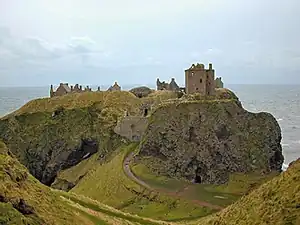
Dunnottar Castle in the Mearns occupies one of the best defensive locations in Great Britain. The site was in use throughout the High Middle Ages, and the castle itself dates to the fourteenth century.
The High Middle Ages of Scotland encompass Scotland in the era between the death of Domnall II in 900 AD and the death of King Alexander III in 1286, which was an indirect cause of the Wars of Scottish Independence.
At the close of the ninth century, various competing kingdoms occupied the territory of modern Scotland. Scandinavian influence was dominant in the northern and western islands, Brythonic culture in the southwest, the Anglo-Saxon or English Kingdom of Northumbria in the southeast and the Pictish and Gaelic Kingdom of Alba in the east, north of the River Forth. By the tenth and eleventh centuries, northern Great Britain was increasingly dominated by Gaelic culture, and by the Gaelic regal lordship of Alba, known in Latin as either Albania or Scotia, and in English as "Scotland". From its base in the east, this kingdom acquired control of the lands lying to the south and ultimately the west and much of the north. It had a flourishing culture, comprising part of the larger Gaelic-speaking world and an economy dominated by agriculture and trade. (Full article...)
Mary, Queen of Scots (8 December 1542 – 8 February 1587), also known as Mary Stuart or Mary I of Scotland, was Queen of Scotland from 14 December 1542 until her forced abdication on 24 July 1567.
The only surviving legitimate child of King James V of Scotland, Mary was six days old when her father died, and she inherited the throne. During her childhood, Scotland was governed by regents, first by the heir to the throne, James Hamilton, Earl of Arran, and then by her mother, Mary of Guise. In 1548, she was betrothed to Francis, the Dauphin of France, and was sent to be brought up in France, where she would be safe from invading English forces during the Rough Wooing. Mary married Francis in 1558, becoming queen consort of France from his accession in 1559 until his death in December 1560. Widowed, Mary returned to Scotland in August 1561. The tense religious and political climate following the Scottish Reformation that Mary encountered on her return to Scotland was further agitated by prominent Scots such as John Knox, who openly questioned whether her subjects had a duty to obey her. The early years of her personal rule were marked by pragmatism, tolerance, and moderation. She issued a proclamation accepting the religious settlement in Scotland as she had found it upon her return, retained advisers such as James Stewart, Earl of Moray (her illegitimate half-brother), and William Maitland of Lethington, and governed as the Catholic monarch of a Protestant kingdom. (Full article...)
The Battle of Blenheim (German: Zweite Schlacht bei Höchstädt; French: Bataille de Höchstädt; Dutch: Slag bij Blenheim) fought on 13 August [O.S. 2 August] 1704, was a major battle of the War of the Spanish Succession. The overwhelming Allied victory ensured the safety of Vienna from the Franco-Bavarian army, thus preventing the collapse of the reconstituted Grand Alliance.
Louis XIV of France sought to knock the Holy Roman Emperor, Leopold, out of the war by seizing Vienna, the Habsburg capital, and gain a favourable peace settlement. The dangers to Vienna were considerable: Maximilian II Emanuel and Marshal Ferdinand de Marsin's forces in Bavaria threatened from the west, and Marshal Louis Joseph, Duke of Vendôme's large army in northern Italy posed a serious danger with a potential offensive through the Brenner Pass. Vienna was also under pressure from Rákóczi's Hungarian revolt from its eastern approaches. Realising the danger, the Duke of Marlborough resolved to alleviate the peril to Vienna by marching his forces south from Bedburg to help maintain Emperor Leopold within the Grand Alliance. (Full article...)- Whisky Galore! is a 1949 British comedy film produced by Ealing Studios, starring Basil Radford, Bruce Seton, Joan Greenwood and Gordon Jackson. It was the directorial debut of Alexander Mackendrick; the screenplay was by Compton Mackenzie, an adaptation of his 1947 novel Whisky Galore, and Angus MacPhail. The story—based on a true event, the running aground of the SS Politician—concerns a shipwreck off a fictional Scottish island, the inhabitants of which have run out of whisky because of wartime rationing. The islanders find out the ship is carrying 50,000 cases of whisky, some of which they salvage, against the opposition of the local Customs and Excise men.
It was filmed on the island of Barra; the weather was so poor that the production over-ran its 10-week schedule by five weeks, and the film went £20,000 over budget. Michael Balcon, the head of the studio, was unimpressed by the initial cut of the film, and one of Ealing's directors, Charles Crichton, added footage and re-edited the film before its release. Like other Ealing comedies, Whisky Galore! explores the actions of a small insular group facing and overcoming a more powerful opponent. An unspoken sense of community runs through the film, and the story reflects a time when the British Empire was weakening. (Full article...)


Selection of good articles


John Gregorson Campbell (1836 – 22 November 1891) was a Scottish folklorist and Free Church minister at the Tiree and Coll parishes in Argyll, Scotland. An avid collector of traditional stories, he became Secretary to the Ossianic Society of Glasgow University in the mid-1850s. Ill health had prevented him taking up employment as a Minister when he was initially approved to preach by the Presbytery of Glasgow in 1858 and later after he was appointed to Tiree by the Duke of Argyll in 1861, parishioners objected to his manner of preaching.
Several of the anecdotes he amassed were published in magazines and, just before his death, work began on collating the first of four compendiums of the tales; three were published a few years after his death. He was fluent in several languages, including Scottish Gaelic, and transcribed the legends precisely as dictated by the narrators. (Full article...)- The Daily Mash is a British satirical website providing parodic commentary on current affairs and other news stories. Neil Rafferty (a former political correspondent for The Sunday Times) and Paul Stokes (former business editor of The Scotsman), created the website in 2007 and remain the lead writers. Both writers earn salaries from the enterprise and also employ freelance contributors. The publication has garnered praise for its absurd, scatological humour and insightful political satire. The current editor is comedy writer and former BBC journalist Tim Telling. The Daily Mash has often been compared to the US publication The Onion. (Full article...)
- Mary Docherty (27 April 1908 – 2 February 2000) was a British activist and member of the Communist Party of Great Britain. Born to a working-class family in Cowdenbeath, Scotland, she was influenced by the communist beliefs of her father, a miner, as well as by the poverty she grew up in. She joined the Communist Party at the age of 18, and in 1929 traveled to the Soviet Union as a Scottish delegate to a gathering of young communists. She founded a local children's wing of the Communist Party, carried out a successful agitation to declare 1 May a school holiday, and worked for communist Member of Parliament Willie Gallacher. She retired from active politics at the age of 60, but continued to give talks and write her memoirs, published in 1991 as A Miner's Lass. (Full article...)
Urien ap Cynfarch Oer or Urien Rheged (Welsh pronunciation: [ˈɨ̞riɛn ˈr̥ɛɡɛd]) was a powerful sixth-century Brittonic-speaking figure who was possibly the ruler of the territory or kingdom known as Rheged. He is one of the best-known and best documented of the British figures of the Old North. His kingdom was most likely centred around the Solway Firth. According to the section known as the "Northern History" of the Historia Brittonum (c. 829–30 AD), Urien gained a decisive advantage in a conflict against the Anglo-Saxons in northern Britain while leading an alliance with three other kings: Rhydderch Hen, Gwallog ap Llênog, and Morgan. The alliance led by Urien penned the Anglo-Saxons in at Lindisfarne, though this siege came to an abrupt end when Urien was murdered on the orders of his erstwhile ally Morgan.
The most secure evidence for his existence comes the Historia Brittonum and eight praise-poems in Middle Welsh orthography dedicated to him surviving in a fourteenth-century manuscript. Despite their being found in later orthography, the poems may possibly reflect early material, even material contemporaneous to Urien. One of these poems is explicitly attributed to the famed poet Taliesin in the manuscript. The "Northern History" in the Historia Brittonum also roughly synchronises Taliesin's career to the reign of Ida of Bernicia (547 × 549). Some of the Beirdd y Tywysogion (c. 1100–1283) also allude to this strong association between Taliesin and Urien. The panegyric attributed to Taliesin concerning Urien is particularly significant because if it truly originates in the sixth century it, together with the poetry attributed to Aneirin, would be the earliest vernacular post-Classical European literature. (Full article...)
The 1971 Scottish soldiers killings took place in Northern Ireland during The Troubles. On 10 March 1971, the Irish Republican Army (IRA) shot dead three off-duty British soldiers of the 1st Battalion, Royal Highland Fusiliers. The soldiers were from Scotland and two were teenage brothers. They were lured from a pub in Belfast where they had been drinking, driven to a remote location and shot by the roadside. Three British soldiers had been killed before this, but all had been killed during rioting.
The deaths led to public mourning and protests. Pressure to act spurred a political crisis for the Northern Ireland Government, which led to the resignation of James Chichester-Clark as Prime Minister of Northern Ireland. The British Army raised the minimum age needed to serve in Northern Ireland to 18 in response to this incident. In 2010, a memorial was dedicated to the three soldiers near the site of their deaths. (Full article...)
St Margaret's Church is a church of the Scottish Episcopal Church near Aberlour in Moray, Scotland. It is Gothic in style, built mostly of tooled granite rubble, and has a cruciform layout with an east–west oriented nave, transepts to the north and south, and a slender tower at the south-west corner. Its interior is lavishly decorated with polished granite columns topped with ornately carved capitals, marble chancel furniture, and many stained glass windows depicting saints and biblical scenes.
St Margaret's was built between 1875 and 1879 by Alexander Ross and largely paid for by Margaret Macpherson Grant, an heiress who had inherited a large fortune from her uncle Alexander Grant, a slave-owning merchant and planter who had become rich in Jamaica. The church was built as the chapel for an orphanage that she founded in the town; the orphanage has since been demolished, but the church continues to be used for weekly services, and has been designated a Category A listed building. (Full article...)
Elections to Argyll and Bute Council took place on 5 May 2022, the same day as the 31 other Scottish local government elections. As with other Scottish council elections, it was held using single transferable vote (STV)—a form of proportional representation—in which multiple candidates are elected in each ward and voters rank candidates in order of preference. New ward boundaries were proposed by Boundaries Scotland in 2021, which would have reduced the total number of councillors to 34. However, these were rejected by the Scottish Parliament and the boundaries used at the previous election remained in place.
For the second consecutive election, the Scottish National Party (SNP) were returned as the largest party with 12 seats—one more than in 2017 but seven short of an overall majority. The Conservatives solidified the gains they had made at the previous election and increased their number by one to return 10 councillors and become the second-largest group on the council. The number of independent councillors fell by almost one third to seven while the Liberal Democrats lost one seat to return five councillors. The remaining two seats were won by Labour and the Greens. (Full article...)- Alexander Patrick Greysteil Hore-Ruthven, 2nd Earl of Gowrie, PC, FRSL (26 November 1939 – 24 September 2021), usually known as Grey Gowrie or Lord Gowrie, was an Irish-born British hereditary peer, politician, and businessman. Lord Gowrie was also the hereditary Clan Chief of Clan Ruthven in Scotland. He was educated at Eton and Oxford, and held posts in academia for a period, in the US and London, including time working with poet Robert Lowell and at Harvard University.
Gowrie was a Conservative Party politician for some years, including a period in the British Cabinet. He held ministerial posts under Margaret Thatcher, in the areas of employment and Northern Ireland, and was Minister of State for the Arts, as well as Chancellor of the Duchy of Lancaster, with responsibility for Civil Service reform. Offered a promotion to full Secretary of State, with responsibility for education across the UK, he turned it down. Previously an arts dealer, he moved to Sotheby's for a reputed salary of around £150,000, chairing parts of the art auction business. He later chaired the Arts Council of England (1994–1998). (Full article...) - Papa Stour (Shaetlan pronunciation: [ˌpapəˈstuər] ⓘ PA-pə-STOOR) is one of the Shetland Islands in Scotland, with a population of fifteen people, some of whom immigrated after an appeal for residents in the 1970s. Located to the west of mainland Shetland and with an area of 828 hectares (3.2 square miles), Papa Stour is the ninth largest island in Shetland. Erosion of the soft volcanic rocks by the sea has created an extraordinary variety of caves, stacks, arches, blowholes, and cliffs. The island and its surrounding seas harbour diverse populations of wildlife. The west side of the island is a Site of Special Scientific Interest and the seas around the island are a Special Area of Conservation.
The island has several Neolithic burial chamber sites, as well as the remains of Duke Hakon's 13th-century house dating from the Norse occupation of the island. The population reached 380 or more in the 19th century, when a fishing station was opened at Crabbaberry in West Voe. Subsequently, there was a steady decline in population. (Full article...)
The women's 400 metres at the 2024 World Athletics Indoor Championships took place over three rounds at the Commonwealth Arena in Glasgow, United Kingdom, on 1 and 2 March 2024. This was the nineteenth time that the women's 400 metres was contested at the World Athletics Indoor Championships. Twenty-four athletes from nineteen different nations competed in the event.
The four heats of round 1 were held in the morning of 1 March, where twelve athletes qualified for the next round. Susanne Gogl-Walli of Austria set a national record of 51.43 seconds. The two heats of the semi-finals were held in the evening of 1 March, where six athletes qualified for the final round. Sharlene Mawdsley of Ireland was disqualified for obstruction. (Full article...)
Sir James Murray, Lord Philiphaugh PC (11 July 1655 – 1 July 1708) was a Scottish judge and politician who twice served as Lord Clerk Register from November 1702 to June 1704 and from April 1705 to July 1708, when he died in office. Serving as a political advisor to the prominent statesman James Douglas, 2nd Duke of Queensberry, Murray assisted him in passing the 1707 Union with England Act through a divided Parliament of Scotland.
Born in Eddleston, Peeblesshire, Murray graduated from the University of Edinburgh in 1674 before being elected to the Scottish Parliament after the death of his father in the previous year. Murray also served as the Sheriff of Selkirk until a dispute with a Scots Army officer led to the Privy Council of Scotland to remove him from the office in October 1681. During this period, he married twice, having eight children with his second wife Margaret. (Full article...)
Gilli was an eleventh-century Hebridean chieftain whose career coincided with an era of Orcadian overlordship in the Kingdom of the Isles. According to mediaeval saga-tradition, Gilli was a brother-in-law of Sigurðr Hlǫðvisson, Earl of Orkney, having married the latter's sister Hvarflǫð. Traditionally regarded as one of the most powerful Orcadian earls, Sigurðr appears to have extended his authority into the Isles in the late tenth century. Gilli apparently acted as Sigurðr's viceroy or tributary earl in the region. The time frame of Gilli's apparent authority in the Isles is uncertain, and may date as early as the reign of Guðrøðr Haraldsson, King of the Isles, or as late as the period following the death of this man's eventual successor, Rǫgnvaldr Guðrøðarson, King of the Isles. Gilli's name is probably Gaelic in origin, and he seems to have seated himself on either Coll or Colonsay, islands in the Inner Hebrides. It is possible that Gilli is identical to Gilla Ciaráin mac Glún Iairn, an Uí Ímair dynast who was slain at the Battle of Clontarf in 1014. If not, another possibility is that he was the father of a certain Conamal/Conmáel who was killed in 980. (Full article...)
The Royal Banner of the Royal Arms of Scotland, also known as the Royal Banner of Scotland, or more commonly the Lion Rampant of Scotland, and historically as the Royal Standard of Scotland, (Scottish Gaelic: Bratach rìoghail na h-Alba, Scots: Ryal banner o Scotland) or Banner of the King of Scots, is the royal banner of Scotland, and historically, the royal standard of the Kingdom of Scotland. Used historically by the Scottish monarchs, the banner differs from Scotland's national flag, the Saltire, in that its official use is restricted by an Act of the Parliament of Scotland to only a few Great Officers of State who officially represent the Monarchy in Scotland. It is also used in an official capacity at royal residences in Scotland when the Head of State is not present.
The earliest recorded use of the Lion Rampant as a royal emblem in Scotland was by Alexander II in 1222; with the additional embellishment of a double border set with lilies occurring during the reign of Alexander III (1249–1286). This emblem occupied the shield of the royal coat of arms of the ancient Kingdom of Scotland which, together with a royal banner displaying the same, was used by the King of Scots until the Union of the Crowns in 1603, when James VI acceded to the thrones of the kingdoms of England and Ireland. Since 1603, the lion rampant of Scotland has been incorporated into both the royal arms and royal banners of successive Scottish then British monarchs in order to symbolise Scotland, as can be seen today in the Royal Standard of the United Kingdom. Although now officially restricted to use by representatives of the Monarch and at royal residences, the Royal Banner continues to be one of Scotland's most recognisable symbols. (Full article...)- John McNichol (20 August 1925 – 17 March 2007) was a Scottish footballer who played more than 500 games in the Football League in England. An inside forward, he played more than 150 games for Brighton & Hove Albion and more than 200 for each of Chelsea and Crystal Palace.
McNichol graduated from junior footballer and apprentice motor mechanic in his native Scotland to a professional contract with English First Division club Newcastle United. After two years, he had found success with the reserve team but was never selected in the first eleven. Brighton & Hove Albion, struggling in the Third Division, broke their transfer record to sign him. McNichol spent four years with the club, acquiring "the reputation as the finest inside-forward in the Third Division", before moving to the First Division as Chelsea manager Ted Drake's first signing. He was part of the Chelsea team that won the League championship in the 1954–55 season. In 1958 he joined Crystal Palace, whom he captained to promotion from the Fourth Division, and finished his on-field career in the Southern League as player-manager of Tunbridge Wells Rangers. He then spent 25 years working on the commercial side of football with two of his previous clubs. (Full article...)
Charles Edward Louis John Sylvester Maria Casimir Stuart (31 December 1720 – 30 January 1788) was the elder son of James Francis Edward Stuart, making him the grandson of James VII and II, and the Stuart claimant to the thrones of England, Scotland, and Ireland from 1766. He is also known as the Young Pretender, the Young Chevalier and Bonnie Prince Charlie, and to Jacobites as Charles III. He led the failed Jacobite Rising of 1745 in an attempt to restore the Stuart dynasty to power.
Born in Rome to the exiled Stuart court, he spent much of his early and later life in Italy. In 1744, he travelled to France to take part in a planned invasion of England to restore the Stuart monarchy under his father. When storms partly wrecked the French fleet, Charles resolved to proceed to Scotland following discussion with leading Jacobites. This resulted in Charles landing by ship on the west coast of Scotland, leading to the Jacobite rising of 1745. The Jacobite forces under Charles initially achieved several victories in the field, including the Battle of Prestonpans in September 1745 and the Battle of Falkirk Muir in January 1746. However, by April 1746, Charles was defeated at Culloden, effectively ending the Stuart cause. Although there were subsequent attempts such as a planned French invasion in 1759, Charles was unable to restore the Stuart monarchy. (Full article...)
Sir John Struthers MD FRCSE FRSE (21 February 1823 – 24 February 1899) was the first Regius Professor of Anatomy at the University of Aberdeen. He was a teacher and administrator, at the university. He was passionate about anatomy, seeking out and dissecting the largest animal specimens, including whales, and speaking to his colleagues with his quest for money and space for his collection. His collection was donated to Surgeon's Hall in Edinburgh.
Among scientists, he is perhaps best known for his work on the ligament which bears his name. His work on the rare and vestigial ligament of Struthers came to the attention of Charles Darwin, who used it in his Descent of Man to help argue the case that man and other mammals shared a common ancestor; or "community of descent," as Darwin expressed it. (Full article...)- Andrew Wodrow (1752–1814) was a prominent Scottish American merchant, militia officer, clerk of court, lawyer, and landowner in the colony (and later U.S. state) of Virginia.
Wodrow was born in Scotland in 1752 and immigrated to Virginia in 1768. In Fredericksburg, he engaged in a thriving import business. Following the outbreak of the American Revolutionary War, Wodrow placed his entire inventory up for public auction and contributed the profits to the American Revolutionary patriot cause. During the war, Wodrow served as a lieutenant colonel in command of cavalry in the Continental Army. (Full article...)
Craigiehall is a late-17th-century country house, which until 2015 served as the Headquarters of the British Army in Scotland. It is located close to Cramond, around 9 km (5.6 mi) west of central Edinburgh, Scotland.
Craigiehall was designed by Sir William Bruce, with input from James Smith, and completed in 1699 for the Earl of Annandale, who had recently acquired the Craigie estate through marriage. It is a good surviving example of one of Bruce's smaller houses, and set a pattern for such villas in the Edinburgh area for the 18th century. (Full article...)- Sir Ewan Forbes, 11th Baronet, MBChB (6 September 1912 – 12 September 1991), was a Scottish nobleman, general practitioner and farmer. Forbes was a trans man; he was officially registered as the youngest daughter of John, Lord Sempill. After an uncomfortable upbringing, he began presenting as a man in the 1930s, following a course of medical treatments in Germany. He formally re-registered his birth as male in 1952, changing his name to Ewan, and was married a month later.
In 1965, he stood to inherit the baronetcy of his elder brother William, Lord Sempill, together with a large estate. This inheritance was challenged by his cousin, who argued that the re-registration was invalid; under this interpretation, Forbes would legally be considered a woman, and thus unable to inherit the baronetcy. The legal position was unclear, and it took three years before a ruling by the Court of Session, which held him to be intersex, finally led to the Home Secretary recognising his claim to the title. The case was heard in great secrecy, with the effect that it was unable to be considered in other judgments on the legal recognition of gender variance, but has become more widely known since his death in 1991. (Full article...)
George Dario Marino Franchitti MBE (born 19 May 1973) is a British motorsport commentator and semi-retired motor racing driver. He won the IndyCar Series Drivers' Championship in 2007, 2009, 2010 and 2011; the Indianapolis 500 in 2007, 2010 and 2012; and the 2008 24 Hours of Daytona driving for Andretti Green Racing (AGR) and later Chip Ganassi Racing (CGR).
Franchitti began kart racing at the age of ten and had early success before progressing to car racing at the age of seventeen, winning the 1991 Formula Vauxhall Junior Championship and the 1993 Formula Vauxhall Lotus Championship. In 1995 and 1996, he competed in the Deutsche Tourenwagen Meisterschaft and the related International Touring Car Championship for the AMG-Mercedes team, winning two races. Franchitti debuted in Championship Auto Racing Teams (CART) with Hogan Racing for the 1997 season. The following year, he joined Team Green and finished third in the championship with three victories. After tying Juan Pablo Montoya on points and winning four fewer races than Montoya, Franchitti finished second in the 1999 season. His form declined over the next three years but he won four races. (Full article...)- The 2002 Scottish Masters (known as the 2002 Regal Scottish Masters for sponsorship reasons) was a professional non-ranking snooker tournament which took place at the Thistle Hotel in Glasgow, Scotland, from 24 to 29 September. It was the final edition of the tournament, as it later lost its sponsorship by the cigarette brand Regal. It was the first of two invitational World Professional Billiards and Snooker Association (WPBSA) competitions in the 2002–03 season. The host broadcaster was BBC Scotland.
Ronnie O'Sullivan, a former world champion, won the tournament, defeating the defending champion John Higgins 9–4 in the final. It was the third time that O'Sullivan had won the Scottish Masters in his career, and he was awarded £65,000 from a prize fund pool of £205,000. In the semi-finals O'Sullivan defeated world number six Stephen Hendry 6–3 and Higgins beat Stephen Lee 6–4; Lee made the tournament's highest break of 139 in his loss. (Full article...)
Staffa (Scottish Gaelic: Stafa, pronounced [ˈs̪t̪afa], from the Old Norse word for a stave or pillar) is an island of the Inner Hebrides in Argyll and Bute, Scotland. The Vikings gave it the name because its columnar basalt reminded them of their houses, which were constructed using vertical logs.
Staffa lies about 10 kilometres (6 miles) west of the Isle of Mull. It is 33 hectares (82 acres) in area and the highest point is 42 metres (138 feet) above sea level. (Full article...)
Glenrothes (/ɡlɛnˈrɒθɪs/ ⓘ glen-ROTH-iss; Scots: Glenrothes; Scottish Gaelic: Gleann Rathais, pronounced [kʲlən̪ˠˈrˠahɪʃ]) is a town situated in the heart of Fife, in east-central Scotland. It is the administrative capital of Fife, containing the headquarters of both Fife Council and Police Scotland Fife Division and is a major service and employment centre within the area. In the 2022 census, the town had a resident population of 37,468, making it the third-largest settlement in Fife and the 18th most populous locality in Scotland.
The name Glenrothes comes from its historical link with the Earl of Rothes, who owned much of the land on which the new town has been built; Glen (Scottish for valley) was added to the name to distinguish it from Rothes in Moray and in recognition that the town lies in a river valley. The motto of Glenrothes is Ex terra vis, meaning "Strength from the earth", which dates back to the founding of the town. Planned shortly after World War II as Scotland's second new town, its purpose was to generate economic growth and renewal in central Fife. Initially this was to be done by providing new homes, industries, infrastructure and services needed to support the development of a newly established National Coal Board 'super pit', the Rothes Colliery. The mine closed early in its life and the town's economy thereafter transitioned and diversified, establishing it as an important centre for light industry and playing a significant role in establishing Scotland's Silicon Glen between 1961 and 2000. (Full article...)
James McAvoy (/ˈmækəvɔɪ/; born 21 April 1979) is a Scottish actor and director. He made his acting debut as a teen in The Near Room (1995) and appeared mostly on television until 2003, when his film career began. His television work includes the thriller State of Play (2003), the science fiction miniseries Frank Herbert's Children of Dune (2003), and the drama series Shameless (2004–2005).
McAvoy gained recognition for playing Mr. Tumnus in the fantasy film The Chronicles of Narnia: The Lion, the Witch and the Wardrobe (2005) and an assassin in the action film Wanted (2008). After winning the inaugural BAFTA Rising Star Award in 2006, his performances in the period dramas The Last King of Scotland (2006) and Atonement (2007) gained him BAFTA Award nominations. In 2011 he voiced the title characters in Arthur Christmas and Gnomeo & Juliet, and portrayed Charles Xavier in the superhero film X-Men: First Class, a role he reprised in subsequent installments of the X-Men series. (Full article...)
Whittingehame House, Balfour's mansion in East Lothian, Scotland
James Balfour (c. 1775 – 19 April 1845) was a Scottish nabob who became a landowner and politician. The son of a prosperous and influential Scottish gentry family, he became a trader in India. Having made a fortune supplying the Royal Navy, he returned to Scotland to buy several landed estates, including Whittingehame in East Lothian where he built a classical mansion.
Balfour became a Tory Member of Parliament (MP) from 1826 to 1834, but never achieved ministerial office. However, many of his descendants found fame and success, including his grandson Arthur Balfour,
who served as prime minister from 1902 to 1905. (Full article...)


Lists of featured content
 | This is a list of recognized content, updated weekly by JL-Bot (talk · contribs) (typically on Saturdays). There is no need to edit the list yourself. If an article is missing from the list, make sure it is tagged (e.g. {{WikiProject Scotland}}) or categorized correctly and wait for the next update. See WP:RECOG for configuration options. |
Featured articles
- Áedán mac Gabráin
- Anglo-Scottish war (1650–1652)
- Anne, Queen of Great Britain
- Anne of Denmark
- HMS Argus (I49)
- Japanese battleship Asahi
- Sieges of Berwick (1355 and 1356)
- Battle of Blenheim
- Blue men of the Minch
- William Bruce (architect)
- William Speirs Bruce
- Burke and Hare murders
- Burnt Candlemas
- Constantine II of Scotland
- Cullen House
- David I of Scotland
- Walter Donaldson (snooker player)
- Donnchadh, Earl of Carrick
- Alec Douglas-Home
- Battle of Dunbar (1650)
- Edward I
- Elgin Cathedral
- Queen Elizabeth the Queen Mother
- English invasion of Scotland (1400)
- Fauna of Scotland
- From the Doctor to My Son Thomas
- Rachel Chiesley, Lady Grange
- Margaret Macpherson Grant
- Great North of Scotland Railway
- Bryan Gunn
- Battle of Halidon Hill
- HMS Hood
- History of infant schools in Great Britain
- Battle of Inverkeithing
- James II of England
- James VI and I
- Jocelin of Glasgow
- Kelpie
- John Knox
- Elizabeth Maitland, Duchess of Lauderdale
- War of the League of Cambrai
- Gregor MacGregor
- Mary, Queen of Scots
- Murray Maxwell
- William McGregor (football)
- Nebula Science Fiction
- Neilston
- Nuckelavee
- Order of the Thistle
- Pitfour estate
- Poisoning of Margaret Warden
- HMS Ramillies (07)
- Renewable energy in Scotland
- Representative peer
- Rockstar North
- HMS Royal Oak (08)
- Scotland in the High Middle Ages
- Scotland national football team
- Scottish National Antarctic Expedition
- Shapinsay
- Isle of Skye
- Charlotte Stuart, Duchess of Albany
- HMS Vanguard (23)
- Second War of Scottish Independence
- John Wark
- Westminster Assembly
- Whisky Galore! (1949 film)
- John Michael Wright
Former featured articles
Good articles
- A82 road
- 1873–74 Scottish Cup
- 2001 Scottish Masters
- 2002 Scottish Masters
- 2014 Scottish Labour leadership election
- 2022 Aberdeen City Council election
- 2022 Aberdeenshire Council election
- 2022 Angus Council election
- 2022 Argyll and Bute Council election
- 2022 City of Edinburgh Council election
- 2022 Clackmannanshire Council election
- 2022 Comhairle nan Eilean Siar election
- 2022 Dumfries and Galloway Council election
- 2022 Dundee City Council election
- 2022 East Ayrshire Council election
- 2022 Fife Council election
- 2022 Glasgow City Council election
- 2022 Highland Council election
- 2022 North Ayrshire Council election
- 2022 North Lanarkshire Council election
- 2022 Orkney Islands Council election
- 2022 Shetland Islands Council election
- 2022 South Ayrshire Council election
- 2022 South Lanarkshire Council election
- 2024 World Athletics Indoor Championships – Women's 4 × 400 metres relay
- 2024 World Athletics Indoor Championships – Women's 400 metres
- 61016
- A9 dualling project
- Aberdeen F.C.
- Aberdeen F.C.–Rangers F.C. rivalry
- Aberdour Castle
- William Adam (architect)
- William Aitken (architect)
- Arbroath
- Architecture of Scotland
- Architecture in early modern Scotland
- Architecture in modern Scotland
- Architecture of Scotland in the Industrial Revolution
- Architecture of Scotland in the Middle Ages
- Architecture of Scotland in the Roman era
- Architecture of Scotland in the prehistoric era
- Art in Medieval Scotland
- Art in early modern Scotland
- Art in modern Scotland
- At Hope's Ravine
- Allison Balfour
- James Balfour (died 1845)
- John Barrowman
- Battle of Barry
- The Batman (film)
- Jim Baxter
- Ian Begg (architect)
- Ben Nevis
- Lewis Benson (boxer)
- Guy Berryman
- The Bhoys from Seville
- Billy Boys
- Tom Birney
- The Black Island
- HMS Bonaventure (31)
- Boobrie
- Bill Bowman (Scottish politician)
- Gordon Brown
- Brownie (folklore)
- Alexander Buchan (artist)
- Jack Buchanan
- Calendar (New Style) Act 1750
- James Campbell (British Army officer, died 1745)
- John Gregorson Campbell
- Camus Cross
- Peter Capaldi
- Thomas Carlyle
- Castles in Scotland
- Celtic Park
- Erik Chisholm
- Church architecture in Scotland
- Winston Churchill
- Clan Maclachlan
- Clydesdale horse
- HMS Conqueror (1911)
- The Cookery Book of Lady Clark of Tillypronie
- Coxton Tower
- Craigiehall
- Lord Ninian Crichton-Stuart
- Cruachan Power Station
- Cú Chulainn
- Cullen Old Church
- Cultybraggan Camp
- 1966 European Cup Winners' Cup final
- The Daily Mash
- Alexander Dalrymple
- Dandie Dinmont Terrier
- Ruth Davidson
- James Davis (escaped convict)
- Dead Pony
- Demographic history of Scotland
- Paul Dickov
- Mary Docherty
- Donkey Punch (novel)
- Doune Castle
- Dowhill Castle
- Dubh Artach
- Andrew Dudley
- Duncraig Castle
- Dunnottar Castle
- Dunrobin Castle
- Dunstaffnage Castle
- East Kirkton Quarry
- East Stirlingshire F.C.
- Easter Road
- Economy of Scotland in the Middle Ages
- Economy of Scotland in the early modern period
- Edinburgh Castle
- University of Edinburgh
- Education in Medieval Scotland
- Education in early modern Scotland
- Edzell Castle
- Eenoolooapik
- Eidyn
- Elcho Castle
- Eriskay Pony
- Estate houses in Scotland
- 1884 FA Cup final
- Edward G. Faile
- Fairy Flag
- Falkirk Wheel
- Family in early modern Scotland
- James Ferguson, Lord Pitfour
- James Ferguson (Scottish politician)
- Finnieston Crane
- Flora of Scotland
- Sir Ewan Forbes, 11th Baronet
- Forglen House
- Forth Bridge
- Forth Valley Royal Hospital
- Dario Franchitti
- Château Gaillard
- Ncuti Gatwa
- Ryan Gauld
- Geography of Scotland in the Middle Ages
- Geography of Scotland in the early modern era
- Geology of Scotland
- Giffnock
- Gilli (Hebridean earl)
- Glass Swords
- The Glenlivet distillery
- Glenrothes
- Glorious Revolution in Scotland
- Michael Gove
- Government in early modern Scotland
- Government in medieval Scotland
- Isobel Gowdie
- Grey Gowrie
- Hampden Park
- Hibernian F.C.
- Highland cattle
- Highlands and Islands Alliance
- Lists of mountains and hills in the British Isles
- Hillforts in Scotland
- History of Scotland
- History of agriculture in Scotland
- Mary Hogarth
- Housing in Scotland
- How the Scots Invented the Modern World
- Leslie Hunter
- HMS Hurst Castle
- Ibrox Stadium
- 1902 Ibrox disaster
- Illieston House
- Inchdrewer Castle
- Inner Hebrides
- James Innes (British Army officer, died 1759)
- Charles Irving (surgeon)
- Islands of the Clyde
- Islay
- James I of Scotland
- Bert Jansch
- Jarlshof
- Jocky Wilson Cup
- Kelvin Scottish
- George Meikle Kemp
- Battle of Kinghorn
- Kirkandrews, Dumfries and Galloway
- Kirkcaldy
- Kirkcudbright Tolbooth
- Punam Krishan
- Labour Party of Scotland
- Johann Lamont
- Landscape painting in Scotland
- Katie Leung
- Billy Liddell
- Literature in early modern Scotland
- Kim Little
- Loch Arkaig treasure
- Loch Henry
- Lochleven Castle
- RAF Lossiemouth
- Alexander MacFarlane (astronomer)
- Donald MacKay (architect)
- Murder of Alesha MacPhail
- Clan MacAulay
- RAF Machrihanish
- Doris Mackinnon
- Sorley MacLean
- Richard Madden
- SS Manasoo
- Marmalade
- James Clerk Maxwell
- Maybole Castle
- James McAvoy
- Stuart McCall
- Angus McDonald (Virginia militiaman)
- McEwan's
- Ewan McGregor
- John George McTavish
- Johnny McNichol
- Meantime (novel)
- Colin Mitchell
- Steven Moffat
- Michelle Mone
- William Montgomerie
- Simone Murphy
- James Murray, Lord Philiphaugh
- Music in early modern Scotland
- John Mylne (died 1667)
- The National (Scotland)
- Robert Alexander Neil
- John Ogilby
- One Kiss
- Orkney
- Outer Hebrides
- Paisley witches
- Papa Stour
- Portrait painting in Scotland
- Potion (song)
- Prehistoric art in Scotland
- Raasay
- Ragnall ua Ímair
- Alex Raisbeck
- Lynne Ramsay
- Rangers F.C. policy of not signing Catholics
- Renaissance in Scotland
- Richard Rennison
- Rhapsody (climb)
- Rockstar Dundee
- Romanticism in Scotland
- Andrew Ross (rugby union, born 1879)
- Royal Banner of Scotland
- Rusco Tower
- St Margaret's Church, Aberlour
- St Peter's Roman Catholic Church, Buckie
- St Rufus Church
- Scandinavian Scotland
- Schiehallion experiment
- Flag of Scotland
- Scotland during the Roman Empire
- Scotland in the Late Middle Ages
- Scotland in the Middle Ages
- Scotland in the early modern period
- Scotland in the modern era
- Scotland national football team manager
- Scotland under the Commonwealth
- Scottish art
- 1999 Scottish Challenge Cup final
- 2002 Scottish Challenge Cup final
- 2007 Scottish Challenge Cup final
- Scottish Challenge Cup
- 2012 Scottish Cup final
- 2019 Scottish Open (snooker)
- 1971 Scottish soldiers' killings
- Scottish Terrier
- Scottish art in the eighteenth century
- Scottish art in the nineteenth century
- Scottish invasion of England (1648)
- Scottish religion in the eighteenth century
- Scottish religion in the seventeenth century
- Scottish society in the Middle Ages
- Scottish society in the early modern era
- Scuttling of the German fleet at Scapa Flow
- Sea Mither
- Bill Shankly
- Shetland
- Shieling
- Ian Smith (rugby union, born 1903)
- Jimmy Speirs
- Catherine Helen Spence
- Staffa
- Jessie Stephen
- Andrew Still (actor)
- Still Wakes the Deep
- Stoor worm
- John Struthers (anatomist)
- Charles Edward Stuart
- Sundrum Castle
- Swim School
- Philipp Tanzer
- Tay Whale
- D'Arcy Wentworth Thompson
- Thurso
- Tibbers Castle
- Titan Clydebank
- Torf-Einarr
- Tradeston Flour Mills explosion
- Trident (UK nuclear programme)
- USS Tucker (DD-374)
- German submarine U-27 (1936)
- Urien Rheged
- Urquhart Castle
- James Walker (Australian politician)
- James Walker (Royal Navy officer)
- William Middleton Wallace
- Warfare in Medieval Scotland
- Warfare in early modern Scotland
- Water bull
- West Highland White Terrier
- Robert White (Virginia physician)
- Krysty Wilson-Cairns
- Witch trials in early modern Scotland
- Andrew Wodrow
- Women in early modern Scotland
Former good articles
- Isle of Arran
- Alexander Bain (inventor)
- Eilley Bowers
- Billy Bremner
- British Isles
- British people
- William Buchanan (locomotive designer)
- Canadian Gaelic
- Andrew Carnegie
- Carnoustie
- Celtic F.C. in international football
- Coatbridge
- Catherine Cranston
- Dundee United F.C.
- The Dykeenies
- Edinburgh Zoo
- Steve Evans (footballer, born 1962)
- Evanton
- Forth Road Bridge
- Glasgow
- Glasgow, Paisley, Kilmarnock and Ayr Railway
- University of Glasgow
- Frank Hadden
- Halloween
- David Hume
- Jordanhill railway station
- Deborah Kerr
- Lothian Buses
- Ian McDiarmid
- Gillian McKeith
- Mingulay
- Monifieth
- Andy Murray
- Partick Thistle F.C.
- Picts
- Scotland
- Scots language
- Still Game
- Alexander Stoddart
- Alec Sutherland
- Tay Bridge
- Treasure Island
- William Morrison (chemist)
Featured lists
- List of islands of Scotland
- List of Celtic F.C. managers
- List of Scottish Football League clubs
- List of Scotland international footballers
- List of Scotland ODI cricketers
- List of Scotland national football team hat-tricks
- List of Scottish football champions
- List of Scottish football clubs in the FA Cup
- Scotland national football team results (1872–1914)
- PFA Scotland Players' Player of the Year
- SFWA Footballer of the Year
- Timeline of prehistoric Scotland
- Timeline of Scottish football
Featured pictures
 13-06-07 RaR Biffy Clyro Simon Neil 02
 Aerial View of Edinburgh, by Alfred Buckham, from about 1920
 Air Chief Marshal Sir Arthur Tedder on the Italian coast, 17 December 1943
 Alexander Gardner by James Gardner - 1863
 Arthur James Balfour, 1st Earl of Balfour (1902)
 CAMPBELL, George W-Treasury (BEP engraved portrait)
 Charles Robert Leslie - Sir Walter Scott - Ravenswood and Lucy at the Mermaiden's Well - Bride of Lammermoor
 Common seal (Phoca vitulina) 2
 Dalziel Brothers - Sir Walter Scott - The Talisman - Sir Kenneth before the King
 Daniel Craig McCallum by The Brady National Photographic Art Gallery
 David Livingstone by Thomas Annan
 Dunrobin Castle -Sutherland -Scotland-26May2008 (2)
 Edinburgh Castle from Grass Market
 Eilean Donan Castle, Scotland - Jan 2011
- Falkirk Wheel Timelapse, Scotland - Diliff
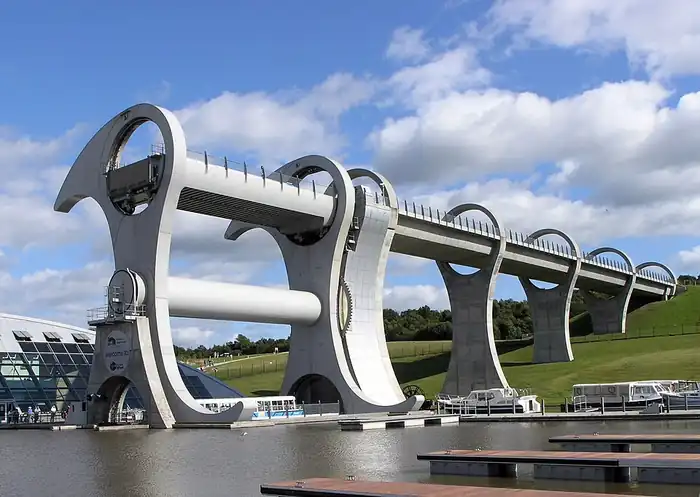 FalkirkWheelSide 2004 SeanMcClean
 Gavin Hamilton - Coriolanus Act V, Scene III edit2
 Jaguar at Edinburgh Zoo
 JamesIEngland
 Jeremiah Gurney - Photograph of Euphrosyne Parepa-Rosa
 Loch Torridon, Scotland
 Mount Stuart House 2018-08-25
 N. M. Price - Sir Walter Scott - Guy Mannering - At the Kaim of Derncleugh
 NEWScotland-2016-Aerial-Blackness Castle 01
 Nils Olav inspects the Kings Guard of Norway after being bestowed with a knighthood at Edinburgh Zoo in Scotland
 Paisley Abbey Interior East
 Paisley Abbey from the south east
 Prince James Francis Edward Stuart by Alexis Simon Belle
 Reverend Robert Walker (1755 - 1808) Skating on Duddingston Loch
 Robert William Thomson - Illustrated London News March 29 1873
 Scotland-2016-West Lothian-Hopetoun House 02
 Sgùrr nan Gillean from Sligachan, Isle of Skye, Scotland - Diliff
 Sir Anthony Van Dyck - Charles I (1600-49) - Google Art Project
 Sir William Thomson, Baron Kelvin by T. & R. Annan & Sons
 St Matthew's Church - Paisley - Interior - 5
 Synthetic Production of Penicillin TR1468
 The Air Ministry, 1939-1945. CH10270 – Edit 1
 The Monarch of the Glen, Edwin Landseer, 1851
 Thomas Keene in Macbeth 1884 Wikipedia crop
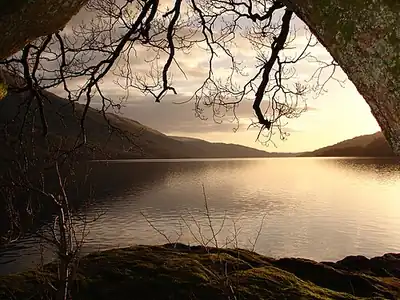 View of loch lomond
 Wemyss Bay railway station concourse 2018-08-25 2
 William Hatherell - Robert Louis Stephenson - The Bottle Imp 1
 William Hatherell - Robert Louis Stephenson - The Bottle Imp 2
 William John Macquorn Rankine by Thomas Annan
Get involved
| ||||||||||||||||||||||||||||||


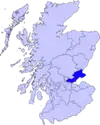

For editor resources and to collaborate with other editors on improving Wikipedia's Scotland-related articles, see WikiProject Scotland.
To get involved in helping to improve Wikipedia's Scotland related content, please consider doing some of the following tasks or joining one or more of the associated Wikiprojects:
- Visit the Scottish Wikipedians' notice board and help to write new Scotland-related articles, and expand and improve existing ones.
- Visit Wikipedia:WikiProject Scotland/Assessment, and help out by assessing unrated Scottish articles.
- Add the Project Banner to Scottish articles around Wikipedia.
- Participate in WikiProject Scotland's Peer Review, including responding to PR requests and nominating Scottish articles.
- Help nominate and select new content for the Scotland portal.
Do you have a question about The Scotland Portal that you can't find the answer to?
Post a question on the Talk Page or consider asking it at the Wikipedia reference desk.
Related portals



Wikipedia in other relevant languages
Associated Wikimedia
The following Wikimedia Foundation sister projects provide more on this subject:
-
 Commons
Free media repository -
 Wikidata
Free knowledge base -
 Wikiquote
Collection of quotations -
 Wikisource
Free-content library -
 Wikispecies
Directory of species -
 Wikiversity
Free learning tools -
 Wikivoyage
Free travel guide -
 Wiktionary
Dictionary and thesaurus
Discover Wikipedia using portals
-
 List of all portals
-

-

-

-

-

-

-

-

-

-
 Random portal
-
 WikiProject Portals
Category: