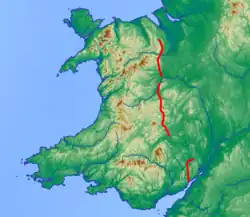
Wales (Welsh: Cymru[ˈkəmrɨ]ⓘ) is a country that is part of the United Kingdom. Located on the island of Great Britain, it is bordered by the Irish Sea to the north and west, England to the east, the Bristol Channel to the south, and the Celtic Sea to the south-west. As of 2021, it had a population of 3.1 million. It has a total area of 21,218 square kilometres (8,192sqmi) and over 2,700 kilometres (1,680mi) of coastline. It is largely mountainous with its higher peaks in the north and central areas, including Snowdon (Yr Wyddfa), its highest summit. The country lies within the north temperate zone and has a changeable, maritime climate. Its capital and largest city is Cardiff.
The A4232, known as the Peripheral Distributor Road (Welsh: Ffordd Ddosbarthu Ymylol) or Cardiff Link Road (Ffordd Gyswllt Caerdydd), is a distributor road in Cardiff. The first section to be completed was the Southern Way Link Road in 1978 and the last section was the Butetown Link Road in 1995. The final section, the Eastern Bay Link Road, is yet to be built, with no date when construction may start. When fully completed, the road will form part of the Cardiff ring road system. The A4232 runs west, south and east of Cardiff, with the M4 motorway between junction 30 and junction 33 completing the northern section. The A4232 is dual carriageway for its entire length except for the East Moors Viaduct, which is a single carriageway.
The A4232 has been constructed in separate link roads of between 1.61km (1.00mi) and 5.47km (3.40mi) around Cardiff and to date 22km (14mi) including spurs have been opened to traffic, with plans for a further 5.53km (3.44mi). It has four large viaducts (Ely Viaduct, Grangetown Viaduct, Taff Viaduct and the East Moors Viaduct), one tunnel (Queen's Gate Tunnel) and two spur roads (Cogan Spur and Central Link Road). The road also has many smaller bridges over or under most of the interchanges on the road. The entire length of the road has clearway restrictions on it.
... that the Living Willow Theatre, an open air theatre constructed of living willow trees, is located near the village of Llanwrthwl and occasionally holds outdoor performances of Shakespeare?
Alfred Ernest Jones (1 January 1879 – 11 February 1958) was a Welshneurologist, psychoanalyst and Sigmund Freud’s official biographer. As the first English-language practitioner of psychoanalysis and as President of both of the British Psycho-Analytical Society and the International Psychoanalytic Association in the 1920s and 1930s, Jones exercised unmatched influence in the establishment of its organisations, institutions and publications in the English-speaking world. After obtaining his medical degrees Jones specialised in neurology and took a number of posts in London Hospitals. It was through his association with the surgeon Wilfred Trotter that Jones recalled first hearing of Freud’s work. Having worked together as surgeons at University College Hospital they had become close friends, with Trotter taking the role of mentor and confidant to his younger colleague. They had in common a wide-ranging interest in philosophy and literature, as well as a growing interest in Continental psychiatric literature and the new forms of clinical therapy it surveyed. By 1905 they were sharing accommodation above Harley Street consulting rooms with Jones’s sister, Elizabeth ( later to become Trotter’s wife), installed as housekeeper. Jones, appalled at what he had seen of the institutionalised treatment of the "insane", began experimenting with hypnotic techniques in his clinical work.
Image 5Britain in AD 500: The areas shaded pink on the map were inhabited by the Britons, here labelled Welsh. The pale blue areas in the east were controlled by Germanic tribes, while the pale green areas to the north were inhabited by the Gaels and Picts. (from History of Wales)
Image 22Map of the Roman invasion of Wales (from History of Wales)
Image 23Cawl, a Welsh dish of meat and vegetables (from Culture of Wales)
Image 24Caradog by Thomas Prydderch. Caradog was leader of the north Walian Celtic tribe, the Ordovices, and led multiple Celtic tribes against the Romans. (from History of Wales)
Image 25The Senedd (Welsh Parliament), Cardiff Bay. (from History of Wales)
This is a list of recognized content, updated weekly by JL-Bot (talk·contribs) (typically on Saturdays). There is no need to edit the list yourself. If an article is missing from the list, make sure it is tagged(e.g. {{WikiProject Wales}})or categorized correctly and wait for the next update. See WP:RECOG for configuration options.