The county is predominantly rural, with an area of 1,375 square miles (3,562km2) and an estimated population of 585,655 in 2024. The county's major settlements include the city of Truro and St Austell in the centre, Redruth and Camborne adjacent to each other in the southwest, Saltash in the extreme southeast, and Penzance and Falmouth on the southern coast. For local government purposes most of Cornwall is a unitary authority area, with the Isles of Scilly governed by a unique local authority. The Cornish nationalist movement disputes the constitutional status of Cornwall and seeks greater autonomy within the United Kingdom.
Cornwall is the westernmost part of the South West Peninsula, and the southernmost county within the United Kingdom. Its coastline is characterised by steep cliffs and, to the south, several rias, including those at the mouths of the rivers Fal and Fowey. It includes the southernmost point on Great Britain, Lizard Point, and forms a large part of the Cornwall National Landscape. The national landscape also includes Bodmin Moor, an upland outcrop of the Cornubian batholith granite formation. The county contains many short rivers; the longest is the Tamar, which forms the border with Devon. (Full article...)
Arnold was the first to design a watch that was both practical and accurate, and also brought the term "chronometer" into use in its modern sense, meaning a precision timekeeper. His technical advances enabled the quantity production of marine chronometers for use on board ships from around 1782. The basic design of these has remained with a few modifications unchanged until the late twentieth century. His legacy includes, together with Abraham-Louis Breguet, being one of the inventors of the modern mechanical watch. One of his most important inventions, the overcoil balance spring, is still used in most mechanical wristwatches.
It was from around 1770 that Arnold developed the portable precision timekeeper, almost from the point where John Harrison ended his work in this field. But, compared to Harrison's complicated and expensive watch, Arnold's basic design was simple whilst consistently accurate and mechanically reliable. Importantly, the relatively simple and conventional design of his movement facilitated its production in quantity at a reasonable price whilst also enabling easier maintenance and adjustment.
Three elements were necessary for this achievement:
A balance design that enabled compensation for the effect of temperature on the balance spring
A method for adjusting the balance spring, so that the balance oscillates in equal time periods, even through different degrees of balance arc (Full article...)
...that the world record for the biggest ever pub quiz was broken in 2007 by punters all over Cornwall as part of a mass event to bring lottery funds to the county?
Boats in the harbour at the fishing village of Mousehole. The village is the setting for The Mousehole Cat, a children's book written by Antonia Barber, based on the legend of fisherman Tom Bawcock ending a famine in the 16th century.
General images
The following are images from various Cornwall-related articles on Wikipedia.
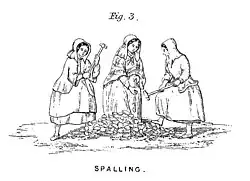
Image 1Bal maidens at work, showing traditional dress (from Culture of Cornwall)
Image 2Stargazy pie, with sardines looking skywards before it is baked in the oven
This is a list of recognized content, updated weekly by JL-Bot (talk·contribs) (typically on Saturdays). There is no need to edit the list yourself. If an article is missing from the list, make sure it is tagged(e.g. {{WikiProject Cornwall}})or categorized correctly and wait for the next update. See WP:RECOG for configuration options.