Portal:Scotland


| Main Page | Selected articles 1 | Selected articles 2 | Selected biographies | Selected quotes | Selected pictures | Featured Content | Categories & Topics |
Introduction
 |
 |
|
 | ||
Scotland (Scots: Scotland; Scottish Gaelic: Alba) is a country that is part of the United Kingdom, consisting of the northern part of the island of Great Britain and adjacent islands, principally in the archipelagos of the Hebrides and the Northern Isles. In 2022, the country's population was about 5.4 million. Its capital city is Edinburgh, whilst Glasgow is the largest and the most populous of the cities in the country. Scotland borders England to the south, the Atlantic Ocean to the north and west, the North Sea to the east, and the Irish Sea to the south-west. In the Scottish Parliament, 129 members represent 73 constituencies. The Scottish Government is the executive arm of the devolved government, headed by the first minister, who chairs the cabinet and is responsible for government policy and international engagement.
The Kingdom of Scotland emerged as a sovereign state in the 9th century. Independence from England was maintained partly through an alliance with France. In 1603, James VI succeeded to the thrones of England and Ireland, forming a personal union of the three kingdoms. On 1 May 1707, Scotland and England combined to create the new Kingdom of Great Britain, with the Parliament of Scotland subsumed into the Parliament of Great Britain. In 1999, a Scottish Parliament was re-established, and has devolved authority over many areas of domestic policy. The country has its own distinct legal system, education system and religious history, which have all contributed to the continuation of Scottish society, Scottish culture and national identity. Scottish English and Scots are the most widely spoken languages in the country, existing on a dialect continuum with each other. Scottish Gaelic speakers can be found all over Scotland, but the language is largely spoken natively by communities within the Hebrides; Gaelic speakers now constitute less than 2% of the total population, although state-sponsored revitalisation attempts have led to a growing community of second language speakers.
The mainland of Scotland is broadly divided into three regions: the Highlands, a mountainous region in the north and north-west; the Lowlands, a flatter plain across the centre of the country; and the Southern Uplands, a hilly region along the southern border. The Highlands are the most mountainous region of the British Isles and contain its highest peak, Ben Nevis, at 4,413 feet (1,345 m). The region also contains many lakes, called lochs; the term is also applied to the many saltwater inlets along the country's deeply indented western coastline. The geography of the many islands is varied. Some, such as Mull and Skye, are noted for their mountainous terrain, while Tiree and Coll are flatter.
Selected article

Cutty Sark is a British clipper ship. Built on the River Leven, Dumbarton, Scotland in 1869 for the Jock Willis Shipping Line, she was one of the last tea clippers to be built and one of the fastest, at the end of a long period of design development for this type of vessel, which ended as steamships took over their routes. She was named after the fictional witch who wore only a short shift (a "cutty sark" in the Scots language) in Robert Burns's poem Tam o' Shanter, first published in 1791. The witch Cutty Sark ran after Tam o' Shanter, who was fleeing on his horse, and caught the horse's tail at the Brig o' Doon. The name was an association between the speed of the fictional witch and that of the clipper ship.
After the big improvement in the fuel efficiency of steamships in 1866, the opening of the Suez Canal in 1869 gave them a shorter route to China, so Cutty Sark spent only a few years on the tea trade before turning to the trade in wool from Australia. Continuing improvements in steam technology early in the 1880s meant that steamships also came to dominate the longer sailing route to Australia, and the ship was sold to the Portuguese company Ferreira and Co. in 1895. She was renamed Ferreira. She continued as a cargo ship until purchased in 1922 by retired sea captain Wilfred Dowman, who used her as a training ship operating from Falmouth, Cornwall. After his death, Cutty Sark was transferred to the Thames Nautical Training College, Greenhithe, in 1938 where she became an auxiliary cadet training ship alongside HMS Worcester. By 1954, she had ceased to be useful as a cadet ship and was transferred to permanent dry dock at Greenwich, London, for public display.
Cutty Sark is listed by National Historic Ships as part of the National Historic Fleet (the nautical equivalent of a Grade I listed building). She is one of only three remaining intact composite construction (wooden hull on an iron frame) ships from the nineteenth century, the others being the clipper City of Adelaide, now in Port Adelaide, South Australia, and the warship HMS Gannet in Chatham. The beached skeleton of Ambassador, of 1869 lying near Punta Arenas, Chile is the only other significant remnant of this construction method.
The ship has been damaged by fire twice in recent years, first on 21 May 2007 while undergoing conservation. She was restored and was reopened to the public on 25 April 2012. Funders for the Cutty Sark conservation project include: the Heritage Lottery Fund, the House of Commons Digital, Culture, Media and Sport Committee, Sammy Ofer Foundation, Greenwich Council, Greater London Authority, The Stavros Niarchos Foundation, Berry Brothers & Rudd, Michael Edwards and Alisher Usmanov. (... Read the full article)
Selected quotes

" ... Some folks are wise and some are otherwise ... "
— Tobias Smollett
" ... It is the mark of a good action that it appears inevitable in restrospect ... "
— Robert Louis Stevenson
" ... Before anything else, preparation is the key to success ... "
— Alexander Graham Bell
" ... A good pun may be admitted among the smaller excellencies of lively conversation ... "
— James Boswell
" ... A rat race is for rats. We’re not rats ... "
— Jimmy Reid
" ... I believe that every Scotsman should be a Scottish Nationalist ... "
— John Buchan
" ... All political parties die at last of swallowing their own lies ... "
— Dr John Arbuthnot
" ... Where all is compulsion and enforcement, it’s the bully that rules ... "
— Neil M. Gunn
" ... There is only one word for aid that is without strings, and that word is blackmail ... "
— Colm Brogan
" ... It is unfortunate, considering that enthusiasm moves the world, that so few enthusiasts can be trusted to speak the truth ... "
— A. J. Balfour
" ... Fashion as King is sometimes a very stupid ruler ... "
— Eric Temple Bell
" ... There is nothing new to be discovered in physics now. All that remains is more and more precise measurement ... "
— Lord Kelvin, address to the British Association for the Advancement of Science, 1900
" ... No laws, however stringent, can make the idle industrious, the thriftless provident, or the drunken sober ... "
— Samuel Smiles
" ... It is a great mortification to the vanity of man, that his utmost art and industry can never equal the meanest of nature's productions, either for beauty or value ... "
— David Hume
" ... My theory is that all of Scottish cuisine is based on a dare ... "
— Mike Myers
" ... A man may well be condemned, not for doing something, but for doing nothing ... "
— William Barclay
" ... History is written from then to now but understood back to front ... "
— Allan Massie
" ... Growing old is great. It’s like getting drunk. Everyone around you gets better-looking ... "
— Billy Connolly
" ... Good lies need a leavening of truth to make them palatable ... "
— William McIlvanney
" ... Golf is a thoroughly national game; it is as Scotch as haggis, cockie-leekie, high cheek-bones or rowanberry jam ... "
— Andrew Lang
" ... Burns of all poets is the most a Man ... "
— Dante Gabriel Rossetti
" ... No great man lives in vain. The history of the world is but the biography of great men ... "
— Thomas Carlyle
" ... One can love a country until it hurts ... "
— Alexander McCall Smith
" ... I thought he was a young man of promise, but I see he was a young man of promises ... "
— A. J. Balfour
" ... Jimmy Hill is to football what King Herod was to babysitting ... "
— Tommy Docherty
" ... Maybe that's why in England you have better horses, and in Scotland we have better men ... "
— James Boswell responding to Samuel Johnson
("In England we wouldn't think of eating oats. We only feed them to horses.")
" ... Those who bring sunshine into the lives of others cannot keep it from themselves ... "
— J. M. Barrie
" ... Speech is human, silence is divine, yet also brutish and dead: therefore we must learn both arts ... "
— Thomas Carlyle
" ... Science is the greatest antidote to the poison of enthusiasm and superstition ... "
— Adam Smith
" ... William Wallace sheds as bright a glory upon his valorous nation as ever was shed upon their country by the greatest men of Greece or Rome ... "
— Giuseppe Garibaldi
" ... Books are a finer world within the world ... "
— Alexander Smith
" ... All men who have turned out worth anything have had the chief hand in their own education ... "
— Sir Walter Scott
" ... Politically correct is the language of cowardice ... "
— Billy Connolly
" ... It is never difficult to distinguish between a Scotsman with a grievance and a ray of sunshine ... "
— P. G. Wodehouse
" ... Minds are like parachutes. They only function when they are open ... "
— Sir James Dewar
" ... The world is neither Scottish, English, nor Irish, neither French, Dutch, nor Chinese, but human ... "
— Sir Alexander Gray
" ... History is the essence of innumerable biographies ... "
— Thomas Carlyle
" ... for, as long as but a hundred of us remain alive, never will we on any conditions be brought under English rule.
It is in truth not for glory, nor riches, nor honours that we are fighting, but for freedom – for that alone, which no honest man gives up but with life itself ... "
— Declaration of Arbroath
" ... Peace is that state in which fear of any kind is unknown ... "
— John Buchan
" ... There are two great days in a person's life - the day we are born and the day we discover why ... "
— William Barclay
" ... I've got a great ambition to die of exhaustion rather than boredom ... "
— Thomas Carlyle
" ... Kilt, n. - a costume sometimes worn by Scotsmen in America and Americans in Scotland ... "
— Ambrose Bierce
" ... Some of my plays peter out and some pan out ... "
— J. M. Barrie, author of Peter Pan
" ... There are two rules for drinking whisky. First, never take whisky without water, and second, never take water without whisky ... "
— Chic Murray
" ... No man is useless while he has a friend ... "
— Robert Louis Stevenson
" ... Scottish separation is part of England's imperial disintegration ... "
— John MacLean
" ... A ripple of laughter is worth an ocean of tears. To laugh is to be free of worry ... "
— Harry Gordon
" ... It has long been an axiom of mine that the little things are infinitely the most important ... "
— Sir Arthur Conan Doyle
" ... I'm not young enough to know everything ... "
— J.M.Barrie
" ... When one door closes another door opens, but we often look so long and so regretfully upon the closed door, that we do not see the ones which open for us ... "
— Alexander Graham Bell
In the news

- 3 August 2026 – 2020–2026 H5N1 outbreak
- Scotland's NatureScot denies a 2026 licence for hunting northern gannets on Sula Sgeir, citing possible harm to the local gannet population after recent bird-flu deaths. (AFP via RFI)
- 25 July 2026 –
- The Bishop of Aberdeen in Scotland declares the sedevacantist Sons of the Most Holy Redeemer religious institute, an order associated with the Society of Saint Pius X, to be excommunicated, after they consecrated a bishop without Vatican approval. (The Herald) (The Catholic Herald)
- 19 June 2026 – Terrorism in the United Kingdom
- 2026 Edinburgh attacks
- Five people are injured in Islamophobic attacks in Edinburgh, Scotland. A 36-year-old man is arrested and counter-terrorism police are investigating. (DW)
Selected biography

Charlotte Stuart, styled Duchess of Albany (29 October 1753 – 17 November 1789) was the illegitimate daughter of the Jacobite pretender Charles Edward Stuart ("Bonnie Prince Charlie" or the "Young Pretender") and his only child to survive infancy.
Charlotte's mother was Clementina Walkinshaw, who was mistress to Charles Edward from 1752 until 1760. After years of abuse, Clementina left him, taking Charlotte with her. Charlotte spent most of her life in French convents, estranged from a father who refused to make any provision for her. Unable to marry, she herself became a mistress with illegitimate children, taking Ferdinand de Rohan, Archbishop of Bordeaux, as her lover.
She was finally reconciled with her father in 1784, when he legitimised her and created her Duchess of Albany in the Jacobite peerage. She left her children with her mother, and became her father's carer and companion in the last years of his life, before dying less than two years after him. Her offspring was raised in anonymity; however, as Prince Charles Stuart's only grandchildren, they have been the subject of Jacobite interest since their lineage was uncovered in the 20th century. (... Read the full article)
Selected picture

Hill House, Helensburgh
Hill House in Helensburgh, Scotland, was created by architects and designers Charles and Margaret Macdonald Mackintosh. The house was built in a Modern Style way.
Photo credit: JeremyA
Looking south from the Quiraing, Skye
The Isle of Skye, commonly known as Skye, is the largest and most northerly island in the Inner Hebrides. In Scottish Gaelic it is commonly referred to as An t-Eilean Sgiathanach ("The Winged Isle").
Photo credit: masher2
Cells of Life, a landform by Charles Jencks at Jupiter Artland
Cells of Life, a landform by Charles Jencks at Jupiter Artland, a contemporary sculpture park and art gallery outside the city of Edinburgh.
Photo credit: Allan Pollok-Morris
The Old Man of Storr
The Old Man of Storr is a rock pinnacle, the remains of an ancient volcanic plug. It is part of The Storr, a rocky hill overlooking the Sound of Raasay on the Trotternish peninsula of the Isle of Skye.
Photo credit: Wojsy
Balmoral Castle
Balmoral Castle. Aberdeenshire a residence of the British royal family in the Scottish baronial style.
Photo credit: Ejdzej
The Room de Luxe at the Willow Tearooms
The Willow Tearooms are tearooms at 217 Sauchiehall Street, Glasgow, designed by internationally renowned architect Charles Rennie Mackintosh, which opened for business in October 1903.
Photo credit: Dave souza
The Black Watch War Memorial on the Mound in Edinburgh.
The Black Watch War Memorial, at the corner of Market Street and North Bank Street on the Mound in Edinburgh.
Photo credit: AdMeskens
Reconstructed crannóg on Loch Tay
A crannóg (pronounced /krəˈno:g/ or /ˈkrɑno:g/ or /ˈkranag/) is an ancient artificial island or natural island found in Scotland and Ireland, used for a settlement. The name may also refer to a wooden platform erected on shallow loch floors.
Photo credit: Dave Morris
Detail of the V&A museum from the west with the Tay Bridge beyond
Detail of the V&A museum, Dundee from the west with the Tay Bridge beyond.
Photo credit: Richard Szwejkowski
Lighthouse on the Bass Rock, Firth of Forth
Lighthouse on the Bass Rock, an island in the outer part of the Firth of Forth, home to the world's largest colony of northern gannets.
Photo credit: Ben Clarke
Reaper under full sail.
Reaper is a restored historic Fifie herring drifter which is registered by the National Historic Ships Committee as part of the Core Collection of historic vessels in the UK, and currently operates as a museum ship.
Photo credit: Scottish Fisheries Museum Boats Club
Inveraray Bridge on Loch Fyne
Loch Fyne (Scottish Gaelic: Loch Fìne, meaning "Loch of the Vine or Wine", is a sea loch on the west coast of Argyll and Bute. Although there is no evidence for grapes growing there, it was more metaphorical, such as meaning that the River, Abhainn Fìne, was a well-respected river.
Photo credit: Michael Parry
The Queens View, Loch Tummel
Loch Tummel (Scottish Gaelic: Loch Teimhil) is a long, narrow loch, 7 kilometres north west of Pitlochry in Perth and Kinross. A well known view over the loch and the surrounding countryside (with Schiehallion in the background) is the 'Queen's View' from the north shore, which Queen Victoria made famous in 1866.
Photo credit: Paul Hermans
Glenfinnan Viaduct
Glenfinnan Viaduct is a railway viaduct on the West Highland Line in Glenfinnan, Lochaber, Highland. It was built between 1897 and 1901. Located at the top of Loch Shiel in the West Highlands, the viaduct overlooks the Glenfinnan Monument and the waters of Loch Shiel.
Photo credit: Nicolas17
St Ninian's Isle
The tied island of St Ninian's Isle is joined to the Shetland Mainland by the largest tombolo in the UK.
Photo credit: ThoWi
Mousa Broch, Shetland Islands
A broch is an Iron Age drystone hollow-walled structure of a type found only in Scotland. Brochs belong to the classification "complex atlantic roundhouse" devised by Scottish archaeologists in the 1980s. Their origin is a matter of some controversy.
Photo credit: Otter
Statue of Greyfriars Bobby on George IV Bridge, Edinburgh
Greyfriars Bobby was a Skye Terrier who became known in 19th-century, Scotland, after reportedly spending fourteen years guarding his owner's grave, until his own death on 14 January 1872. A year after the dog died, the philanthropist Baroness Burdett Coutts, had a statue and fountain erected to commemorate him.
Photo credit: MykReeve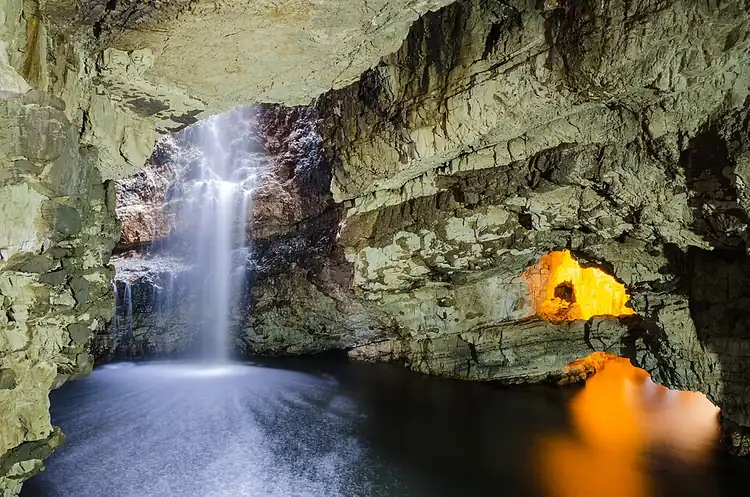
The second chamber of the Smoo Cave, Durness in Sutherland, Scotland 
Arbroath Harbour
Arbroath or Aberbrothock (Scottish Gaelic: Obair Bhrothaig) is a former royal burgh on the North Sea coast, around 16 miles (25.7 km) ENE of Dundee and 45 miles (72.4 km) SSW of Aberdeen. It is the largest town in the council area of Angus. and has a population of 22,785.
Photo credit: Karen Vernon
Glasgow Necropolis
The Glasgow Necropolis is a Victorian cemetery in Glasgow. It sits on a hill above, and to the east of, St. Mungo's Cathedral. It was conceived as a Père Lachaise for Glasgow, and subsequently established by the Merchants' House of Glasgow in 1831. Fifty thousand individuals have been buried in approximately 3500 tombs.
Photo credit: Finlay McWalter
Iona Village
Iona (Scottish Gaelic: Ì Chaluim Chille) is a small island in the Inner Hebrides off the western coast of Scotland. It was a centre of Celtic Christianity for four centuries and is today renowned for its tranquility and natural beauty. It is a popular tourist destination.
Photo credit: Clydecoast
Hopetoun House
Hopetoun House is the traditional residence of the Earl of Hopetoun (later the Marquess of Linlithgow). It was built 1699-1701, designed by William Bruce. It was then hugely extended from 1721 by William Adam until his death in 1748 being one of his most notable projects. The parklands in which it lies were laid out in 1725, also by William Adam.
Photo credit: George Gastin


Did You Know...

- ... that Thorpe's secluded hills provided refuge from Scottish raiders and English Civil War troops?
- ... that Thomas Kerr protested the Iraq War with his SNP-supporting aunt, later campaigned for Labour, joined the Conservatives, and defected to Reform UK?
- ... that local folklore links Boghead, a Northumbrian bastle house, to the story of Barty Milburn, an accomplished swordsman and killer of Scots?
- ... that John Neilson, a Scottish immigrant to Lower Canada, became a major publisher and bookseller, and was reportedly "the largest consumer of paper" in the country?
- ... that the Scottish painter Carole Gibbons had her first US exhibition in her eighties?
- ... that Prince Philip was the first member of the British royal family to fly in a helicopter?
- ... that the 2024 Hillhead by-election was the first by-election won by the Scottish Green Party?
- ... that the Scottish invasion of England in 1648 was defeated by an army less than half their size?
Get involved
| ||||||||||||||||||||||||||||||


For editor resources and to collaborate with other editors on improving Wikipedia's Scotland-related articles, see WikiProject Scotland.
To get involved in helping to improve Wikipedia's Scotland related content, please consider doing some of the following tasks or joining one or more of the associated Wikiprojects:
- Visit the Scottish Wikipedians' notice board and help to write new Scotland-related articles, and expand and improve existing ones.
- Visit Wikipedia:WikiProject Scotland/Assessment, and help out by assessing unrated Scottish articles.
- Add the Project Banner to Scottish articles around Wikipedia.
- Participate in WikiProject Scotland's Peer Review, including responding to PR requests and nominating Scottish articles.
- Help nominate and select new content for the Scotland portal.
Do you have a question about The Scotland Portal that you can't find the answer to?
Post a question on the Talk Page or consider asking it at the Wikipedia reference desk.
Related portals



Other language versions
Associated Wikimedia
The following Wikimedia Foundation sister projects provide more on this subject:
-
 Commons
Free media repository -
 Wikidata
Free knowledge base -
 Wikiquote
Collection of quotations -
 Wikisource
Free-content library -
 Wikispecies
Directory of species -
 Wikiversity
Free learning tools -
 Wikivoyage
Free travel guide -
 Wiktionary
Dictionary and thesaurus
-
 List of all portals
-

-

-

-

-

-

-

-

-

-
 Random portal
-
 WikiProject Portals