2009 Portuguese legislative election
 | ||||||||||||||||||||||||||||||||||||||||||||||||||||||||||||||||||||||||||||||||||||||||||||
27 September 2009
| ||||||||||||||||||||||||||||||||||||||||||||||||||||||||||||||||||||||||||||||||||||||||||||
All 230 seats in the Assembly of the Republic 116 seats needed for a majority | ||||||||||||||||||||||||||||||||||||||||||||||||||||||||||||||||||||||||||||||||||||||||||||
|---|---|---|---|---|---|---|---|---|---|---|---|---|---|---|---|---|---|---|---|---|---|---|---|---|---|---|---|---|---|---|---|---|---|---|---|---|---|---|---|---|---|---|---|---|---|---|---|---|---|---|---|---|---|---|---|---|---|---|---|---|---|---|---|---|---|---|---|---|---|---|---|---|---|---|---|---|---|---|---|---|---|---|---|---|---|---|---|---|---|---|---|---|
| Opinion polls | ||||||||||||||||||||||||||||||||||||||||||||||||||||||||||||||||||||||||||||||||||||||||||||
| Registered | 9,519,921  6.4% | |||||||||||||||||||||||||||||||||||||||||||||||||||||||||||||||||||||||||||||||||||||||||||
| Turnout | 5,681,258 (59.7%) 4.6 pp | |||||||||||||||||||||||||||||||||||||||||||||||||||||||||||||||||||||||||||||||||||||||||||
| ||||||||||||||||||||||||||||||||||||||||||||||||||||||||||||||||||||||||||||||||||||||||||||


| ||||||||||||||||||||||||||||||||||||||||||||||||||||||||||||||||||||||||||||||||||||||||||||
| ||||||||||||||||||||||||||||||||||||||||||||||||||||||||||||||||||||||||||||||||||||||||||||


The 2009 Portuguese legislative election was held on 27 September, to renew all 230 members of the Assembly of the Republic.[1] The election took place during the regular term of the previous four-year legislative period, following four years under a majority government of the Socialist Party (PS). A total of 13 parties and two coalitions competed in this election.
For the first, and so far only, time in legislative elections in Portugal, one of the candidates from the two main parties for the position of prime minister was a woman.[2] The Socialist Party, led by then-prime minister José Sócrates, won the largest number of votes and seats, but failed to repeat the overall majority it obtained in 2005.[3] Despite polling first at 36.6%, the Socialists lost 8 percent of the vote and 24 seats, but still maintained a clear advantage over the conservative Social Democrats, which remained stable at 29%, while the CDS – People's Party and the Left Bloc made strong gains.
Neither of the two major parties won an absolute majority in the Assembly of the Republic, so, the next prime minister had to form a coalition or rely on other parties to govern. In this case, José Sócrates was in a better position than Manuela Ferreira Leite, since the Portuguese left won with 54.23 percent of the votes and 128 seats, compared to 39.54 percent and 102 deputies for the right.
On 12 October, José Sócrates was invited by President Aníbal Cavaco Silva to form government. The new cabinet was announced on 22 October and sworn in on 26 October. Voter turnout was one of the lowest in Portuguese election history, as 59.7 percent of the electorate cast a ballot.
Background
In the February 2005 early election, the Socialists, under the leadership of José Sócrates, won 45 percent of the votes and 121 MPs, the first time ever the Socialists won an absolute majority,[4] whereas the PSD suffered a heavy defeat, achieving their worst results since 1983,[4] and faced with this failure, the then PSD leader and outgoing Prime Minister, Pedro Santana Lopes, resigned from the leadership.[5]
During the first months in his government, Sócrates raised taxes to reduce the deficit and initiated a policy of strict fiscal control.[6] At the same time, he faced a very harsh summer with severe wildfires across the country.[7] That same October, the Socialists suffered a heavy defeat in the 2005 local elections, winning just 108 cities, a drop of four, against the PSD's 158 mayoral holds, with the party unable to regain control of Lisbon and Porto.[8] In January 2006, a new president was elected, with Aníbal Cavaco Silva, prime pinister between 1985 and 1995, becoming the first center-right candidate to win a presidential election, although only just.[9] The PS candidate, former prime minister and president Mário Soares, polled a disappointing third place with just 14% of the votes.[10] In 2007, a referendum for the legalization of abortion was held. After the failure of the 1998 referendum, the Yes side prevailed winning 59 percent of the votes against the No's 41 percent, making abortion legal in Portugal.[11]
While the deficit reduction had been successful, and with the economy growing around 2 percent of GDP by 2007,[12] the government faced heavy opposition for its policies, particularly from teachers unions.[13] In March 2008, more than 100,000 teachers protested in Lisbon against Sócrates and his Education minister, Maria de Lurdes Rodrigues.[14]
José Sócrates four-year term was also marred by a series of corruption and sleaze accusations against the Prime Minister himself, with the two main cases being the Independent affair and the Freeport affair.[15] In the first, Sócrates was accused of obtaining his degree in engineering by irregular means from the Independente University, with this case, plus further irregularities, leading to the closure of the university.[16][17] Several years later, the Public Prosecution office ruled that Sócrates indeed obtained his degree illegally.[18] In the second case, the Freeport affair, Sócrates was accused, as environment minister (1999–2002), of allegedly ignoring environmental restrictions, due to interventions from members of his own family, in order to allow the construction of a shopping mall in Alcochete by the British company Freeport.[19] Regarding this case, the end of a primetime evening news show on TVI network, anchored by Manuela Moura Guedes, also led to accusations of pressure from Sócrates and the PS to end the evening news show, as it had several reports on the Freeport affair and an unfavourable coverage towards the Prime Minister.[20] The Freeport affair was ultimately closed due to lack of evidence.[21]
Entering 2009, Portugal was strongly affected by the 2008 financial crisis and entered in a recession,[22] alongside the government facing problems in the banking sector, with the collapse of BPP and the bailout and nationalization of BPN, a bank with figures close to President Cavaco Silva.[23][24] As a result, the government adopted stimulus measures that worsened public finances, increasing the deficit and the national debt.[25] In the european elections of June 2009, the PSD defied expectations by winning an european election for the first time since 1989, with 31.7 percent of the votes, while the Socialists suffered a huge defeat, obtaining just 26.5 percent of the votes, a drop of 18 points.[26]
Leadership changes and challenges
Social Democratic Party
Following Santana Lopes exit from the leadership, in the party's congress in April 2005,[5] Luís Marques Mendes became party leader winning 56 percent of the delegates, against the 44 percent of his rival, Luís Filipe Menezes.[27] The results were the following:
| Candidate | Votes | % | |
|---|---|---|---|
| Luís Marques Mendes | 497 | 56.6 | |
| Luís Filipe Menezes | 381 | 43.4 | |
| Turnout | 878 | ||
| Source:[27] | |||
By 2007, party leader Luís Marques Mendes was being very criticized for his opposition strategy and was left further weakened after the party's disappointing result in the 2007 Lisbon mayoral by-election, where the PSD polled 3rd with less than 16 percent of the votes.[28] Marques Mendes called a snap leadership election and was challenged by his rival in the 2005 PSD congress, Luís Filipe Menezes.[29] Menezes easily defeated Marques Mendes. The results were the following:
| Candidate | Votes | % | |
|---|---|---|---|
| Luís Filipe Menezes | 21,101 | 53.6 | |
| Luís Marques Mendes | 16,973 | 43.1 | |
| Blank/Invalid ballots | 1,279 | 3.3 | |
| Turnout | 39,353 | 62.42 | |
| Source:[30] | |||
By the spring of 2008, PSD leader, Luís Filipe Menezes, who had been elected in September 2007, resigned after just 6 months in the job.[31] In the following leadership election, held in May 2008, Manuela Ferreira Leite became the first woman to lead a major party in Portugal,[32] winning 38 percent of the votes, against the 31 percent of Pedro Passos Coelho and the 30 percent of Pedro Santana Lopes.[33] The results were the following:
| Candidate | Votes | % | |
|---|---|---|---|
| Manuela Ferreira Leite | 17,278 | 37.9 | |
| Pedro Passos Coelho | 14,160 | 31.1 | |
| Pedro Santana Lopes | 13,495 | 29.6 | |
| Patinha Antão | 308 | 0.7 | |
| Blank/Invalid ballots | 351 | 0.8 | |
| Turnout | 45,592 | 59.13 | |
| Source:[30] | |||
CDS – People's Party
Party leader Paulo Portas resigned from the leadership following the disappointing result of the party in the 2005 elections, saying that "in no civilized country in the world, the difference between Trotskyists and Christian Democrats is one percent", referring to the result of the BE.[34] A snap leadership congress was called to elect a new leader. Two candidates were in the ballot:[35] Telmo Correia, the preferred candidate of Paulo Portas, and José Ribeiro e Castro, more critical of Portas. Ribeiro e Castro was easily elected[36] and the results were the following:
| Candidate | Votes | % | |
|---|---|---|---|
| José Ribeiro e Castro | 492 | 56.0 | |
| Telmo Correia | 387 | 44.0 | |
| Turnout | 879 | ||
| Source:[37] | |||
In April 2007, former CDS–PP leader Paulo Portas challenged the then party leader, José Ribeiro e Castro, for the leadership and was elected for his former job by a landslide.[38] The results were the following:
| Candidate | Votes | % | |
|---|---|---|---|
| Paulo Portas | 5,642 | 74.6 | |
| José Ribeiro e Castro | 1,883 | 24.9 | |
| Blank/Invalid ballots | 38 | 0.5 | |
| Turnout | 7,563 | ||
| Source:[38] | |||
Electoral system

Official logo of the election.

Ballot for the district of Setúbal.
The Assembly of the Republic has 230 members elected to four-year terms. Governments do not require absolute majority support of the Assembly to hold office, as even if the number of opposers of government is larger than that of the supporters, the number of opposers still needs to be equal or greater than 116 (absolute majority) for both the Government's Programme to be rejected or for a motion of no confidence to be approved.[39]
The number of seats assigned to each district depends on the district magnitude.[40] The use of the d'Hondt method makes for a higher effective threshold than certain other allocation methods such as the Hare quota or Sainte-Laguë method, which are more generous to small parties.[41] Changes to the electoral registration system, approved in 2008, which made registration automatic based on each voter's Identity card, led to a significant increase in the number of registered voters, from 8,9 million in 2005 to 9,5 million in 2009.[42]
For these elections, and compared with the 2005 elections, the MPs distributed by districts were the following:[43]
| District | Number of MPs | Map |
|---|---|---|
| Lisbon(–1) | 47 | 
19
6
39
5
3
16
9
4
10
4
10
10
47
2
3
17
3
8
6
5
2
2
|
| Porto(+1) | 39 | |
| Braga(+1) | 19 | |
| Setúbal | 17 | |
| Aveiro(+1) | 16 | |
| Leiria, Santarém and Coimbra | 10 | |
| Viseu | 9 | |
| Faro | 8 | |
| Madeira and Viana do Castelo | 6 | |
| Azores and Vila Real | 5 | |
| Castelo Branco(–1) and Guarda | 4 | |
| Beja, Bragança(–1) and Évora | 3 | |
| Portalegre, Europe and Outside Europe | 2 |
Parties
Once more, the possibility of a joint PSD/CDS–PP coalition was touched upon, but it was quickly rejected by the Social Democrats (PSD).[44] The table below lists the parties represented in the Assembly of the Republic during the 10th legislature (2005–2009) and that also partook in the election:
| Name | Ideology | Political position | Leader | 2005 result | Seats at dissolution[45] | |||
|---|---|---|---|---|---|---|---|---|
| % | Seats | |||||||
| PS | Socialist Party Partido Socialista |
Social democracy Third Way |
Centre-left to Centre | José Sócrates | 45.0% | 121 / 230 |
121 / 230 | |
| PPD/PSD | Social Democratic Party Partido Social Democrata |
Conservatism Classical liberalism |
Centre-right | Manuela Ferreira Leite | 28.8% | 75 / 230 |
75 / 230 | |
| PCP | Portuguese Communist Party Partido Comunista Português |
Communism Marxism–Leninism |
Far-left | Jerónimo de Sousa | 7.5% [a] |
12 / 230 |
11 / 230 | |
| PEV | Ecologist Party "The Greens" Partido Ecologista "Os Verdes" |
Eco-socialism Green politics |
Left-wing | Heloísa Apolónia | 2 / 230 |
2 / 230 | ||
| CDS–PP | CDS – People's Party Centro Democrático e Social - Partido Popular |
Christian democracy Conservatism |
Centre-right to right-wing |
Paulo Portas | 7.2% | 12 / 230 |
11 / 230 | |
| BE | Left Bloc Bloco de Esquerda |
Democratic socialism Anti-capitalism |
Left-wing | Francisco Louçã | 6.4% | 8 / 230 |
8 / 230 | |
| Ind. | Independent Independente |
Luísa Mesquita (expelled from the Portuguese Communist Party caucus);[46] José Paulo Carvalho (left the CDS – People's Party caucus)[47] |
2 / 230 | |||||
Seat changes
- On 24 October 2007, the Portuguese Communist Party removed their confidence in MP Luísa Mesquita, and one month later, she was expelled from the party. The party had asked her to leave her seat in 2006, something she refused, and a rift between her and the party's central committee was created. She decided to remain as an Independent MP.[46]
- On 17 December 2008, CDS – People's Party MP José Paulo Carvalho announced he was leaving the party, citing "lack of strategy" in the party and an "abdication of the party's fundamental ideas and values". He remained in Parliament as an Independent MP.[47]
Campaign period
Issues
The campaign focused on the impact of the 2008 financial crisis, the construction of new infrastructure projects, including the Lisbon-Madrid and Lisbon-Porto-Vigo high-speed rail links, as well as the new Lisbon airport, and accusations of "democratic asphyxiation" by the opposition against the PS government, ranging from concentration of power to interference in the media.[48][49] During the campaign, an alleged wiretapping case also broke, in which advisors to President Aníbal Cavaco Silva suspected that they were being monitored by the government.[50] Opinion polls conducted at the start of the official election campaign period, on 12 September 2009, showed a too close to call race between the Socialists and the conservative Social Democrats,[51] but a few days before the election, the Socialists increased their lead over the Social Democrats.[52]
Party slogans
| Party or alliance | Original slogan | English translation | Refs | |
|---|---|---|---|---|
| PS | « Avançar Portugal » | "Go forward Portugal" | [53] | |
| PSD | « Compromisso de verdade » | "Real commitment" | [54] | |
| CDU | « Soluções para uma vida melhor » | "Solutions for a better life" | [55] | |
| CDS–PP | « Não basta pensar. É preciso votar. » | "Thinking is not enough. You need to vote." | [56] | |
| BE | « Estamos prontos » | "We are ready" | [57] | |
Candidates' debates
| 2009 Portuguese legislative election debates | |||||||||||||||||||||
|---|---|---|---|---|---|---|---|---|---|---|---|---|---|---|---|---|---|---|---|---|---|
| Date | Organisers | Moderator(s) | P Present A Absent invitee N Non-invitee | ||||||||||||||||||
| PS Sócrates |
PSD Leite |
CDU Jerónimo |
CDS–PP Portas |
BE Louçã |
Refs | ||||||||||||||||
| 2 Sep | TVI | Constança Cunha e Sá | P | N | N | P | N | [58] | |||||||||||||
| 3 Sep | SIC | Clara de Sousa | N | N | P | N | P | [58] | |||||||||||||
| 5 Sep | RTP1 | Júdite de Sousa | P | N | P | N | N | [58] | |||||||||||||
| 6 Sep | TVI | Constança Cunha e Sá | N | P | N | N | P | [58] | |||||||||||||
| 7 Sep | SIC | Clara de Sousa | N | N | P | P | N | [58] | |||||||||||||
| 8 Sep | RTP1 | Júdite de Sousa | P | N | N | N | P | [58] | |||||||||||||
| 9 Sep | TVI | Constança Cunha e Sá | N | P | P | N | N | [58] | |||||||||||||
| 10 May | RTP1 | Júdite de Sousa | N | P | N | P | N | [58] | |||||||||||||
| 11 Sep | RTP1 | Júdite de Sousa | N | N | N | P | P | [58] | |||||||||||||
| 12 Sep | SIC | Clara de Sousa | P | P | N | N | N | [58] | |||||||||||||
| Candidate viewed as "most convincing" in each debate | |||||||||||||||||||||
| Date | Organisers | Polling firm/Link | |||||||||||||||||||
| PS | PSD | CDU | CDS–PP | BE | Notes | ||||||||||||||||
| 12 Sep | SIC | Aximage | 45.6 | 30.2 | N/a | N/a | N/a | 24.2% Neither/Tie | |||||||||||||
Opinion polling
View source data.
Voter turnout
The table below shows voter turnout throughout election day including voters from Overseas.
| Turnout | Time | ||||||||
|---|---|---|---|---|---|---|---|---|---|
| 12:00 | 16:00 | 19:00 | |||||||
| 2005 | 2009 | ± | 2005 | 2009 | ± | 2005 | 2009 | ± | |
| Total | 21.93% | 21.29% | 0.64 pp |
50.94% | 43.30% | 7.64 pp |
64.26% | 59.68% | 4.58 pp |
| Sources[59][60][61][62] | |||||||||
Results
National summary
 | ||||||
|---|---|---|---|---|---|---|
| Party | Votes | % | +/– | Seats | +/– | |
| Socialist Party | 2,077,238 | 36.56 | –8.47 | 97 | –24 | |
| Social Democratic Party | 1,653,665 | 29.11 | +0.34 | 81 | +10 | |
| CDS – People's Party | 592,778 | 10.43 | +3.19 | 21 | +9 | |
| Left Bloc | 557,306 | 9.81 | +3.46 | 16 | +8 | |
| Unitary Democratic Coalition[b] | 446,279 | 7.86 | +0.32 | 15 | +1 | |
| Portuguese Workers' Communist Party | 52,761 | 0.93 | +0.09 | 0 | 0 | |
| Hope for Portugal Movement | 25,949 | 0.46 | New | 0 | New | |
| New Democracy Party | 21,876 | 0.39 | –0.31 | 0 | 0 | |
| Merit and Society Movement | 16,924 | 0.30 | New | 0 | New | |
| People's Monarchist Party[c] | 15,262 | 0.27 | — | 0 | –2 | |
| Ecology and Humanism Front (MPT–PH)[d] | 12,405 | 0.22 | –0.08 | 0 | 0 | |
| National Renovator Party | 11,503 | 0.20 | +0.04 | 0 | 0 | |
| Portugal Pro-Life Party | 8,461 | 0.15 | New | 0 | New | |
| Portuguese Labour Party | 4,974 | 0.09 | New | 0 | New | |
| Workers' Party of Socialist Unity | 4,632 | 0.08 | –0.02 | 0 | 0 | |
| Earth Party[e][c] | 3,265 | 0.06 | — | 0 | –2 | |
| Total | 5,505,278 | 100.00 | – | 230 | 0 | |
| Valid votes | 5,505,278 | 96.90 | –0.16 | |||
| Invalid votes | 76,894 | 1.35 | +0.21 | |||
| Blank votes | 99,086 | 1.74 | –0.06 | |||
| Total votes | 5,681,258 | 100.00 | – | |||
| Registered voters/turnout | 9,519,921 | 59.68 | –4.58 | |||
| Source: Comissão Nacional de Eleições[63] | ||||||
Distribution by constituency
| Constituency | % | S | % | S | % | S | % | S | % | S | Total S |
|---|---|---|---|---|---|---|---|---|---|---|---|
| PS | PSD | CDS–PP | BE | CDU | |||||||
| Azores | 39.7 | 3 | 35.7 | 2 | 10.3 | - | 7.3 | - | 2.2 | - | 5 |
| Aveiro | 33.8 | 6 | 34.6 | 7 | 13.0 | 2 | 9.0 | 1 | 3.8 | - | 16 |
| Beja | 34.9 | 2 | 14.6 | - | 5.7 | - | 10.0 | - | 29.1 | 1 | 3 |
| Braga | 41.7 | 9 | 30.8 | 6 | 9.7 | 2 | 7.8 | 1 | 4.6 | 1 | 19 |
| Bragança | 33.0 | 1 | 40.6 | 2 | 12.6 | - | 6.2 | - | 2.4 | - | 3 |
| Castelo Branco | 41.0 | 2 | 29.8 | 2 | 8.4 | - | 9.1 | - | 5.1 | - | 4 |
| Coimbra | 38.0 | 4 | 30.6 | 4 | 8.8 | 1 | 10.8 | 1 | 5.7 | - | 10 |
| Évora | 35.0 | 1 | 19.0 | 1 | 6.4 | - | 11.1 | - | 22.3 | 1 | 3 |
| Faro | 31.9 | 3 | 26.2 | 3 | 10.7 | 1 | 15.3 | 1 | 7.8 | - | 8 |
| Guarda | 36.0 | 2 | 35.6 | 2 | 11.2 | - | 7.6 | - | 3.3 | - | 4 |
| Leiria | 30.1 | 4 | 34.9 | 4 | 12.6 | 1 | 9.5 | 1 | 5.1 | - | 10 |
| Lisbon | 36.4 | 19 | 25.1 | 13 | 11.0 | 5 | 10.8 | 5 | 9.9 | 5 | 47 |
| Madeira | 19.4 | 1 | 48.1 | 4 | 11.1 | 1 | 6.2 | - | 4.2 | - | 6 |
| Portalegre | 38.3 | 1 | 23.8 | 1 | 8.0 | - | 10.8 | - | 12.9 | - | 2 |
| Porto | 41.8 | 18 | 29.2 | 12 | 9.3 | 4 | 9.2 | 3 | 5.7 | 2 | 39 |
| Santarém | 33.7 | 4 | 27.0 | 3 | 11.2 | 1 | 11.8 | 1 | 9.2 | 1 | 10 |
| Setúbal | 34.0 | 7 | 16.4 | 3 | 9.1 | 1 | 14.0 | 2 | 20.1 | 4 | 17 |
| Viana do Castelo | 36.3 | 3 | 31.3 | 2 | 13.6 | 1 | 8.6 | - | 4.2 | - | 6 |
| Vila Real | 36.1 | 2 | 41.1 | 3 | 10.1 | - | 5.5 | - | 2.9 | - | 5 |
| Viseu | 34.7 | 4 | 37.5 | 4 | 13.4 | 1 | 6.5 | - | 2.9 | - | 9 |
| Europe | 43.3 | 1 | 23.8 | 1 | 4.7 | - | 4.7 | - | 4.4 | - | 2 |
| Outside Europe | 22.0 | - | 54.5 | 2 | 3.2 | - | 2.0 | - | 1.0 | - | 2 |
| Total | 36.6 | 97 | 29.1 | 81 | 10.4 | 21 | 9.8 | 16 | 7.9 | 15 | 230 |
| Source: Comissão Nacional de Eleições[63] | |||||||||||
Maps
- Winner and seats by constituency.
 Most voted political force by municipality.
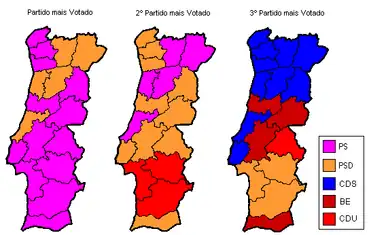 First, second and third most voted political force by district.
 Most voted political force by district or autonomous region.
Aftermath
Fall of the government
By 2010, Portugal was facing a big economic crisis and the Government was forced to implement austerity measures.[64] Plus, Sócrates himself was also involved in a new corruption investigation, Face Oculta,[65] although no accusation was made.[66] Despite the government's announcement of more fiscal restraint policies in order to control public spending, the economy entered in a recession and protests against the government policies began.[67] On 12 March 2011, protests against the Government's austerity measures drew up to 280,000 people just in the streets of Lisbon and Porto alone.[68] By March 2011, the PS Government had presented three Stability and Growth Programs (PECs) and all failed in controlling spending and convincing markets.[69] A forth one, PEC IV, was put for a vote in Parliament on 23 March 2011 but it was rejected by all Opposition parties and only supported by the Socialists.
| 2011 PEC IV José Sócrates (PS) | |||
| Ballot → | 23 March 2011 | ||
|---|---|---|---|
| Required majority → | Simple | ||
Yes
|
97 / 230 | ||
132 / 230 | |||
| Abstentions | 0 / 230 | ||
Absentees
|
1 / 230 | ||
| Result → | Rejected  | ||
| Sources[70][71] | |||
Before the vote, Prime Minister José Sócrates threatened to resign if the PEC failed to pass. After the result of the vote was announced, Sócrates tendered his resignation to President Aníbal Cavaco Silva.[72] A snap legislative election was then called for 5 June 2011.[73]
See also
Notes
- ↑ The Portuguese Communist Party (PCP) and the Ecologist Party "The Greens" (PEV) contested the 2005 election in a coalition called Unitary Democratic Coalition (CDU) and won a combined 7.5% of the vote and elected 14 MPs to parliament.
- ↑ Portuguese Communist Party (13 MPs) and "The Greens" (2 MPs).
- 1 2 Elected in 2005 in the Social Democratic Party electoral lists.
- ↑ Earth Party / Humanist Party joint electoral list only in continental Portugal.
- ↑ Earth Party electoral list only in Madeira and Azores.
References
- ↑ Cavaco Silva marca eleições legislativas para 27 Setembro, Antena 1, 27 August 2009, retrieved 10 October 2022.
- ↑ Política "no feminino" entra em força na campanha da mulher candidata a primeira-ministra, RTP, 16 September 2009, retrieved 12 August 2026.
- ↑ PS vence com 36,56 por cento, mais 7,47 por cento que o PSD, TSF Radio, 28 September 2009, retrieved 10 October 2022.
- 1 2 "PS conquista primeira maioria absoluta da sua história". Público (in Portuguese). 21 February 2005. Retrieved 13 August 2026.
- 1 2 "Santana abandona liderança do PSD, apesar de não se sentir obrigado". Público (in Portuguese). 23 February 2005. Retrieved 13 August 2026.
- ↑ "Sócrates justifica austeridade por faltarem 5,5 mil milhões de euros". RTP (in Portuguese). 25 May 2005. Retrieved 13 August 2026.
- ↑ Incêndios em 2005 devastaram mais de 325 mil hectares, RTP, 30 January 2006, retrieved 10 October 2022.
- ↑ "Sócrates derrotado, socialistas em minoria". Público (in Portuguese). 10 October 2005. Retrieved 13 August 2026.
- ↑ "Cavaco Silva vence à primeira volta e deixa a esquerda destroçada". Público (in Portuguese). 23 January 2006. Retrieved 13 August 2026.
- ↑ "Mário Soares assumiu derrota com "fair play", mas omitiu Manuel Alegre". Público (in Portuguese). 23 January 2006. Retrieved 13 August 2026.
- ↑ "Catholic Portugal votes to allow abortion in early pregnancy", The Guardian, 12 February 2007, retrieved 7 December 2017.
- ↑ "Economia cresceu em 2007 ao ritmo mais elevado dos últimos seis anos". Público (in Portuguese). 14 February 2008. Retrieved 13 August 2026.
- ↑ Professores "recebem" Sócrates com um protesto, TSF, 8 October 2006, retrieved 13 August 2024.
- ↑ 100 mil professores na rua, Expresso, 8 March 2008, retrieved 10 October 2022.
- ↑ "Freeport e licenciatura entre os assuntos que envolveram o nome de Sócrates", Jornal de Notícias, 22 November 2014, retrieved 13 August 2026.
- ↑ "Polémica com a Licenciatura de Sócrates", Rádio e Televisão de Portugal, 5 April 2007, retrieved 13 September 2024.
- ↑ "Mariano Gago fecha definitivamente Universidade Independente", Expresso, 3 August 2007, retrieved 13 September 2024.
- ↑ "MP diz que licenciatura de Sócrates é ilegal mas não tenta invalidar diploma", Público, 16 December 2015, retrieved 13 September 2024.
- ↑ "Caso Freeport", Rádio e Televisão de Portugal, 22 January 2009, retrieved 13 September 2024.
- ↑ "Sócrates nega mão do PS no fim do Jornal de Sexta", Rádio e Televisão de Portugal, 4 September 2009, retrieved 13 September 2024
- ↑ "Caso Freeport arquivado por falta de provas", SIC Notícias, 9 October 2012, retrieved 13 September 2024.
- ↑ "Sócrates admite recessão e vai alterar previsões para crescimento e desemprego", Público, 6 January 2009, retrieved 13 August 2026.
- ↑ "Há 15 anos BPN e BPP foram as vítimas da crise financeira em Portugal", Expresso, 2 March 2016, retrieved 26 July 2026.
- ↑ "O cavaquismo e o lado negro da força", Observador, 16 September 2013, retrieved 26 July 2026.
- ↑ "Sócrates argumenta que défice disparou por "boa razão"", Rádio e Televisão de Portugal, 1 February 2010, retrieved 13 August 2026.
- ↑ "PSD não ganhava europeias há 20 anos", Expresso, 7 June 2009, retrieved 13 August 2026.
- 1 2 Luís Marques Mendes é o novo líder do PSD, RTP, 11 April 2005, retrieved 7 December 2017.
- ↑ "Mau resultado em Lisboa é culpa de Marques Mendes, acusa Mendes Bota", RTP, 16 July 2007, retrieved 11 November 2021.
- ↑ "PSD: Marques Mendes está disponível para debates", MaisFutebol, 6 August 2007, retrieved 11 November 2021.
- 1 2 Congressos e Eleições Diretas PPD/PSD, Social Democratic Party, retrieved 10 October 2022
- ↑ Luís Filipe Menezes demite-se de presidente do PSD, Jornal de Negócios, 17 April 2008, retrieved 7 December 2017.
- ↑ «Dama de ferro», a primeira mulher a liderar o PSD, TVI, 1 June 2008, retrieved 13 August 2026.
- ↑ Manuela Ferreira Leite venceu eleições no PSD, RTP, 1 June 2008, retrieved 7 December 2017.
- ↑ "Paulo Portas deixa liderança do CDS no rescaldo da noite eleitoral", TVI24, 21 February 2005. Retrieved 21 November 2021.
- ↑ "CDS partido ao meio", Correio da Manhã, 24 April 2005. Retrieved 21 November 2021.
- ↑ "Ribeiro e Castro é o novo presidente do CDS-PP", TVI24, 25 April 2005. Retrieved 21 November 2021.
- ↑ Ribeiro e Castro ganha Congresso, Correio da Manhã, 25 April 2005, retrieved 10 October 2022.
- 1 2 "Paulo Portas vence directas com 74,6 por cento", RTP, 22 April 2007, retrieved 11 November 2021.
- ↑ "Constitution of the Portuguese Republic" (PDF). Archived from the original (PDF) on 3 March 2016. Retrieved 29 December 2019.
- ↑ "Effective threshold in electoral systems". Trinity College, Dublin. Retrieved 21 October 2015.
- ↑ Gallaher, Michael (1992). "Comparing Proportional Representation Electoral Systems: Quotas, Thresholds, Paradoxes and Majorities"
- ↑ "Eles nunca foram eleitores e gostavam de assim ter continuado". Público. 4 June 2009. Retrieved 14 July 2026.
- ↑ "Mapa Oficial n.º 2/2009" (PDF). CNE - Comissão Nacional de Eleições - DR, 1.ª Série, n.º 147, de 31 de Julho de 2009. Retrieved 2 December 2020.
- ↑ "PSD rejeita coligações eleitorais com o CDS-PP". Jornal de Notícias. 19 January 2009. Retrieved 26 July 2026.
- ↑ Assembleia da República - Composição dos Grupos Parlamentares/Partidos, Assembly of the Republic, retrieved 10 October 2022
- 1 2 Deputada Luísa Mesquita expulsa do PCP , Público, 27 November 2007. Retrieved 2 December 2020.
- 1 2 Deputado sai do CDS-PP, mas fica na Assembleia da República como não inscrito , Público, 17 December 2008. Retrieved 2 December 2020.
- ↑ Os temas que dominaram a campanha do PS foram praticamente os mesmos que tomaram conta da campanha do PSD, RTP, 25 September 2009. Retrieved 2 December 2020.
- ↑ Ferreira Leite acusa Sócrates de "asfixia democrática", RTP, 21 August 2009. Retrieved 2 December 2020.
- ↑ Cronologia do caso das escutas, Público, 30 September 2009. Retrieved 2 December 2020.
- ↑ PS e PSD separados por dois pontos nas sondagens, Público, 11 September 2009, retrieved 10 October 2022.
- ↑ PS com vantagem de 8 pontos percentuais sobre o PSD, Rádio e Televisão de Portugal, 24 September 2009, retrieved 10 October 2022.
- ↑ "ELEIÇÕES LEGISLATIVAS DE 2009 – PS". EPHEMERA (in Portuguese). Retrieved 11 May 2020.
- ↑ "PSD – ELEIÇÕES LEGISLATIVAS DE 2009 – DISTRITOS". EPHEMERA (in Portuguese). Retrieved 11 May 2020.
- ↑ "CDU – ELEIÇÕES LEGISLATIVAS DE 2009". EPHEMERA (in Portuguese). Retrieved 11 May 2020.
- ↑ "CDS – PP – ELEIÇÕES LEGISLATIVAS DE 2009". EPHEMERA (in Portuguese). Retrieved 11 May 2020.
- ↑ "Legislativas 2009: uma retrospectiva da campanha do Bloco de Esquerda". BE (in Portuguese). Retrieved 11 May 2020.
- 1 2 3 4 5 6 7 8 9 10 "Televisões e partidos acertam debates". RTP (in Portuguese). 29 August 2009. Retrieved 11 May 2020.
- ↑ "Legislativas 2009 - Afluência". eleicoes.mai.gov.pt/legislativas2009/index.html (in Portuguese). Ministry of Internal Administration. Retrieved 8 June 2023.
- ↑ "Afluência às urnas era de 43,3% até às 16h". Jornal de Negócios (in Portuguese). 27 September 2009. Retrieved 8 June 2023.
- ↑ "Dois milhões de eleitores votaram até ao meio-dia". Jornal de Notícias (in Portuguese). 27 September 2009. Retrieved 8 June 2023.
- ↑ "Mais de metade dos eleitores votaram até às 16.00". Diário de Notícias (in Portuguese). 20 February 2005. Retrieved 8 June 2023.
- 1 2 Diário da República Mapa Oficial (PDF), Comissão Nacional de Eleições, retrieved 10 October 2022
- ↑ "Sócrates: medidas de austeridade só foram tomadas porque não restava qualquer outra alternativa". Público (in Portuguese). Lisbon. 29 September 2010. Retrieved 25 June 2023.
- ↑ "Face Oculta: Sócrates classifica notícias como "jornalismo de buraco de fechadura"". RTP. 6 February 2010. Retrieved 13 September 2024.
- ↑ "Despacho do PGR". RTP. 19 February 2010. Retrieved 13 September 2024.
- ↑ "Austeridade gera recessão e obriga a medidas adicionais de mil milhões". Público (in Portuguese). Lisbon. 27 December 2010. Retrieved 25 June 2023.
- ↑ "Protesto Geração à Rasca juntou entre 160 e 280 mil pessoas só em Lisboa e Porto". Público (in Portuguese). Lisbon. 12 March 2011. Retrieved 25 June 2023.
- ↑ "2010 - Um Orçamento e três PEC para domar o défice". Jornal de Negócios (in Portuguese). Lisbon. 27 June 2013. Retrieved 25 June 2023.
- ↑ "Parlamento "chumba" PEC 4". SIC (in Portuguese). Lisbon. 23 March 2011. Retrieved 25 June 2023.
- ↑ Reunião Plenária Ordinária de 2011-03-23., Assembly of the Republic, retrieved 25 June 2023
- ↑ "Chumbo do PEC e demissão de Sócrates penalizaram mais Passos Coelho". Público (in Portuguese). Lisbon. 2 April 2011. Retrieved 25 June 2023.
- ↑ "Cavaco marca eleições para 5 de Junho". Público (in Portuguese). Lisbon. 31 March 2011. Retrieved 25 June 2023.
External links
| Presidential elections | |
|---|---|
| Parliamentary elections |
|
| Constituent Assembly elections | |
| Local elections | |
| European elections | |
| Referendums | |
| |