1980 Portuguese legislative election
 | |||||||||||||||||||||||||||||||||||||||||||||||||||||||||||||||||||||||||||||||||||
5 October 1980
| |||||||||||||||||||||||||||||||||||||||||||||||||||||||||||||||||||||||||||||||||||
All 250 seats in the Assembly of the Republic 126 seats needed for a majority | |||||||||||||||||||||||||||||||||||||||||||||||||||||||||||||||||||||||||||||||||||
|---|---|---|---|---|---|---|---|---|---|---|---|---|---|---|---|---|---|---|---|---|---|---|---|---|---|---|---|---|---|---|---|---|---|---|---|---|---|---|---|---|---|---|---|---|---|---|---|---|---|---|---|---|---|---|---|---|---|---|---|---|---|---|---|---|---|---|---|---|---|---|---|---|---|---|---|---|---|---|---|---|---|---|---|
| Registered | 7,179,023  1.0% | ||||||||||||||||||||||||||||||||||||||||||||||||||||||||||||||||||||||||||||||||||
| Turnout | 6,026,395 (83.9%) 1.0 pp | ||||||||||||||||||||||||||||||||||||||||||||||||||||||||||||||||||||||||||||||||||
| |||||||||||||||||||||||||||||||||||||||||||||||||||||||||||||||||||||||||||||||||||


| |||||||||||||||||||||||||||||||||||||||||||||||||||||||||||||||||||||||||||||||||||
| |||||||||||||||||||||||||||||||||||||||||||||||||||||||||||||||||||||||||||||||||||


The 1980 Portuguese legislative election took place on 5 October. The election renewed all 250 members of the Assembly of the Republic.
Following the victory of the Democratic Alliance (AD) in the previous election, on 2 December 1979, Francisco Sá Carneiro was sworn in as Prime Minister in January 1980. However, since this was a special election[1] and due to the decree that approved the Constitution, which stipulated that the first legislature had a fixed date of completion on 14 October 1980,[2] another election had to be held.
The Democratic Alliance (AD) was again the winner and increased its majority from 10 months before, in December 1979. The AD won almost 48 percent of the votes and gathered 134 seats, an increase of six seats.[3] The Socialist Party (PS), now leading a broad coalition called Republican and Socialist Front (FRS), got basically the same vote share and seats the PS alone obtained in 1979. The Communist led alliance, United People Alliance (APU) lost some ground, gathering almost 17 percent of the votes, 2 percentage points lower than 10 months earlier. The Popular Democratic Union (UDP) was again able to hold its sole seat, while the far-right neo-salazarist PDC–MIRN/PDP–FN coalition, failed to make any breakthrough.[4]
Turnout was one of the highest ever, almost 84 percent, and in terms of ballots cast, the more than 6 million votes cast was a record in Portuguese elections for 44 years after being surpassed in the 2024 legislative election.
Background
After taking office as prime minister in early 1980, marking the first peaceful transfer of power after the revolution,[5] and with only a few months left to govern before a new election, Francisco Sá Carneiro's AD government initiated a series of policies, such as dismantling the post-revolution agrarian reforms by giving back illegally occupied lands to their legitimate owners and distribute plots of land to farmers,[6], expansive economic policies to stimulate private investment, price controls and increase in social benefits, while on the other hand, a strong control of the media.[7] The process of Portugal's accession to the European Economic Community was also relaunched after being frozen due to the political instability of the two years prior.[8] The short government term would also be marked by the terrible relationship between President Ramalho Eanes and the prime minister.[9]
On the opposition side, and in order to respond to the success of the AD, the Socialist Party (PS) decided to form a left-wing coalition called the Republican and Socialist Front (FRS), which also included the Left-wing Union for the Socialist Democracy (UEDS) and the Independent Social Democratic Action (ASDI).[10]
Electoral system
The Assembly of the Republic has 250 members elected to four-year terms. Governments do not require absolute majority support of the Assembly to hold office, as even if the number of opposers of government is larger than that of the supporters, the number of opposers still needs to be equal or greater than 126 (absolute majority) for both the Government's Programme to be rejected or for a motion of no confidence to be approved.[11]
The number of seats assigned to each district depends on the district magnitude.[12] The use of the d'Hondt method makes for a higher effective threshold than certain other allocation methods such as the Hare quota or Sainte-Laguë method, which are more generous to small parties.[13]
For these elections, and compared with the 1979 elections, the MPs distributed by districts were the following:[14]
| District | Number of MPs | Map |
|---|---|---|
| Lisbon | 56 | 
15
6
38
6
4
15
10
5
12
6
11
12
56
4
5
17
5
9
5
5
2
2
|
| Porto | 38 | |
| Setúbal | 17 | |
| Aveiro and Braga | 15 | |
| Santarém and Coimbra | 12 | |
| Leiria | 11 | |
| Viseu | 10 | |
| Faro | 9 | |
| Castelo Branco, Viana do Castelo and Vila Real | 6 | |
| Azores, Beja, Évora, Guarda and Madeira | 5 | |
| Bragança and Portalegre | 4 | |
| Europe and Outside Europe | 2 |
Parties
The table below lists the parties represented in the Assembly of the Republic during the second half of the 1st legislature (1976–1980), as the 1979 election was a national by-election, and that also contested the elections:
Seat changes
- In January 1980, MPs Francisco Sousa Tavares, José Medeiros Ferreira, Armando Adão Silva, Nuno Maria Matos and Pelágio Madureira, elected in the Democratic Alliance lists, left the Social Democratic Party caucus and formed their own parliamentary group, the Reformers, following the agreement made with AD in order for them to be elected.[16]
Campaign period
Issues
The campaign was dominated by deep political and personal divisions. The Socialist Party (PS)-led coalition, the Republican and Socialist Front (FRS), campaigned against Prime Minister Francisco Sá Carneiro mostly on personal issues, criticizing his marital situation of living with another woman, Snu Abecassis, while still remaining married to his first wife,[17] in addition to the accusation that Sá Carneiro owed money to the banks, an issue also raised by the Communists.[18] The Democratic Alliance (AD) campaign responded with the accusation that Soares' father was a defrocked priest.[17] The clash between Sá Carneiro and President Ramalho Eanes was also center stage during the campaign, with the AD blaming the political stalemate on the President, in addition to the Alliance wanting to modify the constitution by a simple majority, via referendum, a move that was rejected by Eanes.[19]
Party slogans
| Party or alliance | Original slogan | English translation | Refs | |
|---|---|---|---|---|
| AD | « Garantir o progresso. » | "Ensure progress." | [20] | |
| FRS | « Um governo para todos. A sua segurança. » | "A government for all. Your safety." | [21] | |
| APU | « Vota APU, para a vitória de Abril » | "Vote APU, for the victory of April" | [22] | |
| UDP | « Abril de novo pela força do povo » | "April again by the strength of the people" | [23] | |
Opinion polling
| Polling firm/Link | Date Released |  |
 |
 |
 |
O | Lead | |
|---|---|---|---|---|---|---|---|---|
| 1980 legislative election | 5 Oct 1980 | 47.6 134 |
27.8 74 |
16.8 41 |
1.4 1 |
6.4 0 |
19.8 | |
| Antropos[g] | Sep 1980 | 52.0 | 32.4 | 13.8 | N/a | 1.8 | 19.6 | |
| Norma/Expresso | 12 Jul 1980 | 43.1 | 22.5 | 8.9 | 1.5 | 24.0 | 20.6 | |
| Antropos[h] | Jul 1980 | 49.4 | 34.9 | 11.9 | N/a | 3.8 | 14.5 | |
| 1979 local elections | 16 Dec 1979 | 47.2 | 27.7 | 20.5 | 1.3 | 3.3 | 19.5 | |
| 1979 legislative election | 2 Dec 1979 | 45.3 128 |
27.3 74 |
18.8 47 |
2.2 1 |
6.4 0 |
17.5 | |
Results
National summary
 | ||||||||
|---|---|---|---|---|---|---|---|---|
| Party or alliance | Votes | % | +/– | Seats | +/– | |||
| Democratic Alliance | Democratic Alliance[i] | 2,706,667 | 44.91 | +2.39 | 126 | +5 | ||
| Social Democratic Party[j] | 147,644 | 2.45 | +0.10 | 8 | +1 | |||
| Democratic and Social Centre[j] | 13,765 | 0.23 | –0.16 | 0 | 0 | |||
| Total | 2,868,076 | 47.59 | +3.44 | 134 | +6 | |||
| Republican and Socialist Front[c] | Republican and Socialist Front[k] | 1,606,198 | 26.65 | — | 71 | — | ||
| Socialist Party[l] | 67,081 | 1.11 | — | 3 | — | |||
| Total | 1,673,279 | 27.77 | +0.36 | 74 | 0 | |||
| United People Alliance[m] | 1,009,505 | 16.75 | –2.05 | 41 | –6 | |||
| Popular Democratic Union | 83,204 | 1.38 | –0.80 | 1 | 0 | |||
| Workers' Party of Socialist Unity | 83,095 | 1.38 | +1.17 | 0 | 0 | |||
| Revolutionary Socialist | 60,496 | 1.00 | +0.38 | 0 | 0 | |||
| Labour Party | 39,408 | 0.65 | New | 0 | New | |||
| Portuguese Workers' Communist Party | 35,409 | 0.59 | –0.30 | 0 | 0 | |||
| PDC–MIRN/PDP–FN | 23,819 | 0.40 | –0.81 | 0 | 0 | |||
| Democratic Party of the Atlantic | 8,529 | 0.14 | New | 0 | New | |||
| Portuguese Marxist–Leninist Communist Organization | 3,913 | 0.06 | +0.00 | 0 | 0 | |||
| Total | 5,888,733 | 100.00 | – | 250 | 0 | |||
| Valid votes | 5,888,733 | 97.72 | +0.45 | |||||
| Invalid votes | 103,140 | 1.71 | –0.30 | |||||
| Blank votes | 34,522 | 0.57 | –0.14 | |||||
| Total votes | 6,026,395 | 100.00 | – | |||||
| Registered voters/turnout | 7,179,023 | 83.94 | +1.07 | |||||
| Source: Comissão Nacional de Eleições | ||||||||
Distribution by constituency
| Constituency | % | S | % | S | % | S | % | S | % | S | % | S | Total S |
|---|---|---|---|---|---|---|---|---|---|---|---|---|---|
| AD | FRS | APU | PSD | PS | UDP | ||||||||
| Azores | 3.1 | - | 57.0 | 4 | 27.3 | 1 | 1.3 | - | 5 | ||||
| Aveiro | 58.8 | 10 | 27.1 | 4 | 6.8 | 1 | 15 | ||||||
| Beja | 22.4 | 1 | 21.1 | 1 | 47.1 | 3 | 1.3 | - | 5 | ||||
| Braga | 54.9 | 9 | 29.3 | 5 | 8.4 | 1 | 0.9 | - | 15 | ||||
| Bragança | 65.3 | 3 | 21.3 | 1 | 4.8 | - | 1.0 | - | 4 | ||||
| Castelo Branco | 51.0 | 4 | 30.3 | 2 | 10.5 | - | 0.7 | - | 6 | ||||
| Coimbra | 46.1 | 6 | 35.9 | 5 | 9.9 | 1 | 0.8 | - | 12 | ||||
| Évora | 29.2 | 1 | 18.7 | 1 | 45.7 | 3 | 0.9 | - | 5 | ||||
| Faro | 37.2 | 4 | 34.7 | 4 | 16.7 | 1 | 1.9 | - | 9 | ||||
| Guarda | 60.6 | 4 | 26.3 | 1 | 5.0 | - | 0.7 | - | 5 | ||||
| Leiria | 59.8 | 7 | 22.7 | 3 | 9.7 | 1 | 1.0 | - | 11 | ||||
| Lisbon | 41.6 | 25 | 28.1 | 17 | 23.1 | 13 | 1.7 | 1 | 56 | ||||
| Madeira | 2.9 | - | 63.6 | 4 | 16.5 | 1 | 4.5 | - | 5 | ||||
| Portalegre | 33.4 | 2 | 32.4 | 1 | 26.1 | 1 | 0.7 | - | 4 | ||||
| Porto | 46.6 | 19 | 34.3 | 14 | 11.9 | 5 | 1.4 | - | 38 | ||||
| Santarém | 42.1 | 6 | 30.4 | 4 | 19.0 | 2 | 1.2 | - | 12 | ||||
| Setúbal | 24.1 | 4 | 23.5 | 4 | 44.0 | 9 | 2.8 | - | 17 | ||||
| Viana do Castelo | 59.2 | 5 | 22.8 | 1 | 10.0 | - | 0.7 | - | 6 | ||||
| Vila Real | 62.1 | 5 | 22.8 | 1 | 5.1 | - | 0.8 | - | 6 | ||||
| Viseu | 66.8 | 8 | 20.9 | 2 | 5.0 | - | 0.6 | - | 10 | ||||
| Europe | 49.6 | 1 | 15.2 | - | 25.4 | 1 | 1.4 | - | 2 | ||||
| Outside Europe | 85.5 | 2 | 2.6 | - | 4.0 | - | 0.4 | - | 2 | ||||
| Total | 44.9 | 126 | 26.7 | 71 | 16.8 | 41 | 2.5 | 8 | 1.1 | 3 | 1.4 | 1 | 250 |
| Source: Comissão Nacional de Eleições | |||||||||||||
Maps
- Winner and seats by constituency.
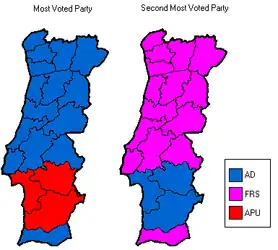 First and second most voted political force by constituency.
 Most voted political force by municipality.
Aftermath
Death of Francisco Sá Carneiro
Just two months after winning the 1980 election, and while campaigning for the Democratic Alliance's candidate for the December 1980 Presidential election, Prime Minister Francisco Sá Carneiro and his Defense minister Adelino Amaro da Costa, along with their spouses Snu Abecassis and Maria Vaz Pires, respectively, plus the plane's pilot, died in tragic air crash when the small aircraft they were on board crashed and burned in Camarate, Loures, shortly after taking off from Lisbon Airport.[24] This tragic air crash sparked a series of conspirancy theories, mainly because of Portugal's involvement in the Iran–Iraq War and the supply of weapons to both Iraq and Iran.[25] Several investigations surrounding the crash were conducted and the official cause of the crash is still a matter of intense debate.[26] Diogo Freitas do Amaral was appointed as interim Prime Minister until the election of Francisco Pinto Balsemão as PSD leader and subsequent nomination as Prime Minister.[27]
Fall of the government
Balsemão's governments were very unstable due to lack of leadership and deep disagreements between the three parties that composed the Democratic Alliance (AD). In the 1982 local elections, the AD was able to gather 42 percent of the votes, against the 31 percent of the PS and 20.5 percent of APU, but suffered loses and many within the coalition, mainly Diogo Freitas do Amaral, labeled the results as a disaster.[28] With this background, Pinto Balsemão resigned as Prime Minister and the PSD proposed names for Prime Minister to President António Ramalho Eanes. However, President Eanes refused to swear in a new AD government and dissolved Parliament by calling elections for 25 April 1983.[29]
See also
Notes
- ↑ As leader of the Social Democratic Party (PSD).
- ↑ As leader of the Socialist Party (PS).
- 1 2 Republican and Socialist Front results are compared to the combined totals of the Socialist Party and the Left-wing Union for the Socialist Democracy in the 1979 election.
- ↑ The Social Democratic Party (PSD), the Democratic Social Center (CDS) and the People's Monarchist Party (PPM) contested the 1979 election in a coalition called Democratic Alliance (AD) and won a combined 45.3% of the vote and elected 128 MP's to parliament.
- ↑ The Socialist Party (PS), Left-wing Union for the Socialist Democracy (UEDS) and the Independent Social-Democratic Action (ASDI) would contest the 1980 election in a coalition called Republican and Socialist Front (FRS).
- ↑ The Portuguese Communist Party (PCP) and the Portuguese Democratic Movement (MDP/CDE) contested the 1979 election in a coalition called United People Alliance (APU) and won a combined 18.8% of the vote and elected 47 MPs to parliament.
- ↑ Results presented here exclude undecideds (17.6%) and doesn't answer (16.4%). With their inclusion results are: AD: 34.4%; FRS: 21.4%; APU: 9.1%; Others/Invalid: 1.2%.
- ↑ Results presented here exclude undecideds (15.1%) and doesn't answer (8.2%). With their inclusion results are: AD: 37.9%; FRS: 26.8%; APU: 9.1%; Others/Invalid: 2.9%.
- ↑ Alliance formed by the Social Democratic Party (74 seats), the Democratic and Social Centre (46 seats) and the People's Monarchist Party (6 seats).
- 1 2 Social Democratic Party and Democratic and Social Centre electoral list only in Azores and Madeira.
- ↑ Alliance formed by the Socialist Party (63 seats), the Leftwing Union for the Socialist Democracy (4 seats) and the Independent Social-Democratic Action (4 seats).
- ↑ Socialist Party electoral list only in Azores and Madeira.
- ↑ Portuguese Communist Party (39 MPs) and Portuguese Democratic Movement (2 MPs) ran in coalition.
References
- ↑ "Previous election results" (in Portuguese). Assembly of the Republic. Retrieved 10 August 2026.
- ↑ "Decreto de Aprovação da Constituição, de 10 de abril", Diário da República, 10 April 1976. Retrieved 14 February 2026.
- ↑ "Vitória de Sá Carneiro nas eleições de 1980 ", RTP, 8 September 2015. Retrieved 9 June 2022.
- ↑ "O passado de uma ilusão". Público. 2018-08-10. Retrieved 2026-08-10.
- ↑ "A primeira alternância democrática e as eleições de 1980". Comissão Comemorativa 50 Anos 25 Abril. Retrieved 2026-08-10.
- ↑ "Uma revolução alentejana feita de vitórias e mágoas". Sapo. 2017-07-20. Retrieved 2026-08-10.
- ↑ "Instabilidade Governativa". Infopédia Porto Editora. Retrieved 2026-08-10.
- ↑ "Nos 35 anos da adesão de Espanha e Portugal à CEE". Público. 2020-06-23. Retrieved 2026-08-10.
- ↑ "A relação tempestuosa entre Eanes e Sá Carneiro". Observador. 2018-10-28. Retrieved 2026-08-10.
- ↑ "Frente Republicana e Socialista". Comissão Nacional de Eleições. 2020-06-23. Retrieved 2026-08-10.
- ↑ "Constitution of the Portuguese Republic" (PDF). Archived from the original (PDF) on 2016-03-03. Retrieved 2019-12-29.
- ↑ "Effective threshold in electoral systems". Trinity College, Dublin. Retrieved 2015-10-21.
- ↑ Gallaher, Michael (1992). "Comparing Proportional Representation Electoral Systems: Quotas, Thresholds, Paradoxes and Majorities"
- ↑ "Eleição da Assembleia da República de 5 de Outubro de 1980". CNE - Comissão Nacional de Eleições - Eleição da Assembleia da República de 5 de Outubro de 1980. Retrieved 3 December 2020.
- ↑ Composição dos Grupos Parlamentares/Partidos
- ↑ "Reformadores (dissidentes do PS) - Jose Adelino Maltez". www.maltez.info (in European Portuguese). Archived from the original on 14 April 2024. Retrieved 16 February 2025.
- 1 2 "Festive Campaigns In Portugal Belie Virulent Rivalries". The Washington Post. 3 October 1980. Retrieved 19 July 2026.
- ↑ "Legislativas. Cavaco lembra que em 1980 ataques ao primeiro-ministro "tiveram efeitos contrários" aos pretendidos". Observador (in Portuguese). 23 April 2025. Retrieved 19 July 2026.
- ↑ "Portugal's Political Wars Aim Potshots at Stability". The New York Times. 5 October 1980. Retrieved 19 July 2026.
- ↑ "Comunicação Política em eleições legislativas em Portugal: uma análise a partir dos cartazes eleitorais (1975-2009)" (PDF). Francisco Teixeira (in Portuguese). Retrieved 12 May 2020.
- ↑ "ELEIÇÕES LEGISLATIVAS DE 1980 – FRENTE REPUBLICANA E SOCIALISTA (PS + ASDI + UEDS)". EPHEMERA (in Portuguese). Retrieved 12 May 2020.
- ↑ "ELEIÇÕES LEGISLATIVAS DE 1980 – APU". EPHEMERA (in Portuguese). Retrieved 12 May 2020.
- ↑ "UDP – 1980". EPHEMERA (in Portuguese). Retrieved 12 May 2020.
- ↑ "Sá Carneiro morre em acidente de aviação" (in Portuguese). RTP. 8 September 2015. Retrieved 8 October 2022.
- ↑ "Atentado de Camarate. Familiar de vítima acusa republicanos dos EUA" (in Portuguese). RTP. 25 August 2020. Retrieved 8 October 2022.
- ↑ "Atentado ou acidente? Quarenta anos depois de Camarate, mistério continua por resolver" (in Portuguese). Jornal Económico. 4 December 2020. Retrieved 8 October 2022.
- ↑ "Tomada de posse do VII Governo Constitucional" (in Portuguese). RTP. 9 January 1981. Retrieved 8 October 2022.
- ↑ "Um Parlamento dissolvido contra a maioria dos deputados" (in Portuguese). Expresso. 16 January 2016. Retrieved 8 December 2023.
- ↑ "Presidente da República dissolve Assembleia da República, em 1983" (in Portuguese). RTP. 8 September 2015. Retrieved 8 December 2023.
External links
| Presidential elections | |
|---|---|
| Parliamentary elections |
|
| Constituent Assembly elections | |
| Local elections | |
| European elections | |
| Referendums | |
| |