2002 Portuguese legislative election
 | ||||||||||||||||||||||||||||||||||||||||||||||||||||||||||||||||||||||||||||||||||||||||||||
17 March 2002
| ||||||||||||||||||||||||||||||||||||||||||||||||||||||||||||||||||||||||||||||||||||||||||||
All 230 seats in the Assembly of the Republic 116 seats needed for a majority | ||||||||||||||||||||||||||||||||||||||||||||||||||||||||||||||||||||||||||||||||||||||||||||
|---|---|---|---|---|---|---|---|---|---|---|---|---|---|---|---|---|---|---|---|---|---|---|---|---|---|---|---|---|---|---|---|---|---|---|---|---|---|---|---|---|---|---|---|---|---|---|---|---|---|---|---|---|---|---|---|---|---|---|---|---|---|---|---|---|---|---|---|---|---|---|---|---|---|---|---|---|---|---|---|---|---|---|---|---|---|---|---|---|---|---|---|---|
| Registered | 8,902,713  0.4% | |||||||||||||||||||||||||||||||||||||||||||||||||||||||||||||||||||||||||||||||||||||||||||
| Turnout | 5,472,851 (61.5%) 0.4 pp | |||||||||||||||||||||||||||||||||||||||||||||||||||||||||||||||||||||||||||||||||||||||||||
| ||||||||||||||||||||||||||||||||||||||||||||||||||||||||||||||||||||||||||||||||||||||||||||


| ||||||||||||||||||||||||||||||||||||||||||||||||||||||||||||||||||||||||||||||||||||||||||||
| ||||||||||||||||||||||||||||||||||||||||||||||||||||||||||||||||||||||||||||||||||||||||||||


The 2002 Portuguese legislative election took place on 17 March. The election renewed all 230 members of the Assembly of the Republic.
This election was called following the resignation of then incumbent Prime Minister António Guterres, after the defeat of the Socialist Party in the 2001 local elections. That fact, plus the problematic state of the country's finances, were the main arguments of the right-wing parties, which led them to be the favourites to win the election.
With just over 40 percent of the votes cast, the Social Democrats (PSD) regained the status as the largest political force in Portugal, although the Socialists (PS) won almost 38 percent of the vote. This was the closest legislative election in Portuguese democracy until 2024. This short distance also appears in the electoral map, with each party winning eleven of the 22 districts, while the PS won the two most populous, Lisbon and Porto. As a result, the Social Democrats fail to win the absolute majority they had between 1987 and 1995, despite having requested it during the campaign.[1]
As no party gained a majority, the Social Democrats formed a coalition with the right-wing People's Party (CDS–PP), which had a fairly solid performance, polling in third place.[2] The left-wing Democratic Unity Coalition (CDU) achieved its lowest result up to that point, being surpassed by CDS–PP and finishing third in its traditional strongholds of Évora and Setúbal. The Left Bloc (BE) gained just one MP. Voter turnout was slightly higher than it was in 1999, as 61.5 percent of the electorate cast a ballot.
Background
After the disappointing result of the Socialist Party (PS) in the 1999 election, the PS government entered in a series of crisis.[3] Resignations of ministers from government, a worsening fiscal and economic situation[4][5] and the inability to pass legislation in Parliament, put pressured over the government, leading to controversial, and weird, alliances, like the 2000 and 2001 budgets which were approved by a sole CDS – People's Party (CDS–PP) member of parliament, Daniel Campelo, in exchange for the government approving a cheese factory in Campelo's hometown, Ponte de Lima, in Viana do Castelo district.[6]
Government fall
The Socialist Party suffered a big, and unexpected, defeat in the December 2001 local elections.[7] The party lost major municipalities across the country, mainly Lisbon, Porto, Sintra and Coimbra to the Social Democratic Party. Due to this surprising defeat, Prime Minister António Guterres announced he was to tender his resignation as Prime Minister in order to avoid the country falling "into a political swamp".[8] President Jorge Sampaio accepted Guterres resignation and called a snap election for March 2002.[9]
Leadership changes and challenges
Social Democratic Party
After the 1999 election defeat, Durão Barroso's leadership started to be challenged and criticized.[10] In January 2000, Durão Barroso called a snap party congress to resolve the leadership dispute.[11] Alongside Barroso, Pedro Santana Lopes and Luís Marques Mendes also ran. Durão Barroso was reelected as PSD leader and the results were the following:
| Candidate | Votes | % | |
|---|---|---|---|
| José Manuel Durão Barroso | 469 | 50.3 | |
| Pedro Santana Lopes | 313 | 33.6 | |
| Luís Marques Mendes | 150 | 16.1 | |
| Turnout | 932 | ||
| Source: Results | |||
Socialist Party
Following the resignation of António Guterres as Prime Minister and PS leader,[12] the party started the process to elect a new leader. The popular minister in Guterres cabinet, Eduardo Ferro Rodrigues, and PS member Paulo Penedos, were the two candidates on the ballot, while the minister of Foreign Affairs Jaime Gama, who had announced his candidacy, dropped out.[13] Around 121,000 PS members were registered to vote.[14] In the end, Ferro Rodrigues got almost unanimous support by being elected with almost 97 percent of the votes.[15] The results were the following:
| Candidate | Votes | % | |
|---|---|---|---|
| Eduardo Ferro Rodrigues | 96.5 | ||
| Paulo Penedos | 2.7 | ||
| Blank/Invalid ballots | 0.8 | ||
| Turnout | |||
| Source: Results | |||
Electoral system

The Assembly of the Republic has 230 members elected to four-year terms. Governments do not require absolute majority support of the Assembly to hold office, as even if the number of opposers of government is larger than that of the supporters, the number of opposers still needs to be equal or greater than 116 (absolute majority) for both the Government's Programme to be rejected or for a motion of no confidence to be approved.[16]
The number of seats assigned to each district depends on the district magnitude.[17] The use of the d'Hondt method makes for a higher effective threshold than certain other allocation methods such as the Hare quota or Sainte-Laguë method, which are more generous to small parties.[18]
For these elections, and compared with the 1999 elections, the MPs distributed by districts were the following:[19]
| District | Number of MPs | Map |
|---|---|---|
| Lisbon(–1) | 48 | 
18
6
38
5
4
15
9
4
10
5
10
10
48
3
3
17
3
8
5
5
2
2
|
| Porto(+1) | 38 | |
| Braga(+1) | 18 | |
| Setúbal | 17 | |
| Aveiro | 15 | |
| Leiria, Santarém and Coimbra | 10 | |
| Viseu | 9 | |
| Faro | 8 | |
| Viana do Castelo | 6 | |
| Azores, Castelo Branco, Madeira and Vila Real | 5 | |
| Bragança and Guarda | 4 | |
| Beja, Évora(–1) and Portalegre | 3 | |
| Europe and Outside Europe | 2 |
Parties
Following the failure to form a joint coalition for the 1999 election, the idea of a PSD/CDS–PP was once again raised but ultimately rejected.[20][21] The table below lists the parties represented in the Assembly of the Republic during the 8th legislature (1999–2002) and that also partook in the election:
| Name | Ideology | Political position | Leader | 1999 result | Seats at dissolution | |||
|---|---|---|---|---|---|---|---|---|
| % | Seats | |||||||
| PS | Socialist Party Partido Socialista |
Social democracy | Centre-left | Ferro Rodrigues | 44.1% | 115 / 230 |
115 / 230 | |
| PPD/PSD | Social Democratic Party Partido Social Democrata |
Liberal conservatism Classical liberalism |
Centre-right | José Manuel Durão Barroso | 32.3% | 81 / 230 |
81 / 230 | |
| PCP | Portuguese Communist Party Partido Comunista Português |
Communism Marxism–Leninism |
Far-left | Carlos Carvalhas | 9.0% [a] |
15 / 230 |
15 / 230 | |
| PEV | Ecologist Party "The Greens" Partido Ecologista "Os Verdes" |
Eco-socialism Green politics |
Left-wing | Isabel Castro | 2 / 230 |
2 / 230 | ||
| CDS–PP | CDS – People's Party Centro Democrático e Social – Partido Popular |
Christian democracy Conservatism |
Centre-right to right-wing |
Paulo Portas | 8.3% | 15 / 230 |
14 / 230 | |
| BE | Left Bloc Bloco de Esquerda |
Democratic socialism Anti-capitalism |
Left-wing | Francisco Louçã | 2.4% | 2 / 230 |
1 / 230 | |
| Ind. | Independent Independente |
Daniel Campelo (left the CDS – People's Party caucus)[22] | 1 / 230 | |||||
Seat changes
- On 7 November 2000, MP Daniel Campelo, elected in the CDS – People's Party list for Viana do Castelo, left the party and became an Independent, following a split with CDS–PP regarding his votes in favour of António Guterres government's State budgets.[23]
Campaign period
Issues
The campaign was dominated by the country's economic situation. Social Democratic Party (PSD) leader, Durão Barroso, proposed strong changes, from a "fiscal shock", by cutting income and corporate taxes, to reforms in the public sector.[24][25] The issue of public sector reform, in addition to gaffes made during the campaign, created problems to the PSD cause.[26] On the other side, the Socialists (PS), led by Eduardo Ferro Rodrigues, portrayed the PSD policies as "voodoo economics", adding this would jeopardize Portugal's deficit situation, even though the party also proposed tax and spending cuts.[25] Despite being stronger than Barroso in personal popularity polls,[25] Ferro Rodrigues had to contend with accusations of mismanagement, corruption, and problematic public service responses during the Socialists' six-year term.[27] The People's Party (CDS–PP) focused on issues such as security and wage increases,[28] while the left-wing, mainly the communist Unitary Democratic Coalition (CDU), campaigned to bolster its vote count with a view to potential post-election alliances with the PS.[29]
Party slogans
| Party or alliance | Original slogan | English translation | Refs | |
|---|---|---|---|---|
| PS | « Fazer bem » | "Doing well" | [30] | |
| PSD | « Somos todos Portugal » | "We are all Portugal" | [31] | |
| CDU | « Mudar para melhor » | "Change for the better" | [32] | |
| CDS–PP | « O braço direito de Portugal » | "Portugal's right-hand man" | [33] | |
| BE | « Com Razões Fortes » | "With Strong Reasons" | [34] | |
Candidates' debates
| 2002 Portuguese legislative election debates | |||||||||||||||||||||
|---|---|---|---|---|---|---|---|---|---|---|---|---|---|---|---|---|---|---|---|---|---|
| Date | Organisers | Moderator(s) | P Present A Absent invitee N Non-invitee | ||||||||||||||||||
| PS Rodrigues |
PSD Barroso |
CDU Carvalhas |
CDS–PP Portas |
BE Louçã |
Refs | ||||||||||||||||
| 26 Feb | SIC | P | P | N | N | N | [35] | ||||||||||||||
| 12 Mar | RTP1 | Judite de Sousa José Alberto Carvalho |
P | P | P | P | P | [36] | |||||||||||||
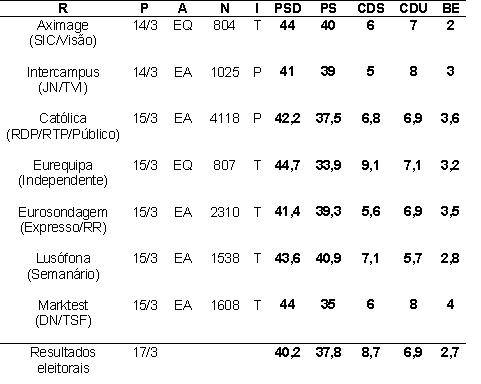
Opinion polling
The following table shows the opinion polls of voting intention of the Portuguese voters before the election. Included is also the result of the Portuguese general elections in 1999 and 2002 for reference.
Exit poll
| Polling firm/Link | Date Released |  |
 |
 |
 |
 |
O | Lead | |
|---|---|---|---|---|---|---|---|---|---|
| 2002 legislative election | 17 Mar 2002 | 37.8 96 |
40.2 105 |
6.9 12 |
8.7 14 |
2.7 3 |
3.7 0 |
2.4 | |
| UCP | 17 Mar 2002 (20:00) | 36– 41 |
37– 42 |
5.5–8 | 7.5– 10 |
3–4 | — | 1 | |
| Eurosondagem | 17 Mar 2002 (20:00) | 35.5–39.3 | 40.1–43.9 | 6.2–8.4 | 6.2–8.4 | 2.0–3.4 | — | 4.6 | |
| Intercampus | 17 Mar 2002 (20:00) | 35.5–40.5 | 37.8–42.8 | 6.8–9.8 | 5.3–8.3 | 1.6–4.2 | — | 2.3 | |
| Marktest | 15 Mar 2002 | 35.2 | 43.7 | 8.1 | 6.0 | 3.7 | 3.3 | 8.5 | |
| Lusófona | 15 Mar 2002 | 40.9 | 43.6 | 5.7 | 7.1 | 2.8 | N/a | 2.7 | |
| Eurosondagem | 15 Mar 2002 | 39.3 | 41.4 | 6.9 | 5.6 | 3.5 | 3.3 | 2.1 | |
| Eurequipa | 15 Mar 2002 | 33.9 | 44.7 | 7.1 | 9.1 | 3.2 | 2.0 | 10.8 | |
| UCP | 15 Mar 2002 | 37.5 | 42.2 | 6.9 | 6.8 | 3.6 | 3.0 | 4.7 | |
| Intercampus | 14 Mar 2002 | 39 | 41 | 8 | 5 | 3 | 4 | 2 | |
| Aximage | 14 Mar 2002 | 40 | 44 | 7 | 6 | 2 | 1 | 4 | |
| SIC/Visão | 13 Mar 2002 | 36.2 | 41.0 | 6.6 | 5.2 | 2.0 | 9.0 | 4.8 | |
| Eurosondagem | 8 Mar 2002 | 39.9 | 42.7 | N/a | N/a | N/a | 17.4 | 2.8 | |
| Marktest | 8 Mar 2002 | 36 | 43 | 6 | 7 | 4 | 4 | 7 | |
| Visão | 7 Mar 2002 | 38.4 | 41.2 | 2.4 | 5.4 | 2.1 | 10.5 | 2.8 | |
| Eurosondagem | 2 Mar 2002 | 35 | 38 | 6 | 5 | 2 | 14 | 3 | |
| Eurequipa | 1 Mar 2002 | 35.0 | 42.3 | N/a | N/a | N/a | 22.7 | 7.3 | |
| SIC/Visão | 28 Feb 2002 | 43.0 | 47.6 | N/a | N/a | N/a | 9.4 | 4.6 | |
| UCP | 27 Feb 2002 | 35.6 | 43.5 | N/a | N/a | N/a | 20.9 | 7.9 | |
| Marktest | Feb 2002 | 34.7 | 45.7 | 6.7 | 7.3 | 2.5 | 3.1 | 11.0 | |
| Marktest | Jan 2002 | 33.8 | 41.8 | 9.6 | 8.1 | 2.5 | 4.2 | 8.0 | |
| Marktest | 22 Dec 2001 | 34 | 39 | 11 | 9 | 3 | 4 | 5 | |
| 2001 local elections | 16 Dec 2001 | 37.1 | 41.1 | 10.6 | 4.0 | 1.2 | 6.0 | 4.0 | |
| Marktest | Nov 2001 | 35.4 | 33.7 | 10.6 | 11.6 | 2.9 | 5.8 | 1.7 | |
| Marktest | Oct 2001 | 35.9 | 33.9 | 10.5 | 11.5 | 2.7 | 5.5 | 2.0 | |
| UCP | 12 Oct 2001 | 41.1 | 38.2 | 7.6 | 5.0 | 8.2 | 2.9 | ||
| Marktest | 28 Jun 2001 | 34.8 | 35.1 | 10.7 | 10.7 | 3.3 | 5.4 | 0.3 | |
| SIC/Visão | 8 Jun 2001 | 36.2 | 37.8 | N/a | N/a | N/a | 26.0 | 1.6 | |
| Marktest | 27 Apr 2001 | 38 | 34 | 9 | 10 | N/a | 9 | 4 | |
| Marktest | Mar 2001 | 39 | 35 | N/a | N/a | N/a | 26 | 4 | |
| Marktest | 26 Jan 2001 | 37 | 33 | 10 | 11 | 3 | 6 | 4 | |
| Marktest | 26 May 2000 | 38.1 | 30.3 | 10.8 | 13.3 | 2.8 | 4.7 | 7.8 | |
| UCP[b] | 8 May 2000 | 40.9 | 32.5 | 6.7 | 8.1 | 3.0 | 8.8 | 8.4 | |
| 1999 legislative election | 10 Oct 1999 | 44.1 115 |
32.3 81 |
9.0 17 |
8.3 15 |
2.4 2 |
3.9 0 |
11.9 | |
Voter turnout
The table below shows voter turnout throughout election day including voters from Overseas. Due to lack of data from the 1999 election, it's not possible to compare the turnout throughout election day between the two elections.
| Turnout | Time | ||||||||
|---|---|---|---|---|---|---|---|---|---|
| 12:00 | 16:00 | 19:00 | |||||||
| 1999 | 2002 | 1999 | 2002 | 1999 | 2002 | ± | |||
| Total | N/a | 18.00% | N/a | 45.88% | 61.09% | 61.48% | 0.39 pp | ||
| Sources[37][38] | |||||||||
Results
National summary
 | ||||||
|---|---|---|---|---|---|---|
| Party | Votes | % | +/– | Seats | +/– | |
| Social Democratic Party | 2,200,765 | 40.21 | +7.89 | 105 | +24 | |
| Socialist Party | 2,068,584 | 37.80 | –6.26 | 96 | –19 | |
| CDS – People's Party | 477,350 | 8.72 | +0.38 | 14 | –1 | |
| Unitary Democratic Coalition[c] | 379,870 | 6.94 | –2.05 | 12 | –5 | |
| Left Bloc | 149,966 | 2.74 | +0.30 | 3 | +1 | |
| Portuguese Workers' Communist Party | 36,193 | 0.66 | –0.08 | 0 | 0 | |
| Earth Party | 15,540 | 0.28 | –0.09 | 0 | 0 | |
| People's Monarchist Party | 12,398 | 0.23 | –0.08 | 0 | 0 | |
| Humanist Party | 11,472 | 0.21 | +0.07 | 0 | 0 | |
| National Renovator Party | 4,712 | 0.09 | New | 0 | New | |
| Workers' Party of Socialist Unity | 4,316 | 0.08 | +0.00 | 0 | 0 | |
| Left Bloc–Popular Democratic Union[d] | 3,911 | 0.07 | — | 0 | — | |
| National Solidarity Party[e] | 0 | 0.00 | –0.21 | 0 | 0 | |
| Total | 5,365,077 | 100.00 | – | 230 | 0 | |
| Valid votes | 5,365,077 | 98.03 | +0.03 | |||
| Invalid votes | 52,653 | 0.96 | +0.01 | |||
| Blank votes | 55,121 | 1.01 | –0.04 | |||
| Total votes | 5,472,851 | 100.00 | – | |||
| Registered voters/turnout | 8,902,713 | 61.47 | +0.38 | |||
| Source: Comissão Nacional de Eleições[f] | ||||||
Distribution by constituency
| Constituency | % | S | % | S | % | S | % | S | % | S | Total S |
|---|---|---|---|---|---|---|---|---|---|---|---|
| PSD | PS | CDS–PP | CDU | BE | |||||||
| Azores | 45.4 | 3 | 41.0 | 2 | 8.4 | - | 1.4 | - | 1.4 | - | 5 |
| Aveiro | 46.4 | 8 | 33.5 | 5 | 12.9 | 2 | 2.6 | - | 1.8 | - | 15 |
| Beja | 21.2 | - | 43.5 | 2 | 3.7 | - | 24.2 | 1 | 1.9 | - | 3 |
| Braga | 44.4 | 9 | 37.4 | 8 | 9.3 | 1 | 4.4 | - | 1.7 | - | 18 |
| Bragança | 53.2 | 3 | 30.0 | 1 | 10.9 | - | 1.9 | - | 0.9 | - | 4 |
| Castelo Branco | 38.3 | 2 | 46.1 | 3 | 7.1 | - | 3.3 | - | 1.5 | - | 5 |
| Coimbra | 41.0 | 5 | 41.3 | 5 | 6.7 | - | 5.1 | - | 2.4 | - | 10 |
| Évora | 25.3 | 1 | 42.8 | 1 | 4.6 | - | 21.8 | 1 | 1.8 | - | 3 |
| Faro | 37.7 | 4 | 40.5 | 4 | 8.3 | - | 6.3 | - | 2.8 | - | 8 |
| Guarda | 48.5 | 2 | 34.7 | 2 | 9.6 | - | 2.2 | - | 1.2 | - | 4 |
| Leiria | 50.8 | 6 | 29.5 | 3 | 9.8 | 1 | 4.1 | - | 2.2 | - | 10 |
| Lisbon | 35.7 | 18 | 38.7 | 20 | 8.5 | 4 | 8.8 | 4 | 4.7 | 2 | 48 |
| Madeira | 53.5 | 4 | 25.8 | 1 | 12.1 | - | 2.5 | - | 3.1 | - | 5 |
| Portalegre | 30.6 | 1 | 45.2 | 2 | 6.4 | - | 12.4 | - | 1.6 | - | 3 |
| Porto | 40.0 | 16 | 41.2 | 17 | 8.4 | 3 | 4.6 | 1 | 2.7 | 1 | 38 |
| Santarém | 38.1 | 4 | 38.4 | 4 | 8.4 | 1 | 8.6 | 1 | 2.9 | - | 10 |
| Setúbal | 24.7 | 5 | 39.3 | 7 | 6.9 | 1 | 20.5 | 4 | 4.6 | - | 17 |
| Viana do Castelo | 45.5 | 3 | 35.3 | 3 | 10.3 | - | 3.5 | - | 1.8 | - | 6 |
| Vila Real | 54.1 | 3 | 31.9 | 2 | 8.1 | - | 2.0 | - | 0.9 | - | 5 |
| Viseu | 52.1 | 5 | 31.1 | 3 | 10.6 | 1 | 1.5 | - | 1.4 | - | 9 |
| Europe | 36.9 | 1 | 42.1 | 1 | 5.0 | - | 4.8 | - | 1.1 | - | 2 |
| Outside Europe | 66.3 | 2 | 21.5 | - | 3.4 | - | 0.9 | - | 0.4 | - | 2 |
| Total | 40.2 | 105 | 37.8 | 96 | 8.7 | 14 | 6.9 | 12 | 2.7 | 3 | 230 |
| Source: Comissão Nacional de Eleições | |||||||||||
Maps
- Winner and seats by constituency.
 Most voted political force by municipality.
Aftermath

After the elections, PSD and CDS–PP formed a coalition government, the first since the Democratic Alliance (AD) in the early 1980s.[39] This government was marked by the fragile fiscal and economic situation of the country, with Durão Barroso accusing the PS of leaving the country "in loincloth",[40] and the 2003 Casa Pia child sexual abuse scandal. During this government, Portugal became a major ally in the War in Iraq, even hosting a summit at Lajes Field, in the Azores, between the United States, the United Kingdom and Spain, which divided public opinion.[41] In the 2004 European Parliament election in Portugal, the PSD/CDS–PP coalition Força Portugal suffered a big defeat by gathering just 33 percent of the votes, against the 44 percent of the Socialist Party. A few days later, José Manuel Durão Barroso announced he was resigning from the post of Prime Minister in order to become President of the European Commission.[42] Despite pleas for a snap legislative election from Opposition parties, President Jorge Sampaio decided to nominate the new PSD leader, Pedro Santana Lopes, as prime minister.[43]
Fall of the government
Santana Lopes government was marked by deep disagreements and disputes within his own party, the Social Democratic Party, as well as mismanagement, which began to damage the government's actions.[44] Several cases followed: The so-called "Caso Marcelo", which broke in early October 2004 regarding former PSD leader Marcelo Rebelo de Sousa's TVI punditry show, that ended abruptly with Marcelo Rebelo de Sousa accusing TVI's management board of pressuring him not to be too critical of the then government in his television commentaries,[45][46] being widely considered as an attack on freedom of the press;[47] Problems related to teacher allocation at the start of the 2004 school year, which led to delays in opening schools, also damaged the government;[48] And then there was the resignation of Youth and Sports Minister, Henrique Chaves, which was a close ally of Santana. This resignation precipitated the fall of the government, with Chaves accusing Santana of not being "loyal and truthful".[49] Following this, and just five months after swearing in Santana Lopes as prime minister, President Jorge Sampaio gave a speech in which he accused the government of "contradictions and lack of coordination that contributed to its discredit",[50] using his power of dissolution of Parliament and called a snap election, so far the only time till date such a drastic action was used in Portuguese democracy by a president.[51][52] Santana Lopes disagreed with the President's decision but respected it and announced his resignation.[53] A new election was called, by the President, for 20 February 2005.[54]
See also
Further reading
- Freire, André (November 2004). "Issue Voting in Portugal: The 2002 Legislative Elections". West European Politics. 27 (5): 779–800. doi:10.1080/0140238042000283328. S2CID 154614163.
Notes
- ↑ The Portuguese Communist Party (PCP) and the Ecologist Party "The Greens" (PEV) contested the 1999 election in a coalition called Unitary Democratic Coalition (CDU) and won a combined 9% of the vote and elected 17 MPs to parliament.
- ↑ Results presented here exclude abstention (19.7%). With their inclusion results are: PS: 32.8%; PSD: 26.1%; CDS-PP: 6.5%; CDU: 5.4%; BE: 2.4%; Others/Invalid: 7.1%.
- ↑ Portuguese Communist Party (10 MPs) and "The Greens" (2 MPs) ran in coalition.
- ↑ Left Bloc / People's Democratic Union joint electoral list only in Madeira.
- ↑ The National Solidarity Party (PSN) ran a list in Vila Real district, but dropped out before election day and got just 7 votes. In the certified results, the votes are counted as invalid.
- ↑ The total vote count from the National Electoral Commission (CNE) is incorrect. In the results table and bar box, the correct number for the sum of votes was used to calculate the percentages for the different parties.
References
- ↑ "Durão Barroso volta a apelar à maioria absoluta". Público. 15 March 2002. Retrieved 15 August 2026.
- ↑ "Paulo Portas classifica resultado do CDS-PP como "histórico"". Público. 17 March 2002. Retrieved 15 August 2026.
- ↑ "António Guterres e o pântano ", Público, 31 December 2001. Retrieved 23 October 2022.
- ↑ "Economia portuguesa perdeu ritmo de 2000 para 2001". Público. 29 April 2002. Retrieved 10 August 2026.
- ↑ "A crise orçamental". Público. 7 July 2001. Retrieved 10 August 2026.
- ↑ "Há 21 anos o orçamento valeu um queijo limiano ", Observador, 12 October 2021. Retrieved 23 October 2022.
- ↑ "PS sofre hecatombe inesperada ", Público, 17 December 2001. Retrieved 23 October 2022.
- ↑ "A noite que mudou a vida de Guterres ", Expresso, 13 October 2016. Retrieved 23 October 2022.
- ↑ "Sampaio assina decreto que dissolve Parlamento e marca eleições antecipadas ", Público, 17 January 2002. Retrieved 23 October 2022.
- ↑ "Divisões no PSD", RTP, 17 January 2000. Retrieved 21 November 2021.
- ↑ "Durão Barroso desafia Santana Lopes", RTP, 19 January 2000. Retrieved 21 November 2021.
- ↑ "Guterres apresenta demissão depois de derrota nas autárquicas (act)", Jornal de Negócios, 17 December 2001. Retrieved 21 November 2021.
- ↑ "Acção Socialista | n.º 1135" (PDF). ps.pt. 2001-12-20. Retrieved 2025-11-01.
- ↑ "Acção Socialista", PS, 10 January 2002. Retrieved 7 June 2022.
- ↑ "Ferro Rodrigues eleito novo secretário-geral do PS ", Público, 20 January 2002. Retrieved 21 November 2021.
- ↑ "Constitution of the Portuguese Republic" (PDF). Archived from the original (PDF) on 2016-03-03. Retrieved 2019-12-29.
- ↑ "Effective threshold in electoral systems". Trinity College, Dublin. Retrieved 2015-10-21.
- ↑ Gallaher, Michael (1992). "Comparing Proportional Representation Electoral Systems: Quotas, Thresholds, Paradoxes and Majorities"
- ↑ "Eleição da Assembleia da República de 17 de Março de 2002". CNE - Comissão Nacional de Eleições - Eleição da Assembleia da República de 17 de Março de 2002. Retrieved 2 December 2020.
- ↑ "Santana Lopes rejeita coligação com PP". Público (in European Portuguese). 20 December 2001. Retrieved 26 July 2026.
- ↑ "Sociais-democratas não querem coligação com CDS-PP". Público (in European Portuguese). 20 December 2001. Retrieved 26 July 2026.
- ↑ "Deputado Daniel Campleo". www.parlamento.pt (in European Portuguese). Retrieved 26 January 2025.
- ↑ "Os orçamentos do PS e Daniel Campelo", RTP, 8 September 2015. Retrieved 26 January 2025.
- ↑ "Choque fiscal do PSD só beneficiará 5 por cento da população, diz Cravinho". Público (in Portuguese). 26 February 2002. Retrieved 26 July 2026.
- 1 2 3 "Clear choice for Portugal voters". The New York Times. 15 March 2002. Retrieved 26 July 2026.
- ↑ "Quando os salários congelaram Durão". Expresso (in Portuguese). 21 September 2015. Retrieved 26 July 2026.
- ↑ "Victory in Portugal lifts European right". The New York Times. 19 March 2002. Retrieved 26 July 2026.
- ↑ "Paulo Portas apela ao voto da classe média". Público (in Portuguese). 14 March 2002. Retrieved 26 July 2026.
- ↑ "Carvalhas favorável a aliança pós-eleitoral com PS". Público (in Portuguese). 30 January 2002. Retrieved 26 July 2026.
- ↑ "ELEIÇÕES LEGISLATIVAS DE 2002 – PS". EPHEMERA (in Portuguese). Retrieved 11 May 2020.
- ↑ "ELEIÇÕES LEGISLATIVAS DE 2002 – PSD". EPHEMERA (in Portuguese). Retrieved 11 May 2020.
- ↑ "PCP Legislativas 2002". PCP (in Portuguese). Retrieved 11 May 2020.
- ↑ "ELEIÇÕES LEGISLATIVAS DE 2002 – CDS". EPHEMERA (in Portuguese). Retrieved 11 May 2020.
- ↑ "Manifesto Legislativas 2002". BE (in Portuguese). Retrieved 11 May 2020.
- ↑ "Debate Ferro/Durão visto por 1,2 milhões de espectadores". Público (in Portuguese). 27 Feb 2002. Retrieved 11 May 2020.
- ↑ "DEBATE: LEGISLATIVAS 2005". RTP1 (in Portuguese). 2002. Retrieved 11 May 2020.
- ↑ "Votaram 18 por cento dos eleitores até ao meio-dia". Público (in Portuguese). 17 March 2002. Retrieved 8 June 2023.
- ↑ "00, mais de metade dos eleitores já tinha votado". RTP (in Portuguese). 20 February 2005. Retrieved 8 June 2023.
- ↑ "2002: O regresso da coligação de Direita ao poder", SIC Notícias, 1 October 2019. Retrieved 8 December 2023.
- ↑ "Durão Barroso diz que socialistas "deixaram Portugal de tanga"", Público, 17 April 2002. Retrieved 4 August 2026 2023.
- ↑ "Cimeira nas Lajes", RTP, 16 March 2003. Retrieved 8 December 2023.
- ↑ "Durão Barroso apresenta demissão para ser presidente da Comissão Europeia ", RTP, 8 September 2015. Retrieved 8 December 2023.
- ↑ "O dia em que Jorge Sampaio decepcionou os socialistas", Expresso, 15 January 2016. Retrieved 8 December 2023.
- ↑ "As "trapalhadas" de Santana em 2004 (que Rio apoiou e Marcelo arrasou) ", Observador, 21 December 2017. Retrieved 23 October 2022.
- ↑ "Marcelo Rebelo de Sousa abandona TVI após conversa com Paes do Amaral", Público, 6 October 2004. Retrieved 20 May 2026.
- ↑ "Patrão da TVI queria Marcelo Rebelo de Sousa mais moderado nas críticas ", Público, 7 October 2004. Retrieved 20 May 2026.
- ↑ "Saída de Marcelo Rebelo de Sousa da TVI", RTP Arquivos, 8 October 2004. Retrieved 20 May 2026.
- ↑ "Educação - Problemas no concurso de professores marcaram a agenda", RTP, 15 December 2004. Retrieved 26 July 2026.
- ↑ "Henrique Chaves demite-se do Governo por falta de «lealdade e de verdade» de Santana", Jornal de Negócios, 28 November 2004. Retrieved 23 October 2022.
- ↑ "Jorge Sampaio anuncia a dissolução do Parlamento ", RTP, 8 September 2015. Retrieved 23 October 2022.
- ↑ "Jorge Sampaio vai dissolver Assembleia da República ", Público, 30 November 2004. Retrieved 23 October 2022.
- ↑ "A bomba atómica de Sampaio", Correio da Manhã, 10 September 2021. Retrieved 23 October 2022.
- ↑ "Santana Lopes pede demissão do XVI Governo Constitucional ", Público, 11 December 2004. Retrieved 8 December 2023.
- ↑ "Jorge Sampaio assinou hoje decreto de dissolução do Parlamento ", Público, 22 December 2004. Retrieved 23 October 2022.
External links
- Preliminary results of the 2002 election
- Comissão Nacional de Eleições
- Centro de Estudos do Pensamento Político
| Presidential elections | |
|---|---|
| Parliamentary elections |
|
| Constituent Assembly elections | |
| Local elections | |
| European elections | |
| Referendums | |
| |