Portal:Philippines


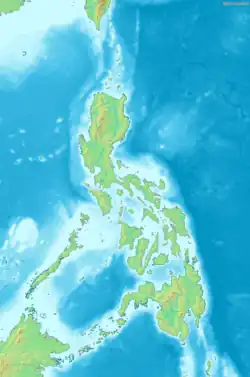
The Philippines, officially the Republic of the Philippines, is an archipelagic country in Southeast Asia. Located in the western Pacific Ocean, it consists of about 7,641 islands, with a total area of about 300,000 square kilometers. The islands are broadly categorized in three main geographical divisions. From north to south, the divisions are: Luzon, Visayas, and Mindanao. With a population of over 114 million, it is the world's twelfth-most-populous country. The Philippines is bounded by the South China Sea to the west, the Philippine Sea to the east, and the Celebes Sea to the south. It shares maritime borders with Taiwan to the north, Japan and South Korea to the northeast, Palau to the east and southeast, Indonesia to the south, Malaysia to the southwest, Vietnam to the west, and China to the northwest. It has diverse ethnicities and a rich culture. Manila is the country's capital, and its most populated city is Quezon City. Both are within Metro Manila. Negritos, the archipelago's earliest inhabitants, were followed by waves of Austronesian peoples. The adoption of animism, Hinduism with Buddhist influence, and Islam established island-kingdoms. Extensive overseas trade with neighbors such as the late Tang or Song empire brought Chinese people to the archipelago as well, who would also gradually settle in and intermix over the centuries. The arrival of the explorer Ferdinand Magellan marked the beginning of Spanish colonization. In 1543, Spanish explorer Ruy López de Villalobos named the archipelago las Islas Filipinas in honor of King Philip II. Catholicism became the dominant religion, and Manila became the western hub of trans-Pacific trade. Hispanic immigrants from Latin America and Iberia would also selectively colonize. The Philippine Revolution began in 1896, and became entwined with the 1898 Spanish–American War. Spain ceded the territory to the United States, and Filipino revolutionaries declared the First Philippine Republic. The ensuing Philippine–American War ended with the United States controlling the territory until the Japanese invasion of the islands during World War II. After the United States retook the Philippines from the Japanese, the Philippines became independent in 1946. Since then, the country notably experienced a period of martial law from 1972 to 1981 under the dictatorship of Ferdinand Marcos and his subsequent overthrow by the People Power Revolution in 1986, returning to democracy. The Philippines is an emerging market and a developing and newly industrialized country, whose economy is transitioning from being agricultural to service- and manufacturing-centered. It has a variety of natural resources and a globally-significant level of biodiversity. The country is also part of multiple international organizations and forums, mainly in the Asia-Pacific region. Despite its fast economic growth, it continues to struggle with inequality, widespread corruption, and vulnerability to natural disasters due to its location both within the Pacific Ring of Fire and near the equator, making it prone to earthquakes, monsoon rains, and typhoons, to which the Philippines has built a resilience. (Full article...) Selected article -On the Job (abbreviated as OTJ) is a 2013 Philippine neo-noir and crime thriller film written and directed by Erik Matti, who co-wrote the screenplay with his wife Michiko Yamamoto. Starring Gerald Anderson, Joel Torre, Joey Marquez and Piolo Pascual, it tells the story of two hit-man prisoners (Anderson and Torre) who are temporarily freed to carry out political executions, and two law enforcers (Marquez and Pascual) tasked with investigating the drug-related murder case connected to the prison gun-for-hire business. The film co-stars Angel Aquino, Shaina Magdayao, Empress Schuck, Leo Martinez, Michael de Mesa, Vivian Velez, and Rayver Cruz. The inspiration for On the Job came from a Viva Films crew member who said he had been temporarily released from prison to commit contract killings before he was reincarcerated. Star Cinema initially refused to produce the film in 2010, deeming it excessively violent compared with their usual rom-com projects; by 2012, however, they agreed to co-produce it with Matti's own film production company, Reality Entertainment. Filming took place in Manila and lasted 33 days, on a production budget of ₱47 million (about US$1.1 million). (Full article...) Did you know (auto-generated) -
Selected picture
Things you can do
Selected biography -Juan Furagganan Ponce Enrile Sr., CLH (born Juanito Furagganan; February 14, 1924 – November 13, 2025), also referred to by his initials JPE, was a Filipino politician and lawyer, who served as 26th President of the Senate of the Philippines from 2008 until his resignation in 2013. Enrile was one of the longest-serving Filipino politicians in history, and one of the few to reach the age of 100. He was known for his role in the administration of Philippine president Ferdinand Marcos; his role in the failed coup that helped hasten the 1986 People Power Revolution and the ouster of Marcos; and his tenure in the Philippine legislature in the years after the revolution. Enrile also participated in rallies supporting ousted president Joseph Estrada in April 2001 that preceded the May 1 riots near Malacañang Palace. Enrile served four terms in the Senate, in a total of twenty-two years and three-hundred twenty days, one of the longest-tenures in the history of the upper chamber. In 2022, at the age of 98, he returned to government office as the Chief Presidential Legal Counsel in the administration of President Bongbong Marcos, serving until his death in 2025. Enrile was a protégé of President Ferdinand Marcos who served as Justice Secretary and Defense Minister during the Marcos administration. Enrile played a key role in the planning and documentary legwork for martial law, and was in charge of the Philippine Military during its implementation. His other roles during this period included Presidency of the Philippine Coconut Authority through which he gained control of the copra industry together with Danding Cojuangco, and being the general put in charge of logging in the Philippines under martial law—a period during which lumber exports were so extensive that the forest cover of the Philippines shrank until only 8% remained. By the 1980s, however, rising factionalism in the Marcos administration led to a reduction in Enrile's influence within the administration. (Full article...) General imagesThe following are images from various Philippines-related articles on Wikipedia.
In the news
More did you know -
WikiProject WikiProject Tambayan Philippines Topics
Categories Select [►] to view subcategories
no subcategories Public inquiries in the Philippines Wikipedia categories named after organizations based in the Philippines Filipino Wikipedians Wikipedia categories named after Filipino people Images of the Philippines Featured pictures of the Philippines PD-Philippines Works of the Philippines government Philippines stub templates Related portalsReligions in Philippines Southeast Asia Other countries Associated WikimediaThe following Wikimedia Foundation sister projects provide more on this subject:
Other Philippines-connected Wikipedias
SourcesMore portalsDiscover Wikipedia using portals
| |||||||||||||||||||||||||||||||||||||||||||||||||||||||||||||||||||||||||||||||||||||||