The natural environment or natural world encompasses all biotic and abiotic things occurring naturally, meaning in this case not artificial. The term is most often applied to Earth or some parts of Earth. This environment encompasses the interaction of all living species, climate, weather and natural resources that affect human survival and economic activity. The concept of the natural environment can be distinguished as components:
Complete ecological units that function as natural systems without massive civilized human intervention, including all vegetation, microorganisms, soil, rocks, plateaus, mountains, the atmosphere and natural phenomena that occur within their boundaries and their nature.
In contrast to the natural environment is the built environment. Built environments are those in which humans have fundamentally transformed landscapes such as in urban settings and agricultural land conversion. Even in acts that seem less extreme, such as building a mud hut or a photovoltaic system in the desert, the modified environment is considered artificial. Though many animals build things to provide a better environment for themselves, they are not human; hence beaver dams and the works of mound-building termites are considered natural.
There are no absolutely natural environments on Earth. Naturalness usually varies in a continuum, from 100% natural in one extreme to 0% natural in the other. The massive environmental changes of humanity in the Anthropocene have fundamentally affected all natural environments including: climate change, biodiversity loss and pollution from plastic and other chemicals in the air and water. More precisely, considering the different aspects or components of an environment, it becomes apparent that their degree of naturalness is not uniform. For instance, in an agricultural field, the mineralogic composition is quite similar to that of undisturbed forest soil while the structure is quite different. (Full article...)
Selected article -
Carbon sinks (green bars on the right) remove carbon from the atmosphere, whereas carbon sources (greenhouse gas emissions) (grey bars on the left) add them. Since the 1850s, there are more carbon sources than sinks and therefore the carbon dioxide in Earth's atmosphere is rising.
A carbon sink is a natural or artificial carbon sequestration process that "removes a greenhouse gas, an aerosol or a precursor of a greenhouse gas from the atmosphere". These sinks form an important part of the natural carbon cycle. An overarching term is carbon pool, which is all the places where carbon on Earth can be, i.e. the atmosphere, oceans, soil, florae, fossil fuel reservoirs and so forth. A carbon sink is a type of carbon pool that has the capability to take up more carbon from the atmosphere than it releases.
Globally, the two most important carbon sinks are vegetation and the ocean. Soil is an important carbon storage medium. Much of the organic carbon retained in the soil of agricultural areas has been depleted due to intensive farming. Blue carbon designates carbon that is fixed via certain marine ecosystems. Coastal blue carbon includes mangroves, salt marshes and seagrasses. These make up a majority of ocean plant life and store large quantities of carbon. Deep blue carbon is located in international waters and includes carbon contained in "continental shelf waters, deep-sea waters and the sea floor beneath them". (Full article...)
... that every in-game environment and asset in Lego Horizon Adventures was constructed entirely from individual digital Lego bricks, meaning that they could theoretically be built in real life?
Chernobyl reactor number four after the disaster, showing the extensive damage to the main reactor hall (image center) and turbine building (image lower left)
Through legal interventions, advocacy and public campaigns, contribution to documentary films, television debates and press articles, she has successfully mainstreamed and built consciousness about previously unknown environmental hazards, notably noise pollution and sand mining, and is a Governing Council and has won national and international awards for her work. She also set up the first network for protection of activists in India after an attack on her by the sand mafia in 2004. (Full article...)
Image 5Proportion of forest area by forest area density class and global ecological zone, 2015, from Food and Agriculture Organization publication The State of the World's Forests 2020. Forests, biodiversity and people – In brief (from Ecoregion)
Image 7Aerial view of stormwater treatment areas in the northern Everglades bordered by sugarcane fields on the right (from Restoration of the Everglades)
Image 8Funding for climate change research in the natural and technical sciences compared to that in the social sciences and humanities according to the study "The misallocation of climate research funding" (from Environmental science)
Image 13Sequence of a decomposing pig carcass over time (from Ecosystem)
Image 14Environmental science examines the effects of humans on nature, such as the Glen Canyon Dam in the United States. (from Environmental science)
Image 15The Paris Agreement (formerly the Kyoto Protocol) is adopted in 2016. Nearly every country in the United Nations has signed the treaty, which aims to reduce greenhouse gas emissions. (from Environmental science)
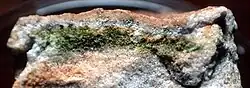
Image 16An Antarctic rock split apart to show endolithic lifeforms showing as a green layer a few millimeters thick (from Habitat)
Image 17Cattails indicate the presence of phosphorus in the water. Cattails are an invasive species; they crowd out sawgrass and grow too thick to allow nesting for birds and alligators. (from Restoration of the Everglades)
Image 18Planned water recovery and storage implementation using CERP strategies (from Restoration of the Everglades)
Image 22A team of British researchers found a hole in the ozone layer forming over Antarctica, the discovery of which would later influence the Montreal Protocol in 1987. (from Environmental science)
Image 24Climbing ferns overtake cypress trees in the Everglades. The ferns act as "fire ladders" that can destroy trees that would otherwise survive fires. (from Restoration of the Everglades)
Image 29Terrestrial Ecoregions of the World (Olson et al. 2001, BioScience) (from Ecoregion)
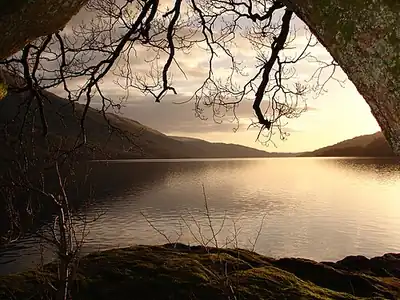
Image 30Loch Lomond in Scotland forms a relatively isolated ecosystem. The fish community of this lake has remained stable over a long period until a number of introductions in the 1970s restructured its food web. (from Ecosystem)
Image 33View of Earth, taken in 1972 by the Apollo 17 crew. Approximately 71% of Earth's surface (an area of some 361 million square kilometers) consists of ocean (from Ecoregion)
Image 34A false color composite of the greater Boston area, created using remote sensing technology, reveals otherwise not visible characteristics about the land cover and the health of the surrounding ecosystems. (from Environmental science)
Image 35Dense mass of white crabs at a hydrothermal vent, with stalked barnacles on right (from Habitat)