Portal:Ecology

 Portal |
 Topics and categories |
 WikiProject |
Ecology |
 Ecology (from Ancient Greek οἶκος (oîkos) 'house' and -λογία (-logía) 'study of') is the natural science of the relationships among living organisms and their environment. Ecology considers organisms at the individual, population, community, ecosystem, and biosphere levels. Ecology overlaps with the closely related sciences of biogeography, evolutionary biology, genetics, ethology, and natural history. Ecology is a branch of biology, and is the study of abundance, biomass, and distribution of organisms in the context of the environment. It encompasses life processes, interactions, and adaptations; movement of materials and energy through living communities; successional development of ecosystems; cooperation, competition, and predation within and between species; and patterns of biodiversity and its effect on ecosystem processes. Ecology has practical applications in fields such as conservation biology, wetland management, natural resource management, and human ecology. The term ecology (German: Ökologie) was coined in 1866 by the German scientist Ernst Haeckel. The science of ecology as it is known today began with a group of American botanists in the 1890s. Evolutionary concepts relating to adaptation and natural selection are cornerstones of modern ecological theory. Ecosystems are dynamically interacting systems of organisms, the communities they make up, and the non-living (abiotic) components of their environment. Ecosystem processes, such as primary production, nutrient cycling, and niche construction, regulate the flux of energy and matter through an environment. Ecosystems have biophysical feedback mechanisms that moderate processes acting on living (biotic) and abiotic components of the planet. Ecosystems sustain life-supporting functions and provide ecosystem services such as biomass production (food, fuel, fiber, and medicine), the regulation of climate, global biogeochemical cycles, water filtration, soil formation, erosion control, flood protection, and many other natural features of scientific, historical, economic, or intrinsic value. (Full article...) Selected article - The biosphere (from Ancient Greek βίος (bíos) 'life' and σφαῖρα (sphaîra) 'sphere'), also called the ecosphere (from Ancient Greek οἶκος (oîkos) 'settlement, house' and σφαῖρα (sphaîra) 'sphere'), is the worldwide sum of all ecosystems. It can also be termed the zone of life on the Earth. The biosphere (which is technically a spherical shell) is virtually a closed system with regard to matter, with minimal inputs and outputs. Regarding energy, it is an open system, with photosynthesis capturing solar energy at a rate of around 100 terawatts. By the most general biophysiological definition, the biosphere is the global ecological system integrating all living beings and their relationships, including their interaction with the elements of the lithosphere, cryosphere, hydrosphere, and atmosphere. The biosphere is postulated to have evolved, beginning with a process of biopoiesis (life created naturally from non-living matter, such as simple organic compounds) or biogenesis (life created from living matter), at least some 3.5 billion years ago. In a general sense, biospheres are any closed, self-regulating systems containing ecosystems. This includes artificial biospheres such as Biosphere 2 and BIOS-3, and potentially ones on other planets or moons. (Full article...) Selected image - Credit: Martin St-Amant The Iguazu Falls, on the border of Brazil and Argentina are waterfalls of the Iguazu River located on the border of the Brazilian State of Paraná and the Argentine Province of Misiones.
General imagesThe following are images from various ecology-related articles on Wikipedia.
Related WikiProjectsWikiProject Ecology 
Things you can do
| ||||||||||||||||||||||||||||||||||||||||||||||||||||


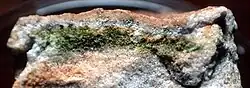


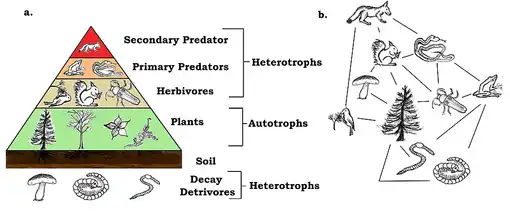
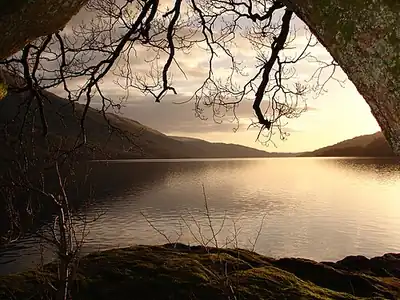

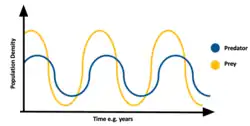





| “ | A land ethic for tomorrow should be as honest as Thoreau's Walden, and as comprehensive as the sensitive science of ecology. It should stress the oneness of our resources and the live-and-help-live logic of the great chain of life. | ” |
| — Stewart Udall |
Selected publication -
Plant Ecology is a scientific journal on plant ecology, formerly known as Vegetatio. The journal publishes original scientific papers on the ecology of vascular plants and terrestrial and aquatic ecosystems. The editor in chief is Neal J. Enright (Murdoch University). (Full article...)
Related portals
More did you know -
Related articles
| Overview |
|  |
|---|---|---|
| Chemical basis | ||
| Cells | ||
| Genetics | ||
| Evolution | ||
| Diversity | ||
| Plant form, function | ||
| Animal form, function | ||
| Ecology | ||
| ||


| Main fields |  | |
|---|---|---|
| Related fields |
| |
| Applications | ||
| Lists | ||
| See also | ||
| ||

Associated Wikimedia
The following Wikimedia Foundation sister projects provide more on this subject:
-
 Commons
Free media repository -
 Wikidata
Free knowledge base -
 Wikiquote
Collection of quotations -
 Wikisource
Free-content library -
 Wikiversity
Free learning tools -
 Wiktionary
Dictionary and thesaurus
Web resources
-
 List of all portals
-

-

-

-

-

-

-

-

-

-
 Random portal
-
 WikiProject Portals