Hwasong-16A
| Hwasong-16A (presumed) | |
|---|---|
| Type | Intermediate-range ballistic missile |
| Place of origin | North Korea |
| Service history | |
| Used by | Korean People's Army Strategic Force |
| Production history | |
| Designed | 2024 |
| Manufacturer | North Korea |
| Specifications | |
| Warhead | Maneuverable reentry vehicle |
| Engine | Two-stage, solid-fueled engine |
| Maximum speed | Tested: Mach 10 (12,300 km/h) |
The Hwasong-16A (Korean: 《화성-16가》형; lit. 'Mars Type 16A') is presumed to be the official designation of a North Korean two-stage, solid-fueled hypersonic, intermediate-range ballistic missile first tested in January 2024.
Description
| Images of the Hwasong-16A | |
|---|---|
 Launch of the missile |
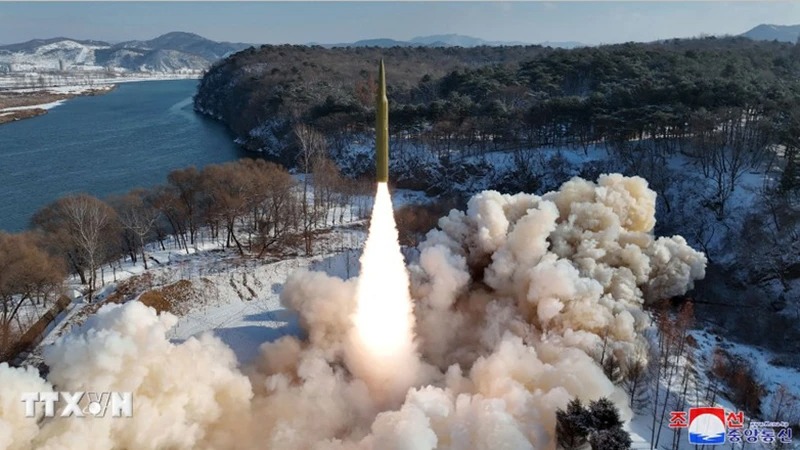
The Hwasong-16A is a two-stage, solid-fueled missile,[1] uses the same booster as Hwasong-16B,[2] which is based on the Hwasong-18 solid-fueled ICBM.[3] A solid-fuel IRBM would be able to threaten U.S. military bases such as on Guam as far as 3,400 km (2,100 mi) away from North Korea, while having the same advantages of being easier to move and quicker to launch than the liquid-fueled Hwasong-12 IRBM.[4] North Korean media also claimed the missile was equipped with a hypersonic warhead, similar to the conical, finned maneuverable reentry vehicle (MaRV) payload used on the Hwasong-12A, which was tested in January 2022.[5] Such a payload would complicate ballistic missile defenses due to its lower altitude flight path keeping it below radar coverage longer and the ability to perform terminal maneuvers.[6]
Data from the January 2024 test-fire showed that the missile had achieved a maximum speed of Mach 10 (12,300 km/h).[1]
History
In November 2023, North Korea announced static ground tests of solid-fueled engines for a solid-fueled IRBM.[7]
On 14 January 2024, Hwasong-16A made its public debut with a flight test, conducted by the DPRK Missile Administration.[8][9] However, the missile was not officially named by North Korean state media.[10]
Its booster was used for the Hwasong-16B's maiden flight test on 2 April 2024.[11] After the launch, the Hwasong-16A designation was suggested to be the missile's official name.[10] However, this designation remains unconfirmed.[12]
List of tests
| Attempt | Date (Pyongyang Standard Time) | Location | Pre-launch announcement | Outcome | Additional notes | References |
|---|---|---|---|---|---|---|
| 1 | 14 January 2024, 2:55 p.m. | Around Pyongyang | None | Success | South Korea claimed it travelled 1,000 km (620 mi), while Japanese data showed it flew at least 500 km (310 mi). According to North Korean state media, the launch was to verify the reliability of a new multi-stage, high-thrust solid-fuel engine and the hypersonic warhead. United States, Japan and South Korea condemned the launch. | [13][14][15] |
See also
References
- 1 2 Yoon, Sang-ho (16 January 2024). 서울 1분내 타격… 北 음속10배 IRBM, 사드로 요격 어려워 [Seoul can be hit within one minute... North Korea's IRBM has a speed of Mach 10, difficult to intercept with THAAD]. The Dong-A Ilbo (in Korean). Retrieved 11 February 2025.
- ↑ "Hwasong-16B". Missile Threat. Center for Strategic and International Studies. 17 December 2025. Retrieved 5 January 2026.
- ↑ Van Diepen, Vann H. (18 January 2024). "North Korea Tests New Solid IRBM With MaRV Payload". 38 North. Retrieved 7 February 2025.
- ↑ Kim, Hyung-Jin (14 January 2024). "North Korea launches a suspected intermediate-range ballistic missile that can reach distant US bases". Associated Press. Retrieved 7 February 2025.
- ↑ JSF (15 January 2024). 北朝鮮が「極超音速ミサイル」を固体燃料化した新型中距離ミサイルの試験発射に成功 [North Korea successfully test-fired new IRBM using solid fuel instead of the hypersonic technology]. Yahoo News Japan (in Japanese). Retrieved 28 May 2026.
- ↑ Lendon, Brad; Seo, Yoonjung (15 January 2024). "North Korea claims another successful test of its hypersonic glide missile tech". CNN. Retrieved 7 February 2025.
- ↑ "North Korea tests 'new type, high thrust' solid-fuel engines for IRBMs". Al Jazeera. 15 November 2023. Retrieved 8 August 2025.
- ↑ "Nhật-Hàn cảnh báo khả năng Triều Tiên gia tăng tần suất các vụ phóng tên lửa" [Japan and South Korea warns about increased frequency of North Korean missile tests]. Gia Lai TV (in Vietnamese). Gia Lai Newspaper and Radio, Television. 17 January 2024. Retrieved 28 May 2026.
- ↑ "Hypersonic Missile Test-fire Conducted in DPRK". Korean Central News Agency. 15 January 2024. Archived from the original on 15 December 2024. Retrieved 26 December 2024.
- 1 2 Kim, Tong-hyung (2 April 2024). "North Korea says it tested a new hypersonic intermediate-range missile that's easier to hide". Associated Press. Retrieved 28 May 2026.
Kim Dong-yub, a professor at the University of North Korean Studies in Seoul, said the missile tested on Tuesday was likely different from the system tested in January, which state media didn't name but was likely the Hwasong-16A.
- ↑ Van Diepen, Vann H. (5 April 2024). "Second Flight of North Korea's Solid IRBM Also Second Flight of HGV". 38 North. Retrieved 31 January 2025.
- ↑ Kristensen, Hans M.; Korda, Matt; Johns, Eliana; Knight-Boyle, Mackenzie (15 July 2024). "North Korean nuclear weapons, 2024". Bulletin of the Atomic Scientists. Retrieved 20 July 2025.
- ↑ "S/2024/215". UNDOCS. United Nations. 7 March 2024. p. 129. Retrieved 28 May 2026.
- ↑ "Triều Tiên xác nhận thử nghiệm thành công tên lửa siêu thanh nhiên liệu rắn, khẳng định không ảnh hưởng tới các nước láng giềng" [North Korea confirms successful test of solid-fuel hypersonic missile, asserting it poses no threat to neighboring countries]. Truyền hình Thanh Hóa (in Vietnamese). Thanh Hoa Newspaper and Radio, Television. 15 January 2024. Archived from the original on 28 April 2026. Retrieved 5 January 2026.
- ↑ "Triều Tiên tuyên bố thử thành công tên lửa mang đầu đạn siêu vượt âm" [North Korea claims to have successfully tested missile with hypersonic warhead]. Langson Radio & Television (in Vietnamese). Lang Son Newspaper and Radio, Television. 15 January 2024. Retrieved 28 May 2026.