Hwasong-11B
| Hwasong-11B | |
|---|---|
 Artist rendition of the missile, with two color variants: Black-white (left) and tan-white (right) | |
| Type | Short-range ballistic missile |
| Place of origin | North Korea |
| Service history | |
| Used by | North Korea (Korean People's Army Strategic Force) Russia |
| Wars | Russo-Ukrainian war |
| Production history | |
| Designed | 2019 |
| Specifications | |
| Length | 7.2 m (24 ft) |
| Diameter | 1.0 m (3 ft 3 in) |
| Warhead | 400–500 kg (880–1,100 lb) |
| Engine | Solid fuel rocket |
Operational range | 410 km (250 mi) |
| Maximum speed | up to 2.1 km/s (Mach 6.2) |
Guidance system | Inertial navigation system (INS), possible satellite navigation |
| Accuracy | 35–200 m (115–656 ft) |
Launch platform | tracked or 8×8 wheeled TEL |
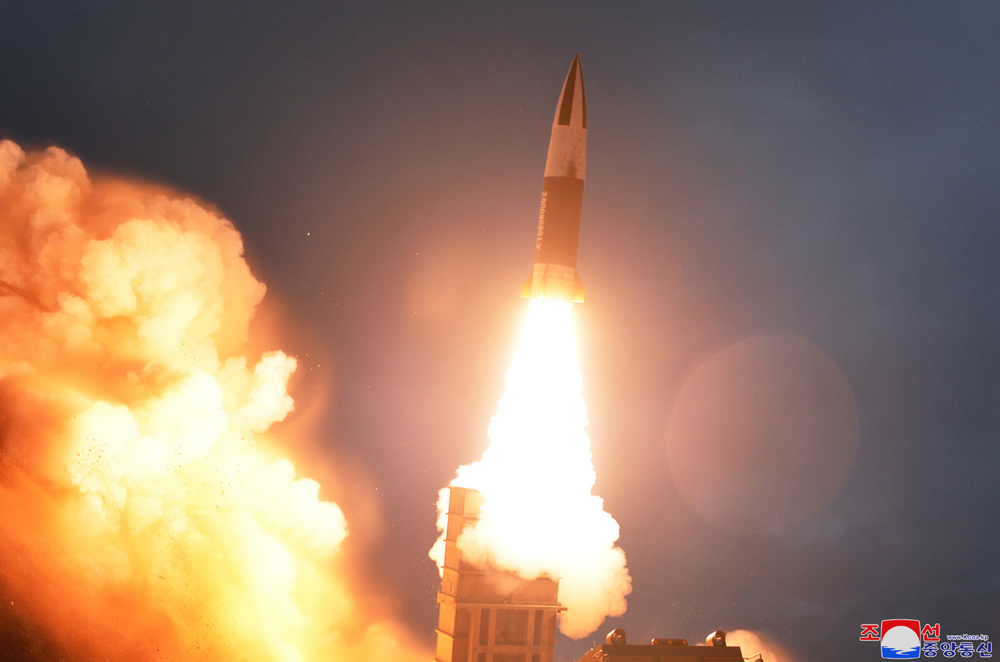
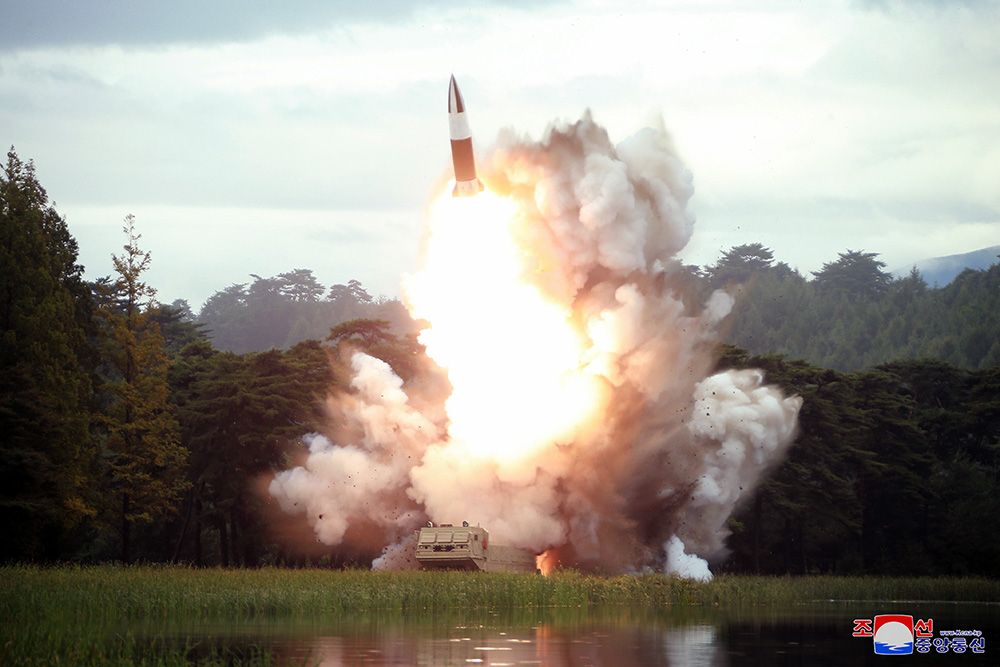
The Hwasong-11B (Korean: 《화성포-11나》형; lit. 'Mars Artillery Type 11B'), also known as KN-24 under the United States naming convention and other names,[a] is a North Korean single-stage, solid-fueled tactical ballistic missile. A missile closely resembling the American ATACMS, it was first revealed on 10 August 2019 with a test flight. The official designation was confirmed in October 2021, during a military exhibition. The missile has been reported to be used by Russian force during Russo-Ukrainian war.
Description
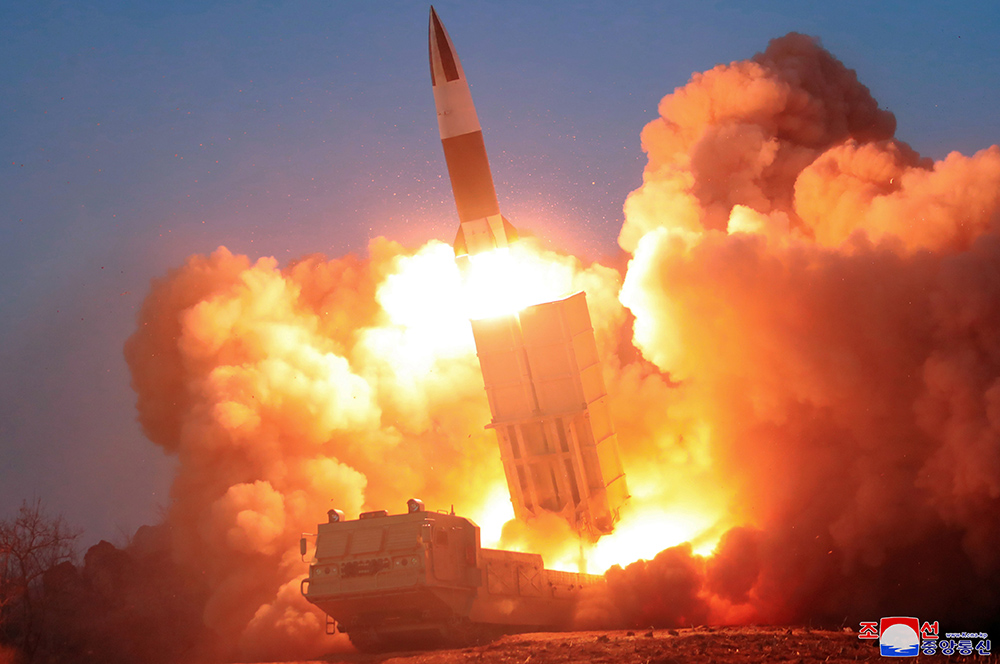
The Hwasong-11B is a missile that bears similarities to the American ATACMS and South Korean KTSSM,[1][2] especially in external resemblance, which is similar to ATACMS. It likely fills a similar role of supporting battlefield operations. The missile's aft-mounted aerodynamic fins are fixed rather than foldable like those on the ATACMS, requiring deployment from rectangular launch canisters. It flies in a "variable ballistic trajectory," flattening out at a lower altitude, below around 50 km (31 mi), than traditional SRBMs like the Scud, where the atmosphere is dense enough, so the missile's fins can maintain aerodynamic control over its entire flight and dive toward the target.[3][4][5]
The use of INS updated with satellite-guidance data could make it accurate to within 35–200 m (115–656 ft) CEP, depending whether the missile uses satellite guidance or INS alone.[5][6] Although the missile is outwardly similar to the ATACMS, it has demonstrated greater range, suggesting its physical dimensions are larger.[4] It appears to share a common booster with the Hwasong-11A (KN-23) and is estimated to carry a 400–500 kg (880–1,100 lb) payload with a unitary or submunition warhead.[3] The Hwasong-11B is also capable of carrying the Hwasan-31 tactical nuclear warhead.[7] It is likely to replace older liquid-fueled North Korean SRBMs, such as Hwasong-5 and Hwasong-6, as its non-parabolic trajectory makes it more survivable against missile defense systems, and its increased accuracy reduces the number of missiles that would be needed to destroy a single target.[5]
Despite their similarities to the ATACMS system, the Hwasong-11B is significantly larger, with estimated length and diameter being 7.2 m (24 ft) and 1.0 m (3 ft 3 in), respectively.[8][9] The missile also likely uses the same motor as the Pukguksong-1 with similar jet vanes, and overall resembling a single stage version of it. The transporter erector launcher is a tracked chassis, which has a width of about 1.26 m (4 ft 2 in) and a wheel diameter of 0.78 m (2 ft 7 in), similar to the Pukguksong-2's tracked mobile launcher.[8] It is similar to the TEL of South Korean Hyunmoo-2A and 2B; however, North Korean system utilizes two launch canisters instead of one used by South Korean counterpart.[2] A number of images shown of the system appears to be manipulated, significantly increasing the size of the launcher.[8] The Hwasong-11B can also be launched using a four-axle truck chassis.[10]
With the missile fulfilling a similar role to the Hwasong-11A, there should have been no need to develop another missile later with an overlapping performance. In an analysis of news reports from the Korean Central News Agency, despite the differences the Hwasong-11A possesses from the 9K720 Iskander, the Hwasong-11A is likely to be constructed with foreign assistance or foreign parts.[11]
While all the news reports on the Hwasong-11A mainly focused on the deployment, "demonstration of power" and newness of it, reports on the Hwasong-11B instead focused on the "research" and "development" in its first launch,[11] as well as its superiority compared with older weapons.[12] Later launches of Hwasong-11B made mention of "Juche weapons of Korean style", which is not mentioned at all for the Hwasong-11A, hinting that whereas the Hwasong-11B underwent a research and development phase, the Hwasong-11A was already deployed prior to being tested, and likely having foreign involvement in some form.[11]
Naming
The official designation, Hwasong-11B, was revealed in October 2021 during the "Self-Defense 2021" military exhibition, as an image published by North Korean state media clearly showed the missile's official name.[13] The Hwasong-11B can also be referred to as Hwasong-11Na or Hwasongpho-11Na,[14][15] with the letter "Na" (나) being the second letter of the Korean alphabet.[16] In its known launches, occurred between 2019 and 2023, North Korean state media called Hwasong-11B "new weapon", "tactical guided missile" and "tactical ballistic missile" instead of the formal name.[17][18][19]
The Hwasong-11B is externally known by intelligence communities outside North Korea as KN-24 under the US nomenclature.[3] Other external names also include 19-4 SRBM, used by South Korean military,[20] as well as Songun ATACMS, a nickname given by analysts.[21][22]
History
Hwasong-11B made its public debut on 10 August 2019 with a flight test. Another test-fire occurred on 16 August 2019. A third flight test was also carried out on 21 March 2020.[23] Later, North Korea featured Hwasong-11B in military parades on 10 October 2020 and 14 January 2021,[24][25] as well as the "Self-Defence 2021" military exhibition in October 2021, where North Korea revealed official name of the missile.[13]
North Korea also unveiled a tan-coloured version of Hwasong-11B during the "Self-Defence 2021" military exhibition.[8][13] After the exhibition, a further test of Hwasong-11B occurred on 17 January 2022,[26] where North Korea declared it under production.[18]
Hwasong-11B also appeared in military parades on 25 April 2022,[27] 8 February 2023,[28] as well as on 27 July 2023, when North Korea unveiled truck-type TEL of Hwasong-11B.[10] A further test-fire took place on 30 August 2023.[19][28]
According to the International Institute for Strategic Studies (IISS), as of 2025, North Korea is possessing more than nine Hwasong-11B launchers. These launchers are assessed as "in test" by the IISS.[29]: 268
Russian use in Ukraine
In February 2024, Ukraine claimed to shoot down Hwasong-11B missiles,[30] with Ukrainian media confirming an interception on 15 February near Kyiv.[31] A day after the claimed shooting down, Ukrainian data showed 24 missiles, including Hwasong-11B, being used by Russia, allegedly with low accuracy.[32]
In August 2024, the Conflict Armament Research documented the debris of four additional North Korean ballistic missiles that landed in Ukraine. These debris, retrieved in Bila Tserkva, Vitrova Balka and Rozhivka, may be from Hwasong-11B.[33]
According to Ukraine, at the start of 2025, North Korea had supplied 148 ballistic missiles of two types, including Hwasong-11B.[34]
In April 2026, a Ukrainian report revealed that North Korean ballistic missiles (including Hwasong-11B) used by Russia in 2024 were made using commercial electronics with outdated manufacturing methods (up to 50 years old) and used less energy-efficient fuel, requiring North Korean missiles to use larger engines to achieve the same range as Russian counterpart.[30] Four months later, Ukraine claimed that North Korea had supplied another batch of 40 Hwasong-11A and 11B missiles to Russia and would deploy a missile unit that could be equipped with six launchers and additional 120 missiles (including Hwasong-11B).[35]
List of tests
Confirmed tests
| Attempt | Date | Location | Number of missiles tested | Outcome | Additional notes | References |
|---|---|---|---|---|---|---|
| 1 | 10 August 2019 | Hamhung | 2 | Success | These missiles reached an apogee of 48 km (30 mi) and a range of 400 km (250 mi), at a speed of 2.1 km/s (7,600 km/h; 4,700 mph). North Korean state media did not name the missile, and Kim Jong Un oversaw the test-fire. | [3][17][36] |
| 2 | 16 August 2019 | Tongchon | 2 | Success | These missiles flew to an apogee of 30 km (19 mi) and a range of 230 km (140 mi), demonstrating a depressed trajectory. Kim Jong Un supervised the test-fire. | [23][37] |
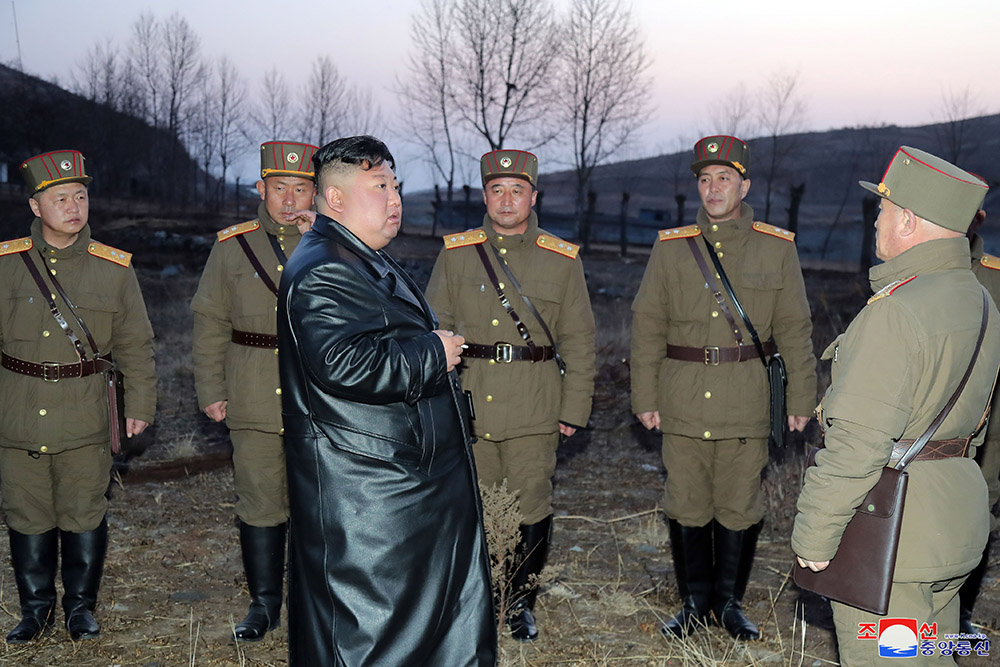
| 3 | 21 March 2020 | Sonchon | 2 | Success | These missiles flew to an apogee of 50 km (31 mi) and a range of 410 km (250 mi), performing "pull-up maneuvers" in flight, and one supposedly striking a small 100 meter-long island. Kim Jong Un supervised the test-fire. | [3][4][38] |
| 4 | 17 January 2022 | Sunan Airport | 2 | Success | The missiles flew 380 km (240 mi) and achieved an apogee of 42 km (26 mi), with a maximum speed of Mach 5 (1.7 km/s). The test-fire was conducted to check operational readiness and validate the build quality of mass-produced Hwasong-11B missiles. | [26][39] |
| 5 | 5 November 2022 | Unknown | 2 | Success | Information based on images released by the Korean Central News Agency on 7 November 2022. These missiles were equipped with cluster warheads, reached 20 km (12 mi) apogee and flew 130 km (81 mi). The missiles were beige-white-painted, not the original black-white. | [40][41] |
| 6 | 30 August 2023 | Sunan Airport | 2 | Success | These missiles achieved 50 km (31 mi) apogee. One missile flew 400 km (250 mi), the other flew 350 km (220 mi). It exploded at an altitude of about 400 m (1,300 ft) above the target. According to North Korea, the launch was to simulate a tactical nuclear strike drill against South Korea. | [19][23][42] |
Alleged tests
According to member states of the United Nations Security Council, some of the eight ballistic missiles fired on 5 June 2022 could be the Hwasong-11B.[43]
See also
- KTSSM – South Korean tactical ballistic missile
- ATACMS – American tactical ballistic missile
- Hwasong-11D – North Korean short-range ballistic missile
Notes
References
- ↑ "Sự tương đồng bất ngờ giữa vũ khí chiến thuật của Triều Tiên và tên lửa Mỹ - Hàn" [Surprising similarities between North Korea's tactical weapon and US-South Korean missiles]. Thái Nguyên TV (in Vietnamese). ThaiNguyen Radio and Television Station. Archived from the original on 12 November 2024. Retrieved 29 August 2025.
- 1 2 "Vũ khí chiến thuật Triều Triên vừa phóng giống tên lửa Mỹ, Hàn" [Newly-launched North Korean tactical weapon similar to US, South Korean missiles]. Bắc Ninh TV (in Vietnamese). Bac Ninh Newspaper and Radio – Television. 12 August 2019. Retrieved 25 April 2026.
- 1 2 3 4 5 "KN-24". Missile Threat. CSIS. 15 April 2020. Retrieved 26 January 2025.
- 1 2 3 Elleman, Michael (25 March 2020). "Preliminary Assessment of the KN-24 Missile Launches". 38 North. Retrieved 9 February 2025.
- 1 2 3 Elleman, Michael (9 October 2019). "North Korea's New Short-Range Missiles: A Technical Evaluation". 38 North. Retrieved 9 February 2025.
- ↑ Delory, Stéphane; Bondaz, Antoine; Maire, Christian (2023). "North Korean Short Range Systems: Military consequences of the development of the KN-23, KN-24 and KN-25" (PDF). Foundation for Strategic Research. p. 77. Archived (PDF) from the original on 16 January 2023. Retrieved 27 December 2024.
- ↑ Yang, Uk (29 June 2023). 북한의 최신 핵무기 개발 현황: 핵그림자를 드리우는 북한의 인지전 시도 [North Korea's latest nuclear weapons developments: North Korea's cognitive warfare attempts to cast a nuclear shadow]. Asan Institute for Policy Studies (in Korean). Retrieved 26 July 2025.
- 1 2 3 4 Brügge, Norbert. "Pukguksong GLBM-1". b14643.eu. Norbert Brügge. Retrieved 25 October 2021.
- ↑ Sokolin, Anton (17 April 2026). "North Korean missiles used in Ukraine strikes aren't just Russian copies: Kyiv". NK News. Retrieved 19 April 2026.
- 1 2 Xu, Tianran (8 August 2023). "Brief on 27 July 2023 Parade of the DPRK". Open Nuclear Network. Retrieved 26 January 2025.
- 1 2 3 Xu, Tianran; Shin, Jaewoo (23 April 2020). "A Tale of Two Missiles: Analysis of KCNA Reports on North Korea's KN-23 and KN-24 Short-Range Ballistic Missiles". Datayo. Archived from the original on 15 January 2021. Retrieved 12 October 2021.
- ↑ "Triều Tiên khẳng định vũ khí vừa thử vượt trội so với các mẫu cũ" [North Korea confirmed the new weapon was superior compared with older models]. Gia Lai TV (in Vietnamese). Gia Lai Newspaper and Radio, Television. 11 August 2019. Retrieved 12 April 2026.
- 1 2 3 Zwirko, Colin (18 January 2022). "North Korea says it successfully launched 'tactical guided missiles' on Monday". NK News. Retrieved 5 June 2025.
- ↑ Xu, Tianran (18 October 2021). "Brief on the Defence Development Exhibition of the Democratic People's Republic of Korea" (PDF). Open Nuclear Network. p. 10. Retrieved 20 April 2026.
- ↑ Lee, Je-hun (29 March 2023). "N. Korea reveals tactical nuclear warhead for first time". The Hankyoreh. Retrieved 28 December 2024.
- ↑ "North Korean nuclear forces (2021)" (PDF). Stockholm International Peace Research Institute. p. 5. Retrieved 28 December 2024.
- 1 2 "Supreme Leader Kim Jong Un Guides Test-Fire of New Weapon". Korean Central News Agency. 11 August 2019. Retrieved 26 January 2025 – via Korean Association of Social Scientists. For images, see 1 and 2.
- 1 2 Ji, Da-gyum (18 January 2022). "'Tactical guided missiles' now under production, N. Korea says". The Korea Herald. Retrieved 19 July 2026.
- 1 2 3 "KPA General Staff Releases Report". Korean Central News Agency. 31 August 2023. Retrieved 26 July 2025. For image, see here.
- ↑ JSF (3 February 2021). 韓国軍国防白書2020の北朝鮮ミサイル比較図から大きさ推定値 [Size estimate from comparative diagram of North Korean missiles in South Korean Defense White Paper 2020]. Yahoo News Japan (in Japanese). Retrieved 20 June 2025.
- ↑ Panda, Ankit (11 August 2019). "Unpacking North Korea's new weapon: the "Songun ATACMS"". NK Pro. NK News. Retrieved 28 December 2024.
- ↑ Lim, Dong Geon (20 August 2019). "North Korea's Recent Missile and 'Projectile' Tests Need Your Attention". Center for the National Interest. Retrieved 20 April 2026.
- 1 2 3 "The CNS North Korea Missile Test Database". Nuclear Threat Initiative. 12 November 2024. Retrieved 12 January 2025.
- ↑ "Viewbook of DPRK 10 October 2020 Parade" (PDF). Open Nuclear Network. 13 October 2020. Retrieved 26 January 2025.
- ↑ Dahlgren, Masao (15 January 2021). "North Korea Displays New Missiles in Nighttime Parade". Missile Threat. CSIS. Retrieved 26 January 2025.
- 1 2 "Triều Tiên xác nhận phóng thử hai tên lửa dẫn đường chiến thuật" [North Korea confirmed test of two tactical guided missiles]. Nam Định TV (in Vietnamese). Nam Dinh Radio and Television Station. 18 January 2022. Archived from the original on 27 January 2022. Retrieved 25 April 2026.
- ↑ Xu, Tianran (2 May 2022). "25 April 2022 DPRK Parade" (PDF). Open Nuclear Network. Retrieved 26 January 2025.
- 1 2 "S/2024/215". UNDOCS. United Nations. 7 March 2024. Retrieved 23 May 2026.
- ↑ International Institute for Strategic Studies (12 February 2025). The Military Balance 2025 (1st ed.). Routledge. ISBN 978-1041049678.
- 1 2 Loh, Matthew (17 April 2026). "North Korean ballistic missiles were made with outdated methods from up to 50 years ago: Ukraine MOD". Business Insider. Retrieved 22 April 2026.
- ↑ Buderatskyi, Yevhen; Kizilov, Yevhen (16 February 2024). "North Korean KN-24 missile leaves huge crater in Bucha district". Ukrainska Pravda. Retrieved 7 February 2025.
- ↑ Balforth, Tom (16 February 2024). "Ukrainian data casts doubt on precision of N.Korea missiles fired by Russia". Reuters. Archived from the original on 19 August 2024. Retrieved 17 February 2024.
- ↑ "MSMT/2025/1" (PDF). Multilateral Sanctions Monitoring Team. 29 May 2025. p. 12. Retrieved 16 February 2026.
- ↑ Balforth, Tom (24 April 2025). "Missile that killed 12 in Russian strike on Kyiv was North Korean, Zelenskiy says". Reuters. Retrieved 25 April 2025.
By the start of 2025, Pyongyang had supplied Russia with 148 KN-23 [Hwasong-11A] and KN-24 [Hwasong-11B] ballistic missiles, Ukraine's military spy agency says.
- ↑ Newdick, Thomas (5 August 2026). "North Korea Upping Ballistic Missile Supplies To Russia Would Be Bad News For Ukraine At The Worst Time". The War Zone. Recurrent Ventures. Retrieved 6 August 2026.
- ↑ "Triều Tiên: Ngày 10/8 đã thử nghiệm vũ khí mới 'hoàn hảo yêu cầu về uy lực'" [North Korea tested new weapon on 10 August, 'perfectly meeting requirements for destructive power']. Quảng Trị TV (in Vietnamese). Quảng Trị Radio and Television Station. 11 August 2019. Archived from the original on 23 August 2019. Retrieved 16 February 2026.
- ↑ "Supreme Leader Kim Jong Un Guides Test-fire of New Weapon Again". Korean Central News Agency. 17 August 2019. Retrieved 21 May 2026 – via Korean Association of Social Scientists. For images, see 1 and 2.
- ↑ "Supreme Leader Kim Jong Un Observes Demonstration Fire of Tactical Guided Weapon". Korean Central News Agency. 22 March 2020. Retrieved 26 January 2025. For images, see 1 and 2.
- ↑ "Test-fire of Tactical Guided Missiles Held". Korean Central News Agency. 18 January 2022. Retrieved 26 January 2025.
- ↑ "S/2023/171". UNDOCS. United Nations. 7 March 2023. p. 185. Retrieved 23 May 2026.
- ↑ JSF (7 November 2022). 北朝鮮が11月2日~5日のミサイル大量発射を報告 [North Korea reports numerous missile launches from 2 to 5 November]. Yahoo News Japan (in Japanese). Retrieved 29 August 2025.
- ↑ "Triều Tiên diễn tập tấn công hạt nhân nhằm vào Hàn Quốc" [North Korea hold simulated nuclear strike drill against South Korea]. Truyền hình Nghệ An (in Vietnamese). Nghe An Newspaper and Radio, Television. 31 August 2023. Retrieved 16 February 2026.
- ↑ "S/2022/668". UNDOCS. United Nations. 7 September 2022. pp. 22, 161. Retrieved 23 May 2026.