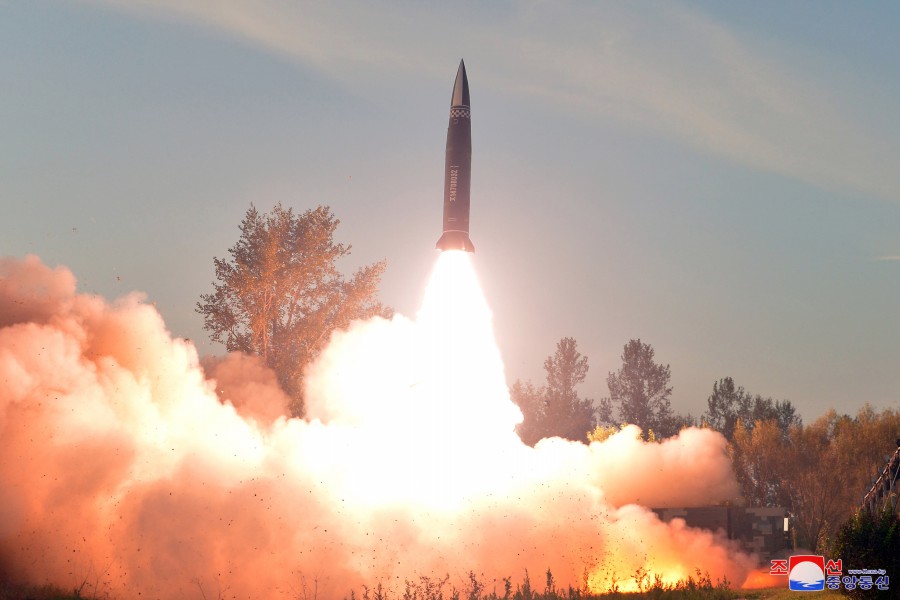
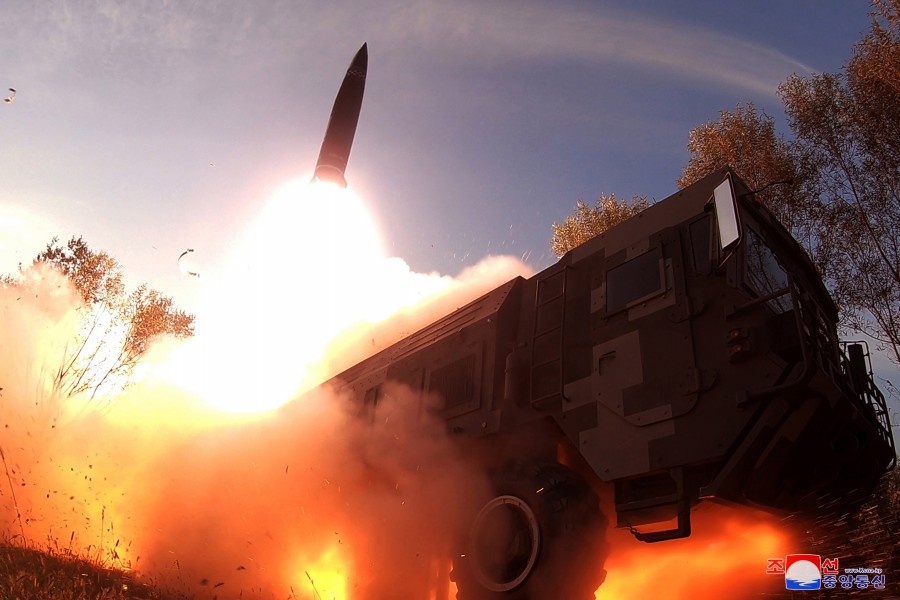
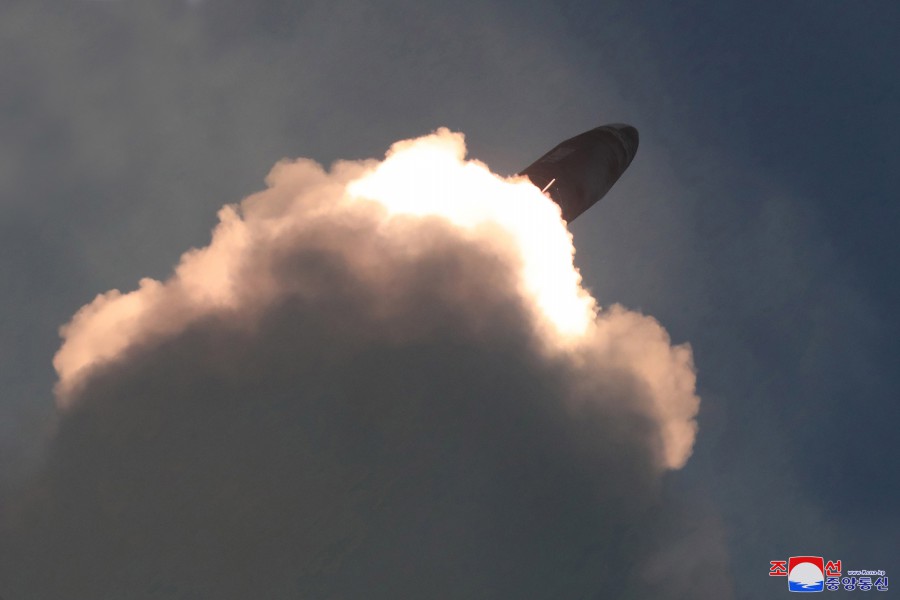
Hwasong-11C
| Hwasong-11C | |
|---|---|
 Artist rendition of the missile | |
| Type | Short-range ballistic missile |
| Place of origin | North Korea |
| Service history | |
| In service | 2021–present |
| Used by | Korean People's Army Strategic Force |
| Production history | |
| Designed | 2021 |
| Developed from | Hwasong-11A |
| Developed into | Hwasong-11C-4.5, Hwasong-11E |
| Produced | 2025–present |
| Specifications | |
| Length | 10.1 m (33 ft) |
| Diameter | 1.26 m (4 ft 2 in) |
| Warhead | 2,500 kg (5,500 lb) Hwasan-31 |
| Engine | Solid-propelled engine 406.871 kN (41.4893 tf) |
Operational range | 600–1,000 km (370–620 mi) |
| Maximum speed | Mach 5 – Mach 6 (6,100–7,400 km/h; 3,800–4,600 mph) |
| Accuracy | 1–5 m (3 ft 3 in – 16 ft 5 in) |
Launch platform | 10×10 wheeled TEL |
The Hwasong-11C (Korean: 《화성포-11다》형; lit. 'Mars Artillery Type 11C') is a North Korean single-stage, solid-fueled short-range ballistic missile. It was first displayed during a military parade on 14 January 2021. A larger variant of the Hwasong-11A, Hwasong-11C has a heavier warhead compared to its baseline version, with the payload mass being claimed by North Korean state media as 2,500 kg (5,500 lb). First test of Hwasong-11C occurred on 25 March 2021 and mass production began in late 2025. In August 2026, Ukraine claimed Russia received Hwasong-11C missiles from North Korea.
Continued developments resulted in two further variants. In July 2024, a 4.5-ton warhead version Hwasong-11C was revealed. In late 2025, a Hwasong-11C-based design with hypersonic glide vehicle, called Hwasong-11E, was also unveiled.
Description
Hwasong-11C is the enlarged variant of the Hwasong-11A, with a closely similar design.[1][2] The missile's estimated length and diameter are 10.2 m (33 ft) and 1.26 m (4 ft 2 in), respectively,[3] while its maximum range based on data from March 2021 test is estimated to be at least 600 km (370 mi).[4] However, upper estimates indicate a longer range of from 900 km (560 mi) to 1,000 km (620 mi).[5][6] Hwasong-11C's aeroballistic trajectory, low flight altitude of 50 km (31 mi) and maximum speed of Mach 5 – Mach 6 (6,100–7,400 km/h; 3,800–4,600 mph) make it harder for missile defenses to intercept.[7][8] Recent upgrades (as of 2026) indicate a circular error probable of 1–5 m (3 ft 3 in – 16 ft 5 in).[7]
Hwasong-11C is fitted to a longer wheeled TEL with an additional two sections.[9] It is a 10×10 chassis capable of carrying missile in pairs.[10] This TEL design allows rapid deployment and makes it less vulnerable to detection and preemtive strikes.[7]
Based on information from the 25 March 2021 test, it appears that Hwasong-11C is longer compared with the base version. Its nose is also conical than Hwasong-11A, despite similar in shape to the Hwasong-11B. North Korea claims the missile to be equipped with a 2,500 kg (5,500 lb) warhead. According to 38 North, such a large warhead weight is almost certainly exaggerated.[11][12] It is possible North Korea can use this claim for propaganda purpose, intended to give the impression that North Korea is keeping pace with their adversary's missile advancements, as the South Korean Hyunmoo-4 has a 2,000 kg (4,400 lb) warhead and the Hwasong-11C was proclaimed as the world's largest warhead weight.[13] The new weapon may be able to almost completely cover South Korea from its launch site. If it can perform as claimed by North Korea, the weapon may be a powerful bunker buster weapon.[12] This claim is not independently verified,[14] and United Nations Security Council (UNSC) member states have questioned whether the 2.5-tonne warhead claim could refer to the entire weight of the missile after burnout, not just the warhead weight.[15]
The missile also uses the most powerful known solid propellant rocket motor developed by North Korea as of December 2021. It is longer and stronger than Hwasong-11A's engine, as Hwasong-11C's engine likely has an extra segment and produces a thrust of 406.871 kN (41.4893 tf).[3][9]
If Hwasong-11C is fired with a large payload mass, its actual range may be reduced.[14] In contrast, according to a member state of the UNSC, the missile can have a longer range and become a medium-range ballistic missile (MRBM) with a lighter warhead.[16]
Alongside with heavy warhead, Hwasong-11C is also claimed to be capable of carrying the Hwasan-31 tactical nuclear warhead.[17][18]
Naming
The official designation of Hwasong-11C was confirmed through photo evidence in March 2023. However, the blurred images led the suffix attached with the official name to confusing, and the name might also be read as Hwasong-11E, name of a hypersonic missile unveiled in late 2025.[19] Other romanization variants also include Hwasong-11Da and Hwasongpho-11Da.[20][21] However, in its earlier launches, the Hwasong-11C was simply referred to as "new-type tactical guided projectile" and later, "tactical ballistic missile".[22][23]
On 23 September 2024, South Korean analyst Jo Jang-won wrote for the Sejong Institute, suggesting that the two sub-variants of Hwasong-11C were internally named Hwasongpho-11-Da-2.5 and Hwasongpho-11-Da-4.5.[20]
Reportedly, before 2025, United States designated Hwasong-11C as KN-23A or KN-23B under their naming convention. However, in April 2025, it was revealed that these designations were unified to KN-30.[24]
The name of Hwasong-11C's 4.5-ton warhead variant was revealed just after its maiden test in July 2024.[25]
History
Hwasong-11C made its public debut on 14 January 2021 during a military parade,[26] with six Hwasong-11C launchers participating.[1] North Korea did not name these missiles.[27]
Hwasong-11C underwent its maiden flight test on 25 March 2021, the first North Korean state media-reported ballistic missile test since March 2020.[28][29] It was organized by the Academy of Defence Sciences.[30] A further test-fire occurred on 28 September 2022.[31] Between the test-fires, Hwasong-11C was displayed in the "Self-Defence 2021" military exhibition, as well as the 25 April 2022 military parade, when twelve Hwasong-11C missiles mounted on 5-axle launchers were displayed.[8][32]
The missile's official name was revealed in the Korean Central News Agency's report on the new Hwasan-31 nuclear warhead in late March 2023,[33] and continued testing resulted in a 4.5-ton warhead variant in July 2024.[34]
North Korea began mass production of Hwasong-11C in late 2025.[24] According to the International Institute for Strategic Studies (IISS), as of 2026, North Korea is possessing more than six "in test" Hwasong-11C launchers.[35]: 277
Alleged transfer to Russia
There are speculations that Hwasong-11C has been deployed by Russian forces in its war against Ukraine.[5][36] As of 2025, there is no evidence for the Hwasong-11C's transfer to Russia according to NK News.[17]
On 20 August 2026, Ukrainian intelligence claimed that Hwasong-11C missiles were part of a new batch of around 50 ballistic missiles newly received by Russia from North Korea as of July 2026.[37] It is the first known report of Hwasong-11C's transfer to Russia from a belligerent.[26] However, there is no evidence to confirm Russian use of this missile in Ukraine.[38]
List of tests
Confirmed tests
| Attempt | Date | Location | Number of missiles tested | Outcome | Additional notes | References |
|---|---|---|---|---|---|---|
| 1 | 25 March 2021 | Yonpo Airfield, near Hamhung and Sondok Airport, Chongpyong County (both in South Hamgyong Province) | 2 | Success | Initial data from South Korea and Japan showed the missiles were launched from Hamju County at 7:06 a.m. and 7:25 a.m. local time, with their analysis initially saying they only flew 420–450 km (260–280 mi) while reaching an apogee of 60 km (37 mi). Later, the missiles were confirmed to be launched from two different airfields located in South Hamgyong Province. According to North Korea, the "new-type tactical guided projectiles" flew 600 km (370 mi) and each missile was equipped with a 2,500 kg (5,500 lb) warhead. A month after the launch, South Korea revised their estimate and agreed with the North Korean statement of a 600 km (370 mi) range, saying the discrepancy resulted from blind spots in radar coverage due to the Earth's curvature. | [28][31][39][40] |
| 2 | 28 September 2022 | Sunan, Pyongyang | 2 | Success | South Korea detected the launch at 6:10 p.m. and 6:20 p.m. local time from Sunan. Both missiles reached 50 km (31 mi) apogee and flew 300–350 km (190–220 mi). Information released by North Korea on 10 October 2022 confirmed the test-fire was a nuclear warhead loading and launch simulation test for "neutralizing the airports in the operation zones of south Korea", with Kim Jong Un attending. North Korea published images of the test without naming the missile. | [23][31][41] |
Alleged tests
Member states of the United Nations Security Council alleges that the then-unnamed Hwasong-11C was test-fired on 25 May 2022 and 5 June 2022.[32]
American astrophysicist Jonathan McDowell claims another Hwasong-11C missile launch occurred on 1 July 2024, with the missile travelling 120 km (75 mi) and being launched with another missile, later confirmed to be its 4.5-ton warhead variant.[42]
Variants
Hwasong-11C-4.5
| Hwasong-11C-4.5 | |
|---|---|
| Type | Short-range ballistic missile |
| Place of origin | North Korea |
| Service history | |
| In service | 2024–present |
| Used by | Korean People's Army Strategic Force |
| Production history | |
| Designed | 2024 |
| Specifications | |
| Warhead | 4,500 kg (9,900 lb) |
| Engine | Solid-propelled engine |
Operational range | 500–900 km (310–560 mi) |
| Flight altitude | 50–100 km (31–62 mi) |
| Maximum speed | Mach 5 – Mach 6 (6,100–7,400 km/h; 3,800–4,600 mph) |
Guidance system | INS combined with satellite navigation |
| Accuracy | 5–30 m (16–98 ft) |
Launch platform | Mobile TEL |
The 4.5 tons warhead version of Hwasong-11C, called Hwasong-11C-4.5[a] (《화성포-11다-4.5》; lit. 'Mars Artillery Type 11C-4.5') is named after its 4.5-ton warhead.[46]
Description
| Images of the Hwasong-11C-4.5 | |
|---|---|
 September 2024 test | |
| Missile hitting target |
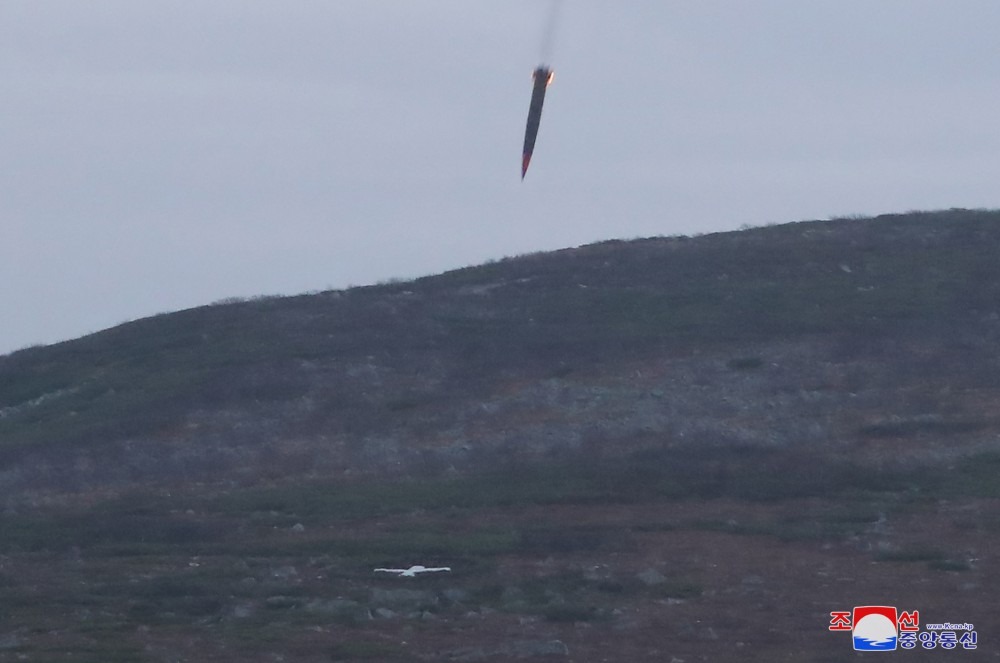

Hwasong-11C-4.5 is capable of carrying a 4,500 kg (9,900 lb) warhead,[47] an increase from the 2,500 kg (5,500 lb) warhead of the baseline Hwasong-11C.[48] It is nine times heavier than Hwasong-11A's payload mass. This payload capacity focuses on countering larger targets, such as military bases, aircraft carriers and strategic infrastructures.[49] It is developed due to the introduction of a Hyunmoo ballistic missile variant with super-large warhead by South Korea.[50]
Hwasong-11C-4.5 can be launched from a road-mobile TEL, which is capable of carrying two missiles. Its range is estimated from 500 km (310 mi) to 900 km (560 mi), depending on payload capacity. It can flew in a quasi-ballistic trajectory, with a flight altitude of 50–100 km (31–62 mi). The missile uses a guidance system combining INS and satellite navigation, thus reducing CEP to 5–30 m (16–98 ft). The solid-fueled composite engine burns for 20–30 seconds, and the missile can achieve a speed of Mach 5 – Mach 6 (6,100–7,400 km/h; 3,800–4,600 mph) at terminal phase.[49]
Assuming that the diameters of Hwasong-11C and its 4.5-ton warhead variant are similar, the Hwasong-11C-4.5 appears to be longer than its baseline version, possibly due to the lengthened missile body and heavier warhead.[50]
History
In 2021, North Korean leader Kim Jong Un listed super-large warhead on its list of high-tech weapons that North Korea wanted to develop.[34]
The first test flight of Hwasong-11C-4.5 occurred on 1 July 2024.[51] A further launch took place on 18 September 2024,[52] after some delays from a planned launch in July.[50]
An alleged third test occurred on 22 October 2025,[49] but it could also involved Hwasong-11E,[53] given the "hypersonic projectile" claim by North Korea.[54]
List of tests
| Attempt | Date (Pyongyang Standard Time) | Location | Outcome | Additional notes | References |
|---|---|---|---|---|---|
| 1 | 1 July 2024 | Jangyon County, South Hwanghae Province | Success | North Korean statement did not carry photos of the test, but claimed that the missile was launched with a simulated 4.5 tons warhead to verify its flight stability and target accuracy. The minimum and maximum range stated by North Korea were 90 km (56 mi) and 500 km (310 mi), respectively. The test was carried out by the Missile Administration.
According to South Korean military officials, the 1 July launch involved two missiles, one of which flew 120 km (75 mi) before disappearing from radar (likely failed), and the other flew 600 km (370 mi). |
[55][56][57] |
| 2 | 18 September 2024 | Kaechon Airport, South Pyongan Province | Success | The first test-fire with image publication of Hwasong-11C-4.5, it was conducted with two 4.5-ton conventional warhead-armed missiles. It was organized by the Missile Administration and supervised by Kim Jong Un. The missile flew 320 km (200 mi) before hitting an inland target. A "strategic" cruise missile was also launched along with Hwasong-11C-4.5 in this test. According to South Korea, two missiles were launched and flew 400 km (250 mi).
This test was likely delayed from a scheduled test in July 2024, which was planned to be conducted with a 250 km (160 mi) range. |
[50][58][59] |
| Unconfirmed | 22 October 2025 | Ryokpho District, Pyongyang | Success | South Korean military detected the launch of multiple ballistic missiles at 8:10 a.m., flying about 350 km (220 mi) before landing inland. However, given the description of "hypersonic projectiles" by North Korea, it is possible that the launch may also involve Hwasong-11E.
North Korean state media confirmed the Missile Administration-organized launch, with two missiles being fired. It flew in a northeast direction and hit their preset target at Kwesang Peak, located in Orang County, North Hamgyong Province, 430 km (270 mi) away from launch point. |
[60][61][62] |
Hwasong-11E
The Hwasong-11E is a Hwasong-11C-based missile with hypersonic glide vehicle. It was first displayed in October 2025 during a military exhibition,[63] with the missile likely using the same booster and 5-axle TEL.[64]
See also
Notes
References
- 1 2 "S/2021/211". UNDOCS. United Nations. 4 March 2021. pp. 14, 101. Retrieved 23 May 2026.
- ↑ "S/2024/215". UNDOCS. United Nations. 7 March 2024. p. 124. Retrieved 23 May 2026.
- 1 2 Chang, Young-Keun (December 2021). 북한 신형전술미사일(개량형 KN-23)의 기술평가 및 함의 [A Technical Evaluation and Implications of New North Korean SRBM Launched on March 25, 2021]. Korea Journal of Military Affairs (in Korean). 10 (2). Korea Institute for Military Affairs: 167–186. doi:10.33528/kjma.2021.12.10.167. ISSN 1228-2804. Retrieved 22 May 2026.
- ↑ Đào Cảnh (23 August 2026). "Tên lửa KN-30 Triều Tiên, đầu đạn 2,5 tấn hiện diện ở kho vũ khí Nga 'khủng' cỡ nào?" [What is the power of North Korea's KN-30 missile with 2.5-ton warhead in Russia's arsenal?]. VietNamNet (in Vietnamese). Retrieved 23 August 2026.
- 1 2 Abrams, A.B. (8 January 2024). "KN-23B deployments against Ukraine could be major boon for North Korea's wider defence exports". Daily NK. Retrieved 16 May 2025.
- ↑ Xuân Minh (22 August 2026). "Nga nhận tên lửa mới có tầm bắn gấp đôi Iskander" [Russia receives new missile with twice the range of Iskander]. Sức khỏe và Đời sống (in Vietnamese). Retrieved 22 August 2026.
- 1 2 3 Đào Cảnh (25 June 2026). "Tên lửa KN-23B tầm bắn 900km, đầu đạn 2.5 tấn và bài toán phòng không hiện đại" [KN-23B missile with 900 km range, 2.5-ton warhead and the problem of modern missile defenses]. VietNamNet (in Vietnamese). Retrieved 25 June 2026.
- 1 2 Xu, Tianran (2 May 2022). "25 April 2022 DPRK Parade" (PDF). Open Nuclear Network. p. 21. Retrieved 22 January 2025.
- 1 2 Brügge, Norbert. "Pukguksong GLBM-3". b14643.eu. Norbert Brügge. Retrieved 29 December 2024.
- ↑ "Hwasong-11C (Hwasong-11Da, KN-30)". NK Pro. NK News. 17 August 2026. Retrieved 22 August 2026.
- ↑ Van Diepen, Vann H. (30 March 2021). "Initial Analysis of North Korea's March 25 SRBM Launches". 38 North. Retrieved 22 January 2025.
- 1 2 Shin, Jaewoo; Bedenko, Veronika; Besaw, Clayton; Xu, Tianran (3 April 2021). "ONN Korean Peninsula Risk Assessment, March 2021" (PDF). Open Nuclear Network. p. 16. Retrieved 22 January 2025.
- ↑ Lee, Sangsoo (7 May 2021). "Missile Deployments on the Korean Peninsula: An Accelerating Arms Race". 38 North. Retrieved 22 January 2025.
- 1 2 Quỳnh Oanh (23 August 2026). "Quân sự thế giới hôm nay (23-8): Nga tiếp nhận tên lửa đạn đạo KN-30?" [World military news today (23 August): Did Russia receive KN-30 missiles?]. People's Army Newspaper (in Vietnamese). Retrieved 23 August 2026.
- ↑ "DPRK Military Parade Viewbook 2022" (PDF). Open Nuclear Network. 21 April 2022. p. 13. Retrieved 29 December 2024.
- ↑ "S/2021/777". UNDOCS. United Nations. 8 September 2021. p. 86. Retrieved 23 May 2026.
- 1 2 Zwirko, Colin (2 July 2024). "North Korea says it tested new tactical missile variant at two different ranges". NK News. Retrieved 16 May 2025.
- ↑ Yang, Uk (29 June 2023). 북한의 최신 핵무기 개발 현황: 핵그림자를 드리우는 북한의 인지전 시도 [North Korea's latest nuclear weapons developments: North Korea's cognitive warfare attempts to cast a nuclear shadow]. Asan Institute for Policy Studies (in Korean). Retrieved 25 May 2025.
- ↑ Zwirko, Colin (3 April 2023). Derr, Arius (ed.). "North Korea reveals internal names for several missile systems: Analysis". NK Pro. NK News. Retrieved 13 April 2026.
- 1 2 Jo, Jang-won (23 September 2024). "[Sejong Focus] Analysis of North Korea's Test Launch of Missile with 4.5-Ton Super-Large Warhead". Sejong Institute. Retrieved 29 May 2025.
The "Hwasongpho-11-Da" is an improved version of the KN-23 (North Korean Iskander) with an increased range and ability to accommodate larger warheads. It appears that North Korea refers to the 2.5-ton warhead variant as "Hwasongpho-11-Da-2.5," and the 4.5-ton variant as "Hwasongpho-11-Da-4.5".
- ↑ Xu, Tianran (8 August 2023). "Brief on 27 July 2023 Parade of the DPRK". Open Nuclear Network. Retrieved 29 December 2024.
- ↑ "Academy of Defence Science Test-fires New-type Tactical Guided Projectile". Korean Central News Agency. 26 March 2021. Retrieved 25 May 2025.
- 1 2 "Respected Comrade Kim Jong Un Guides Military Drills of KPA Units for Operation of Tactical Nukes". Korean Central News Agency. 10 October 2022. Retrieved 30 December 2024. For images, see 1, 2 and 3.
- 1 2 Muczyński, Rafał (21 August 2026). "Korea Płn. dostarczyła do Rosji nowe pociski balistyczne KN-30" [North Korea transferred new KN-30 ballistic missiles to Russia]. Milmag (in Polish). Retrieved 22 August 2026.
- ↑ "DPRK Missile Administration Conducts Test-fire of New-type Tactical Ballistic Missile". Korean Central News Agency. 2 July 2024. Retrieved 21 March 2026.
- 1 2 "Russia received KN-30 ballistic missiles from North Korea, Ukrainian intelligence says amid rising tensions". Firstpost. 21 August 2026. Retrieved 23 August 2026.
- ↑ Trevithick, Joseph (26 March 2021). "North Korea Carried Out The First Known Test Of Its Newest Ballistic Missile". The War Zone. Recurrent Ventures. Retrieved 20 April 2026.
However, the pictures that North Korea released of this latest test show that that the weapon is not the KN-23, but rather appears to be a ballistic missile the country publicly debuted at a military parade in Pyongyang in January. This new weapon, the formal designation of which is unknown, as is the U.S. nomenclature, is notably larger, as evidenced by its 10-wheeled transporter-erector-launcher (TEL).
- 1 2 "Giải mã loại tên lửa "xịn" của Triều Tiên vừa được phóng" [Decoding the advanced, newly-launched North Korean missiles]. Langson Radio & Television (in Vietnamese). Lang Son Newspaper and Radio, Television. 26 March 2021. Retrieved 12 April 2026.
- ↑ "БНАСАУ шинэ загварын пуужин туршсанаа албан ёсоор мэдээллээ" [North Korea officially announces test of new missile]. Mongolian National Broadcaster (in Mongolian). 27 March 2021. Retrieved 23 April 2026.
- ↑ Thanh Phương (26 March 2021). "Triều Tiên xác nhận tiến hành thử tên lửa đạn đạo" [North Korea confirmed ballistic missile test]. Kon Tum TV (in Vietnamese). Kon Tum Radio and Television Station. Archived from the original on 2 December 2021. Retrieved 11 May 2026.
- 1 2 3 "The CNS North Korea Missile Test Database". Nuclear Threat Initiative. 12 November 2024. Retrieved 30 December 2024.
- 1 2 "S/2022/668". UNDOCS. United Nations. 7 September 2022. p. 21. Retrieved 23 May 2026.
- ↑ JSF (4 April 2023). 北朝鮮のファサン31戦術核弾頭の量産とその影響 [North Korea's mass production of the Hwasan-31 tactical nuclear warhead and its implications]. Yahoo News Japan (in Japanese). Retrieved 7 April 2026.
- 1 2 "Triều Tiên xác nhận phóng tên lửa đạn đạo mang đầu đạn siêu lớn" [North Korea confirms the launch of ballistic missile with super-large warhead]. Bắc Ninh TV (in Vietnamese). Bac Ninh Newspaper and Radio – Television. 2 July 2024. Retrieved 10 January 2026.
- ↑ International Institute for Strategic Studies (24 February 2026). The Military Balance 2026 (1st ed.). Routledge. ISBN 978-1041314240.
- ↑ Abrams, A. B. (6 August 2024). "North Korea Closes Russia's Anti-Tank Missile Gap With Ukraine". The Diplomat. Retrieved 11 May 2026.
The KN-23B ballistic missile system and KN-25 rocket artillery system confirmed to have been deployed by Russian forces in early January are notable prior examples. Both enjoy far longer ranges among other advantages compared to analogous Russian systems.
- ↑ Shymkiv, Kateryna; Frykholm, Samuel; Mappes, Grace; Trach, Tetiana; Sundstrom, Nikolai; Olmsted, Jennie; Sher, Arielle; Kagan, Frederick W. (20 August 2026). "Russian Offensive Campaign Assessment, August 20, 2026". Institute for the Study of War. Retrieved 22 August 2026.
- ↑ Minh Phương (22 August 2026). "Nga sẵn sàng đối thoại với Mỹ về vấn đề Ukraine" [Russia is ready to talk with the US about Ukraine]. Báo Thanh Hóa (in Vietnamese). Thanh Hóa Newspaper and Radio, Television. Retrieved 22 August 2026.
- ↑ Dominguez, Gabriel; Kim, Dae Young (29 April 2021). "Seoul says North Korean SRBMs test-launched on 25 March travelled 600 km". Janes Information Services. Retrieved 7 February 2025.
- ↑ "Tiếp tục phóng vật thể, Triều Tiên vẫn "dò" phản ứng của Mỹ?" [Continuing to launch projectiles, did North Korea still "test" reaction from the US?]. NBTV (in Vietnamese). Ninh Binh News & Radio, Television Station. 25 March 2021. Retrieved 11 May 2026.
- ↑ "Triều Tiên phóng 2 tên lửa đạn đạo ra vùng biển phía Đông" [North Korea launched two ballistic missiles toward eastern sea]. Gia Lai TV (in Vietnamese). Gia Lai Newspaper and Radio, Television. 29 September 2022. Retrieved 14 March 2026.
- ↑ McDowell, Jonathan (25 July 2024). "Jonathan's Space Report No. 835". planet4589.org. Jonathan McDowell. Retrieved 24 May 2025.
- ↑ "Triều Tiên phóng thử một tên lửa đạn đạo chiến thuật mới" [North Korea test-fired new tactical ballistic missile]. Hanoi Radio Television (in Vietnamese). Hanoi Media Group. 2 July 2024. Retrieved 7 April 2026.
- ↑ Kim, Jack (2 July 2024). "North Korea says it tested ballistic missile capable of carrying super-large warhead". Reuters. Retrieved 28 February 2026.
- ↑ Hacıcaferoğlu, İbrahim Hamdi (19 September 2024). "Kuzey Kore, "süper büyük harp başlığı" kapasiteli balistik füze test etti" [North Korea tested a ballistic missile capable of carrying a "super-large warhead"]. Anadolu Agency (in Turkish). Retrieved 3 June 2026.
Kuzey Kore, 2 Temmuz'da da "Hwasongpho-11Ta-4.5" ismi verilen "4,5 ton sınıfı süper büyük harp başlığı taşıma kapasitesine sahip" taktik balistik füzenin başarıyla test edildiğini duyurmuştu.
[On 2 July, North Korea also announced the successful test of a tactical ballistic missile named "Hwasongpho-11Ta-4.5", which is capable of carrying a 4.5-ton super-large warhead.] - ↑ Zwirko, Colin (25 September 2024). "North Korea's new inland missile target range located in wildlife sanctuary". NK Pro. NK News. Retrieved 13 March 2026.
- ↑ "Ông Kim Jong-un thị sát thử tên lửa, kêu gọi tăng cường năng lực hạt nhân" [Kim Jong Un supervised missile launch, calls for strengthening nuclear capabilities]. Langson Radio & Television (in Vietnamese). Lang Son Newspaper and Radio, Television. 19 September 2024. Retrieved 28 February 2026.
- ↑ Kim, Jong-won (1 October 2024). 남한 '현무-5' vs 북한 '화성-11다'…'전술핵 위력 초대형 미사일 전쟁' [South Korea's 'Hyunmoo-5' vs. North Korea's 'Hwasong-11C'... 'Tactical nuclear power super-large warhead missile war']. NewsPim (in Korean). Retrieved 11 April 2025.
- 1 2 3 Đào Cảnh (24 October 2025). "Khám phá công nghệ tên lửa Hwasong-11DA-4.5 tầm bắn 900km, tốc độ Mach 6, 'siêu đầu đạn' 4.5 tấn" [Discovering the technology of the Hwasong-11DA-4.5 missile with 900 km range, Mach 6 speed and 4.5-ton 'super warhead']. VietNamNet (in Vietnamese). Retrieved 24 October 2025.
- 1 2 3 4 JSF (19 September 2024). 北朝鮮が「火星砲-11タ-4.5」短距離弾道ミサイルの2回目の試射、着弾場所は内陸部 [North Korea conducts second test-fire of Hwasong-11C-4.5 short-range ballistic missile, landing inland]. Yahoo News Japan (in Japanese). Retrieved 24 May 2025.
- ↑ Giuliani, Federico (5 July 2024). ""Testato l'Hwasong-11C-4.5": cosa sappiamo del misterioso super missile di Kim" ["The test of Hwasong-11C-4.5": What we know about Kim [Jong Un]'s mysterious super missile]. il Giornale (in Italian). Retrieved 24 May 2025.
- ↑ "Triều Tiên trình làng tên lửa đạn đạo mới với đầu đạn siêu lớn" [North Korea unveils new ballistic missile with super-large warhead]. Bắc Ninh TV (in Vietnamese). Bac Ninh Newspaper and Radio – Television. 19 September 2024. Retrieved 28 February 2026.
- ↑ Zwirko, Colin (23 October 2025). "North Korea claims it successfully test launched new 'hypersonic' missiles". NK News. Retrieved 27 October 2025.
- ↑ "DPRK Missile Administration Tests Important Weapon System". Korean Central News Agency. 23 October 2025. Retrieved 20 July 2026.
- ↑ Kim, Soo-yeon (2 July 2024). "(2nd LD) N. Korea says it test-fired new tactical ballistic missile capable of carrying super-large warhead". Yonhap News Agency. Retrieved 28 February 2026.
- ↑ "Giải quyết căng thẳng trên Bán đảo Triều Tiên vẫn là bài toán khó" [Resolving the Korean Peninsula tension is very hard]. Gia Lai TV (in Vietnamese). Gia Lai Newspaper and Radio, Television. 3 July 2024. Retrieved 11 May 2026.
- ↑ "Triều Tiên phóng thử một tên lửa đạn đạo có khả năng mang đầu đạn siêu lớn" [North Korea test-fired a ballistic missile capable of carrying a super-large warhead]. Nhân Dân (in Vietnamese). 1 July 2024. Retrieved 29 December 2024.
- ↑ "DPRK Missile Administration and Academy of Defence Sciences Make Public Important Scientific Research Achievements". Korean Central News Agency. 19 September 2024. Retrieved 21 March 2026.
- ↑ Reddy, Shreyas (19 September 2024). "North Korea tests 'explosive power' of new ballistic missile". NK News. Retrieved 29 December 2024.
- ↑ "Triều Tiên tuyên bố phóng thử thành công 2 tên lửa siêu vượt âm" [North Korea claims to have successfully test-fired two hypersonic missiles]. Quảng Ngãi TV (in Vietnamese). Quang Ngai Newspaper and Radio, Television. 23 October 2025. Retrieved 17 April 2026.
- ↑ Lee, Minji (23 October 2025). "(2nd LD) N. Korea says it tested 2 hypersonic projectiles, successfully hit target". Yonhap News Agency. Retrieved 24 October 2025.
- ↑ Chung, Yeong-gyo; Lee, Yu-jung (23 October 2025). "North confirms launch of 'important' hypersonic weapon that could possibly reach APEC host city". Korea JoongAng Daily. Retrieved 20 July 2026.
- ↑ Trevithick, Joseph (6 October 2025). "New North Korean Hypersonic Missile Unveiled At Pyongyang Arms Expo". The War Zone. Recurrent Ventures. Retrieved 8 October 2025.
- ↑ Phạm Giang (12 October 2025). "Mẫu tên lửa Triều Tiên có thể xuyên thủng lưới phòng không Hàn - Mỹ" [The North Korean missile that can evade US and South Korean missile defenses]. VnExpress (in Vietnamese). Retrieved 5 June 2026.