Hwasong-12A
| Hwasong-12A (presumed) | |
|---|---|
| Type | Medium-range or intermediate-range ballistic missile |
| Service history | |
| In service | 2022–present |
| Used by | Korean People's Army Strategic Force |
| Production history | |
| Designed | 2021 |
| Specifications | |
| Length | About 14.5 m (48 ft) |
| Warhead | Maneuverable reentry vehicle (MaRV) |
| Engine | Liquid-propelled engine |
Operational range | Over 2,000 km (1,200 mi) |
| Maximum speed | Mach 10 (12,300 km/h) |
Launch platform | 6-axle TEL |
The Hwasong-12A (Korean: 《화성-12가》형; lit. 'Mars Type 12A') is presumed to be the official designation of a North Korean single-stage, liquid-fueled, hypersonic ballistic missile. Unofficially known in South Korea as Hypersonic Missile Type 2 (극초음속 미사일 2형), Hwasong-12A was revealed in October 2021, during a military exhibition. First test-fire of the missile occurred on 5 January 2022.
Description
| Images of the Hwasong-12A | |
|---|---|
 Launch of the missile | |
| At the 25 April 2022 military parade |

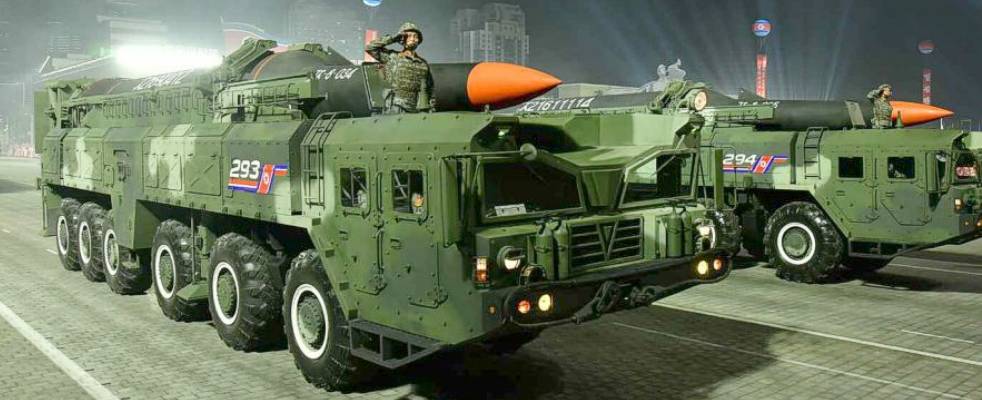
The missile is believed to be a Hwasong-12-based medium-range or intermediate-range ballistic missile, with an estimated length of about 14.5 m (48 ft).[1][2][3] However, after the missile's public debut, South Korean researchers initially assessed the missile to be an anti-aircraft missile with maneuverable reentry vehicle (MaRV) payload.[4] Its assumed range is over 2,000 km (1,200 mi).[5]
The shape of the reentry vehicle (RV) is totally different from Hwasong-8, this having a conical shaped RV. It suggests that North Korea is trying to develop two different types of hypersonic missiles.[6] The MaRV is mounted on a shortened Hwasong-12 booster.[7] From this point of view, American researcher Jeffrey Lewis assessed that conical shape of this missile's warhead seems to be a maneuvering reentry vehicle that has high maneuverability. Also he claimed that framing this missile into 'hypersonic' may mislead to focus speed of this missile.[8] Technically speaking, the missile can be classed as hypersonic, as it exceeds Mach 5 in speed, stays within the atmosphere during the entire flight, and is able to conduct at least one maneuver that deviates from the initial flight direction.[9] However, the shape and relatively modest turning maneuvers demonstrated are more consistent with an MaRV than a boost-glide vehicle (BGV) like the Hwasong-8's RV; although comparatively less maneuverable, an MaRV is a simpler design.[10]
Similar to Hwasong-8, North Korean state media also claimed Hwasong-12A to use fuel ampoulization. However, in its first launch, no canister was shown in images released by North Korean state media, suggesting that it is akin to the Soviet and Russian practice of preloading propellants to submarine-launched ballistic missiles and sealed it before installing onto the launcher.[11]
History
North Korea first tested MaRVs in 2017, with the Scud-derived KN-18 and KN-21.[a][12][13] North Korea claimed successful launch test of KN-18 on 28 May 2017 since it hit the target with only 7 m (23 ft) error.[12] Later, during the 8th Congress of the Workers' Party of Korea held in January 2021, North Korea listed the development of hypersonic weapon in its five-year of defense capabilities enhancement plan.[14]
In October 2021, Hwasong-12A was first displayed in "Self-Defence 2021" military exhibition between Hwasong-12 and Pukguksong-5, but the name was not revealed, unlike Hwasong-11B, which had the name confirmed in this event.[15] At the same event, photos of TEL and launching tests of this missile was also shown on the board with blurred name tag. This name tag suggests this missile already has official designation, as North Korean double arrow brackets (《》) used for missile name designation was shown on the name tag.[16]
On 5 January 2022, North Korea tested the missile.[17][18] Since North Korean naming convention uses "hyŏng" (형; lit. 'type') instead of "ho" (호; lit. 'number'), South Korean researchers unofficially named this missile as Hypersonic Missile Type 2.[19] South Korean Joint Chiefs of Staff publicized that actual distance of the missile trajectory was less than 700 km (430 mi), but the velocity was about Mach 6. After the official briefing one anonymous official asserted that this missile only has MaRV technology that the Hyunmoo-2C has, and the terminology 'hypersonic' does not match this missile.[20] A day after the launch, the Korean Central News Agency (KCNA) reported that Hwasong-12A made a 120 km (75 mi)-long lateral movement before hitting a target 700 km (430 mi) away,[21] despite the initial assessment of 500 km (310 mi) from the Japanese Defense Ministry. This could account for the range discrepancy if the glider separation happened at low altitude and so was not picked up by Japanese sensors.[22][23]
Just days after the first test, on 11 January 2022, North Korea launched this missile for the second time.[24] Kim Jong Un observed the test and KCNA reported it involved a hypersonic glide vehicle, which after its release from the rocket booster demonstrated "glide jump flight" and "corkscrew maneuvering" before landing 1,000 km (620 mi) away.[25] South Korea's JCS claimed the missile flew 700 km (430 mi) at a maximum speed of around Mach 10; although they had claimed North Korea exaggerated the details of their previous test, with this one they stated it had demonstrated "more advanced capability" compared to the last test, though how was not explained. While observers believe North Korea is still years away from developing a credible hypersonic system, Kim's attendance and state media's description of the launch as a "final test-fire" could indicate that the weapon may be operational deployed relatively soon.[26] Japanese Minister of Defense Nobuo Kishi described the missile as hypersonic, as North Korea described it.[27]
During a military parade on 25 April 2022, North Korea displayed six Hwasong-12A missiles. However, these missiles were not officially named.[2][28]
The Hwasong-12A designation was first suggested by German expert Norbert Brügge after test-fires.[29] Later, the Bulletin of the Atomic Scientists suggested it to be the official name of the missile in an article published in July 2024 based on the confirmed name of Hwasong-12B; however, it remains unconfirmed,[7] as the missile have its formal name unreported by North Korean state media.[30]
List of tests
Confirmed tests
| Attempt | Date | Location | Pre-launch announcement or detection | Outcome | Additional notes | References |
|---|---|---|---|---|---|---|
| 1 | 5 January 2022 | Chagang Province | None | Success | The second known hypersonic missile test by North Korea, with KCNA announcing that the test was successful. The missile made a 120 km (75 mi) lateral movement and "precisely" hit a set target 700 km (430 mi) away. However, officials in South Korea's defense ministry mentioned that the KCNA's announcement was "exaggerated". | [17][21][31] |
| 2 | 11 January 2022 | Chagang Province | None | Success | South Korean Joint Chiefs of Staff said that the missile had flown 700 km (430 mi) with an apogee of 60 km (37 mi) at a maximum speed of around Mach 10 (12,300 km/h; 7,610 mph) before landing. However, the Korean Central News Agency claimed the missile flew 1,000 km (620 mi) before hitting the sea target. Kim Jong Un supervised the launch with his sister Kim Yo Jong, with the former attending a missile test after 661 days without visiting it. | [14][32][33] |
Alleged tests
During the "Self-Defence 2021" military exhibition held in October 2021, images of two unannounced Hwasong-12A test-fires were shown. These launches appear to occur before its first confirmed test.[16]
American astronomer and astrophysicist Jonathan McDowell claimed that the Hwasong-12A was used for following tests on these dates (Pyongyang time):[34]
- 27 February 2022
- 5 March 2022
- 5 May 2022
- 25 May 2022 (two tests)
According to Jonathan McDowell, four of five tests were to evaluate reconnaissance satellite components.[34]
Notes
- ↑ KN-18 and KN-21 are the external names given by the United States to these missiles.
References
- ↑ Brügge, Norbert. "What we really know about the North Korean spacerockets and ballistic missiles". b14643.eu. Norbert Brügge. Retrieved 27 January 2025.
- 1 2 "S/2022/668". UNDOCS. United Nations. 7 September 2022. p. 20. Retrieved 23 May 2026.
- ↑ "DPRK Military Parade Viewbook 2022" (PDF). Open Nuclear Network. 21 April 2022. p. 9. Retrieved 4 January 2025.
- ↑ Yu, Yong-won (6 January 2022). 4개의 조종날개로 족집게 타격… 北, 美 항모 때리는 미사일 개발? [Strike with 4 maneuvering fins... Did North Korea develop missile targeting US aircraft carriers?]. KODEF researcher (in Korean). The Chosun Ilbo. Retrieved 15 January 2022.
- ↑ Lee, Cheol-jae; Kim, Sang-jin (26 April 2022). 북, 극초음속 미사일·신형 ICBM·SLBM…신무기 총동원 [North Korea mobilizes new weapons including hypersonic missiles, new ICBMs, and SLBMs]. JoongAng Ilbo (in Korean). Retrieved 27 January 2025.
- ↑ Kim, Min-seok (6 January 2022). [밀덕텔링] '비싸도 투 트랙' 북한은 왜 같은 미사일을 두 종류 만들까 ['Expensive But Two Tracks' Why North Korea try to develop two different type of same weapon?]. Hankook (in Korean). Biz Hankook. Retrieved 6 January 2022.
- 1 2 Kristensen, Hans M.; Korda, Matt; Johns, Eliana; Knight-Boyle, Mackenzie (15 July 2024). "North Korean nuclear weapons, 2024". Bulletin of the Atomic Scientists. Retrieved 20 July 2025.
- ↑ Lewis, Jeffrey [@ArmsControlWonk] (7 January 2022). "One of my complaints about the "hypersonic" framing is that it wrongly emphasizes speed when what we really are discussing is maneuverability and accuracy. So, yeah, the new DPRK glider is hypersonic. But more importantly, it's a MaRV" (Tweet). Retrieved 27 January 2025 – via Twitter.
- ↑ Xu, Tianran (14 January 2022). "Analysis of the 11 January 2022 Hypersonic Missile Test of the DPRK". Open Nuclear Network. Retrieved 27 January 2025.
- ↑ Van Diepen, Vann H. (18 January 2022). "Implications of the Second Launch of North Korea's Second "Hypersonic" Missile". 38 North. Retrieved 27 January 2025.
- ↑ Van Diepen, Vann H. (7 January 2022). "Another North Korean "Hypersonic" Missile?". 38 North. Retrieved 16 May 2026.
- 1 2 "KN-18 (Scud MaRV)". Missile Threat. Center for Strategic and International Studies. 18 April 2017. Retrieved 4 January 2025.
- ↑ "KN-21". Missile Defense Advocacy Alliance. Retrieved 4 January 2025.
- 1 2 "Triều Tiên xác nhận bắn thử tên lửa siêu vượt âm" [North Korea confirmed the test of hypersonic missile]. Langson Radio & Television (in Vietnamese). Lang Son Newspaper and Radio, Television. 12 January 2022. Retrieved 7 May 2026.
- ↑ Xu, Tianran (18 October 2021). "Brief on the Defence Development Exhibition of the Democratic People's Republic of Korea" (PDF). Open Nuclear Network. Retrieved 27 January 2025.
- 1 2 The last image of the first row. "Defence Development Exhibition "Self-Defence-2021" Opens with Splendor". Explore DPRK. 13 October 2021. Retrieved 15 January 2022. For amended image, see here.
- 1 2 "Triều Tiên tuyên bố phóng tên lửa siêu thanh" [North Korea claimed to launch hypersonic missile]. Langson Radio & Television (in Vietnamese). Lang Son Newspaper and Radio, Television. 6 January 2022. Retrieved 16 May 2026.
- ↑ "Hypersonic Missile Newly Developed by Academy of Defence Science Test-Fired". Korean Central News Agency. 6 January 2022. Retrieved 16 May 2026.
- ↑ See the image in following news: Kim, Yong-rae (6 January 2022). 진화하는 北 극초음속미사일…속도 음속 5배이상·사거리도 늘어 [North Korea's evolving hypersonic missiles... Extended range with a maximum speed of Mach 5]. KODEF researcher (in Korean). Yonhap News Agency. Retrieved 7 January 2022.
- ↑ Jung, Bit-na (7 January 2022). 군 "북한이 쏜 건 일반적 탄도미사일"…'극초음속' 주장 반박(종합) [Military: "North Korea's launch was a regular ballistic missile"... Refuting 'hypersonic' claims (comprehensive)]. Yonhap News Agency (in Korean). Retrieved 8 February 2025.
- 1 2 "Triều Tiên tuyên bố tên lửa siêu vượt âm bắn trúng mục tiêu cách xa 700 km" [North Korea claimed the hypersonic missile to hit the target 700 km away]. Truyền hình Thanh Hóa (in Vietnamese). Thanh Hoa Newspaper and Radio, Television. 6 January 2022. Archived from the original on 26 April 2026. Retrieved 7 January 2026.
- ↑ "North Korea claims second successful test of hypersonic missile". NPR. 6 January 2022. Retrieved 8 February 2025.
- ↑ "North Korea says it has tested hypersonic missile, launched from Russian-made vehicle". Defense News. 5 January 2022. Retrieved 27 January 2025.
- ↑ Yeo, Mike (10 January 2022). "Neighbors say North Korea launched second missile in a week". Military Times. Retrieved 27 January 2025.
- ↑ "Success in Another Hypersonic Missile Test-fire". Korean Central News Agency. 12 January 2022. Retrieved 7 May 2026.
- ↑ Kim, Tong-Hyung (12 January 2022). "North Korea claims successful test of hypersonic missile". AP News. Retrieved 6 February 2026.
- ↑ Gale, Alastair (11 January 2022). "What Are Hypersonic Missiles and Who's Developing Them?". The Wall Street Journal. Retrieved 14 November 2022.
- ↑ Xu, Tianran (2 May 2022). "25 April 2022 DPRK Parade" (PDF). Open Nuclear Network. p. 22. Retrieved 25 May 2025.
- ↑ Brügge, Norbert. "Hwasong-12A missile". b14643.eu. Norbert Brügge. Retrieved 27 January 2025.
- ↑ "Second Hwasong-12 HGV offshoot (tentative Hwasong-12A)". NK Pro. NK News. 17 August 2026. Retrieved 18 August 2026.
- ↑ Song, Sang-ho (7 January 2022). "(LEAD) S. Korea calls N.K. claim of hypersonic missile launch 'exaggerated'". Yonhap News Agency. Yonhap News Agency. Retrieved 14 January 2022.
- ↑ Lee, Je-hun (13 January 2022). "[News analysis] Why Kim Jong-un attended missile test after nearly 2 years of absence". The Hankyoreh. Retrieved 14 January 2022.
- ↑ "Triều Tiên tuyên bố thử thành công tên lửa siêu vượt âm" [North Korea claimed successful test of hypersonic missile]. Bắc Ninh TV (in Vietnamese). Bac Ninh Newspaper and Radio – Television. 12 January 2022. Retrieved 6 February 2026.
- 1 2 McDowell, Jonathan. "Tests of Hwasong-12 missile family". planet4589.org. Jonathan McDowell. Retrieved 4 January 2025.