Portal:Western Australia

Introduction
 Western Australia (commonly abbreviated as WA) is the westernmost state of Australia. It is bounded by the Indian Ocean to the north and west, the Southern Ocean to the south, the Northern Territory to the north-east, and South Australia to the south-east. Western Australia is Australia's largest state, with a land area of 2,527,013 square kilometres (975,685 sq mi), and is also the second-largest subdivision of any country on Earth. The state has a diverse range of climates, including tropical conditions in the Kimberley, deserts in the interior (including the Great Sandy Desert, Little Sandy Desert, Gibson Desert, and Great Victoria Desert) and a Mediterranean climate on the south-west and southern coastal areas. As of June 2024, the state has 2.965 million inhabitants—10.9 percent of the national total. Over 90 percent of the state's population live in the south-west corner and around 80 percent live in the state capital Perth, leaving the remainder of the state sparsely populated. The Trans-Australian Railway and the Eyre Highway traverse the Nullarbor Plain in the state's south-east, providing the principal connection between Western Australia and the population centres in the eastern states. (Full article...)
|





(Northern
Territory) |
 Good articles -

Tropical Cyclone Herbie was the only known tropical system to impact Western Australia during the month of May on record. The final cyclone of the 1987–88 Australian region cyclone season, Herbie was first identified northwest of the Cocos Islands on 17 May. The following day, the system was classified as a tropical low by the Australian Bureau of Meteorology and intensified into a Category 1 cyclone later that day. Several hours after this upgrade, the storm attained its initial peak intensity with winds of 75 km/h (45 mph 10-minute sustained). Around the same time, the Joint Typhoon Warning Center classified Herbie as Tropical Storm 21S.
On 19 May, the cyclone formed a new low-pressure center and relocated roughly 300 km (190 mi) south. Shortly thereafter, the storm began to accelerate towards the southeast and started to undergo an extratropical transition. Early on 21 May, Herbie made landfall in Shark Bay before losing its identity the following day over the Great Australian Bight. Although a weak storm, Herbie brought flooding rains and severe dust storms to portions of Western Australia. Additionally, a 30,000 ton freighter broke in half amidst rough seas produced by the storm. Total losses from the storm reached A$20 million (US$15.6 million). Due to the significant damage wrought by Herbie, the name was retired following its use. (Full article...)
Nicolas Pierre Goiran (born 15 October 1977) is an Australian politician who has been a member of the Western Australian Legislative Council (MLC), the upper house of the Parliament of Western Australia, since 22 May 2009. A member of the Liberal Party, Goiran has been the leader of the opposition in the Legislative Council since May 2025.
Goiran is a conservative Christian. He is pro-life, and opposes same-sex marriage, euthanasia and surrogacy. He has been outspoken on the issue of elder abuse and has opposed COVID-19 vaccine mandates. Goiran has twice been accused of filibustering: he spoke for over 22 hours in total on a surrogacy bill in 2019, delaying it; and he proposed 357 amendments to a voluntary assisted dying bill and spoke on every clause of the bill. (Full article...)- The history of Fremantle Prison, a former Australian prison in Fremantle, Western Australia, extends from its construction as a prison for convicts, using convict labour, in the 1850s, through to its modern-day usage as a tourist attraction. The design for Fremantle Prison was based on the Pentonville Prison in Britain, and it would be the longest, tallest prison cell block in the southern hemisphere. Construction began in 1851, and was completed by the end of 1859. The prison was transferred to the colonial government in 1886 for use for locally sentenced prisoners. Following a Royal Commission held in 1898−99, some changes were made to Fremantle Prison, including knocking down the inner wall between two cells, introducing a prisoner classification system, and constructing internal walls in the main block to create four separate divisions. A new cell block, New Division, was completed in 1907 and occupied in 1908.
Following another Royal Commission investigation 1911, there were some rapid changes in prison policy. A new superintendent with outside experience, Hugh Hann, was appointed, and supported by the newly elected Labor government interested in penal reform. Fremantle Prison was partially used as a military gaol during both world wars. The World War II takeover necessitated the commissioning of Barton's Mill Prison in 1942, which remained opened after the war. Pardelup Prison Farm was another prison outstation established in 1927 to reduce overcrowding at Fremantle. Both facilities were part of reforms made to the prison system, but significant changes to the operation of Fremantle Prison did not begin until the 1960s. Comptroller General Colin Campbell introduced expedient prisoner assessments, officer training, work release programs, and social workers and welfare officers. (Full article...)
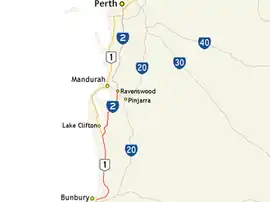
Lakelands railway station is on the Mandurah line on the Transperth network in Western Australia. The station is in the Mandurah suburb of Lakelands, 6.5 kilometres (4.0 mi) north of Mandurah station and 64.5 kilometres (40.1 mi) south of Perth Underground station. Construction started in 2021 and it opened on 11 June 2023.
Provision for the station was made when the Mandurah line was built during the 2000s. There were several proposals to build the station during the 2010s but, when the state Labor Party came to power in 2017, it had committed to build the nearby Karnup station, not Lakelands. However, the federal Coalition government wanted Lakelands station to be built, and committed to funding 80% of the A$80 million required. The federal government refused requests for the funding to be transferred to the Karnup station project, and that project was put on hold so that the state could provide its share of funding for Lakelands. That resulted in accusations that the federal government was pork barrelling, because Lakelands station was in Liberal MP Andrew Hastie's seat, whereas Karnup station was in a safe Labor seat, held by Madeleine King. (Full article...)
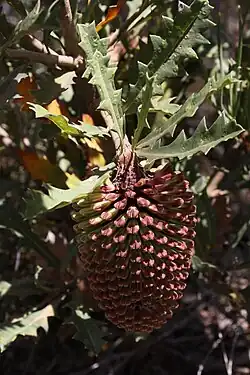
Banksia acanthopoda is a species of shrub in the family Proteaceae. It grows as a small spreading shrub to 2 m (6+1⁄2 ft) high and has prickly leaves and yellow composite flower heads, called inflorescences, composed of 50 to 60 individual yellow flowers. Flowering takes place in the southern hemisphere winter. Endemic to Western Australia, it occurs only in a few populations in the vicinities of Woodanilling, Katanning and Darkan. Because of its rarity, it is classed as "Priority Two" conservation flora by Western Australia's Department of Environment and Conservation.
The botanist Alex George first described this species in 1996, naming it Dryandra acanthopoda. It was renamed to its current name in 2007, when all Dryandra species were transferred to the genus Banksia. It is little known in cultivation and its sensitivity to dieback is unclear (although highly likely). It has potential as a cut flower. (Full article...)- The electoral district of Perth is a Legislative Assembly electorate in the state of Western Australia. Perth is named for the capital city of Western Australia whose central business district falls within its borders. It is one of the oldest electorates in Western Australia, with its first member having been elected in the inaugural 1890 elections of the Legislative Assembly.
Perth has traditionally been a safe Labor seat, but was briefly held by Liberal Eleni Evangel between 2013 and 2017. Perth is currently held by Labor MLA John Carey. (Full article...)
Bedford is a suburb 6 kilometres (4 mi) north-east of the central business district (CBD) of Perth, the capital of Western Australia. Named after Frederick Bedford, the Governor of Western Australia from 1903 to 1909, the suburb is within the City of Bayswater local government area. It is predominantly a low density residential suburb consisting of single-family detached homes, with clusters of commercial buildings along Beaufort Street, Grand Promenade and Walter Road.
Before European settlement, the area was inhabited by the Mooro group of the Whadjuk Noongar people. The first major developments for the suburb occurred in the 1920s, when the extension of Beaufort Street and its associated tram service into the area triggered housing construction. Bedford Park was gazetted as a townsite in 1937, and major growth occurred following World War II, due to developments by the State Housing Commission. Today, Bedford is fully suburbanised. (Full article...)
Redcliffe railway station is a station for underground commuter rail services in Redcliffe, east of Perth, Western Australia. The station is one of three stations that were built as part of the Forrestfield–Airport Link project and is served by Transperth's Airport line services.
The contract for the Forrestfield–Airport Link, which consists of 8 kilometres (5.0 mi) of twin bored tunnels and three new stations, was awarded to Salini Impregilo and NRW Pty Ltd in April 2016. Forward works, which included the permanent closure of Brearley Avenue between Great Eastern Highway and Dunreath Drive, began in 2016. Construction began in mid-2017, and by June 2018, excavation was complete. The two tunnel boring machines (TBMs) reached the station in mid-2019, having tunnelled from High Wycombe, and left tunnelling towards Bayswater after several weeks of maintenance. Construction of the station infrastructure followed. (Full article...)- Linda Yunkata Syddick Napaltjarri (born c. 1937) is a Pintupi- and Pitjantjatjara- speaking Indigenous artist from Australia's Western Desert region. Her father was killed when she was young; her mother later married Shorty Lungkarta Tjungarrayi, an artist whose work was a significant influence on Syddick's painting.
Syddick was one of many Western Desert women who took up painting in the early 1990s, as part of a broader contemporary Indigenous Australian art movement. She began painting some time prior to 1991, when her work was first exhibited in Alice Springs. Her work includes a distinctive fusion of Christian and Aboriginal traditional themes and motifs. She has been a finalist in the National Aboriginal & Torres Strait Islander Art Awards on at least four occasions, and in the Blake Prize (a religious art competition) at least three times. Her works are held by numerous galleries including the National Gallery of Australia, the Art Gallery of New South Wales and the Art Gallery of South Australia. Syddick was the subject of a portrait painted by Robert Hannaford, which was a 1992 finalist in Australia's premiere portrait competition, the Archibald Prize. (Full article...)
Severe Tropical Cyclone Fay was an intense late-season tropical cyclone which struck Western Australia during the 2003–04 Australian region cyclone season. Forming from an area of low pressure on 12 March, Fay was the only Category 5 cyclone during the season. The system had a minimum pressure of
910 mbar (hPa; 26.87 inHg) and maximum sustained winds of 210 km/h (130 mph). Moving towards the southwest and eventually towards the south, Fay gradually strengthened as it paralleled the northwestern coast of Australia, and made landfall on the Pilbara coast on the morning of 27 March as a Category 4 cyclone.
While no fatalities were reported, the cyclone brought record-breaking rainfall to Australia, which led to a sharp decrease in the country's gold output. The cyclone also caused minor damage in the Pilbara region of Western Australia. In the spring of 2005, the Australian Bureau of Meteorology retired the name Fay from use, and it will never be used again as a cyclone name. (Full article...)
Victoria Park railway station is a suburban railway station on the Transperth network in Western Australia. The station is in the Perth suburbs of Lathlain and Victoria Park. Between November 2023 and June 2025, the station was the terminus of the Armadale and Thornlie lines due to the Victoria Park-Canning Level Crossing Removal Project.
The first Victoria Park station opened in 1898 after lobbying by the Municipality of Victoria Park. It gained a station master in 1922, which lasted until 1969. The Victoria Park section of the Armadale line underwent several improvements in the 2000s. Lathlain station closed in 2003, and a nearby level crossing was removed and replaced with a bridge. The Thornlie line commenced services on 7 August 2005, enabling most Armadale services to skip the station. In 2007, construction started on a new Victoria Park station, 230 metres (750 ft) south of the original station and closer to the demolished Lathlain station. The new station had greater accessibility and was no longer on a curve, which allowed for a smaller platform gap. The new Victoria Park station opened on 2 August 2008, and the old one was demolished soon afterwards. (Full article...)
Cullacabardee is a northeastern rural suburb of Perth, the capital city of Western Australia, located 21 km (13 mi) from Perth's central business district via Alexander Drive or Tonkin Highway. It is in the City of Swan local government area. Most of the suburb is covered in native sheoak and banksia forest. A small Noongar community is based on Baal Street, a drug rehabilitation retreat is located off Gnangara Road in the suburb's northeast, and the Perth International Telecommunications Centre facility is based in the suburb's northwest. (Full article...)
The Thornlie–Cockburn line, formerly the Thornlie line, is a suburban railway line in Perth, Western Australia, which is operated by the Public Transport Authority as part of the Transperth system. The line branches off the Armadale line south of Beckenham station and runs for 17.6 kilometres (10.9 mi) to Cockburn Central station on the Mandurah line. North of Beckenham station, Thornlie–Cockburn line services run alongside the Armadale line to Perth station.
The Thornlie line originated from initial plans for the Mandurah line, which was to branch off the Armadale line and run along the Kwinana freight railway. The Mandurah line's planned route changed in 2001, but not before tunnels were built for the line to exit the Armadale line south of Beckenham and enter the Kwinana Freeway. It was decided to build the Thornlie line instead as a one-station branch of the Armadale line. The main construction contract was awarded to Barclay Mowlem in 2004 and the Thornlie line opened on 7 August 2005. (Full article...)
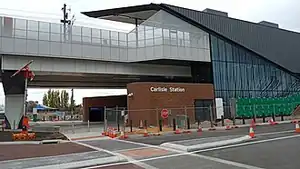
Carlisle railway station is a suburban railway station on the Transperth network in Western Australia. It is in the Perth suburbs of Carlisle and East Victoria Park and is served by Thornlie–Cockburn line and Armadale line services.
The station first opened in July 1912. It was known as Mint Street station at first, but it was renamed Victoria Park East station in October 1912 and to its present name in May 1919. It gained a station master in 1922, which lasted until 1971. Carlisle station had minor upgrades from 2002 to 2003 in preparation for the opening of the Thornlie line, which happened in 2005. In 20 November 2023, the station closed to undergo a complete rebuild as an elevated station as part of the Victoria Park-Canning Level Crossing Removal Project to remove a nearby level crossing. The station reopened in June 2025. (Full article...)- John Biase D'Orazio (5 September 1955 – 11 April 2011) was an Australian politician who served as the member for Ballajura in the Western Australian Legislative Assembly from 10 February 2001 to 6 September 2008. He was a minister in the governments of Geoff Gallop and Alan Carpenter, and a member of the Labor Party until 29 August 2006, when he resigned following several controversies. Born to Italian immigrants, D'Orazio grew up on a market garden in the Perth suburb of Bayswater. He studied pharmacy at the Western Australian Institute of Technology, later opening his own pharmacy business. In 1981, he was elected to the City of Bayswater council, and in 1984, he became the mayor of Bayswater, in which position he served until 2001.
At the 2001 Western Australian state election, D'Orazio was elected to the seat of Ballajura, beating the Liberal incumbent Rhonda Parker. Following the 2005 state election, he was promoted to cabinet by Premier Geoff Gallop, becoming the minister for justice and minister for small business. In February 2006, after Alan Carpenter became premier, D'Orazio was appointed as the minister for police and emergency services, minister for justice, and minister for community safety. (Full article...)


Did you know (auto-generated)

- ... that Dan Bull was a keyboardist for Eskimo Joe before he was elected to the Western Australian Legislative Assembly?
- ... that Bill Dunn, an Indigenous Australian pastoralist approaching retirement, sold his station at half-price to the Jigalong community despite receiving full-price offers from non-Indigenous people?
Categories

More portals
More did you know...
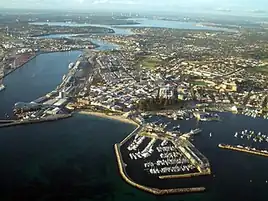
- ...that when the 1987 America's Cup was raced off Fremantle, Western Australia it was the first time for 132 years that the regatta had not been hosted by the New York Yacht Club?
- ...that the original Victoria Dam, constructed in 1891, was the first dam in Western Australia, and it stood for almost 100 years before being replaced with the current dam?
- ...that Anglican bishop Kay Goldsworthy was consecrated as the first woman bishop of any Australian church on 22 May 2008?
Related WikiProjects
|
 |
 |
 |
 |
 |
| Western Australia | Australia | Perth | Maritime History | Literature | Banksia |
Things you can do
Here are some tasks you can do to help with WikiProject Western Australia:
| Vital articles: | 100 Most Influential Western Australians is a possible starting point | |
| Requested articles: | Nicholson, Western Australia • Robin Sarah Greenburg (see Crimenet page) • Indiana Teahouse | |
| Missing topics: | Peter M. Olde • Neil R. Marriott • Christopher J. French • 1962 British Empire and Commonwealth Games Parade of Nations • See missing topics report for more | |
| Draft articles: | Search for Western Australia drafts • Search for Perth drafts • See draft articles listing for more | |
| Split topic articles: | See Split topic listing for more | |
| Seeking sources: | William Harris (Australian civil rights leader) • Michael Kailis | |
| Expansion needed: | David Parker • Economy of Western Australia • Bill Hassell • May Holman • Barry MacKinnon • PGA • Pilbara historical timeline • List of WA waterfalls • tourism sections needed in Western Australia • Thomas Hughes (Australian politician) - needs expansion from cultural sources | |
| Requested images: | Requested photographs in Western Australia • Requested photographs in Perth | |
| Article cleanup: | See Cleanup listing | |
| Popular pages: | See Popular pages listing (related changes) – improvements to (or vandalism of) these articles will impact a larger number of readers | |
| Assessment: | See Unassessed WA articles and Unknown-importance WA articles | |
| Outreach projects: |
Associated Wikimedia
The following Wikimedia Foundation sister projects provide more on this subject:
-
 Commons
Free media repository -
 Wikidata
Free knowledge base -
 Wikiquote
Collection of quotations -
 Wikisource
Free-content library -
 Wikispecies
Directory of species -
 Wikiversity
Free learning tools -
 Wikivoyage
Free travel guide -
 Wiktionary
Dictionary and thesaurus
-
 List of all portals
-

-

-

-

-

-

-

-

-

-
 Random portal
-
 WikiProject Portals