Portal:New South Wales

The New South Wales Portal


New South Wales (commonly abbreviated as NSW) is a state on the east coast of Australia. It borders Queensland to the north, Victoria to the south, and South Australia to the west. Its coast borders the Coral and Tasman Seas to the east. The Australian Capital Territory and Jervis Bay Territory are enclaves within the state. New South Wales' state capital is Sydney, which is also Australia's most populous city. As of September 2025, the population of New South Wales was over 8.6 million, making it Australia's most populous state. Almost two-thirds of the state's population live in the Greater Sydney area.
The Colony of New South Wales was founded as a British penal colony in 1788. It originally comprised more than half of the Australian mainland with its western boundary set at 129th meridian east in 1825. The colony then also included the island territories of Van Diemen's Land, Lord Howe Island, and Norfolk Island. During the 19th century, most of the colony's area was detached to form separate British colonies that eventually became the various states and territories of Australia. The Swan River Colony (later called the Colony of Western Australia) was never administered as part of New South Wales. (Full article...)
 Recognized content -

 The Inbetweeners 2 is a 2014 teen coming of age adventure sex comedy film and sequel to The Inbetweeners Movie (2011), which is based on the E4 sitcom The Inbetweeners. It was written and directed by series creators Damon Beesley and Iain Morris.
The film involves four school friends who meet up again for a holiday in Australia, and stars Simon Bird, Joe Thomas, James Buckley and Blake Harrison. In media interviews, the film's writers and actors stated that it was to be an end to the series. (Full article...)
Telopea speciosissima, commonly known as the New South Wales waratah or simply waratah, is a large shrub in the plant family Proteaceae. It is endemic to New South Wales in Australia. No subspecies are recognised; the closely related Telopea aspera was classified as a separate species in 1995. T. speciosissima is a shrub to 3 or 4 m (9.8 or 13.1 ft) high and 2 m (6.6 ft) wide, with dark green leaves. Its several stems arise from a pronounced woody base known as a lignotuber. The species is well renowned for its striking large red springtime inflorescences (flowerheads), each including hundreds of individual flowers. These are visited by the eastern pygmy possum (Cercartetus nanus), birds such as honeyeaters (Meliphagidae), and various insects.
The floral emblem for its home state of New South Wales, Telopea speciosissima has featured prominently in art, architecture, and advertising, particularly since Australian federation. Commercially grown in several countries as a cut flower, it is also cultivated in home gardens, requiring good drainage yet adequate moisture, but is vulnerable to various fungal diseases and pests. A number of cultivars with various shades of red, pink and even white flowers are available. Horticulturists have also developed hybrids with T. oreades and T. mongaensis which are more tolerant of cold, shade, and heavier soils. (Full article...)
Reginald Walter Darcy Weaver (18 July 1876 – 12 November 1945) was an Australian conservative parliamentarian who served in the New South Wales Legislative Assembly for 28 years. Serving from 1917 in the backbenches, he entered the cabinet of Thomas Bavin in 1929 as Secretary for Mines and Minister for Forests until he returned to opposition in 1930. Following the success of the United Australia Party in the 1932 election, Weaver returned as the Secretary for Public Works and Minister for Health in the Stevens ministry.
In 1935, he was dropped from the ministry but was later elected as the Speaker of the New South Wales Legislative Assembly in 1937, holding office until the Mair Government lost power in 1941. Weaver then witnessed the death of the United Australia Party in 1943 and became the leader of the new Democratic Party in 1944. He was then involved in the negotiations to form the New South Wales branch of the Liberal Party, with Weaver becoming the first leader of the state Liberal Party in April 1945. He served only briefly until dying of a heart attack in November 1945. (Full article...)
William Alfred Brown, OAM (31 July 1912 – 16 March 2008) was an Australian cricketer who played 22 Test matches between 1934 and 1948, captaining his country in one Test. A right-handed opening batsman, his partnership with Jack Fingleton in the 1930s is regarded as one of the finest in Australian Test history. After the interruption of World War II, Brown was a member of the team dubbed "The Invincibles", who toured England in 1948 without defeat under the leadership of Don Bradman. In a match in November 1947, Brown was the unwitting victim of the first instance of "Mankading".
Raised in New South Wales, Brown initially struggled in both work and cricket, before gradually rising through the cricket ranks. He made his first-class debut for New South Wales in the 1932–33 season and forced his way into the national side during the 1934 tour of England. When long-term openers Bill Ponsford and Bill Woodfull retired at the end of the tour, Brown and his state opening partner Fingleton took over. After poor form made his selection for the 1938 tour of England controversial, Brown responded with a total of 1,854 runs, including an unbeaten 206 that saved Australia from defeat in the Second Test, and was honoured as one of the five Wisden Cricketers of the Year. (Full article...)
Philip Henry (Pat) Morton (28 October 1910 – 18 January 1999) was an Australian businessman and politician. Born in Lismore in Northern New South Wales to a prominent political family and educated at Lismore High School, Morton left school at fourteen to be employed in a legal firm, before branching out into various businesses. Moving to Sydney, Morton first entered politics in 1944 as an Alderman on Mosman Municipal Council, rising to be Mayor in 1946. Morton then entered the New South Wales Legislative Assembly on 3 May 1947, representing the Electoral district of Mosman for the Liberal Party.
Morton soon rose through the party ranks, becoming touted as a possible leader. When the Liberals lost their third election under party leader Vernon Treatt, Morton contested the leadership in July 1954. Although Morton was defeated, Treatt did not stay long, resigning in August. Morton then stood, but was deadlocked against party whip, Robert Askin, and Askin then asked Murray Robson to take the leadership. Robson proved ineffective and was deposed in September 1955 in a party spill and Morton was elected to succeed him as Leader of the New South Wales Opposition. (Full article...)
The T4 Eastern Suburbs & Illawarra Line is a suburban rail line on the Sydney Trains network in the eastern and southern suburbs of Sydney. The line was constructed in the 1880s to Wollongong to take advantage of agricultural and mining potentials in the Illawarra area. In March 1926, it became the first railway in New South Wales to run electric train services.
Today, the railway consists of three connected lines: the original Illawarra line from the Sydney CBD to Waterfall; the Cronulla line from Sutherland to Cronulla, which opened in 1939 replacing an earlier tram service; and the Eastern Suburbs line from the Sydney CBD to Bondi Junction, which opened in 1979. (Full article...)
Edward Davis Millen (7 November 1860 – 14 September 1923) was an Australian journalist and politician who served as the first Minister for Repatriation.
Millen emigrated to Australia from England around 1880 and established himself as a journalist, subsequently serving in the New South Wales Legislative Assembly from 1894 to 1898, during which time he fiercely opposed the proposed Federation despite supporting the principle. He was a member of the New South Wales Legislative Council from 1899 until his election to the Australian Senate as a Free Trader from New South Wales at the first federal election in 1901. Millen led the conservative parties in the Senate from 1907 until shortly before his death in 1923. (Full article...)
Ernest Raymond Herbert Toshack (8 December 1914 – 11 May 2003) was an Australian cricketer who played in 12 Tests from 1946 to 1948. A left arm medium paced bowler known for his accuracy and stamina in the application of leg theory, Toshack was a member of Don Bradman's "Invincibles" that toured England in 1948 without being defeated. Toshack reinforced the Australian new ball attack of Ray Lindwall and Keith Miller.
Born in 1914, Toshack overcame many obstacles to reach international level cricket. He was orphaned as an infant, and his early cricket career was hindered because of financial difficulties caused by the Great Depression. The Second World War prevented Toshack from competing at first-class level until he was into his thirties. In 1945–46, the first season of cricket after the end of the War, Toshack made his debut at first-class level and after only seven matches in the Sheffield Shield he was selected for Australia's tour of New Zealand. In Wellington, he opened the bowling in a match that was retrospectively classed as an official Test match. Toshack became a regular member of the Australian team, playing in all of its Tests until the 1947–48 series against India. He took his career-best match bowling figures of 11 wickets for 31 runs (11/31) in the First Test but began to suffer recurring knee injuries, and a medical board had to approve his selection for the 1948 England tour. Toshack played in the first four Tests before being injured. After a long convalescence, he attempted a comeback during Australia's 1949–50 season, but further injury forced him to retire. He was a parsimonious bowler, who was popular with crowds for his sense of humour. (Full article...)
Banksia serrata, commonly known as the saw banksia, the old man banksia, the saw-tooth banksia or the red honeysuckle and as wiriyagan by the Cadigal people, is a species of woody shrub or tree of the genus Banksia, in the family Proteaceae. Native to the east coast of Australia, it is found from Queensland to Victoria with outlying populations on Tasmania and Flinders Island. Commonly growing as a gnarled tree up to 16 m (50 ft) in height, it can be much smaller in more exposed areas. This Banksia species has wrinkled grey bark, shiny dark green serrated leaves and large yellow or greyish-yellow flower spikes appearing over summer. The flower spikes, or inflorescences, turn grey as they age and pollinated flowers develop into large, grey, woody seed pods called follicles.
B. serrata is one of the four original Banksia species collected by Sir Joseph Banks in 1770, and one of four species published in 1782 as part of Carolus Linnaeus the Younger's original description of the genus. There are no recognised varieties, although it is closely related to Banksia aemula. Throughout its range, it grows exclusively in sandy soil, and is usually the dominant plant in scrubland or low woodland. B. serrata is pollinated by and provides food for a wide array of vertebrate and invertebrate animals in the autumn and winter months, and is an important source of food for honeyeaters. It is a common plant of parks and gardens. (Full article...)
Persoonia linearis, commonly known as the narrow-leaved geebung, is a shrub native to New South Wales and Victoria in eastern Australia. It reaches 3 m (9.8 ft), or occasionally 5 m (16 ft), in height and has thick, dark grey papery bark. The leaves are, as the species name suggests, more or less linear in shape, and are up to 9 cm (3.5 in) long, and 0.1 to 0.7 cm (0.039 to 0.276 in) wide. The small yellow flowers appear in summer, autumn and early winter (December to July), followed by small green fleshy fruit known as drupes. Within the genus Persoonia, it is a member of the Lanceolata group of 58 closely related species. P. linearis interbreeds with several other species where they grow together.
Found in dry sclerophyll forest on sandstone-based nutrient-deficient soils, P. linearis is adapted to a fire-prone environment; the plants resprout epicormic buds from beneath their thick bark after bushfires. The fruit are consumed by vertebrates such as kangaroo, possums and currawongs. As with other members of the genus, P. linearis is rare in cultivation as it is very hard to propagate by seed or by cuttings, but once propagated, it adapts readily, preferring acidic soils with good drainage and at least a partly sunny aspect. (Full article...)
Banksia ericifolia, the heath-leaved banksia, or lantern banksia, is a species of woody shrub of the family Proteaceae native to Australia. It grows in two separate regions of Central and Northern New South Wales east of the Great Dividing Range. Well known for its orange or red autumn inflorescences, which contrast with its green fine-leaved heath-like foliage, it is a medium to large shrub that can reach 6 m (20 ft) high and wide, though is usually half that size. In exposed heathlands and coastal areas, it is more often 1–2 m (3.3–6.6 ft).
Banksia ericifolia was one of the original Banksia species collected by Joseph Banks around Botany Bay in 1770 and was named by Carl Linnaeus the Younger, son of Carl Linnaeus, in 1782. A distinctive plant, it has split into two subspecies: Banksia ericifolia subspecies ericifolia of the Sydney region and Banksia ericifolia subspecies macrantha of the New South Wales Far North Coast which was recognised in 1996. (Full article...)
Abbotsford Bridge is a steel Allan truss-type road bridge that carries the Silver City Highway across the Murray River, between Curlwaa in New South Wales, and Yelta, Victoria in Australia. It is the only remaining steel truss bridge with a lift span that crosses the Murray. Opened in 1928, the bridge was built by the NSW Department of Public Works and was designed by Percy Allan. It was the second last vertical-lift bridge to be built over the river, the last being the Nyah Bridge, which opened in 1941.
The bridge was constructed over a three-year period from 1925. The project was not originally planned to take as long, but there were delays due to problems with a contractor, and industrial action. The bridge was designed to carry the Mildura railway line over the Murray River and into New South Wales, to service significant cross-border traffic arising from the fruit-growing industry, but the line was never extended beyond the terminus at Yelta. The bridge currently carries a single lane of road controlled by traffic lights. (Full article...)- Keith Ormond Edley Johnson MBE (28 December 1894 – 19 October 1972), was an Australian cricket administrator. He was the manager of the Australian Services cricket team in England, India and Australia immediately after World War II, and of the Australian team that toured England in 1948. The 1948 Australian cricket team earned the sobriquet The Invincibles by being the first side to complete a tour of England without losing a single match.
Johnson joined the Australian Board of Control for International Cricket in 1935 as a delegate for New South Wales and served in the Royal Australian Air Force during World War II, performing public relations work in London. With the allied victory in Europe, first-class cricket resumed and Johnson was appointed to manage the Australian Services team, which played England in a series of celebratory matches known as the Victory Tests to usher in the post-war era. The series was highly successful, with unprecedented crowds raising large amounts for war charities. As a result, further matches were scheduled and Johnson's men toured British India and Australia before being demobilised. Johnson's administration was regarded as a major factor in the success of the tour. (Full article...) 
Persoonia levis, commonly known as the broad-leaved geebung, is a shrub native to New South Wales and Victoria in eastern Australia. It reaches 5 m (16 ft) in height and has dark grey papery bark and bright green asymmetrical sickle-shaped leaves up to 14 cm (5.5 in) long and 8 cm (3.2 in) wide. The small yellow flowers appear in summer and autumn (December to April), followed by small green fleshy fruit, which are classified as drupes. Within the genus Persoonia, it is a member of the Lanceolata group of 58 closely related species. P. levis interbreeds with several other species where they grow together.
Found in dry sclerophyll forest on sandstone-based nutrient-deficient soils, P. levis is adapted to a fire-prone environment; the plants resprout epicormic buds from beneath their thick bark after bushfires, and can live for over 60 years. Regeneration also takes place after fire by a ground-stored seed bank. The longtongue bee Leioproctus carinatifrons is a pollinator of the flowers, and the fruit are consumed by vertebrates such as kangaroos, possums and currawongs. Despite its horticultural appeal, P. levis is rare in cultivation as it is very hard to propagate, either by seed or cuttings. (Full article...)
Raymond Russell Lindwall MBE (3 October 1921 – 23 June 1996) was an Australian cricketer who played 61 Test matches for Australia between 1946 and 1960. He is widely regarded as one of the greatest fast bowlers in cricket history. In addition to his cricket career, he played top-flight rugby league for St. George, appearing in two grand finals for the club.
Lindwall made his first-class debut for New South Wales in 1941–42. At the same time, Lindwall played for St. George in the first-grade of the New South Wales Rugby Football League premiership as a full back. His career was interrupted by World War II, in which he served in the Australian Army in New Guinea from 1943 to 1945. He made his Test debut against New Zealand in March 1946. During the early part of his career, he also played rugby league at first-grade level before retiring from the sport in 1946 to focus on cricket. (Full article...)


Selected image

The University of Sydney, established in Sydney in 1850, is the oldest university in Australia. It is a member of Australia's "Group of Eight" Australian universities that are highly ranked in terms of their research performance, and is one of the country's most prestigious educational institutions. In 2005, the University of Sydney had 45,966 students and 2,300 (full-time equivalent) academic staff, making it the second largest in Australia. The university's main campus has Oxbridge-inspired grounds and is situated in the south-west of the Sydney central business district.
Related portals

(Northern
Territory) |
WikiProjects
|
 |
| WikiProject New South Wales | WikiProject Australia |
Selected articles -
The Snowy Mountains, known informally as "The Snowies", is an IBRA subregion in southern New South Wales, Australia, and is the tallest mountain range in mainland Australia, being part of the continent's Great Dividing Range, a cordillera system. It makes up the northeastern half of the Australian Alps (the other half being the Victorian Alps) and contains Australia's five tallest peaks, all of which are above 2,100 m (6,890 ft), including the tallest Mount Kosciuszko, which reaches to a height of 2,228 m (7,310 ft) above sea level. The offshore Tasmanian highlands makes up the only other major alpine region present in the whole of Australia.
The Snowy Mountains experience large natural snowfalls for several months of the year; with significant accumulation during May, June, July, August, September and October with the snow cover usually melting by November (although it can occasionally persist through high summer and the next autumn). It is considered to be one of the centres of the Australian ski industry during the winter months, with all four snow resorts in New South Wales being located in the region. The range is host to the mountain plum-pine, a low-lying type of conifer. (Full article...)
Nimbin is a town in the Northern Rivers area of the Australian state of New South Wales, approximately 30 km (19 mi) north of Lismore, 33 km (21 mi) northeast of Kyogle, and 70 km (43 mi) west of Byron Bay.
Nimbin is notable for the prominence of its environmental initiatives such as permaculture, sustainability, and self-sufficiency, as well as the cannabis counterculture. Writer Austin Pick described his initial impressions of the village this way: "It is as if a smoky avenue of Amsterdam has been placed in the middle of the mountains behind frontier-style building facades. ... Nimbin is a strange place indeed." (Full article...)- Cabbage Tree Island may refer to three locations in New South Wales, Australia:
- Cabbage Tree Island, New South Wales, a settlement in Ballina Shire
- Cabbage Tree Island (John Gould Nature Reserve), an island and nature reserve near Port Stephens
- Cabbage Tree Island, an island in the Manning River in Entrance State Park, NSW
The Montreal Community Theatre is a heritage-listed cinema and community theatre at 46 Russell Street, Tumut, Snowy Valleys Council, New South Wales, Australia. It was designed by Kaberry & Chard and built from 1929 to 1930. It is also known as Montreal Community Theatre and Moveable Heritage Collection. The property is owned by the Snowy Valleys Council. It was added to the New South Wales State Heritage Register on 21 June 2013. (Full article...)- Sport in New South Wales describes participation in and attendance at organised sports events in the state of New South Wales in Australia. Sport forms an integral part of the culture of the state.
New South Wales has attracted many international multi-sport events including the 2000 Summer Olympics, held in Sydney. There are many professional sporting teams in New South Wales. The biggest sport in the state by a wide margin is rugby league, in which the state has 10 professional clubs in the National Rugby League. Other popular spectator sports include rugby union, cricket, Australian rules football and soccer. In terms of participation, the most popular sports in the state are netball, tennis, soccer, rugby league and touch football. (Full article...)
The Sydney Harbour Bridge is a steel through arch bridge in Sydney, New South Wales, Australia, spanning Sydney Harbour from the central business district (CBD) to the North Shore. The view of the bridge, the harbour, and the nearby Sydney Opera House is widely regarded as an iconic image of Sydney, and of Australia itself. Nicknamed "the Coathanger" because of its arch-based design, the bridge carries rail, vehicular, bicycle and pedestrian traffic.
Under the direction of John Bradfield of the New South Wales Department of Public Works, the bridge was designed and built by British firm Dorman Long of Middlesbrough, and opened in 1932. The bridge's general design, which Bradfield tasked the NSW Department of Public Works with producing, was a rough copy of the Hell Gate Bridge in New York City. The design chosen from the tender responses was original work created by Dorman Long, who leveraged some of the design from its own Tyne Bridge. (Full article...)
Wollongong (/ˈwʊlənɡɒŋ/ WUUL-ən-gong; Dharawal: Woolyungah) is a city in the Illawarra region of New South Wales, Australia. It lies on the narrow coastal strip between the Illawarra Escarpment and the Pacific Ocean, 85 kilometres (53 miles) south of Sydney. Wollongong had an estimated urban population of 302,739 at June 2018, making it the third-largest city in New South Wales after Sydney and Newcastle and the tenth-largest city in Australia by population. The city's current Lord Mayor is Tania Brown who was elected in 2024.
The Wollongong area extends from Helensburgh in the north to Windang and Yallah in the south. Geologically, the city is in the south-eastern part of the Sydney basin, which extends from Newcastle to Nowra. (Full article...)
The Central Coast is a peri-urban region lying on the Pacific Ocean in northern New South Wales, Australia, just north of Sydney. The area is the third-largest urban area in New South Wales and the ninth-largest urban area in the country.
The Central Coast is generally considered to include the region bounded by the Hawkesbury River in the south, the Watagan Mountains in the west and Lake Macquarie, lying on the Sydney basin. The region is filled with subtropical national parks, forests and also encompasses the major coastal waterways of Brisbane Water, Tuggerah Lakes and southern Lake Macquarie. The region's hinterland has fertile valleys, rural farmland and wineries, and also includes the Watagan Mountains. (Full article...)
The City of Canterbury Bankstown, legally named Canterbury-Bankstown, is a local government area (LGA) in metropolitan Sydney, New South Wales, Australia. It is governed by Canterbury-Bankstown Council, branded as CBCity. The LGA was formed on 12 May 2016 from a merger of the City of Canterbury and the City of Bankstown, after a statewide review of local government by the NSW Government.
The City of Canterbury Bankstown comprises an area of 110.8 square kilometres (42.8 sq mi) and as per the 2021 census, had a population of 371,006 making it the second most populous local government area in New South Wales. (Full article...)
The Parramatta River is an intermediate tide-dominated, drowned valley estuary located in Sydney, New South Wales, Australia. With an average depth of 5.1 metres (17 ft), the Parramatta River is the main tributary of Sydney Harbour, a branch of Port Jackson. Secondary tributaries include the smaller Lane Cove and Duck rivers.
Formed by the confluence of Toongabbie Creek and Darling Mills Creek at North Parramatta, the river flows in an easterly direction to a line between Yurulbin in Birchgrove and Manns Point in Greenwich. Here, it flows into Port Jackson, about 21 kilometres (13 mi) from the Tasman Sea. The total catchment area of the river is approximately 252.4 square kilometres (97.5 sq mi) and is tidal to Charles Street Weir in Parramatta, approximately 30 kilometres (19 mi) from the Sydney Heads. (Full article...)
Blackheath (postcode: 2785) is a town located near the highest point of the Blue Mountains, between Katoomba and Mount Victoria in New South Wales, Australia. The town's altitude is about 1,065 m (3,494 ft) AHD and it is located about 120 km (75 mi) west north-west of Sydney, 11 km (6.8 mi) north-west of Katoomba, and about 30 km (19 mi) south-east of Lithgow.
Blackheath has a vibrant artistic community and hosts two monthly markets – the Blackheath Growers Market and The Blackheath Community Market, as well as annual Christmas markets, antique markets and bimonthly craft markets. The town has many community activities, such as the Blackheath Philosophy Forum, which was founded in 2002 to arrange public discussion forums on philosophy and related topics. (Full article...)- Tooth and Co was a major brewer of beer in New South Wales, Australia. It was one of Australia's oldest companies, having been established as a partnership in 1835. It was formerly listed on the Australian Securities Exchange. (Full article...)
- The University of New South Wales (UNSW) is a public research university based in Sydney, New South Wales, Australia. It was established in 1949.
The university consists of seven faculties, through which it offers bachelor's, master's and doctoral degrees. Its main campus is in the Sydney eastern suburb of Kensington, 7 kilometres (4.3 mi) from the Sydney central business district (CBD). Its creative arts school, UNSW Art & Design (in the faculty of Arts, Design and Architecture), is located in Paddington and it has subcampuses in the Sydney CBD and several other suburbs, including Randwick and Coogee. It has a campus at the Australian Defence Force military academy, ADFA in Canberra, Australian Capital Territory. It has research stations located throughout the state of New South Wales. (Full article...)
The Hawkesbury River, or Hawkesbury-Nepean River (Dharug: Dyarubbin) is a river located northwest of Sydney, New South Wales, Australia. The Hawkesbury River and its associated main tributary, the Nepean River, almost encircle the metropolitan region of Sydney. The river between Wisemans Ferry and the Pacific Ocean marks the boundary of Greater Metropolitan Sydney in the south and the Central Coast region to the north.
The Hawkesbury River has its origin at the confluence of the Nepean River and the Grose River, to the north of Penrith and travels for approximately 120 kilometres (75 mi) in a north–easterly and then a south–easterly direction to its mouth at Broken Bay, about 15 kilometres (9.3 mi) from the Tasman Sea. The Hawkesbury River is the main tributary of Broken Bay. Secondary tributaries include Brisbane Water and Pittwater, which, together with the Hawkesbury River, flow into Broken Bay and thence into the Tasman Sea north of Barrenjoey Head. (Full article...)
The Blue Mountains (Gundungurra/Dharug: Colomatta or Gulumada) are a mountainous region and a mountain range located in New South Wales, Australia. The region is considered to be part of the western outskirts of the Greater Sydney area. The region borders on Sydney's main metropolitan area, its foothills starting about 50 kilometres (31 mi) west of centre of the state capital, close to Penrith. The public's understanding of the extent of the Blue Mountains is varied, as it forms only part of an extensive mountainous area associated with the Great Dividing Range. As defined in 1970, the Blue Mountains region is bounded by the Nepean and Hawkesbury rivers in the east, the Coxs River and Lake Burragorang to the west and south, and the Wolgan and Colo rivers to the north. Geologically, it is situated in the central parts of the Sydney Basin.
The Blue Mountains Range comprises a range of mountains, plateau escarpments extending off the Great Dividing Range about 4.8 kilometres (3.0 mi) northwest of Wolgan Gap in a generally southeasterly direction for about 96 kilometres (60 mi), terminating at Emu Plains. For about two-thirds of its length it is traversed by the Great Western Highway, the Main Western railway line and the proposed Blue Mountains tunnel. Several established towns are situated on its heights, including Katoomba, Blackheath, Mount Victoria, and Springwood. The range forms the watershed between Coxs River to the south and the Grose and Wolgan rivers to the north. The range contains the Explorer Range and the Bell Range. (Full article...)


Did you know (auto-generated)

- ... that the rural village of Neath, New South Wales, had a population of three Tok Pisin speakers in 2021?
- ... that four people and three hundred sheep died after sixteen carriages broke off a mixed-use train and collided with a goods train in Bathurst?
- ... that Turkish international soccer player Rojin Polat was named member of the "2021 All Schools Merit Girls Team" in New South Wales, Australia?
- ... that Robert Brodribb Hammond established the Sydney suburb of Hammondville to house families made homeless by the Great Depression?
- ... that many an Xplorer has traversed the rails in Canberra?
- ... that the jury of matrons who assessed whether Ann Davis was pregnant after she was sentenced to death were the first civilian jurors for a criminal trial in New South Wales?
General images -
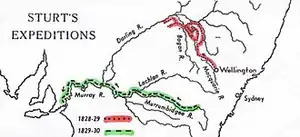 Early expeditions of Charles Sturt (from History of New South Wales)
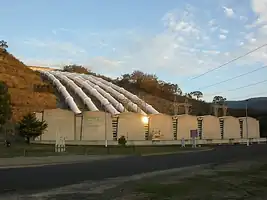 Tumut 3 Power Station was constructed as part of the vast Snowy Mountains Scheme in New South Wales (1949–1974). Construction necessitated the expansion of Australia's immigration program. (from History of New South Wales)
 Dry paddocks in the Riverina region during the 2007 drought (from History of New South Wales)
 A bulk carrier entering the Port of Newcastle, New South Wales, 2009 (from Economy of New South Wales)
 Ribbon ceremony to open the Sydney Harbour Bridge on 20 March 1932. Breaking protocol, the soon to be dismissed Premier Jack Lang cuts the ribbon while Governor Philip Game looks on. (from History of New South Wales)

 Federation Pavilion, Centennial Park, Sydney, 1 January 1901. (from History of New South Wales)
 Autumn colour at Mount Wilson (from Geography of New South Wales)
 Founding of the settlement of Port Jackson at Botany Bay in New South Wales in 1788, by Thomas Gosse (1799) (from History of New South Wales)
 The 5th Governor of New South Wales, Lachlan Macquarie, was influential in establishing civil society in Australia (from History of New South Wales)
 World leaders with Prime Minister John Howard in Sydney for the 2007 APEC conference (from History of New South Wales)
 William Wentworth was key in the establishment of self-governance in New South Wales (from History of New South Wales)
 Sydney Opera House was opened in 1973. (from History of New South Wales)
 Hyde Park, Sydney with the Australian Museum under construction in the distance, 1842 (from History of New South Wales)
 A 630 lb gold specimen from Hill End, unearthed in 1872 (from History of New South Wales)
 Murray Grey cows and calves (from Economy of New South Wales)
 A General Chart of New Holland including New South Wales & Botany Bay with The Adjacent Countries and New Discovered Lands, published in An Historical Narrative of the Discovery of New Holland and New South Wales, London, Fielding and Stockdale, November 1786 (from History of New South Wales)
 Olympic colours on the Sydney Harbour Bridge in the year 2000 (from History of New South Wales)
 Mr E.H. Hargraves, The Gold Discoverer of Australia, returning the salute of the gold miners - Thomas Tyrwhitt Balcombe, 1851 (from History of New South Wales)
 Humanitarian Caroline Chisholm provided support to poverty-stricken women migrants (from History of New South Wales)
 Landing of Lieutenant James Cook at Botany Bay, 29 April 1770 by E. Phillips Fox (1902) (from History of New South Wales)
 A chart of part of the interior of New South Wales by John Oxley, Surveyor General, 1822 (from History of New South Wales)
 Bondi Beach circa 1900 (from History of New South Wales)

 Köppen climate types in New South Wales (from Geography of New South Wales)
Topics
Categories

More portals
In the news
- 19 August 2026 – 2026 Sydney Swans player investigation
- In Australian football, the Sydney Swans suspend five of their players for the remainder of the season who are under police investigation over allegations of sexual assault against multiple women. (ABC News Australia)
Associated Wikimedia
The following Wikimedia Foundation sister projects provide more on this subject:
-
 Commons
Free media repository -
 Wikidata
Free knowledge base -
 Wikiquote
Collection of quotations -
 Wikisource
Free-content library -
 Wikiversity
Free learning tools -
 Wikivoyage
Free travel guide -
 Wiktionary
Dictionary and thesaurus
-
 List of all portals
-

-

-

-

-

-

-

-

-

-
 Random portal
-
 WikiProject Portals