Thailand, officially the Kingdom of Thailand, and formerly known as Siam, is a country located in Mainland Southeast Asia. It shares land borders with Myanmar to the west and northwest, Laos to the east and northeast, Cambodia to the southeast, and Malaysia to the south. Its maritime boundaries include the Gulf of Thailand and the Andaman Sea and shares maritime borders with Vietnam, Indonesia, and India. Thailand has a population of nearly 66 million people and covers an area of approximately 513,115km2 (198,115 sq mi). The capital and largest city is Bangkok.
After the fall of Ayutthaya, King Taksin reunified the kingdom and established the Thonburi Kingdom, which lasted only 15 years before he was overthrown by Phutthayotfa Chulalok (Rama I), the founder of the Chakri dynasty. King Rama I established the Rattanakosin Kingdom and moved the capital to Bangkok in 1782. During the era of Western imperialism, Siam remained the only country in Southeast Asia to avoid colonisation by European powers, although it ceded territory, trade rights, and legal privileges through several unequal treaties. The governance system evolved into an absolute monarchy centralised under the rule of King Chulalongkorn (Rama V). Siam adapted to international relations during the imperialist era and joined World War I on the side of the Allies, a political decision aimed at revising the effects of unequal treaties and enhancing Siam's international status.
After dissolving the government and the Senate of Thailand, the NCPO vested executive and legislative powers in its leader and ordered the judicial branch to operate under its directives. In addition, it partially repealed the 2007 constitution, save the second chapter that concerned the king, declared martial law and curfew nationwide, banned political gatherings, arrested and detained politicians and anti-coup activists, imposed Internet censorship in Thailand and took control of the media. (Full article...)
Image 2
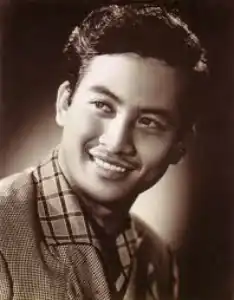
Mitr around 1970s
Mitr Chaibancha (Thai: มิตร ชัยบัญชา, RTGS:Mit Chaibancha; 28 January 1934 – 8 October 1970) was a Thaifilm actor. He acted in 266 films from 1956 to 1970. He died on 8 October 1970 at Dongtan Beach, Jomtien, South Pattaya, after falling from a helicopter during the filming of a stunt for the final scene of Insee Thong (Golden Eagle).
At the height of his career in the 1960s, Mitr, along with Petchara Chaowarat, made a string of hit films that packed cinemas. Of the 75 to 100 films produced each year by the Thai film industry during this period, Mitr starred in nearly half of them. (Full article...)
Image 3
Thai New Year, also known as Songkran (Thai: สงกรานต์, pronounced[sǒŋ.krāːn]), or the Songkran Festival (Songkran Splendours), is the Thai New Year's national holiday. It is celebrated annually on 13 April, with the holiday period extending from 14 to 15 April.
Siamosaurus (meaning "Siam lizard") is a potentially dubiousgenus of spinosauriddinosaur that lived in what is now Thailand and possibly China during the Early Cretaceousperiod (Barremian to Aptian) and is the first reported spinosaurid from Asia. It is confidently known only from tooth fossils; the first were found in the Sao Khua Formation, with more teeth later recovered from the younger Khok Kruat Formation. The only speciesSiamosaurus suteethorni, whose name honours Thai palaeontologistVaravudh Suteethorn, was formally described in 1986. In 2009, four teeth from China previously attributed to a pliosaur—under the species "Sinopliosaurus" fusuiensis—were identified as those of a spinosaurid, possibly Siamosaurus. It is yet to be determined if two partial spinosaurid skeletons from Thailand and an isolated tooth from Japan also belong to Siamosaurus.
Since it is based only on teeth, Siamosaurus's body size is uncertain, though it has been estimated at between 5.1 to 9.1 metres (17 to 30 feet) in length. The holotype tooth is 62.5 millimetres (2.46 inches) long. Siamosaurus's teeth were straight, oval to circular in cross-section, and lined with distinct lengthwise grooves. Its teeth had wrinkled enamel, similar to teeth from the related genus Baryonyx. As a spinosaur it would have had a long, low snout and robust forelimbs, and one possible skeleton indicates the presence of a tall sail running down its back, another typical trait of this theropod family. Siamosaurus is considered by some palaeontologists to be a dubious name, with some arguing that its teeth are hard to differentiate from those of other Early Cretaceous spinosaurids, and others that it may not be a dinosaur at all. Based on dental traits, Siamosaurus and "S." fusuiensis have been placed in the subfamilySpinosaurinae. (Full article...)
Image 5
Formal portrait, c.1880
Chulalongkorn (20 September 1853 – 23 October 1910), posthumously honoured as King Chulalongkorn the Great, was the fifth king of Siam from the Chakri dynasty, titled Rama V. Chulalongkorn's reign from 1868 until his death in 1910 was characterised by the modernisation of Siam, governmental and social reforms, and territorial concessions to the British and French empires. As Siam was surrounded by European colonies, Chulalongkorn, through his policies and acts, ensured the independence of Siam.
Chulalongkorn was born as the son of Mongkut, the fourth king of Siam. In 1868, he travelled with his father to observe the solar eclipse of 18 August 1868 in Prachuap Khiri Khan Province. During that trip, Chulalongkorn and his father both contracted malaria which resulted in his father's death, and his accession to the throne. The 1893 Franco-Siamese crisis and Haw wars took place during his reign. All his reforms were dedicated to ensuring Siam's independence given the increasing encroachment of Western powers. Chulalongkorn's success earned him the epithet Phra Piya Maharat or the Great Beloved King. (Full article...)
Image 6
Phra Pathommachedi
Phra Pathommachedi or Phra Pathom Chedi (Thai: พระปฐมเจดีย์) is a Buddhist stupa in Thailand. The stupa is located in the Wat Phra Pathommachedi Ratcha Wora Maha Wihan (Thai: วัดพระปฐมเจดีย์ราชวรมหาวิหาร), a temple in the town center of Nakhon Pathom, Nakhon Pathom Province, Thailand. Phra Pathommachedi is the second tallest stupa in the world. The top of its spire reaches 120.45 meters, with the base circumference of 235.50 meters.
The name Phra Pathommachedi means the first holy stupa, given by king Mongkut. Modern Historians believe that the stupa was one of the principal stupas of ancient Nakhon Pathom, the largest city of the ancient Mon kingdom of Dvaravati in Nakhon Pathom area together with the nearby Phra Prathon Chedi (Thai: พระประโทณเจดีย์) during the 6th to the 8th centuries. (Full article...)
Image 7
Skyline of Bangkok
Bangkok, known in Thai as Krung Thep Maha Nakhon and colloquially as Krung Thep, is the capital and most populous city of the Kingdom of Thailand. The city occupies 1,568.7 square kilometres (605.7sqmi) in the Chao Phraya River delta in central Thailand and has an estimated population of 9.1 million people as of 2024, 15.9% of the country's population. Over 17.4million people (25% of Thailand's population) live within the surrounding Bangkok Metropolitan Region as of the 2021 estimate, making Bangkok a megacity and an extreme primate city, dwarfing Thailand's other urban centres in both size and importance to the national economy.
Bangkok traces its roots to a small trading post during the Ayutthaya era in the 15th century, which eventually grew and became the site of two capital cities, Thonburi in 1767 and Rattanakosin in 1782. Bangkok was at the heart of the modernization of Siam during the late 19th century, as the country faced pressures from the West. The city was at the centre of the country's political struggles throughout the 20th century, as Siam—later renamed Thailand—abolished absolute monarchy, adopted constitutional rule, and underwent numerous coups and several uprisings. The city, which was incorporated as a special administrative area under the Bangkok Metropolitan Administration in 1972, grew rapidly during the 1960s through the 1980s and now exerts a significant impact on Thailand's politics, economy, education, media, and modern society. (Full article...)
The kingdom governed based on the mandala system. This allows for high-autonomy locally with the kingdom influencing and effectively ruling its area of suzerainty. At its zenith in 1805 to 1812, the Kingdom was composed of 25 polities, ranging from duchies and principalities to federations and kingdoms. With the furthest extent reaching the Shan States, southern Yunnan, Laos, Cambodia, northern Si Rat Malai and Kawthoung. The kingdom was founded by Rama I of the Chakri dynasty. The first half of this period was characterized by the consolidation of Siamese power in the center of Mainland Southeast Asia and was punctuated by contests and wars for regional supremacy with rival powers Burma and Vietnam. The second period was one of engagements with the colonial powers of Britain and France in which Siam remained the only Southeast Asian state to maintain its independence. (Full article...)
The auto rickshaw is a common form of transport around the world (especially in South Asian countries like India and Pakistan) both as a vehicle for hire and private use. They are especially common in countries with tropical or subtropical climate since they are usually not fully enclosed, and in many developing countries because they are relatively inexpensive to own and operate. (Full article...)
Image 16Map showing linguistic family tree overlaid on a geographic distribution map of Tai-Kadai family. This map only shows general pattern of the migration of Tai-speaking tribes, not specific routes, which would have snaked along the rivers and over the lower passes. (from History of Thailand)
Image 34Ananta Samakhom Throne Hall, the royal reception hall built in European architectural style. Construction was started by Rama V, but was completed in 1915. (from History of Thailand)
Image 41Display of respect of the younger towards the elder is a cornerstone value in Thailand. A family during the Buddhist ceremony for young men who are to be ordained as monks. (from Culture of Thailand)
Image 46Wat Arun was originally a small temple called Wat Makok built in the 17th century. The central prang was completed around 1851. (from History of Thailand)
Street food in Thailand brings together various offerings of ready-to-eat meals, snacks, fruits and drinks sold by hawkers or vendors at food stalls or food carts on the street side in Thailand. Sampling Thai street food is a popular activity for visitors, as it offers a taste of Thai cooking traditions. Bangkok is often mentioned as one of the best places for street food. In 2012, VirtualTourist named Bangkok as the number one spot for street food—the city is notable for both its variety of offerings and the abundance of street hawkers. (Full article...)







 Commons
 Wikidata
 Wikiquote
 Wikisource
 Wikispecies
 Wikiversity
 Wikivoyage
 Wiktionary
 List of all portals






 Random portal
 WikiProject Portals