Nakhon Pathom
Nakhon Pathom
นครปฐม | |
|---|---|
| City of Nakhon Pathom เทศบาลนครนครปฐม | |
 | |
 Seal | |
  Nakhon Pathom Location in Bangkok Metropolitan Region  Nakhon Pathom Location in Thailand | |
| Coordinates: 13°49′14″N 100°03′45″E / 13.82056°N 100.06250°E | |
| Country |  Thailand |
| Province | Nakhon Pathom |
| District | Mueang Nakhon Pathom |
| Government | |
| • Type | City Municipality |
| • Mayor | Ekaphan Kuptawat |
| Area | |
• Total | 19.85 km2 (7.66 sq mi) |
| Population (2000) | |
• Total | 120,657 |
| Time zone | UTC+7 (ICT) |
| Area code | (+66) 34 |
| Website | nakhonpathomcity |
Nakhon Pathom (Thai: นครปฐม, pronounced [náʔkʰɔ̄ːn pā.tʰǒm]) is a city (thesaban nakhon) in central Thailand, the capital of Nakhon Pathom province. One of the most important landmarks is the giant Phra Pathommachedi.[1] The city is also home to Thailand's only Bhikkhuni temple Wat Song Thammakanlayani (วัดทรงธรรมกัลยาณี), which is also open to women from abroad.[2]
Nakhon Pathom houses a campus of Silpakorn University within the former Sanam Chandra Palace.
The city is 57 km west of Bangkok.
According to Charles Higham, "Two silver medallions from beneath a sanctuary at Nakhon Pathom, the largest of the moated sites, proclaim that it was 'the meritorious work of the King of Sri Dvaravati', the Sanskrit term Dvaravati meaning 'that which has gates'. The script is in south Indian characters of the seventh century." Nakhon Pathom was the largest Dvaravati center.[3]: 301–302, 304
History
Nakhon Pathom is often said to have stood on the Gulf of Thailand two thousand years ago, the coast having since moved south through sedimentation. How far inland the sea reached is disputed. Phōngsi Wanasin and Thiwa Supcanya found the ancient towns of the plain arranged in two rows above the 3.5-metre contour, which David K. Wyatt reads as the fringes of a plain then largely under water rather than as a shoreline; on his account Nakhon Chai Si stands considerably higher than the ground to its east.[4]: 7, 57 Nakhon Pathom, along with Ratchaburi and Sing Buri, is considered one of the oldest cities in Thailand, having been founded as far back as 40 BC. It was for a long time one of the important capitals of Dvaravati, a prestigious Mon kingdom from Lop Buri to ex Tun Sun area. The Indian King Ashoka sent monks to Siam at this time to popularize Theravada Buddhism. They arrived in Nakhon Pathom and from there toured the country. Hence the city's self-image of having spread Buddhism throughout Siam.
The moated city encloses 602 ha, the largest of the Dvaravati settlements of the central plain. In Karen Mudar's locational analysis of 63 of them it is the only site at the top of a four-level administrative hierarchy, standing above seven regional centres, and the best provided with public buildings; the region assigned to it holds eight moated settlements.[5]: 7–9, 24 The enclosure reached that size in two stages, a second moat taking it from about 300 ha to 602. Before that expansion it was the size of Suphanburi and of Phraek Si Racha after its own enlargement, and Mudar suggested that if the three stood at that size at the same time they may have been the capitals of competing polities, with Nakhon Pathom's doubling marking the outcome; the expansions have not been dated against one another, which the argument requires.[5]: 11, 19–20, 24 The rank-size distribution of the settlements falls close to a straight line, which she read as a single integrated economic system by the end of the period rather than one centre suppressing the growth of the rest.[5]: 10–11
Walailak Songsiri counts Wat Na Phra Men in the ancient city among the places holding crowned bronze Buddhas of a group current in the western basin between the 11th and 13th centuries, most often recovered buried in Chinese jars. The images sit in rueankaeo arches of Bagan type under Pala influence, some wearing the Pala feathered crown and some in the U Thong manner.[6]: 16
In April 1842, trouble broke out between three groups of Chinese who had formed secret societies, each with about 1,000 men. The leaders of these groups were named Khim, Ia and Phiao (Piaw). The Siamese government sent soldiers under the command of Phra Sombat Wanit to arrest the leaders. In fact, Khim and Phiao were the first to be thrown into the dungeon, but Ia managed to escape. He then robbed the houses in the Samut Sakhon and Nakhon Pathom area along with his people. They could only be overpowered after a large police operation.[7]
In the 1930s, Nakhon Pathom was a nest of 300 houses and about 12. Buddhist temples. There was also the famous monks' retreat at Bang Thammasala.[8]
Geography
Nakhon Pathom is located about 50 kilometers west of Thailand's capital, Bangkok, in the middle of a wide plain, crossed by watercourses, such as the Mae Nam Tha Chin (Tha Chin River). Sugar cane has been grown here since the late 18th century. Old travel reports describe that near Nakhon Pathom on the Tha Chin, there were sugar factories every four to five kilometers, surrounded by some ten to fifteen houses and firmly in Chinese hands.[9]
Places of interest
- Phra Pathom Chedi (พระปฐมเจดีย,) - considered the tallest Buddhist structure in the world, it is about 127 meters high, rediscovered by King Mongkut (Rama IV) during his time as a wandering monk in the jungle (restored since 1853) and covered with fine Chinese tiles at the behest of his son Chulalongkorn (Rama V).
- Phra Ruang Rochanarit - Standing Buddha about eight meters high in the north chapel.
- New museum at the south entrance of the temple complex, displaying mainly Dvaravati period artifacts found during construction work on the chedi and in the surrounding excavations, as well as Mon-style Buddha statues.
- Wat Phra Praton Praton Chedi (พระประโทณเจดีย์): small, quiet temple with an ancient Khmer prang and a small but popular shrine to the heroes of a legend Phya Khong and his foster mother Yai Hom.
- Wat Songdhammakalyani- (วัดทรงธรรมกัลยาณี) - Thailand's only Bhikkhuni temple, open also to interested Western women.[10]
- Sanam Chandra Palace - King Vajiravudh's palace complex in the west of the city. The complex now houses the Sanam Chan Palace Campus of Silpakorn University.
Gallery


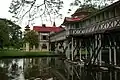 Sanam Chandra Palace
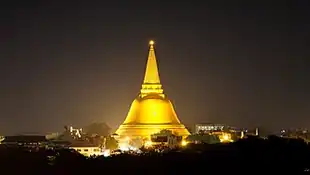 Phra Pathommachedi
See also
References
- ↑ "Phra Pathom Chedi". Tourism Authority of Thailand (TAT). Archived from the original on 28 May 2015. Retrieved 28 May 2015.
- ↑ "Wat Songdhammakalyani". On Thailand & Engaged Buddhism. Archived from the original on 8 July 2011. Retrieved 28 May 2015.
- ↑ Higham, Charles., 2014, Early Mainland south-east Asia, Bangkok: River Books Co., Ltd., ISBN 9786167339443
- ↑ David K. Wyatt (2001). "Relics, Oaths and Politics in Thirteenth-Century Siam" (PDF). Journal of Southeast Asian Studies. 32 (1): 3–65. JSTOR 20072298. Archived from the original on 26 January 2026. Retrieved 10 September 2025.
- 1 2 3 Karen M. Mudar (1999). "How Many Dvaravati Kingdoms? Locational Analysis of First Millennium A.D. Moated Settlements in Central Thailand" (PDF). Journal of Anthropological Archaeology. 18 (1): 1–28. Bibcode:1999JAnAr..18....1M. doi:10.1006/jaar.1998.0329.
- ↑ Walailak Songsiri (2025). "ในดินแดนแห่งเจนลีฟู นครรัฐที่ไม่ได้อยู่ในอำนาจทางการเมืองของพระเจ้าชัยวรมันที่ ๗ สู่ปัญหาทางประวัติศาสตร์ที่หาทางออกไม่เจอของสังคมไทย" [In the land of Chen Li Fu, a city-state outside the political power of Jayavarman VII, and the historical problem Thai society has not resolved]. Lek-Prapai Viriyaphan Foundation (in Thai). Retrieved 14 July 2025.
- ↑
↑ Terwiel (1989), S. 78 - ↑ Terwiel (1989), S. 91
- ↑ Terwiel (1989), S. 68
- ↑ "On Thailand & Engaged Buddhism: Wat Songdhammakalyani"
External links
 Nakhon Pathom travel guide from Wikivoyage
