Portal:Renewable energy

  |
The Renewable Energy Portal |
  |
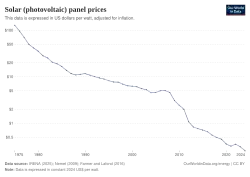
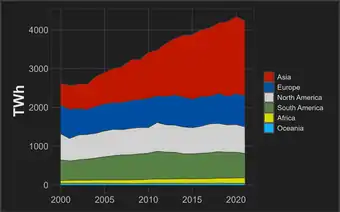
Introduction Renewable energy (also called green energy) is energy made from renewable natural resources that are replenished on a human timescale. The most widely used renewable energy types are solar energy, wind power, and hydropower. Bioenergy and geothermal power are also significant in some countries. Renewable energy installations can be large or small and are suited for both urban and rural areas. Renewable energy is often deployed together with further electrification. This has several benefits: electricity can move heat and vehicles efficiently and is clean at the point of consumption. Variable renewable energy sources are those that have a fluctuating nature, such as wind power and solar power. In contrast, controllable renewable energy sources include dammed hydroelectricity, bioenergy, or geothermal power. For an energy to be renewable, it must be an endless source. Nuclear power is therefore not considered renewable, due to its reliance on non-renewable fuel. Renewable energy systems have rapidly become more efficient and cheaper over the past 40 years. A large majority of newly installed worldwide electricity capacity is now renewable. Renewable energy sources, such as solar and wind power, have seen significant cost reductions over the past decade, making them more competitive with traditional fossil fuels. In some geographic localities, photovoltaic solar or onshore wind is the cheapest new-build electricity. From 2011 to 2021, renewable energy grew from 20% to 28% of the global electricity supply. Power from the sun and wind accounted for most of this increase, growing from a combined 2% to 10%. Use of fossil energy shrank from 68% to 62%. In 2025, renewables accounted for than 30% of global electricity generation and are projected to reach over 45% by 2030. Many countries already have renewables contributing more than 20% of their total energy supply, with some generating over half or even all their electricity from renewable sources. The main motivation to use renewable energy instead of fossil fuels is to reduce greenhouse gas emissions, which cause climate change. In general, renewable energy sources pollute much less than fossil fuels. Renewables also cause much less air pollution than fossil fuels, improving public health, and are less noisy. The International Energy Agency estimates that to achieve net zero emissions by 2050, 90% of global electricity will need to be generated by renewables. The current pace of renewable expansion remains far from this required rate globally, including in major economies with high financial capacities such as the G7 and the EU. The deployment of renewable energy still faces obstacles, especially fossil fuel subsidies, lobbying by incumbent power providers, and local opposition to the use of land for renewable installations. Like all mining, the extraction of minerals required for many renewable energy technologies also results in environmental damage. Some also consider nuclear power a renewable power source, although this is controversial, as nuclear energy requires mining uranium, a nonrenewable resource. (Full article...) Selected article - New Melones Dam is an earth and rock filled embankment dam on the Stanislaus River, about 5 miles (8.0 km) west of Jamestown, California, United States, on the border of Calaveras County and Tuolumne County. The water impounded by the 625-foot-tall (191 m) dam forms New Melones Lake, California's fourth-largest reservoir, in the foothills of the Sierra Nevada east of the San Joaquin Valley. The dam serves mainly for irrigation water supply, and also provides hydropower generation, flood control, and recreation benefits. The dam was authorized in 1944 as a unit of the federal Central Valley Project, a system designed to provide irrigation water to the fertile agricultural region of the Central Valley. It would be built by the U.S. Army Corps of Engineers (Corps), and transferred to the U.S. Bureau of Reclamation (Reclamation) upon completion. In 1966, work began to clear the foundations for a high dam that would replace an earlier, much smaller structure built by two irrigation districts. Construction of the main embankment began in 1976, and was topped out in late 1978. The filling of New Melones Lake began in 1978, and the dam's hydroelectric station produced its first power in mid-1979. New Melones was the focus of a long environmental battle during the 1970s and early 1980s; critics protested the flooding of a long scenic stretch of the Stanislaus River, which flowed over whitewater rapids through the deepest limestone canyon in the western United States. The protestors employed a variety of methods, some extreme, to prevent the filling of New Melones Lake until 1983, when record-setting floods filled the reservoir and nearly breached the dam's emergency spillway. The fight over New Melones galvanized the river conservation movement in California and influenced major water policy changes on the state and federal levels; since its completion, no other dams of its size or importance have been built in the United States. (Full article...) Quotations -
Main topicsRenewable energy sourcesGeneralRenewable energy commercialization · Smart grid · Timeline of sustainable energy research 2020–present Renewable energy by countryList of countries by electricity production from renewable sources
WikiProjectsWikiProjects connected with renewable energy:
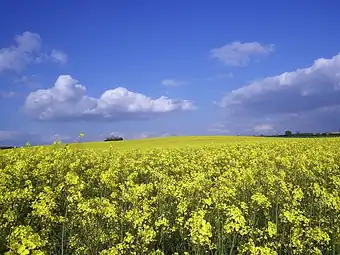
Selected image -Rapeseed field at Grendon, Northamptonshire. Rapeseed oil is used in the manufacture of biodiesel for powering motor vehicles. Selected biography -Elon Reeve Musk (/ˈiːlɒn/ ⓘ EE-lon; born June 28, 1971) is a businessman and former public official who is the CEO and largest shareholder of Tesla and SpaceX. Musk has been the wealthiest person in the world since 2025, and briefly became the only trillionaire (in terms of US dollars) in June 2026; as of August 14, 2026, Forbes estimates his net worth to be US$864 billion. Born into the wealthy Musk family in Pretoria, South Africa, Musk emigrated in 1989 to Canada; he has Canadian citizenship since his mother was born there. He received bachelor's degrees in 1997 from the University of Pennsylvania before moving to California to pursue business ventures. In 1995, Musk co-founded Zip2, a web software company. Following its sale in 1999, he co-founded X.com, an e-commerce payment system that merged with Confinity in March 2000 to form PayPal, which was acquired by eBay in 2002. Musk also became an American citizen in 2002. (Full article...) Did you know? -... that the first recorded instance of solar distillation was by 16th century Arab alchemists? A large-scale solar distillation project was first constructed in 1872 in Chile a mining town of Las Salinas. The plant, which had a solar collection area of 4,700 m², could produce up to 22,700 L per day and operated for 40 years. Individual still designs include single-slope, double-slope (or greenhouse type), vertical, conical, inverted absorber, multi-wick, and multiple effect. These stills can operate in passive, active, or hybrid modes. Double-slope stills are the most economical for decentralized domestic purposes, while active multiple effect units are more suitable for large-scale applications. General images -The following are images from various renewable energy-related articles on Wikipedia.
Related portalsCategories Select [►] to view subcategories
Associated WikimediaThe following Wikimedia Foundation sister projects provide more on this subject:
Discover Wikipedia using portals
|