Solar power in Thailand

Solar power in Thailand reached installed capacity of 6.84 GW in 2025.[2] Rapid growth in the sector brought a doubling of capacity over just two years, and the country passed its 2036 goal eleven years early, a target of 6 GW set in 2012.[3] As of 2025, solar power makes up around 3% of Thailand's electricity generation.[4] Thailand has the second-most solar power capacity in Southeast Asia, after Vietnam.[2]
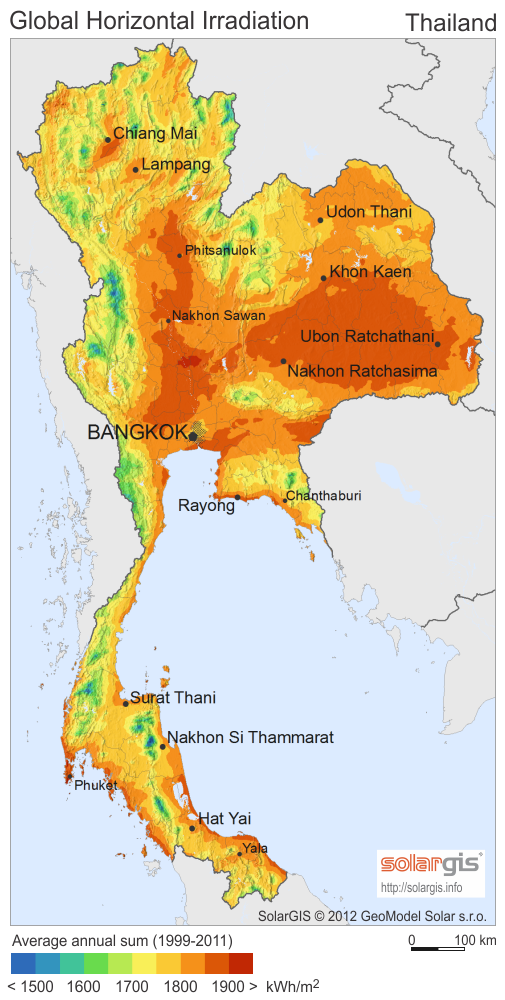
Thailand has great solar potential, especially the southern and northern parts of the northeastern region of Udon Thani Province and certain areas in the central region. Around 14.3% of the country has a daily solar exposure of around 19–20 MJ/m2/day, while another 50% of the country gains around 18–19 MJ/m2/day. In terms of solar potential, Thailand lags behind the US, but is ahead of Japan.[5]
The 84 MW Lopburi Solar Farm was completed in May 2013. German solar energy company Conergy signed a contract with Thailand's Siam Solar Energy to construct three solar plants of 10.5 MW each in addition to existing two solar plants that have been under construction since autumn 2012.[6]
In 2021, the world’s largest hybrid solar-hydropower project, the Sirindhorn floating solar farm, commenced operations.[7]
Power purchase scheme
In January 2015, Thailand's Energy Regulatory Commission (ERC) announced a new regulation for the purchase of electricity from ground-mounted solar projects, replacing the "adder" scheme with the "feed-in-tariff" (FiT) scheme. The regulation aims to revive the investment in renewable energy projects in Thailand after a quiet period in the renewable energy sector in 2014. There are over one hundred projects, with a total capacity of 1,000 MW, whose applications have not yet been accepted under the adder scheme and therefore are eligible for the feed-in-tariff scheme.[8]
Statistics
 Daily insolation in Bangkok with an average of 5.04 hours of sun per day[9] |
| Year | Cumulative capacity (MWp) |
Annual installations (MWp) | ||||||
|---|---|---|---|---|---|---|---|---|
| On-grid
(distributed) |
On-grid
(centralized) |
Off-grid | Total | On-grid
(distributed) |
On-grid
(centralized) |
Off-grid | Total | |
| 2005 | - | 1.77 | 22.11 | 23.88 | - | 0.01 | - | 13.05 |
| 2006 | - | 1.86 | 28.66 | 30.52 | - | 0.09 | 6.55 | 6.64 |
| 2007 | - | 3.61 | 28.90 | 32.51 | - | 1.75 | 0.24 | 1.99 |
| 2008 | - | 4.05 | 29.34 | 33.39 | - | 0.44 | 7.23 | 0.88 |
| 2009 | - | 13.68 | 29.49 | 43.17 | - | 9.63 | 0.15 | 9.78 |
| 2010 | - | 19.57 | 29.65 | 49.22 | - | 5.89 | 7.54 | 6.05 |
| 2011 | - | 212.28 | 29.88 | 242.68 | - | 192.71 | 0.23 | 193.46 |
| 2012 | - | 357.38 | 30.19 | 387.57 | - | 145.10 | 8.08 | 144.89 |
| 2013 | - | 793.73 | 29.73 | 823.46 | - | 436.35 | -0.46a | 435.89 |
| 2014 | - | 1,268.78 | 29.15 | 1,298.51 | - | 475.05 | 7.04 | 475.05 |
| 2015 | - | 1,389.55 | 30.03 | 1,419.58 | - | 120.77[10] | 0.88 | 121.07 |
| 2016 | 129.68 | 2,282.64 | 33.80 | 2,446.12 | 129.68 | 893.09 | 11.69 | 1,026.54 |
| 2017 | 359.79 | 2,663.12 | 34.14 | 3,057.05 | 230.11 | 380.48 | 0.34 | 610.93 |
| 2018 | 598.86 | 2,827.05 | 11.43 | 3,437.34 | 239.07 | 163.93 | -10.68a | 380.29 |
| Source: IEA-PVPS, Annual Report 2015 (AR2015),[11] National Survey report of PV applications in Thailand [12] Notes:
| ||||||||
See also
References
- ↑ "Global Horizontal Irradiation (GHI): Thailand". solargis. Retrieved 5 Mar 2015.
- 1 2 "Electricity Data Explorer". Ember. Retrieved 2026-08-29.
- ↑ Jittapong, Khettiya (2015-07-12). "Thailand ignites solar power investment in Southeast Asia". Reuters. Reuters UK. Archived from the original on December 24, 2015. Retrieved 2014-07-24.
- ↑ IRENA (22 September 2025). "Energy Profile: Thailand" (PDF). www.irena.org. Archived from the original (PDF) on 2026-01-14. Retrieved 2026-03-12.
- ↑ "Areas with solar power potential". Thailand Ministry of Energy, Department of Alternative Energy Development and Efficiency. Retrieved 5 Mar 2015.
- ↑ "Thailand turns to solar power". Investvine.com. 2013-02-25. Retrieved 2013-02-25.
- ↑ "Thailand starts operating massive floating solar panel project as pressure mounts on climate action". CNA. Retrieved 2021-11-02.
- ↑ "Solar power in Thailand: new power purchase scheme creates investment opportunities". www.nortonrosefulbright.com. Retrieved 2015-09-23.
- ↑ "PV Watts". US National Renewable Energy Laboratory (NREL). Archived from the original on 23 October 2014. Retrieved 9 Jul 2012.
- ↑ "Solarpv.tv".
- ↑ IEA-PVPS, Annual Report 2015 (AR2015), p. 105, 27 May 2016
- ↑ "IEA National Survey Report of PV Applications in Thailand 2018" (PDF). 2018.
| Africa | |||||
|---|---|---|---|---|---|
| Asia | |||||
| Europe |
| ||||
| North America | |||||
| Oceania | |||||
| South America | |||||