Portal:Primates

The Primates Portal A primate is a member of the biological order Primates, the group that contains lemurs, the aye-aye, lorisids, galagos, tarsiers, monkeys, and apes, with the last category including great apes. With the exception of humans, who inhabit every continent on Earth, most primates live in tropical or subtropical regions of the Americas, Africa and Asia. Primates range in size from the 30-gram (1 oz) pygmy mouse lemur to the 200-kilogram (440 lb) mountain gorilla. According to fossil evidence, the primitive ancestors of primates may have existed in the late Cretaceous period around 65 mya (million years ago), and the oldest known primate is the Late Paleocene Plesiadapis, c. 55–58 mya. Molecular clock studies suggest that the primate branch may be even older, originating in the mid-Cretaceous period around 85 mya. Primates exhibit a wide range of characteristics. Some primates do not live primarily in trees, but all species possess adaptations for climbing trees. Locomotion techniques used include leaping from tree to tree, walking on two or four limbs, knuckle-walking, and swinging between branches of trees (known as brachiation). Primates are characterized by their large brains relative to other mammals. These features are most significant in monkeys and apes, and noticeably less so in lorises and lemurs. Many species are sexually dimorphic, which means males and females have different physical traits, including body mass, canine tooth size, and coloration.
Selected article
Selected picture Emperor tamarins inhabit tropical rain forests, living deep in the forest and also in open tree-covered areas. This diurnal species walks or runs quadrupedally through the forest, spending the majority of its days in the trees with quick, safe movements and broad jumps among the limbs. CategoriesSelect [►] to view subcategories
Selected species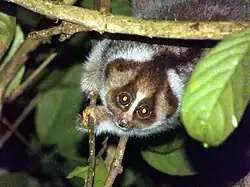 Not evaluated (IUCN 3.1)|
Nycticebus kayan is a strepsirrhine primate and a species of slow loris that is native to the northern and central highland region of the island of Borneo. The species was originally thought to be a part of the Bornean slow loris (N. menagensis) population until 2013, when a study of museum specimens and photographs identified distinct facial markings, which helped to differentiate it. It is distinguished by the high contrast of its black and white facial features, as well as the shape and width of the stripes of its facial markings. The species is named after the Kayan River, which runs through its native habitat. As with other slow lorises, this arboreal and nocturnal species primarily eats insects, tree gum, nectar, and fruit and has a toxic bite, a unique feature among primates. Although not yet evaluated by the International Union for Conservation of Nature (IUCN), it is likely to be listed as "Vulnerable" or placed in a higher-risk category when its conservation status is assessed. It is primarily threatened by habitat loss and the illegal wildlife trade. Did you know?
Primate lists
WikiProjectsWikiProject Science
Things to do
Associated WikimediaDiscover Wikipedia using portals
|







