The region constituting Morocco has been inhabited since the Paleolithic era, more than 300,000 years ago. The Moroccan state traces its origins to the establishment of the Idrisid dynasty by Idris I in 788, although its historical territories did not coincide with those of present-day Morocco; the country is regarded as one of the world's oldest continuously existing states. Morocco was subsequently ruled by a series of other independent dynasties, reaching its zenith as a regional power in the 11th and 12th centuries, under the Almoravid and Almohad dynasties, both Berber kingdoms, when it controlled most of the Iberian Peninsula and the Maghreb. In the 15th and 16th centuries, Morocco faced external threats to its sovereignty, with Portugal seizing some territory and the Ottoman Empire encroaching from the east. The Marinid and Saadi dynasties otherwise resisted foreign domination, and Morocco was the only North African nation to escape Ottoman dominion. The Saadi dynasty expanded its territory through the conquest of the Songhai Empire in the late 16th century. The Alawi dynasty, which rules the country to this day, seized power in 1631, and over the next two centuries expanded diplomatic and commercial relations with the Western world. It is among the world's oldest reigning royal dynasties. Morocco's strategic location near the mouth of the Mediterranean drew renewed European interest. In 1912, France and Spain established protectorates over the country and designated Tangier as an international zone, while the Sultan remained the formal sovereign with limited authority under colonial control. Following intermittent riots and revolts against colonial rule, Morocco regained its independence and reunified in 1956 under the leadership of Sultan Mohammed V.
Since independence, Morocco has remained relatively stable. It has the fifth-largest economy in Africa and wields significant influence in both Africa and the Arab world; it is considered a middle power in global affairs and holds membership in the Arab League, the Arab Maghreb Union, the Union for the Mediterranean, and the African Union. It is one of the few countries in Africa ranking high on the Human Development Index and is Africa's leading industrial economy. Morocco is a unitary semi-constitutional monarchy with an elected parliament. The executive branch is led by the King of Morocco and the prime minister, while legislative power is vested in the two chambers of parliament: the House of Representatives and the House of Councillors. Judicial power rests with the Constitutional Court, which may review the validity of laws, elections, and referendums. The king holds vast executive and legislative powers, especially over the military, foreign policy and religious affairs; he can issue dahirs, decrees which have the force of law, and he can also dissolve the parliament after consulting the prime minister and the president of the constitutional court. Morocco is classified as a hybrid regime and, as of 2025, holds the highest ranking in the Arab world, according to The Economist Democracy Index. Islam is both the official and predominant religion, with nearly all of the population identifying as Muslims. Arabic and Berber are the official languages, though the Moroccan dialect of Arabic (known locally as Darija) is widely spoken and considered the lingua franca. The culture of Morocco is a mix of Arab, Berber, European (specifically Andalusian), and African cultures.
Lesbian, gay, bisexual, transgender, and queer (LGBTQ) people in Morocco face significant challenges not experienced by non-LGBTQ residents. Both male and female forms of same-sex sexual activity are illegal in Morocco. Gay and lesbian Moroccans face many hardships in the country, as they have limited legal rights. Moroccan police disproportionately target perceived LGBTQ people, and attitudes towards the wider LGBTQ community remain mostly negative throughout the nation. (Full article...)
Image 8Group of Moroccan women; some of them wear a Gandoura and others Jellabas. The Gandoura doesn't have a hood (from Culture of Morocco)
Image 9The Berber entrepot Sijilmassa along the trade routes of the Western Sahara, c. 1000–1500. Goldfields are indicated by light brown shading (from History of Morocco)
Image 11A group of Gnawa musicians performing in Zagora, southeastern Morocco (from Culture of Morocco)
Image 12Headdress of the traditional Moussem of roses, Kelaat Mgouna (from Culture of Morocco)
Image 13Two kids in Morocco, 1926, the little boy has a Tamzurt haircut. His head is shaved leaving a single braid hanging down (from Culture of Morocco)
Image 14Moroccan Jewish woman wearing the Keswa lKbira (from Culture of Morocco)
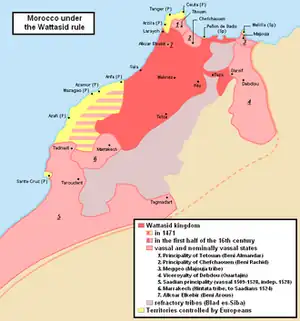
Image 20Map of the Wattasid sultanate (dark red) and its vassal states (light red) (from History of Morocco)
Image 21Sultan Abd-al-Aziz with his bicycle in 1901. The young sultan was noted for his capricious spending habits, which exacerbated a major trade deficit (from History of Morocco)
Image 26Portrait of his excellency Mohamed Ben Ali abgali with Al sulham, ambassador of the King of Morocco to the court of Saint James. August 1725. He wears a traditional Moroccan Burnous. (from Culture of Morocco)
Image 27The Maghreb in the second half of the 19th century (from History of Morocco)
Image 36A window displaying a wrought iron window grill in Asila. The knots are tied with bent metal in the traditional way, rather than soldered. (from Culture of Morocco)
Image 37Ahwach a traditional dance performed during Yennayer and symbolizing unity. The women all dance under the same long veil (from Culture of Morocco)
Image 45French artillery in Rabat in 1911. The dispatch of French forces to protect the sultan from a rebellion instigated the Agadir Crisis. (from History of Morocco)
Image 46Taburida, a traditional Arab exhibition of horsemanship performed during festivals (from Culture of Morocco)
Image 48Moroccan Chedda (the traditional northern wedding dress and attire) in various regional forms (Chamliya, Oujdia, Rbatia, Fassia) (from Culture of Morocco)
Image 49Extent of the Saadian empire at the beginning of the 17th century (from History of Morocco)
This is a Good article, an article that meets a core set of high editorial standards.
Morocco competed at the 2014 Winter Olympics in Sochi, Russia. The country's participation at Sochi marked its sixth appearance at a Winter Olympics since its debut at the 1968 Games; no athlete has ever won any medals. Sochi 2014 marked the first time the Moroccan Olympic team competed in Russia as Morocco and 63 other Western nations took part in the US-led boycott of the 1980 Summer Olympics in Moscow due to the Soviet invasion of Afghanistan. The 2014 delegation consisted of two athletes competing in alpine skiing, Adam Lamhamedi and Kenza Tazi, who were accompanied by Adam's brother Sami and four officials. Adam Lamhamedi was also the nation's flag bearer in the Parade of Nations, and at the closing ceremony. Neither skier finished on a medal podium. (Full article...)
This list was generated from these rules. Questions and feedback are always welcome! The search is being run daily with the most recent ~14 days of results. Note: Some articles may not be relevant to this project.
Rules | Match log | Results page (for watching) | Deleted articles| Last updated: 2026-08-26 20:19 (UTC)
Note: The list display can now be customized by each user. See List display personalization for details.
↑In the 2014 census, the High Commission for Planning gave the legal population of Casablanca as 3,359,818,[1] which corresponds to the population of Casablanca Prefecture.[2]
↑In the 2014 census, the High Commission for Planning gave the legal population of Fez as 1,112,072,[1] which corresponds to the combined population of those parts of Fez Prefecture not within the cercle of Fez Banlieue ("suburbs").[2]
↑In the 2014 census, the High Commission for Planning gave the legal population of Tangier as 947,952,[1] which corresponds to the combined population of the four arrondissements of Bni Makada, Charf-Mghogha, Charf-Souani and Tanger-Médina.[2]
↑In the 2014 census, the High Commission for Planning gave the legal population of Marrakesh as 928,850,[1] which corresponds to the combined population of the municipality of Méchouar-Kasba and the five arrondissements of Annakhil, Gueliz, Marrakech-Médina, Ménara and Sidi Youssef Ben Ali.[2]
↑In the 2014 census, the High Commission for Planning gave the legal population of Salé as 890,403,[1] which corresponds to the combined population of the five arrondissements of Bab Lamrissa, Bettana, Hssaine, Layayda and Tabriquet.[2]
↑In the 2014 census, the High Commission for Planning gave the legal population of Meknes as 632,079,[1] which corresponds to the combined population of the municipalities of Meknes, Al Machouar – Stinia, Toulal and Ouislane.[2]
↑In the 2014 census, the High Commission for Planning gave the legal population of Rabat as 577,827,[1] which corresponds to the population of Rabat Prefecture.[2]
↑The population figure refers only to the urban centre (HCP geographic code 09.001.05.09.3) of the rural commune of Drargua.