This portal is not manually maintained. However, please contactNihonjoewhen you plan to make significant changes.
This portal's subpages have been checked by an editor, and are needed.
Please take care when editing, especially if using automated editing software, and seek consensus before making major changes.Learn how to update the maintenance information here.
The posting system is a baseball player transfer system currently in effect between Japan's Nippon Professional Baseball (NPB) and the United States' Major League Baseball (MLB). NPB players have never been eligible to be obtained through the traditional means of the Rule 4 Draft, and since there were no set legal rules in place to govern the process, problems arose. The system was implemented for two reasons. First, the NPB players Hideo Nomo and Alfonso Soriano used loopholes to void contracts and leave for the MLB - possibly taking fans with them. Second, NPB player Hideki Irabu had very little negotiating power when it came to his trade deal between NPB and MLB teams. By creating a system that requires MLB teams to pay NPB teams transfer fees while allowing players the power to negotiate their own trade deals, the posting system presumably was meant to solve both problems. As of 2008, twelve Japanese players have been "posted" using the system. Of these, seven were immediately signed to Major League contracts, three were signed to minor league contracts and two were unsuccessful in drawing any MLB interest. The two highest-profile players that have been acquired through the posting system are Ichiro Suzuki and Daisuke Matsuzaka. Respectively, they attracted high bids of $13.125million and $51.1million and have enjoyed highly successful careers in the MLB. (Fullarticle...)
Asahi Breweries is a Japanese global beer, spirits, soft drinks and food business group. This photograph, taken during the blue hour with a full moon, shows the headquarters of Asahi Breweries in Sumida, Tokyo, as viewed from the wharf on the Sumida River near Azuma Bridge. The Asahi Beer Hall, topped by the Asahi Flame, designed by Philippe Starck, is visible on the right, with the Tokyo Skytree in the background on the left.
Located at the Buddhist temple Hōryū-ji, Yumedono (Hall of Dreams) was built on the ground which was once Prince Shōtoku's private palace. The present incarnation of this hall was built in 739 to assuage the Prince's spirit.
This large silk-embroidered wall hanging is part of the Khalili Collection of Japanese Art. The embroidery is worked in long and short silk stitch, with a composite imaginary view of Japan, including flowers, shrines, bridges, lakes and forests, with Mount Fuji rising in the distance. The private collection of decorative art, dating from Meiji-era Japan (1868–1912), was assembled by the British-Iranian scholar Nasser D. Khalili. It includes metalwork, enamels, ceramics, and lacquered objects, including works by artists of the imperial court that were exhibited at the Great Exhibitions of the late 19th century.
Image 9
A Buddhist temple ruined after the atomic bomb attack on Nagasaki
The destroyed remains of a Buddhist temple in Nagasaki, Japan. This picture was taken on September 24, 1945, six weeks after the city was destroyed by the world's secondatomic bomb attack.
The siege of Osaka was a series of battles undertaken by the Japanese Tokugawa shogunate against the Toyotomi clan, and ending in the clan's dissolution. Divided into two stages (the winter campaign and the summer campaign), and lasting from 1614 to 1615, the siege put an end to the last major armed opposition to the shogunate's establishment. This eight-metre-long (26 ft) painting, titled The Summer Battle of Osaka Castle and executed on a Japanese folding screen, illustrates Osaka Castle under siege, and was commissioned by the daimyoKuroda Nagamasa, who took a team of painters with him to the battlefield to record the event. The painting depicts 5071 people and 21 generals, and is held in the collection of Osaka Castle.
Before the outbreak of World WarI, German naval ships were located in the Pacific; Tsingtao developed into a major seaport while the surrounding Kiautschou Bay area was leased to Germany since 1898. During the war, Japanese and British Allied troops besieged the port in 1914 before capturing it from the German and Austro-Hungarian Central Powers, occupying the city and the surrounding region. It served as a base for the exploitation of the natural resources of Shandong province and northern China, and a "New City District" was established to furnish the Japanese colonists with commercial sections and living quarters. Tsingtao eventually reverted to Chinese rule by 1922.
A registration card for Louis Wijnhamer (1904–1975), an ethnic Dutch humanitarian who was captured soon after the Empire of Japan occupied the Dutch East Indies in March 1942. Prior to the occupation, many ethnic Europeans had refused to leave, expecting the Japanese occupation government to keep a Dutch administration in place. When Japanese troops took control of government infrastructure and services such as ports and postal services, 100,000 European (and some Chinese) civilians were interned in prisoner-of-war camps where the death rates were between 13 and 30 per cent. Wijnhamer was interned in a series of camps throughout Southeast Asia and, after the surrender of Japan, returned to what was now Indonesia, where he lived until his death.
Banknotes: Empire of Japan. Reproduction: National Numismatic Collection, National Museum of American History at the Smithsonian Institution
The Japanese-issued Netherlands Indies gulden was the currency issued by the Japanese Empire when it occupied the Dutch East Indies during World War II. Following the Dutch capitulation in March 1942, the Japanese closed all banks, seized assets and currency, and assumed control of the economy in the territory. They began issuing military banknotes, as had previously been done in other occupied territories. These were printed in Japan, but retained the name of the pre-war currency and replaced the Dutch gulden at par. From 1943 the military banknotes were replaced by identical bank-issued notes printed within the territory, and the currency was renamed the roepiah from 1944. The currency was replaced by the Indonesian rupiah in 1946, one year after the Japanese surrender and the country's independence.
This note, denominated half gulden, is part of the 1942 series.
See other denominations: One cent·Five cents·Ten cents·Half gulden·One gulden, Five gulden, Ten gulden
Banknote design credit: Empire of Japan; photographed by Andrew Shiva
The Japanese government-issued dollar was a form of currency issued between 1942 and 1945 for use within the territories of Singapore, Malaya, North Borneo, Sarawak and Brunei, under occupation by Imperial Japan during World WarII. The currency, informally referred to as "banana money", was released solely in the form of banknotes, as metals were considered essential to the war effort. The languages used on the notes were reduced to English and Japanese. Each note bears a different obverse and reverse design, but all have a similar layout, and were marked with stamped block letters that begin with "M" for "Malaya". This 1944 one-hundred-dollar Japanese-issued banknote, depicting a Malay house with palm trees on the obverse, and a man with water buffaloes in a stream on the reverse, is part of the National Numismatic Collection at the Smithsonian Institution.
Other denominations: '"`UNIQ--templatestyles-00000010-QINU`"'
Born in Toyooka in Tajima Province, Toyoharu first studied art in Kyoto, then in Edo (modern Tokyo), where from 1768 he began to produce designs for ukiyo-e woodblock prints. He soon became known for his uki-e "floating pictures" of landscapes and famous sites, as well as copies of Western and Chinese perspective prints. Though his were not the first perspective prints in ukiyo-e, they were the first to appear as full-colour nishiki-e, and they demonstrate a much greater mastery of perspective techniques than the works of his predecessors. Toyoharu was the first to make the landscape a subject of ukiyo-e art, rather than just a background to figures and events. By the 1780s he had turned primarily to painting. The Utagawa school of art grew to dominate ukiyo-e in the 19th century with artists such as Utamaro, Hiroshige, and Kuniyoshi. (Full article...)
Fukuoka Prefecture is a prefecture of Japan located on KyūshūIsland. The capital is the city of Fukuoka. It includes the former provinces of Chikugo, Chikuzen, and Buzen. Fukuoka Prefecture has signed Friendship Agreements with Bangkok, Thailand, Delhi, India, and Hanoi, Vietnam. Fukuoka Prefecture faces the sea on three sides, bordering on Saga, Ōita, and Kumamoto prefectures and facing Yamaguchi Prefecture across the Kanmon Straits. Fukuoka includes the two largest cities on Kyūshū, Fukuoka and Kitakyushu, and much of Kyūshū's industry. It also includes a number of small islands near the north coast of Kyūshū. Twenty-eight cities are located in Fukuoka Prefecture. Its main cities form one of Japan's main industrial centers, accounting for nearly 40% of the economy of Kyūshū. Major industries include automobiles, semiconductors and steel. The most popular places for tourists are Fukuoka City, especially at the time of the Dontaku festival, and Dazaifu, although Kitakyushu has also tried to attract tourists.
Image 3Relief map of the land and the seabed of Japan. It shows the surface and underwater terrain of the Japanese archipelago. (from Geography of Japan)
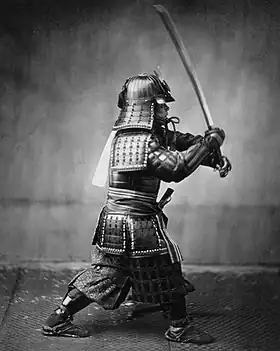
Image 10Samurai could kill a commoner for the slightest insult and were widely feared by the Japanese population. Edo period (1798) (from History of Japan)
Image 11
Edo period screen depicting the Battle of Sekigahara. It began on 21 October 1600, with a total of 160,000 men facing each other.
Image 41The Kuril Islands, with their Russian names. The borders of the Treaty of Shimoda (1855) and the Treaty of St. Petersburg (1875) are shown in red. Currently, all islands northeast of Hokkaido are administered by Russia. (from Geography of Japan)
This is a list of recognized content, updated weekly by JL-Bot (talk·contribs) (typically on Saturdays). There is no need to edit the list yourself. If an article is missing from the list, make sure it is tagged(e.g. {{WikiProject Japan}})or categorized correctly and wait for the next update. See WP:RECOG for configuration options.