Portal:Food

F o o d
A portal dedicated to food and foodways
Introduction


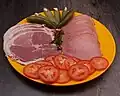


Food is any substance that is consumed by an organism for nutritional support. Food usually consists of plant, animal, or fungal origin and contains essential nutrients such as carbohydrates, fats, proteins, vitamins, or minerals. The substance is ingested by an organism and assimilated by the organism's cells to provide energy, maintain life, encourage physical requirements, and support growth. Different species of animals have different feeding behaviours that satisfy the needs of their metabolisms and have evolved to fill specific ecological niches within specific geographical contexts.
Omnivorous humans are highly adaptable and have adapted to obtaining food in many different ecosystems. Humans generally use cooking to prepare food for consumption. The majority of the food energy required is supplied by the industrial food industry, which produces food through intensive agriculture and distributes it through complex food processing and food distribution systems. This system of conventional agriculture relies heavily on fossil fuels, which means food and agricultural systems are one of the major contributors to climate change, accounting for as much as 37% of total greenhouse gas emissions. (Full article...)
Cooking, also known as cookery, is the art, science and craft of using heat to make food more palatable, digestible, nutritious, or safe. Cooking techniques and ingredients vary widely, from grilling food over an open fire, to using electric stoves, to baking in various types of ovens, to boiling and blanching in water, reflecting local conditions, techniques and traditions. Cooking is an aspect of all human societies and a cultural universal.
Preparing food with heat or fire is an activity unique to humans. Archaeological evidence of cooking fires dates to at least 300,000 years ago, but some estimate that humans started cooking as early as 2 million years ago.
The expansion of agriculture, commerce, trade, and transportation between civilizations in different regions offered cooks many new ingredients. New inventions and technologies, such as the invention of pottery for holding and boiling of water, expanded cooking techniques. Some modern cooks apply advanced scientific techniques to food preparation to further enhance the flavor of the dish served. (Full article...)
 Good article –
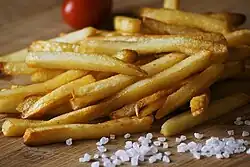
French fries, or simply fries, also known as French fried potatoes, chips, and finger chips, are batonnet or julienne-cut deep-fried potatoes of disputed origin. They are prepared by cutting potatoes into even strips, drying them, and frying them, usually in a deep fryer. Pre-cut, blanched, and frozen russet potatoes are widely used, and sometimes baked in a regular or convection oven, such as an air fryer.
French fries are served hot, either soft or crispy, and are generally eaten as part of lunch or dinner or by themselves as a snack, and they commonly appear on the menus of diners, fast food restaurants, pubs, and bars. They are typically salted and may be served with ketchup, vinegar, mayonnaise, tomato sauce, or other sauces. Fries can be topped more heavily, as in the dishes of poutine, loaded fries or chilli cheese fries, and are occasionally made from sweet potatoes instead of potatoes. (Full article...)
Selected article –

A bagel (Yiddish: בײגל, romanized: beygl; Polish: bajgiel [ˈbajɡʲɛl] ⓘ; also spelled beigel) is a bread roll originating in the Jewish communities of Poland. Bagels are traditionally made from yeasted wheat dough that is shaped by hand into a torus or ring, briefly boiled in water, and then baked. The result is a dense, chewy, doughy interior with a browned and sometimes crisp exterior.
Bagels are often topped with seeds baked on the outer crust—traditional choices include poppy and sesame seeds—or with salt grains. Different dough types include whole-grain and rye. The basic roll-with-a-hole design, hundreds of years old, allows even cooking and baking of the dough; it also allows groups of bagels to be gathered on a string or dowel for handling, transportation, and retail display. (Full article...)
Selected cuisine -

Ancient Israelite cuisine was similar to other contemporary Mediterranean cuisines. Dietary staples were bread, wine, and olive oil; also included were legumes, fruits and vegetables, dairy products, and fish and other meat. Importance was placed on the Seven Species, which are listed in the Hebrew Bible as being special agricultural products of the Land of Israel.
Like many cultures, the Israelites abided by a number of dietary regulations and restrictions that were variously unique or shared with other Near Eastern civilizations. These culinary practices were largely shaped by the Israelite religion, which later developed into Judaism and Samaritanism. People in ancient Israel generally adhered to a particular slaughter method and only consumed from certain animals, notably excluding pigs and camels and all predators and scavengers, as well as forbidding blood consumption and the mixing of milk and meat. There was a considerable continuity in the main components of the diet over time, despite the introduction of new foodstuffs at various stages. (Full article...)
Selected ingredient –

Salt is a mineral composed primarily of sodium chloride (NaCl). When used in food, especially in granulated form, it is more formally called table salt. In the form of a natural crystalline mineral, salt is also known as rock salt or halite. Salt is essential for life in general (being the source of the essential dietary minerals sodium and chlorine), and saltiness is one of the basic human tastes. Salt is one of the oldest and most ubiquitous food seasonings, and is known to uniformly improve the taste perception of food. Salting, brining, and pickling are ancient and important methods of food preservation.
Some of the earliest evidence of salt processing dates to around 6000 BC, when people living in the area of present-day Romania boiled spring water to extract salts; a salt works in China dates to approximately the same period. Salt was prized by the ancient Hebrews, Greeks, Romans, Byzantines, Hittites, Egyptians, and Indians. Salt became an important article of trade and was transported by boat across the Mediterranean Sea, along specially built salt roads, and across the Sahara on camel caravans. The scarcity and universal need for salt have led nations to go to war over it and use it to raise tax revenues, for instance triggering the El Paso Salt War which took place in El Paso in the late 1860s. Salt is used in religious ceremonies and has other cultural and traditional significance. (Full article...)
Selected recipe –

Vindaloo is a curry dish known globally in its British form as a staple of curry houses and Indian restaurants, specifically a fiery, spicy dish that can be made with a choice of meats. Vindaloo's name derives from the famous Portuguese Goan dish carne de vinha d'alhos (meat with garlic vinegar) or vindalho, made with pork.
From the 19th century onwards, the Portuguese-Indian dish was adapted within Anglo-Indian cuisine. The British highly prized Goan cooks, and acquired "Portuguese curry". This was initially applied to meats including beef and duck. In the 20th century, some recipes in Britain called for lemon juice in place of wine vinegar, possibly because British Muslim chefs intentionally omitted it. As a postwar British restaurant dish, vindaloo became popular as the curry to eat after pub closing time. The drunken clientele then demonstrated its machismo by ordering a specially hot curry. Fat Les's 1998 song "Vindaloo", which became a sort of football anthem, celebrates such lad culture behaviour. Potatoes are sometimes added through confusion with Hindi aloo. (Full article...)
 Featured article –
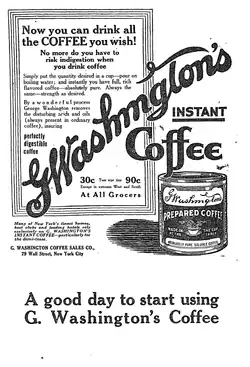
George Constant Louis Washington[I] (May 20, 1871 – March 29, 1946) was a Belgian-British inventor and businessman. He is best remembered for his improvement of an early instant coffee process and for the company he founded to mass-produce it, the G. Washington Coffee Company.
An emigrant from his native Belgium, he arrived in the New York area in 1897. He dabbled in several technical fields before hitting upon manufacturing an adapted version of the nascent instant coffee, during a sojourn in Central America in 1906 or 1907. He began selling his coffee in 1909 and founded a company to manufacture it in 1910. Based in New York and New Jersey, his company prospered and became an important military supplier during World War I. The company's products were also advertised in New York newspapers and on the radio. The success of his company made Washington wealthy, and he lived in a mansion in Brooklyn and then moved to a country estate in New Jersey in 1927. In that same year, he lost a dispute with the tax authorities. Washington was married and had three children. (Full article...)
Selected image –

Selected biography –
B. February 2, 1948
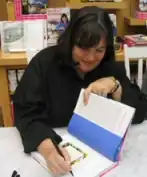
Ina Rosenberg Garten (/ˈaɪnə/ EYE-nə; born February 2, 1948) is an American television cook and author. She is host of the Food Network program Barefoot Contessa and was formerly a staff member of the Office of Management and Budget.
Among her dishes are Perfect Roast Chicken, Weeknight Bolognese, French Apple Tart, and a simplified version of beef bourguignon. Her culinary career began with her gourmet food store, Barefoot Contessa; Garten then expanded her activities to many best-selling cookbooks, magazine columns, and a popular Food Network television show. (Full article...)
Did you know (auto-generated) –

- ... that the horned sungem becomes a nectar robber when food is scarce?
- ... that the Indonesian women's magazine Ummi dealt with issues such as dress, food, jewellery, contraceptives, and accepting sons' jihad?
- ... that Gwen went viral in 2025 due to the way she ate one of her country's most beloved street foods?
- ... that John A. Jakle has co-authored nine books on "roadside America", including books on motels, road signs, gas stations, parking lots, and fast-food restaurants?
- ... that food stylist Susan Spungen estimated that she baked hundreds of pies with Josh Brolin and film staff while practicing for a scene in Labor Day?
- ... that some fans of Genshin Impact have referred to the character Paimon as "emergency food"?
More did you know –
Related portals
Food topics
The following are topics relating to food


| Continental |
| ||||||||||||
|---|---|---|---|---|---|---|---|---|---|---|---|---|---|
| National and (regional) |
| ||||||||||||
| Ethnic |
| ||||||||||||
| Religious | |||||||||||||
| Historical |
| ||||||||||||
| Styles | |||||||||||||
| Lists | |||||||||||||
| Related | |||||||||||||
| |||||||||||||

| Common meals | |
|---|---|
| Components and courses | |
| Table service | |
| Presentation | |
| Dining | |
| Regional styles | |
| Packed | |
| Menus and meal deals | |
| Communal meals | |
| Catering and food delivery | |
| Places to eat | |
| Related | |
| Dishes by origin |
| ||||||||||||||||||||
|---|---|---|---|---|---|---|---|---|---|---|---|---|---|---|---|---|---|---|---|---|---|
| By type and origin |
| ||||||||||||||||||||
| By type |
| ||||||||||||||||||||
Categories
The following are categories relating to food.

Food list articles
- See also: Lists of foods and Category:Lists of drinks
The following are some Food list articles on Wikipedia:

- American cheeses
- Appellation d'Origine Contrôlée cheeses
- Apple cultivars
- Bacon dishes
- Bacon substitutes
- Basil cultivars
- Breads
- Breakfast beverages
- Breakfast cereals
- Breakfast foods
- British cheeses
- Cakes
- Candies
- Cheeses
- Cheese soups
- Christmas dishes (list)
- Cocktails
- Cookies
- Dishes using coconut milk
- Diets
- Doughnut varieties
- Egg dishes
- Fermented soy products
- Food additives
- Food additives (Codex Alimentarius)
- Foods named after people
- French cheeses
- French dishes
- Fried dough foods
- Fruits
- List of hamburgers
- Herbs and spices
- Hors d'oeuvre
- Indian dishes
- Indian snack foods
- Indonesian dishes
- Italian dishes
- Japanese snacks
- Japanese dishes
- Jewish dishes
- Kebabs
- Korean beverages
- Mango cultivars
- Moroccan dishes
- Pasta
- Pastries
- Philippine snack food
- Pies, tarts and flans
- Poppy seed pastries and dishes
- Potato dishes
- Puddings
- Raw fish dishes
- Rice dishes
- Rolled foods
- Sauces
- Seafood
- Seeds
- Sandwiches
- Snack foods
- Soft drinks by country
- Soul foods and dishes
- Soups
- Stews
- Street foods
- Tapas
- Turkish dishes
- Twice-baked foods
- Vegetable oils
- Vegetables
- Vodkas
Things you can do
 |
Here are some tasks awaiting attention:
|
Related WikiProjects
| Parent project: WikiProject Food and Drink |  view |
| Child projects: | Task forces: (All inactive) |
|
|
| Related projects: | |
|
New articles
Rules | Match log | Results page (for watching) | Deleted articles| Last updated: 2026-08-26 19:10 (UTC)
Note: The list display can now be customized by each user. See List display personalization for details.
- 1984 Marval turkey strike (edit | talk | history | links | watch | logs | tools | Portal:Food (Q6947759) ) by JJonahJackalope (talk · contribs · new pages (3)) started on 2026-08-26, score: 10
- Louis Lemke (edit | talk | history | links | watch | logs | tools | Louis Lemke (Q138007069) ) by Das osmnezz (talk · contribs · new pages (13)) started on 2026-08-25, score: 10
- Dillagence II (edit | talk | history | links | watch | logs | tools | Dillagence II (Q141174779) ) by RTSthestardust (talk · contribs · new pages (8)) started on 2026-08-13, score: 10
- Boom Battle Bar (edit | talk | history | links | watch | logs | tools | Boom Battle Bar (Q134963330) ) by Mechanical Elephant (talk · contribs · new pages (1)) started on 2026-08-24, score: 10
- Keefe d (edit | talk | history | links | watch | logs | tools | Portal:Food (Q6947759) ) by ~2026-35926-81 (talk · contribs · new pages (1)) started on 2026-08-24, score: 20
- Ye-geon Kim (edit | talk | history | links | watch | logs | tools | Portal:Food (Q6947759) ) by Markisazm (talk · contribs · new pages (1)) started on 2026-08-22, score: 10
- Bless Your Heart Burgers (edit | talk | history | links | watch | logs | tools | Portal:Food (Q6947759) ) by Another Believer (talk · contribs · new pages (94)) started on 2026-08-17, score: 10
- Fermentation and curing of olives (edit | talk | history | links | watch | logs | tools | Portal:Food (Q6947759) ) by Chiswick Chap (talk · contribs · new pages (7)) started on 2026-08-24, score: 10
- Fedelini (edit | talk | history | links | watch | logs | tools | fedelini (Q58898059) ) by Bermensterflora (talk · contribs · new pages (27)) started on 2026-08-24, score: 20
- Jack Scalfani (edit | talk | history | links | watch | logs | tools | Jack Scalfani (Q141162864) ) by Mulan11111 (talk · contribs · new pages (1)) started on 2026-08-24, score: 10
- Modenese (sheep breed) (edit | talk | history | links | watch | logs | tools | Portal:Food (Q6947759) ) by Justlettersandnumbers (talk · contribs · new pages (37)) started on 2026-08-23, score: 10
- Julienne (dish) (edit | talk | history | links | watch | logs | tools | Julienne (Q29920362) ) by Викидим (talk · contribs · new pages (27)) started on 2026-08-23, score: 10
- Portland Fruit Tree Project (edit | talk | history | links | watch | logs | tools | Portal:Food (Q6947759) ) by Another Believer (talk · contribs · new pages (94)) started on 2026-08-23, score: 20
- Tartelette (edit | talk | history | links | watch | logs | tools | tartlet (Q48792394) ) by Викидим (talk · contribs · new pages (27)) started on 2026-08-23, score: 10
- Sbergia (edit | talk | history | links | watch | logs | tools | (Q3951292) ) by Sulfurboy (talk · contribs · new pages (261)) started on 2026-08-22, score: 10
- Adolf Ritter von Denk (edit | talk | history | links | watch | logs | tools | Adolf Ritter von Denk (Q141155689) ) by Historybuff0105 (talk · contribs · new pages (6)) started on 2026-08-22, score: 10
- Webster Makombe (edit | talk | history | links | watch | logs | tools | Portal:Food (Q6947759) ) by Pablowhite44 (talk · contribs · new pages (24)) started on 2026-08-22, score: 10
- Amanhom Khamis (edit | talk | history | links | watch | logs | tools | Amanhom Khamis (Q141150431) ) by BroGownerd (talk · contribs · new pages (10)) started on 2026-08-22, score: 10
- Kim Ye-geon (edit | talk | history | links | watch | logs | tools | Portal:Food (Q6947759) ) by Markisazm (talk · contribs · new pages (1)) started on 2026-08-22, score: 10
- Yūya Shintō (edit | talk | history | links | watch | logs | tools | Yuya Shinto (Q123405957) ) by TSUBAME98 (talk · contribs · new pages (22)) started on 2026-08-22, score: 10
- Ruan Ohtsuka (edit | talk | history | links | watch | logs | tools | Ruan Ōtsuka (Q138418179) ) by TSUBAME98 (talk · contribs · new pages (22)) started on 2026-08-22, score: 10
- Ryohei Hosokawa (edit | talk | history | links | watch | logs | tools | Ryohei Hosokawa (Q105259050) ) by TSUBAME98 (talk · contribs · new pages (22)) started on 2026-08-22, score: 10
- Naoki Arizono (edit | talk | history | links | watch | logs | tools | Naoki Arizono (Q108776878) ) by TSUBAME98 (talk · contribs · new pages (22)) started on 2026-08-22, score: 10
- Reo Shibata (edit | talk | history | links | watch | logs | tools | Reo Shibata (Q130726841) ) by TSUBAME98 (talk · contribs · new pages (22)) started on 2026-08-22, score: 10
- Toret (edit | talk | history | links | watch | logs | tools | Torèt (Q3993741) ) by AKeen (talk · contribs · new pages (3)) started on 2026-08-22, score: 10
- Haruki Hosono (edit | talk | history | links | watch | logs | tools | Haruki Hosono (Q123405925) ) by TSUBAME98 (talk · contribs · new pages (22)) started on 2026-08-22, score: 10
- Toshitake Yokoo (edit | talk | history | links | watch | logs | tools | Toshitake Yokoo (Q24866820) ) by TSUBAME98 (talk · contribs · new pages (22)) started on 2026-08-22, score: 10
- David Protein (edit | talk | history | links | watch | logs | tools | Portal:Food (Q6947759) ) by Hmr (talk · contribs · new pages (1)) started on 2026-08-22, score: 20
- Queen Victoria Monument, New Plymouth (edit | talk | history | links | watch | logs | tools | Queen Victoria Monument (Q79312008) ) by Itineris55 (talk · contribs · new pages (2)) started on 2026-08-22, score: 10
- Pulque curado (edit | talk | history | links | watch | logs | tools | Curado (Q5794872) ) by Reppopul (talk · contribs · new pages (1)) started on 2026-08-21, score: 10
- Hawaiʻi ʻUlu Cooperative (edit | talk | history | links | watch | logs | tools | Portal:Food (Q6947759) ) by PacificDepths (talk · contribs · new pages (1)) started on 2026-08-21, score: 10
- Granny's Apple Fries (edit | talk | history | links | watch | logs | tools | Portal:Food (Q6947759) ) by NewAccount7295 (talk · contribs · new pages (24)) started on 2026-08-20, score: 10
- The Convalescent (edit | talk | history | links | watch | logs | tools | The Convalescent (Q88022399) ) by Lord Cornwallis (talk · contribs · new pages (49)) started on 2026-08-20, score: 20
- Eating Europe (edit | talk | history | links | watch | logs | tools | Portal:Food (Q6947759) ) by Carthalla (talk · contribs · new pages (2)) started on 2026-08-20, score: 20
- Blake's Hard Cider (edit | talk | history | links | watch | logs | tools | Blake's Hard Cider (Q141150166) ) by DUBYA18 (talk · contribs · new pages (4)) started on 2026-08-20, score: 50
- Tiana's Palace (edit | talk | history | links | watch | logs | tools | Portal:Food (Q6947759) ) by NewAccount7295 (talk · contribs · new pages (24)) started on 2026-08-19, score: 10
- Colored Campbell's Soup Cans (edit | talk | history | links | watch | logs | tools | Portal:Food (Q6947759) ) by Twixister (talk · contribs · new pages (8)) started on 2026-08-19, score: 20
- Moth Drinks (edit | talk | history | links | watch | logs | tools | Moth Drinks (Q141124870) ) by Blythwood (talk · contribs · new pages (53)) started on 2026-08-19, score: 10
- 200 Soup Cans (edit | talk | history | links | watch | logs | tools | Portal:Food (Q6947759) ) by Twixister (talk · contribs · new pages (8)) started on 2026-08-18, score: 20
- Rescuing Leftover Cuisine (edit | talk | history | links | watch | logs | tools | Portal:Food (Q6947759) ) by Watermeloncooler (talk · contribs · new pages (2)) started on 2026-08-17, score: 10
- Bollo de hornazzo (edit | talk | history | links | watch | logs | tools | Portal:Food (Q6947759) ) by Coldupnorth (talk · contribs · new pages (6)) started on 2026-08-18, score: 20
- Big Campbell's Soup Can with Can Opener (Vegetable) (edit | talk | history | links | watch | logs | tools | Portal:Food (Q6947759) ) by Twixister (talk · contribs · new pages (8)) started on 2026-08-18, score: 20
- William Chen Wing Young (edit | talk | history | links | watch | logs | tools | William Chen Wing Young (Q141118674) ) by Chainpiano (talk · contribs · new pages (1)) started on 2026-08-17, score: 10
- Woody's Lunch Box (edit | talk | history | links | watch | logs | tools | Portal:Food (Q6947759) ) by NewAccount7295 (talk · contribs · new pages (24)) started on 2026-08-17, score: 10
- International outdoor barbecue sports federation (edit | talk | history | links | watch | logs | tools | Portal:Food (Q6947759) ) by Aralio (talk · contribs · new pages (1)) started on 2026-08-17, score: 10
- To Say I Love You (edit | talk | history | links | watch | logs | tools | To Say I Love You (Q7811098) ) by KarlyRaeMarx (talk · contribs · new pages (5)) started on 2026-08-17, score: 10
- Kit's Writing Lesson (edit | talk | history | links | watch | logs | tools | Kit’s Writing Lesson (Q28555577) ) by Lord Cornwallis (talk · contribs · new pages (49)) started on 2026-08-16, score: 20
- The Boy with Many Friends (edit | talk | history | links | watch | logs | tools | The Boy with Many Friends (Q119062390) ) by Lord Cornwallis (talk · contribs · new pages (49)) started on 2026-08-16, score: 20
- Frozen pizza (edit | talk | history | links | watch | logs | tools | frozen pizza (Q125167827) ) by DeemDeem52 (talk · contribs · new pages (1)) started on 2026-08-10, score: 10
- Eduardo Frieiro (edit | talk | history | links | watch | logs | tools | Eduardo Frieiro (Q10270681) ) by Laptss (talk · contribs · new pages (18)) started on 2026-08-16, score: 10
- Doves Farm (edit | talk | history | links | watch | logs | tools | Doves Farm (Q141093769) ) by Blythwood (talk · contribs · new pages (53)) started on 2026-08-15, score: 20
- Caffè Borbone (edit | talk | history | links | watch | logs | tools | Portal:Food (Q6947759) ) by Ktkvtsh (talk · contribs · new pages (17)) started on 2026-08-15, score: 10
- The Original Red Onion (edit | talk | history | links | watch | logs | tools | Portal:Food (Q6947759) ) by Bola Made (talk · contribs · new pages (3)) started on 2026-08-15, score: 10
- The Boy (fountain) (edit | talk | history | links | watch | logs | tools | The Boy (Q27081477) ) by RanulfLampard (talk · contribs · new pages (46)) started on 2026-08-14, score: 10
- Maurice Boakye (edit | talk | history | links | watch | logs | tools | Maurice Boakye (Q131361286) ) by Ortizesp (talk · contribs · new pages (119)) started on 2026-08-15, score: 10
- Belgian Beer World (edit | talk | history | links | watch | logs | tools | Belgian Beer World (Q112161617) ) by Alexjamesevans6923 (talk · contribs · new pages (1)) started on 2026-08-15, score: 10
- William Larson (businessman) (edit | talk | history | links | watch | logs | tools | William Larson (Q99518133) ) by Thomasfan1916 (talk · contribs · new pages (12)) started on 2026-08-15, score: 10
- Boy Statue (edit | talk | history | links | watch | logs | tools | The Boy (Q27081477) ) by RanulfLampard (talk · contribs · new pages (46)) started on 2026-08-14, score: 10
- Grub Street (website) (edit | talk | history | links | watch | logs | tools | Portal:Food (Q6947759) ) by G13 vs G14 (talk · contribs · new pages (10)) started on 2026-08-14, score: 20
- Doughnut Plant (edit | talk | history | links | watch | logs | tools | Doughnut Plant (Q11323491) ) by Jeffmag (talk · contribs · new pages (2)) started on 2026-08-14, score: 10
- Dinner at Somizi's (edit | talk | history | links | watch | logs | tools | Portal:Food (Q6947759) ) by Slippery slope302 (talk · contribs · new pages (2)) started on 2026-08-14, score: 10
- Conor Grimes (edit | talk | history | links | watch | logs | tools | Conor Grimes (Q141066246) ) by DanDee03 (talk · contribs · new pages (41)) started on 2026-08-14, score: 10
- AsiaFest (edit | talk | history | links | watch | logs | tools | Portal:Food (Q6947759) ) by CherryPie94 (talk · contribs · new pages (39)) started on 2026-08-14, score: 20
- Sohari (edit | talk | history | links | watch | logs | tools | (Q28015549) ) by Biplab Anand (talk · contribs · new pages (6)) started on 2026-08-14, score: 10
- Dachsbräu (edit | talk | history | links | watch | logs | tools | Dachsbräu (Q1156773) ) by Isderion (talk · contribs · new pages (1)) started on 2026-08-09, score: 10
- Konkola (constituency) (edit | talk | history | links | watch | logs | tools | Portal:Food (Q6947759) ) by GeographicAccountant (talk · contribs · new pages (129)) started on 2026-08-13, score: 20
- Aperitif for Destruction (edit | talk | history | links | watch | logs | tools | Aperitif for Destruction (Q4779372) ) by JTtheOG (talk · contribs · new pages (50)) started on 2026-08-13, score: 10
- Ikeda's (edit | talk | history | links | watch | logs | tools | Ikedas California Country Market & Pie Shop (Q141030459) ) by BaduFerreira (talk · contribs · new pages (9)) started on 2026-08-13, score: 20
- Bar Sprezzatura (edit | talk | history | links | watch | logs | tools | Portal:Food (Q6947759) ) by Another Believer (talk · contribs · new pages (94)) started on 2026-08-13, score: 10
- Roast Pig (painting) (edit | talk | history | links | watch | logs | tools | Portal:Food (Q6947759) ) by Lord Cornwallis (talk · contribs · new pages (49)) started on 2026-08-13, score: 20
- George M. Rolph (edit | talk | history | links | watch | logs | tools | George M. Rolph (Q110777978) ) by DMVHistorian (talk · contribs · new pages (34)) started on 2026-08-12, score: 10
- Blue Tokai (edit | talk | history | links | watch | logs | tools | Portal:Food (Q6947759) ) by Dz5t 8O12 (talk · contribs · new pages (3)) started on 2026-08-12, score: 10
- Parisi Coffee (edit | talk | history | links | watch | logs | tools | Portal:Food (Q6947759) ) by Redleatheryellowleather (talk · contribs · new pages (1)) started on 2026-08-12, score: 30
- Bubba's Sulky Lounge (edit | talk | history | links | watch | logs | tools | Portal:Food (Q6947759) ) by Bklibcat67 (talk · contribs · new pages (4)) started on 2026-08-12, score: 10
- IDS Ukraine (edit | talk | history | links | watch | logs | tools | IDS Ukraine (Q12071257) ) by The Red Fairy (talk · contribs · new pages (1)) started on 2026-08-12, score: 20
- South Korea v Italy (2002 FIFA World Cup) (edit | talk | history | links | watch | logs | tools | South Korea v Italy (2002 FIFA World Cup) (Q61093385) ) by Wikipediæ philosophia (talk · contribs · new pages (9)) started on 2026-08-12, score: 10
- Sunny Sunny (edit | talk | history | links | watch | logs | tools | Sunny Sunny (Q123459794) ) by Babin Mew (talk · contribs · new pages (27)) started on 2026-08-12, score: 10
- Salcë shakulli (edit | talk | history | links | watch | logs | tools | Portal:Food (Q6947759) ) by Kj1595 (talk · contribs · new pages (15)) started on 2026-08-12, score: 10
- Panda Fest (edit | talk | history | links | watch | logs | tools | Portal:Food (Q6947759) ) by Another Believer (talk · contribs · new pages (94)) started on 2026-08-12, score: 20
Associated Wikimedia
The following Wikimedia Foundation sister projects provide more on this subject:
-
 Commons
Free media repository -
 Wikidata
Free knowledge base -
 Wikiquote
Collection of quotations -
 Wikisource
Free-content library -
 Wikiversity
Free learning tools -
 Wiktionary
Dictionary and thesaurus
Sources
More portals
-
 List of all portals
-

-

-

-

-

-

-

-

-

-
 Random portal
-
 WikiProject Portals