Portal:Colombia

The Colombia Portal

Republic of Colombia
República de Colombia  (Spanish)
Location of Colombia (dark green)in South America (grey)
Location of Colombia (dark green)

in South America (grey)

CapitalBogotá
4°35′N 74°4′W / 4.583°N 74.067°W / 4.583; -74.067
ISO 3166 codeCO

Colombia, officially the Republic of Colombia, is a country located in South America, with insular regions in North America. Colombia's mainland is bordered by the Caribbean Sea to the north, Venezuela to the east, Brazil to the southeast, Peru and Ecuador to the south and southwest, the Pacific Ocean to the west, and Panama to the northwest. Colombia is divided into 32 departments. The Capital District of Bogotá is the country's largest city hosting the main financial and cultural hub. Other urban areas include Medellín, Cali, Barranquilla, Cartagena, Bucaramanga, Pereira, Santa Marta, Cúcuta, Ibagué, Villavicencio and Manizales. It covers an area of 1,141,748 square kilometers (440,831 sq mi) and has a population of around 52 million. Its rich cultural heritage—including language, religion, cuisine, and art—reflects its history as a colony, fusing cultural elements brought by immigration from Europe and the Middle East, with those brought by the African diaspora, as well as with those of Indigenous civilizations that predate colonization. Spanish is the official language, although Creole, English and 64 other languages are recognized regionally.

Colombia has been home to many Indigenous peoples and cultures since at least 12,000 BCE. The Spanish landed in La Guajira in 1499, and by the mid-16th century had colonized much of present-day Colombia, establishing the New Kingdom of Granada. Independence from the Spanish Empire was declared in 1810, with what is now Colombia emerging as the United Provinces of New Granada. After a Spanish reconquest, Colombian independence was secured and the Gran Colombia period began in 1819. The new polity experimented with federalism as the Granadine Confederation (1858) and then the United States of Colombia (1863), before becoming a centralised republic in 1886. With the backing of the US and France, Panama seceded from Colombia in 1903, resulting in Colombia's present borders. Beginning in the 1960s, the country has suffered from an asymmetric low-intensity armed conflict and political violence, both of which escalated in the 1990s. Since 2000, there has been improvement in security, stability, and rule of law, as well as economic growth and development.

Colombia is recognized for its healthcare system, being the best healthcare in the Americas according to the World Health Organization and 22nd in the world. Its diversified economy is the third-largest in South America, with macroeconomic stability and favorable long-term growth prospects. The country has one of the widest recognitions of LGBT rights, gender equality, animal rights, and human rights, permitting same-sex adoption, same-sex marriage, legality of abortion, legality of euthanasia, and animal rights protections.

Colombia is one of the world's seventeen megadiverse countries; it has the highest level of biodiversity per square mile in the world, and second-highest level overall. Its territory encompasses the Amazon rainforest, highlands, grasslands and deserts. Colombia is a member of global and regional organizations including the UN, the WTO, the OECD, the OAS, the CIVETS, the Pacific Alliance and the Andean Community; it is a NATO Global Partner and a major non-NATO ally of the United States. (Full article...)

Selected article -

Gonzalo Jiménez de Quesada, the leader of conquest expedition from Santa Marta to the Muisca territories

The Spanish conquest of the Muisca took place from 1537 to 1540. The Muisca were the inhabitants of the central Andean highlands of Colombia before the arrival of the Spanish conquistadors. They were organised in a loose confederation of different rulers; the psihipqua of Muyquytá, with his headquarters in Funza, the hoa of Hunza, the iraca of the sacred City of the Sun Sugamuxi, the Tundama of Tundama, and several other independent caciques. The most important rulers at the time of the conquest were psihipqua Tisquesusa, hoa Eucaneme, iraca Sugamuxi and Tundama in the northernmost portion of their territories. The Muisca were organised in small communities of circular enclosures (ca in their language Muysccubbun; literally "language of the people"), with a central square where the bohío of the cacique was located. They were called "Salt People" because of their extraction of salt in various locations throughout their territories, mainly in Zipaquirá, Nemocón, and Tausa. For the main part self-sufficient in their well-organised economy, the Muisca traded with the European conquistadors valuable products as gold, tumbaga (a copper-silver-gold alloy), and emeralds with their neighbouring indigenous groups. In the Tenza Valley, to the east of the Altiplano Cundiboyacense where the majority of the Muisca lived, they extracted emeralds in Chivor and Somondoco. The economy of the Muisca was rooted in their agriculture with main products maize, yuca, potatoes, and various other cultivations elaborated on elevated fields (in their language called tá). Agriculture had started around 3000 BCE on the Altiplano, following the preceramic Herrera Period and a long epoch of hunter-gatherers since the late Pleistocene. The earliest archaeological evidence of inhabitation in Colombia, and one of the oldest in South America, has been found in El Abra, dating to around 12,500 years BP.

The main part of the Muisca civilisation was concentrated on the Bogotá savanna, a flat high plain in the Eastern Ranges of the Andes, far away from the Caribbean coast. The savanna was an ancient lake, that existed until the latest Pleistocene and formed a highly fertile soil for their agriculture. The Muisca were a deeply religious civilisation with a polytheistic society and an advanced astronomical knowledge, which was represented in their complex lunisolar calendar. Men and women had specific and different tasks in their relatively egalitarian society; while the women took care of the sowing, preparation of food, the extraction of salt, and the elaboration of mantles and pottery, the men were assigned to harvesting, warfare, and hunting. The guecha warriors were tasked with the defence of the Muisca territories, mainly against their western neighbours; the Muzo ("Emerald People") and the bellicose Panche. To impress their enemies, the Muisca warriors wore mummies of important ancestors on their backs, while fighting. In their battles, the men used spears, poisoned arrows, and golden knives. (Full article...)

Categories

Category puzzle
Category puzzle
Select [►] to view subcategories

Selected biography -

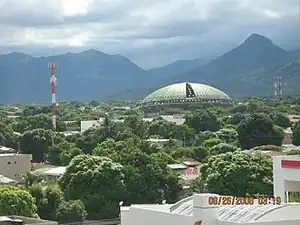
View of Valledupar in the basin

The Cesar-Ranchería Basin (Spanish: Cuenca Cesar-Ranchería) is a sedimentary basin in northeastern Colombia. It is located in the southern part of the department of La Guajira and northeastern portion of Cesar. The basin is bound by the Oca Fault in the northeast and the Bucaramanga-Santa Marta Fault in the west. The mountain ranges Sierra Nevada de Santa Marta and the Serranía del Perijá enclose the narrow triangular intermontane basin, that covers an area of 11,668 square kilometres (4,505 sq mi). The Cesar and Ranchería Rivers flow through the basin, bearing their names.

The basin is of importance for hosting the worldwide tenth biggest and largest coal mine of Latin America, Cerrejón. The coals are mined from the Paleocene Cerrejón Formation, that also has provided several important paleontological finds, among others Titanoboa cerrejonensis, with an estimated length of 14 metres (46 ft) and a weight of 1,135 kilograms (2,502 lb), the biggest snake discovered to date, the giant crocodylians Cerrejonisuchus improcerus, Anthracosuchus balrogus and Acherontisuchus guajiraensis, and the large turtles Carbonemys cofrinii, Puentemys mushaisaensis and Cerrejonemys wayuunaiki. Various genera of flora, as Aerofructus dillhoffi, Menispermites cerrejonensis, M. guajiraensis, Montrichardia aquatica, Petrocardium cerrejonense and P. wayuuorum, Stephania palaeosudamericana and Ulmoidicarpum tupperi among others, have been found in the Cerrejón Formation, the sediments of which are interpreted as representing the first Neotropic forest in the world. Mean annual temperature has been estimated to have been between 28.5 and 33 °C (83.3 and 91.4 °F) and yearly precipitation ranging from 2,260 to 4,640 millimetres (89 to 183 in) per year. (Full article...)

Did you know (auto-generated)

General images

The following are images from various Colombia-related articles on Wikipedia.

Selected picture

Largest cities


Largest cities or towns in Colombia
According to the 2018 Census[2]
Rank Name Department Pop. Rank Name Department Pop.
1BogotáDistrito Capital7,387,40011IbaguéTolima492,554
2MedellínAntioquia2,382,39912VillavicencioMeta492,052
3CaliValle del Cauca2,172,52713Santa MartaMagdalena455,299
4BarranquillaAtlántico1,205,28414ValleduparCesar431,794
5CartagenaBolívar876,88515ManizalesCaldas405,234
6CúcutaNorte de Santander685,44516MonteríaCórdoba388,499
7SoachaCundinamarca655,02517PereiraRisaralda385,838
8SoledadAtlántico602,64418NeivaHuila335,994
9BucaramangaSantander570,75219PastoNariño308,095
10BelloAntioquia495,48320ArmeniaQuindío287,245
  1. ↑ "ARC" stands for "Armada Nacional de la República de Colombia."
  2. ↑ "Largest cities" (PDF). Departamento Administrativo Nacional de Estadistica (DANE). Retrieved 10 February 2020.

Topics

New articles

This list was generated from these rules. Questions and feedback are always welcome! The search is being run daily with the most recent ~14 days of results. Note: Some articles may not be relevant to this project.

Rules | Match log | Results page (for watching) | Deleted articles| Last updated: 2026-08-31 19:40 (UTC)

Note: The list display can now be customized by each user. See List display personalization for details.


Wikiprojects

WikiProject Colombia WikiProject Colombian Departments

Things you can do

If you are interested in helping with this portal, please join WikiProject Colombia or one of its child projects:

  • WikiProject Colombian Departments
Article requests

History (High priority)

  • Pact of Benidorm (1956)
  • Chiquita papers
  • Various events and aspects of the Colombian War of Independence are red linked on this template: Template:Campaignbox Colombian War of Independence
  • Various events and aspects of the Colombian conflict are red linked on this template:Template:Campaignbox Colombian conflict
  • Lleras printing press

Events

  • 1949 Colombian coup d'état
  • 1996 Capture of Las Delicias military base
  • 2007 Gorgona Island earthquake
  • 1995 Tauramena earthquake
  • 1741 Cartagena yellow fever epidemic
  • 1991 Latin America cholera epidemic
  • March of Silence
    • mentioned in Bogotazo, led by Jorge Eliécer Gaitán

Years in

Society

  • Social structure of Colombia - Colombian middle class - Colombian upper class - Colombian working class - Colombian lower class
  • Administradora de riesgos profesionales
  • Corabastos large wet market in Bogotá
  • Plaza de Mercado Paloquemao or Paloquemao Fruit Market in Bogotá
  • India Catalina Awards held since 1984 within the Cartagena Film Festival
  • Inequality in Colombia
  • Marriage in Colombia
  • Irreligion in Colombia
  • Danza del pilón

Censuses

  • Census in Colombia

Ethnic groups

  • Pacabuy
  • Passé people

Schools

See: List of universities in Colombia and its Spanish version

  • Autonomous University of Colombia
  • University College of Cundinamarca
  • ECCI University
  • Catholic University of Manizales
  • Superior College of Public Administration
  • International University of the American Tropics
  • EAN University
  • Sinú University
  • National Open and Distance University
  • University College of Cundinamarca
  • International University Foundation of the American Tropics
  • University of America
  • Catholic University of Manizales
  • Universidad Antonio Nariño
  • Autonomous University of Manizales

Sports

  • Colombia women's national ice hockey team

People (Medium priority)

See also: Wikipedia:WikiProject Women in Red/Missing articles by nationality/Colombia for Women

  • Jorge Cock Quevedo
  • William Montes - politician, former senator and chamber rep.
  • Carlos Bernal Pulido - current 2nd Vice President of Inter-American Commission on Human Rights (see article)
  • Enrique Penalosa Camargo Colombian ambassador to the UN, Minister of Agriculture, and father of Enrique Peñalosa
  • Max Alejandro Flórez Rodríguez lawyer, former magistrate of the Superior Council of Judicature
  • Francisco Galán (ex-guerilla) the only person under the Commanders and leaders section of the Colombian conflict infobox that does not have an article. Legal name is Gerardo Antonio Bermúdez Sánchez, but is better known under his nombre de guerra.

Physical geography

  • Cayos de Este Sudeste
  • List of Colombian departments by elevation - A comprehensive list, like the equivalent article for the U.S., should include each department's high point, low point, the elevation range between the highest point and lowest point, and the average elevation.
  • Special District of Bogotá
  • Valleys and Plateaus of Colombia
  • Uramita Fault System

Rivers

  • Yaguas River

Parks

for national parks of Colombia with Spanish articles, see Categoría:Parques nacionales de Colombia
for parks in Bogotá with Spanish articles, see Categoría:Parques de Bogotá

  • Chicó Museum
  • Río Puré National Park
  • Alto Fragua-Indi Wasi National Park
  • Cahuinarí National Park
  • Catatumbo Barí National Park
  • Cordillera de los Picachos National Park

Subdivisons

  • Junta Administradora Local

Metropolitan areas (officially defined)

See Metropolitan areas of Colombia

  • Greater Bucaramanga
  • Greater Pereira
  • Greater Valledupar

Media (Medium Priority)

  • Aló (magazine)
  • Credencial (magazine)
  • Diners (magazine)
  • Semanario Voz Newspaper of the PCC (est. 1957)
  • El Mosaico Magazine (1858-1872)

Government and political affairs (High priority)

  • Chambacú Affair
  • Demobilization process
  • Extradition Treaty (?)
  • Kidnapping of Íngrid Betancourt
  • Ralito Pact
  • Santa Fe de Ralito Agreement
  • Independence Heros of Colombia
  • Ospinopastranismo
  • Colombian judicial crisis
  • Water rationing in Bogotá

Ministries, Agencies, and Programs

  • Territorial Credit Institute
  • List of ministries of Colombia
  • Territorial Focus Development Program (PDET)
  • Ministry of Public Works (Colombia) (1905-1993)
  • Ministry of Mines and Petroleum (Colombia) (1940-1974)

Department Assemblies

see: List of Colombian Department Assemblies

Political parties/alliances

Embassies (Low priority)

Elections

general sources:

Presidential
  • 1811 Colombian presidential election
  • 1813 Colombian presidential election
  • 1821 Colombian presidential election
  • 1836-37 Colombian presidential election
  • 1840-41 Colombian presidential election
  • 1844-45 Colombian presidential election
  • 1863 Colombian presidential election
Legislature
  • 1813 Colombian general election
  • 1820 Colombian parliamentary election
  • 1831 Colombian Constituent Assembly election
  • 1838 Colombian parliamentary election
  • 1867 Colombian parliamentary election
  • 1892 Colombian parliamentary election
Local
  • 1991 Colombian regional and municipal elections
  • 1992 Colombian regional and municipal elections
  • 1994 Colombian regional and municipal elections
  • 1997 Colombian regional and municipal elections
  • 2000 Colombian regional and municipal elections
  • 2003 Colombian regional and municipal elections

Economy

  • Family Compensation Fund

Wikipedia's portals

Discover Wikipedia using portals

Sources