This is a featured article, which represents some of the best content on English Wikipedia.
Image 1
A Yuan-era stele in the ruins of the Cross Temple. Another stele (left) and some scattered groundwork (right) are visible in the background.
The Cross Temple (Chinese:十字寺; pinyin:Shízì sì) is a former place of worship in Fangshan, Beijing. The temple was used during different periods by Buddhists and early Chinese Christians. Though it was originally built as a Buddhist temple, some scholars hypothesise that it saw Christian use during the Tang dynasty (618–907). The temple was used by Buddhists during the Liao dynasty (916–1125) and by Christians during the Yuan dynasty (1271–1368). It returned to Buddhist use during the Ming dynasty (1368–1644), before being sold in 1911. It was first recorded in modern scholarship in 1919, damaged during the Cultural Revolution, and re-established as a national-level protected site in 2006. Some scholars consider it to be the only place of worship of the Church of the East (also known as Nestorian Christianity) discovered in China.
Today, the site features two ancient steles, as well as groundwork and the bases of several pillars. The steles date to the Liao and Yuan dynasties, but their inscriptions were tampered with during the Ming. During the early 20th century, two stone blocks carved with crosses and other patterns were also discovered at the site, with one of them also bearing an inscription in Syriac. The blocks are presently on display at the Nanjing Museum. (Full article...)
Image 2
With the pale yellow rump visible. Buryatia, Russia.
Pallas's leaf warbler is one of the smallest Palearcticwarblers, with a relatively large head and short tail. It has greenish upperparts and white underparts, a lemon-yellow rump, and yellow double wingbars, supercilia and central crown stripe. It is similar in appearance to several other Asian warblers, including some that were formerly considered to be subspecies of it, although its distinctive vocalisations aid identification. (Full article...)
Image 3
Jin dynasty (blue) and Song dynasty (orange) in 1141
The Jin–Song Wars were a series of conflicts between the Jurchen-led Jin dynasty (1115–1234) and the Han-led Song dynasty (960–1279). In 1115, Jurchen tribes rebelled against their overlords, the Khitan-led Liao dynasty (916–1125), and declared the formation of the Jin. Allying with the Song against their common enemy the Liao dynasty, the Jin promised to cede to the Song the Sixteen Prefectures that had fallen under Liao control since 938. The Song agreed but the Jin's quick defeat of the Liao combined with Song military failures made the Jin reluctant to cede territory. After a series of negotiations that embittered both sides, the Jurchens attacked the Song in 1125, dispatching one army to Taiyuan and the other to Bianjing (modern Kaifeng), the Song capital.
Surprised by news of an invasion, Song general Tong Guan retreated from Taiyuan, which was besieged and later captured. As the second Jin army approached the capital, Song emperor Huizong abdicated and fled south. Qinzong, his eldest son, was enthroned. The Jin dynasty laid siege to Kaifeng in 1126, but Qinzong negotiated their retreat from the capital by agreeing to a large annual indemnity. Qinzong reneged on the deal and ordered Song forces to defend the prefectures instead of fortifying the capital. The Jin resumed war and again besieged Kaifeng in 1127. They captured Qinzong, many members of the imperial family and high officials of the Song imperial court in an event known as the Jingkang Incident. This separated north and south China between Jin and Song. Remnants of the Song imperial family retreated to southern China and, after brief stays in several temporary capitals, eventually relocated to Lin'an (modern Hangzhou). The retreat divided the dynasty into two distinct periods, Northern Song and Southern Song. (Full article...)
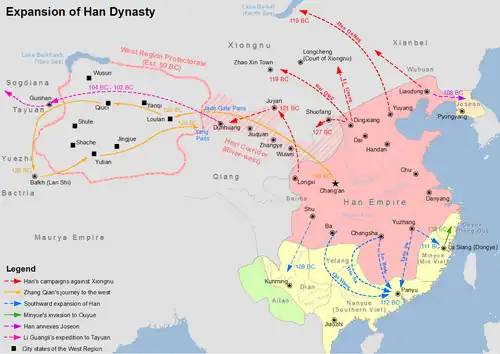
The Han dynasty (202 BC – 220 AD) was the second imperial dynasty of China, following the Qin dynasty (221–207 BC). It was divided into the periods of Western (Former) Han (202 BC – 9 AD) and Eastern (Later) Han (25–220 AD), briefly interrupted by the Xin dynasty (9–23 AD) of Wang Mang. The capital of Western Han was Chang'an, and the capital of Eastern Han was Luoyang. The emperor headed the government, promulgating all written laws, serving as commander-in-chief of the armed forces, and presiding as the chief executive official. He appointed all government officials who earned a salary of 600 bushels of grain or more (though these salaries were largely paid in coin cash) with the help of advisors who reviewed each nominee. The empress dowager could either be the emperor's actual or symbolic mother, and was in practice more respected than the emperor, as she could override his decisions; she could even make decisions on behalf of the emperor in dilemma matters of the country or for the order and continuation of the dynasty. If necessary, with the support of the courtiers, she would decide on his successor or his dismissal, although such a challenge was only raised by the empress dowager to the emperor during the emperor's youth or incapacity. The emperor's executive powers could also be practiced by any official upon whom he bestowed the Staff of Authority. These powers included the right to execute criminals without the imperial court's permission.
Choe Bu (Korean: 최부, 1454–1504) was a Korean diarist, historian, politician, and travel writer during the early Joseon Dynasty. He was most well known for the account of his shipwrecked travels in China from February to July 1488, during the Ming dynasty (1368–1644). He was eventually banished from the Joseon court in 1498 and executed in 1504 during two political purges. However, in 1506 he was exonerated and given posthumous honors by the Joseon court.
Choe's diary accounts of his travels in China became widely printed during the 16th century in both Korea and Japan. Modern historians also refer to his written works, since his travel diary provides a unique outsider's perspective on Chinese culture in the 15th century. The attitudes and opinions expressed in his writing represent in part the standpoints and views of the 15th century Confucian Korean literati, who viewed Chinese culture as compatible with and similar to their own. His description of cities, people, customs, cuisines, and maritime commerce along China's Grand Canal provides insight into the daily life of China and how it differed between northern and southern China during the 15th century. (Full article...)
Image 6
A statue depicting Zhang Heng at his tomb in Nanyang, Henan province, China
Zhang Heng began his career as a minor civil servant in Nanyang. Eventually, he became Chief Astronomer, Prefect of the Majors for Official Carriages, and then Palace Attendant at the imperial court. His uncompromising stance on historical and calendrical issues led to his becoming a controversial figure, preventing him from rising to the status of Grand Historian. His political rivalry with the palace eunuchs during the reign of Emperor Shun (r.125–144) led to his decision to retire from the central court to serve as an administrator of Hejian Kingdom in present-day Hebei. Zhang returned home to Nanyang for a short time, before being recalled to serve in the capital once more in 138. He died there a year later, in 139. (Full article...)
Cai Lun (Chinese:蔡伦; courtesy name: Jingzhong (敬仲); c.50–62 – 121 CE), formerly romanized as Ts'ai Lun, was a Chinese eunuch court official of the Eastern Han dynasty. He occupies a pivotal place in the history of paper due to his addition of pulp via tree bark and hemp ends which resulted in the large-scale manufacture and worldwide spread of paper. Although traditionally regarded as the inventor of paper, earlier forms of paper have existed since the 3rd century BCE, so Cai's contributions were an innovation, rather than an invention.
Born in Guiyang Commandery (in what is now Leiyang), Cai arrived at the imperial court in Luoyang by 75 CE, where he served as a chamberlain for Emperor Ming, and then as Xiao Huangmen, an imperial messenger for Emperor Zhang. To assist Lady Dou in securing her adopted son as designated heir, he interrogated Consort Song and her sister, who then killed themselves. When Emperor He ascended the throne in 88 CE, Dou awarded Cai with two positions: Zhongchang shi, a political counselor to the emperor that was the highest position for eunuchs of the time, and also as Shangfang Ling, where Cai oversaw the production of instruments and weapons at the Palace Workshop. (Full article...)
Hu lived in Nanjing during the transition from the Ming dynasty to the Qing dynasty. A Ming loyalist, he was offered a position at the rump court of the Hongguang Emperor, but declined the post, and never held anything more than minor political office. He did, however, design the Hongguang Emperor's personal seal, and his loyalty to the dynasty was such that he largely retired from society after the emperor's capture and death in 1645. He owned and operated an academic publishing house called the Ten Bamboo Studio, in which he practised various multi-colour printing and embossing techniques, and he employed several members of his family in this enterprise. Hu's work at the Ten Bamboo Studio pioneered new techniques in colour printmaking, leading to delicate gradations of colour which were not previously achievable in this art form. (Full article...)
Image 10
Zeng, 1872
Zeng Laishun (13 September 1826–2June 1895) was a Chinese interpreter, businessman, and educator. He was among the first Chinese people to study at a foreign college. Born in Singapore to a Teochew father and a Malay mother, he was orphaned as a young child. He was educated by the American Board of Commissioners for Foreign Missions, a Christian missionary organization, where he converted to Christianity. He was sent to the US in 1843, and in 1846 was admitted to Hamilton College, but he did not graduate due to a lack of funds. Zeng subsequently traveled to China.
After several years working as a missionary assistant in Guangzhou, he left with his family to pursue a trading career in Shanghai. In 1866, Zeng was hired by the local Fuzhou government as an English language instructor at the newly established Fuzhou Navy Yard School. Seeking to gain experience with Western practices and institutions, the imperial government began the Chinese Educational Mission in 1871, amassing a group of 120 Chinese boys to study in the US. He worked as an interpreter and English tutor for the mission under bureaucrat Chen Lanbin and Zeng's colleague Yung Wing. He returned to the US in 1872, where he was frequently and erroneously hailed as the "Chinese Commissioner of Education". (Full article...)
Image 11
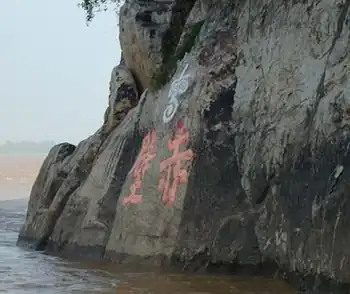
Engravings on a cliff-side near a widely accepted candidate site for the battlefield, in the vicinity of Chibi, Hubei. The engravings are at least 1000 years old, and include the Chinese characters 赤壁 ('red cliffs') written from right to left.
The Battle of Red Cliffs, also known as the Battle of Chibi, was a decisive naval battle in China that took place during the winter of 208–209 AD. It was fought on the Yangtze River between the forces of warlords controlling different parts of the country during the end of the Han dynasty. The allied forces of Sun Quan, Liu Bei, and Liu Qi based south of the Yangtze defeated the numerically superior forces of the northern warlord Cao Cao. By doing so, Liu Bei and Sun Quan prevented Cao Cao from conquering any lands south of the Yangtze, frustrating Cao Cao's efforts to reunify the territories formerly held by the Eastern Han dynasty.
The allied victory at Red Cliffs ensured the survival of Liu Bei and Sun Quan and left them in control of the Yangtze, establishing defensible frontiers that would later serve as the basis for the states of Shu Han and Eastern Wu during the Three Kingdoms period (220–280 AD). Historians have arrived at different conclusions in their attempts to reconstruct the timeline of events at Red Cliffs. The location of the battlefield itself remains a subject of debate: most scholars consider either a location southwest of present-day Wuhan, or a location northeast of Baqiu in present-day Yueyang, Hunan as plausible candidate sites for the battle. The battle has been the subject of or influenced numerous poems, dramas, movies and games. (Full article...)
Brady was born an American citizen in Tientsin, China, and traveled frequently as a child, spending time in Los Angeles, California, British Columbia, and Austin, Texas. She studied in the University of California system, receiving her bachelor's and master's degrees, and her Ph.D. in 1935. She next became an English instructor at that university's College of Agriculture, and worked as an assistant professor of languages and literature at Berkeley from 1941 to 1946. The following three years were spent at the University of Pennsylvania, until, at the end of 1949, Brady moved to teach at Central Oregon Community College; her resignation due to "ill health" was announced a few months later. After being named the 1952–53 Marion Talbot Fellow of the American Association of University Women and writing two articles, Brady's scholarship ceased for a quarter of a century. In 1979, and posthumously in 1983, her final two articles were published. (Full article...)
The Ming dynasty's founder, the Hongwu Emperor (r.1368–1398), attempted to create a society of self-sufficient rural communities ordered in a rigid, immobile system that would guarantee and support a permanent class of soldiers for his dynasty: the empire's standing army exceeded one million troops and the navy's dockyards in Nanjing were the largest in the world. He also took great care breaking the power of the court eunuchs and unrelated magnates, enfeoffing his many sons throughout China and attempting to guide these princes through the Huang-Ming Zuxun, a set of published dynastic instructions. This failed when his teenage successor, the Jianwen Emperor, attempted to curtail his uncle's power, prompting the Jingnan campaign, an uprising that placed the Prince of Yan upon the throne as the Yongle Emperor in 1402. The Yongle Emperor established Yan as a secondary capital and renamed it Beijing, constructed the Forbidden City, and restored the Grand Canal and the primacy of the imperial examinations in official appointments. He rewarded his eunuch supporters and employed them as a counterweight against the Confucian scholar-bureaucrats. One eunuch, Zheng He, led seven enormous voyages of exploration into the Indian Ocean as far as Arabia and the eastern coasts of Africa. Hongwu and Yongle emperors had also expanded the empire's rule into Inner Asia. (Full article...)
Set in the People's Republic of China during the 1990s, the film centers on a 13-year-old substitute teacher, Wei Minzhi, in the Chinese countryside. Called in to substitute for a village teacher for one month, Wei is told not to lose any students. When one of the boys takes off in search of work in the big city, she goes looking for him. The film addresses education reform in China, the economic gap between urban and rural populations, and the prevalence of bureaucracy and authority figures in everyday life. It is filmed in a neorealist/documentary style with a troupe of non-professional actors who play characters with the same names and occupations as the actors have in real life, blurring the boundaries between drama and reality. (Full article...)
Image 15
Beato, c.1866
Felice Beato (c.1832 – 29 January 1909), also known as Felix Beato, was an Italian–British photographer. He was one of the first people to take photographs in East Asia and one of the first war photographers as well as a pioneer of travel photography. He is noted for his genre works, portraits, and views and panoramas of the architecture and landscapes of Asia and the Mediterranean region. Beato's travels gave him opportunities to create images of countries, people, and events unfamiliar and remote to most people in Europe and North America. His works provide images of such events as the Indian Rebellion of 1857 and the Second Opium War, and represent the first substantial body of photojournalism. He influenced other photographers; and his impact in Japan, where he taught and worked with numerous other photographers and artists, was particularly deep and lasting. (Full article...)
Did you know (auto generated)
... that Gao Cai, a Chinese eunuch during the Ming dynasty, was accused of consuming the brains of young boys in the belief that it would restore his penis?
... that when Dutch ships reached China for the first time, seventeen out of twenty crew members were executed by the Portuguese?
...that when Tang dynasty general Zhang Yi signed a peace treaty with Tufan, he made an offering of goats instead of the customary cattle and horses because he was embarrassed to be dealing with "barbarians"?
White Rabbit Creamy Candy (Chinese:大白兔奶糖; pinyin:Dàbáitù Nǎitáng) is a brand of milkcandy manufactured by Shanghai Guan Sheng Yuan Food, Ltd. (Chinese:上海冠生园食品有限公司; pinyin:Shànghǎi Guānshēngyuán Shípǐn Yǒuxiàn Gōngsī), in China. It is an iconic cultural brand and has been in production since 1943.
White Rabbit Creamy Candy is considered to be a part of many mainlanders' and Hong Kongers' childhood nostalgia, and has been featured in many classic Chinese films and TV series. Guan Sheng Yuan has made White Rabbit Creamy Candy a popular treat food for generations of children living in Shanghai, Hong Kong, China, and abroad by adapting its product and business systems to new needs and cultivating the loyalty of its customers. Cross promotion with other products and specialized stores have contributed to its appeal. When its reputation has been challenged, it has been able to re-establish itself. (Full article...)
Chen was abandoned as an infant, and then lost both foster parents during early childhood. Before becoming a film director, Chen worked mainly in drama. His patriotic play Put Down Your Whip was highly influential and performed countless times during the Japanese invasion of China. During the war he also made a famous staging of the play Qu Yuan, and wrote one of the first Chinese books on film theory. (Full article...)
Image 2
Chinese workers in a gambier and pepper plantation in Singapore, circa 1900.
The Kangchu system was a socio-economic system of organisation and administration developed by Chinese agricultural settlers in Johor during the 19th century. The settlers organised themselves into informal associations (similar to the Kongsi organisations found in other Chinese communities), and chose a leader from among themselves.
In Chinese, "Kangchu" (Chinese:港主; HokkienPe̍h-ōe-jī: Káng-chú; TeochewPe̍h-ūe-jī: Káng-tsú) literally means 'master of the riverbank', and was the title given to the Chinese headmen of these river settlements. The "Kangchu" leaders are also called "Kapitan". (Full article...)
Image 3
Sun, early 1900s
Sun Jianai (7 April 1827 – 29 November 1909) was a Chinese official and educator during the late Qing dynasty, noted as an advisor and tutor to the Guangxu Emperor. Born in Anhui, he passed the imperial examinations and became a jinshi in 1859. After service as an education director in Hubei and at the Palace School for Princes, he was appointed as the tutor of the young Guangxu Emperor alongside Weng Tonghe. He served in various administrative posts during the 1880s and 1890s, including as president of the Censorate, Ministry of Works, Ministry of Rites, and Ministry of Civil Appointments. He was an advocate for the creation of what would become the Imperial University of Peking. Emperor Guangxu appointed Sun the Director of Educational Affairs and the imperial minister of the university. During the Hundred Days' Reform, he managed the university's opening and served as one of the emperor's closest advisors during the period.
A political moderate, Sun survived Empress Dowager Cixi's coup against the reform movement, and continued to manage the university. During the Boxer Rebellion, the university was destroyed and Sun's house was looted by the Kansu Braves. Following Cixi, he fled to Xi'an. After the war, he was promoted to the post of Grand Secretary of the Tiran Ge, and served as an examiner for the metropolitan imperial exams. He returned to managing the university in a triad with Zhang Baixi and Rongqing in 1904. He was named the prospective chairman of the advisory National Assembly, but died before the body could convene. (Full article...)
Image 4
Fossils of A. longicervia described in Wong et al. (2015)
The species was originally described as a pitcher plant with close affinities to extant members of the familySarraceniaceae. This would make it the earliest known carnivorous plant and the only known fossil record of Sarraceniaceae, or the New World pitcher plant family. Archaeamphora is also one of the three oldest known genera of angiosperms (flowering plants). Li (2005) wrote that "the existence of a so highly derived Angiosperm in the Early Cretaceous suggests that Angiosperms should have originated much earlier, maybe back to 280 mya as the molecular clock studies suggested". (Full article...)
Image 5
Tonghai Earthquake Memorial Monument, erected at Fengyi Pavilion of Xiushan Park An earthquake occurred in Tonghai, Yunnan province, China at 01:00:41 local time on 5 January 1970 with a moment magnitude of 7.1 and a maximum Mercalli intensity of X (Extreme). The strike-slip rupture originated on the Red River Fault, which had not experienced an earthquake above magnitude 7 since 1700. At least 10,000 people were killed, making it one of the deadliest in its decade. The tremor caused between US$5 and $25 million in damage, felt over an area of 8,781km2 (3,390sqmi). In Hanoi, North Vietnam, almost 483km (300mi) from the epicenter, victims left their homes as the rupture rumbled through the city.
Occurring during the height of the Cultural Revolution, it was not widely publicized by the Chinese government for well over a decade. The amount of aid and finances distributed was described by the Beijing Morning Post as "pathetically small". Much of the aid provided to survivors was in "spiritual" form, including Mao Zedong badges and condolence letters. Nevertheless, the earthquake was among the first to be studied over a long term by the Chinese government. It was cited as one of the reasons behind creating the largest earthquake monitoring system in China, 25 years later. (Full article...)
Image 6
Mexican forces outside the Casino de la Laguna
The Torreón massacre (Spanish: Matanza de chinos de Torreón; Chinese:萊苑慘案) was a massacre that took place from May 13 to May 15, 1911 in the Mexican city of Torreón, Coahuila. A total of 308 Chinese were killed, amounting to half the Chinese community in Torreón. The victims, accused of collusion with dictator Porfirio Díaz, were killed by a local mob and the revolutionary forces of Francisco I. Madero. A large number of Chinese homes and shops were looted and destroyed.
Torreón was the last major city to be taken by the Maderistas during the Mexican Revolution. When the government forces withdrew, the rebels entered the city early in the morning and, along with the local population, began a ten-hour massacre of the Chinese community. The event sparked a diplomatic crisis between China and Mexico, with the former demanding 30 million pesos in reparations. At one point, it was rumored that Qing China had even dispatched a warship to Mexican waters (the cruiser Hai Chi, which was anchored in Cuba at the time). An investigation into the massacre concluded that it was an unprovoked act of racism. (Full article...)
During the Great Leap Forward, Pan sympathized with Marshal Peng Dehuai, a critic of Mao Zedong's collectivization policy. As a result, in 1958, he was dismissed as party chief of Henan and subjected to persecution, but was later rehabilitated. (Full article...)
Ni has gone through multiple arrests, three prison sentences, and torture following her human rights cases against the Chinese government. Her license to practice law was later revoked by Chinese authorities. (Full article...)
Image 10
Peng in his Marshal uniform, 1955
Peng Dehuai (October 24, 1898–November 29, 1974; also spelled as Peng Teh-Huai) was a Chinese general and politician who was the Minister of National Defense from 1954 to 1959.
Born into a poor peasant family, Peng received several years of primary education before his family's poverty forced him to suspend his education at the age of ten, and to work for several years as a manual laborer. When he was sixteen, Peng became a professional soldier. Over the next ten years Peng served in the armies of several Hunan-based warlord armies, raising himself from the rank of private second class to major. In 1926, Peng's forces joined the Kuomintang, and Peng also got introduced to communism during this time. Peng participated in the Northern Expedition, and supported Wang Jingwei's attempt to form a left-leaning Kuomintang government based in Wuhan. After Wang was defeated, Peng briefly rejoined Chiang Kai-shek's forces before joining the Chinese Communist Party (CCP), allying himself with Mao Zedong and Zhu De. (Full article...)
As thousands of soldiers from the Republic of Korea Army (ROK) began to withdraw through the valley, the PVA infiltrated the brigade position under the cover of darkness and assaulted the 3 RAR on Hill 504 during the evening and into the following day. Five companies of the US and UK forces attached to 27th Brigade fled the battlefield without orders, expecting an imminent PVA breakthrough at the Kapyong Valley. Although heavily outnumbered, the 3 RAR and US tanks held their positions into the afternoon of April 24, before retreating from the battlefield to a reserve position near brigade headquarters. Both sides suffered heavy casualties. (Full article...)
In its formative years, the NCC became involved in the endeavors of Chinese nationalists. It sided with protesters in the May Thirtieth Incident and went as far as calling for the re-evaluation of "unequal treaties" China had with foreign powers. This angered foreign missionaries working in China. The NCC took an increasingly liberal theological stance, leading some foreign missionary organizations like the China Inland Mission and the Christian and Missionary Alliance to resign from its ranks. (Full article...)
Image 13
Xu in 1940
Xu Lai (Chinese:徐来; Wade–Giles:Hsü Lai; 1909 – 4 April 1973) was a Chinese film actress, socialite, and World War II secret agent. Known as the "Standard Beauty", she was active in the film industry for only three years, and quit acting after the suicide of the great star Ruan Lingyu in 1935. Her first husband was Li Jinhui, the "Father of Chinese pop music".
Hanpu (Chinese:函普; pinyin:Hánpǔ), later Wanyan Hanpu (Chinese:完顏函普), was a leader of the JurchenWanyan clan in the early tenth century. According to the ancestral story of the Wanyan clan, Hanpu came from Goryeo when he was sixty years old, reformed Jurchen customary law, and then married a sixty-year-old local woman who bore him three children. His descendants eventually united Jurchen tribes into a federation and established the Jin dynasty in 1115. Hanpu was retrospectively given the temple nameShizu (始祖) and the posthumous nameEmperor Yixian Jingyuan (懿憲景元皇帝) by the Jin dynasty.
Chinese historians have long debated whether Hanpu was of Silla, Goryeo, or Jurchen ethnicity. Since the 1980s, they have chiefly argued that he was a Jurchen who had lived in Silla, the state that had dominated the Korean peninsula until it was destroyed by Goryeo in 935. Western scholars usually treat Hanpu's story as a legend, but agree that it hints to contacts between some Jurchen clans and the states of Goryeo and Balhae (a state located between Jurchen lands and Silla until it was destroyed in 926) in the early tenth century. In Korea, a recent KBS history special treated Hanpu as a native Silla man who moved north and settled in Jurchen lands during the demise of Silla. (Full article...)
Mae Salong's early history centered on the Golden Triangle's opium trade, in which its distinctive population – the "lost army" of the Republic of China Army's 93rd Division – became involved. At the conclusion of the Chinese Civil War in 1949, some remnants of the anti-communist Kuomintang (KMT) forces refused to surrender, including the 278th Regiment of the 93rd Division and the 709th Regiment of the 237th Division (led by General Li Kuo-hui). The troops fought their way out of Yunnan in south-western China, and its soldiers lived in Burma's (now Myanmar) jungles. The army grew and part of it returned to Taiwan under international pressure. The remaining troops moved to the Thai border area and eventually established several communities in Thailand. Those led by Gen Tuan Shi-wen (also known as Chiwan Khamlue) settled in Mae Salong. The Thai government allowed their presence in exchange for their help fighting the communist insurgency on the Thai frontier. In reward, the Thai government granted citizenship to most of the KMT soldiers and their families. (Full article...)
Image 21Photo showing serving chopsticks (gongkuai) on the far right, personal chopsticks (putongkuai) in the middle, and a spoon. Serving chopsticks are usually more ornate than the personal ones. (from Chinese culture)
Image 22Official map of the Qing Empire published in 1905 (from History of China)
Image 24Relief of a fenghuang in Fuxi Temple (Tianshui). They are mythological birds of East Asia that reign over all other birds. (from Chinese culture)
Image 30Gilin with the head and scaly body of a dragon, tail of a lion and cloven hoofs like a deer. Its body enveloped in sacred flames. Detail from Entrance of General Zu Dashou Tomb (Ming Tomb). (from Chinese culture)
Image 34Red lanterns are hung from the trees during the Chinese New Year celebrations in Ditan Park (Temple of Earth) in Beijing. (from Chinese culture)
This is a list of recognized content, updated weekly by JL-Bot (talk·contribs) (typically on Saturdays). There is no need to edit the list yourself. If an article is missing from the list, make sure it is tagged(e.g. {{WikiProject China}})or categorized correctly and wait for the next update. See WP:RECOG for configuration options.
Assess: rate the Unassessed China-related articles and Unknown-importance China-related articles, tag the talk pages of China-related articles with the {{WikiProject China}} banner.
Translate: please visit the Chinese translation department and the Chinese intertranswiki project for more details.
Verify:Transformers: Robots in Disguise (2015 TV series) - see Talk:Transformers: Robots in Disguise (2015 TV series)#In China on 1905.com from Dec 31, 2014 and Wikipedia talk:WikiProject Transformers/Archive 7#Transformers in (PR) China
The President of the Republic of China is the head of state of the Republic of China (ROC).
The Constitution names the president as head of state and commander-in-chief of the Republic of China Armed Forces (formerly known as the National Revolutionary Army). The president is responsible for conducting foreign relations, such as concluding treaties, declaring war, and making peace. The president must promulgate all laws and has no right to veto. Other powers of the president include granting amnesty, pardon or clemency, declaring martial law, and conferring honors and decorations.
The current President is Lai Ching-te(pictured), since May 20, 2024. Lai is a Taiwanese politician and former physician, who is currently serving as the eighth president of the Republic of China under the 1947 Constitution and the third president from the Democratic Progressive Party (DPP).
Related WikiProjects
You are invited to participate in WikiProject China, a WikiProject dedicated to developing and improving articles about China.

















 wiki incubator Xiang (湘语)
 Commons
 Wikidata
 Wikiquote
 Wikisource
 Wikiversity
 Wikivoyage
 Wiktionary
 List of all portals






 Random portal
 WikiProject Portals