Portal:Cetaceans

The Cetaceans Portal

Cetaceans are marine mammals belonging to the infraorder Cetacea (/sɪˈteɪʃə/), a secondarily aquatic clade under the order Artiodactyla that include whales, dolphins, porpoises and extinct groups such as Basilosaurus. Most cetaceans live in marine environments, particularly the pelagic zone, but some reside solely in brackish or fresh water. Having a cosmopolitan distribution, they can be found in some rivers and all of Earth's oceans. Many species migrate seasonally over vast ranges for food advantages.
Key characteristics of cetaceans are their fully aquatic life cycle, streamlined, fish-like body shape, the need to periodically surface and breathe air, and exclusively carnivorous diet. Some cetaceans - the toothed whales - are capable of echolocation.
As nektonic animals, cetaceans propel themselves through the water with powerful up-and-down movements of their tails, which have evolved into in a horizontal paddle-like fluke. Their hindlimbs have disappeared with only some vestigial skeleton of the pelvis and femurs, and their forelimbs have evolved into flippers which they use to paddle and steer. Some fast-swimming groups, most notably the smaller dolphins and porpoises, have a dorsal fin to facilitate directional stability. Cetaceans also have large brains and have high intelligence, complex social behaviour, and song-like communication. Some cetaceans have large bodies, such as the blue whale, which reaches a maximum confirmed length of 29.9 meters (98 feet) and a weight of 173 tonnes (190 short tons), making it the largest animal known to have existed.
There are approximately 90 living cetacean species split into two parvorders: Odontoceti or toothed whales, which contains 75 species including porpoises, dolphins, the beaked whales and other predatory whales like the beluga and sperm whale, who prey upon fish, cephalopods and other marine mammals such as pinnipeds; and Mysticeti or baleen whales, which contains 15 species of large whales including the blue whale, humpback whale and bowhead whale among others, who are mostly filter-feeding planktivores (or sometimes bottom-feeding crustacivores or molluscivores, as in the case of the gray whale) using oral bristle plates known as baleen to sieve out and feed on large swarms of small invertebrates, usually crustaceans such as krill. Despite their highly modified bodies and carnivorous lifestyle, genetic and fossil evidence places cetaceans within the terrestrial even-toed ungulates, most closely related to the hippopotamids. (Full article...)
 Recognized content -


Livyatan is an extinct genus of macroraptorial sperm whale, containing one known species: L. melvillei. The genus name was inspired by the biblical sea monster Leviathan, and the species name by Herman Melville, the author of the famous novel Moby-Dick about a white bull sperm whale. Herman Melville often referred to whales as "Leviathans" in his book. It is mainly known from the Pisco Formation of Peru during the Tortonian stage of the Miocene epoch, about 8.9–9.9 million years ago (mya); however, finds of isolated teeth from other locations such as Chile, Argentina, the United States (California), South Africa and Australia imply that either it or a close relative survived into the Pliocene, around 5 mya, and may have had a global presence.
The body length of Livyatan melvillei holotype is approximately 13.5–17.5 meters (44–57 ft) long. Comparable to that of the modern sperm whale (Physeter macrocephalus), making it one of the largest predators known. The teeth of Livyatan measured 36.2 cm (14.3 in) and are the largest biting teeth of any known animal, excluding tusks. It is distinguished from the other raptorial sperm whales by the basin on the skull spanning the length of the snout. The spermaceti organ contained in that basin is thought to have been used in echolocation and communication, or for ramming prey and other sperm whales. The whale may have interacted with the large extinct shark megalodon (Otodus megalodon), competing with it for a similar food source. Its extinction was probably caused by a cooling event at the end of the Miocene period causing a reduction in food populations. The geological formation where the whale has been found has also preserved a large assemblage of marine life, such as sharks and other marine mammals. Characteristically of raptorial sperm whales, Livyatan had functional, enamel-coated teeth on the upper and lower jaws, as well as several features suitable for hunting large prey. (Full article...)
Rice's whale (Balaenoptera ricei), also known as the Gulf of Mexico whale, is a species of baleen whale endemic to the northern Gulf of Mexico. Initially identified as a subpopulation of the Bryde's whale, genetic and skeletal studies found it to be a distinct species in 2021. In outward appearance, it is virtually identical to the Bryde's whale. Its body is streamlined and sleek, with a uniformly dark charcoal gray dorsal and pale to pinkish underside. A diagnostic feature often used by field scientists to distinguish Rice's whales from whales other than the Bryde's whale is the three prominent ridges that line the top of its head. The species can be distinguished from the Bryde's whale by the shape of the nasal bones, which have wider gaps due to a unique wrapping by the frontal bones, its unique vocal repertoire, and genetic differences.
It is a medium-sized baleen whale that grows up to 12.65 meters (41.5 ft) in length and weighs up to 13.87–27.2 metric tons (13.65–26.77 long tons; 15.29–29.98 short tons). The Rice's whale inhabits a restricted stretch along the continental slope in the northeastern part of the Gulf of Mexico between depths of 150–410 meters (490–1,350 ft) off the coast of western Florida, although some whales have been sighted in the northwestern portions and the species may have inhabited a wider distribution throughout the Gulf in historical times. It does not migrate but remains within this area year-round. Rice's whales employ a diel vertical diving pattern, in which the whale spends most of the day feeding at or near the seafloor at depths at around 150–250 meters (490–820 ft). At night it feeds closer to the surface. The whale appears to selectively prey on the silver-rag driftfish, which has a very high energy density, although other fishes are suspected to also be consumed. (Full article...)
The bottlenose dolphin is a toothed whale in the genus Tursiops. They are common, cosmopolitan members of the family Delphinidae, the family of oceanic dolphins. Molecular studies show the genus contains three species: the common bottlenose dolphin (Tursiops truncatus), the Indo-Pacific bottlenose dolphin (Tursiops aduncus), and Tamanend's bottlenose dolphin (Tursiops erebennus). Others, like the Burrunan dolphin (Tursiops (aduncus) australis), may be alternately considered their own species or be subspecies of T. aduncus. Bottlenose dolphins inhabit warm and temperate seas worldwide, being found everywhere except for the Arctic and Antarctic Circle regions. Their name derives from the Latin tursio (dolphin) and truncatus for the truncated teeth (the type specimen was old and had worn down teeth; this is not a typical characteristic of most members of the species).
Numerous investigations of bottlenose dolphin intelligence have been conducted, examining mimicry, use of artificial language, object categorization, and self-recognition. They can use tools (sponging; using marine sponges to forage for food sources they normally could not access) and transmit cultural knowledge from generation to generation, and their considerable intelligence has driven interaction with humans. Bottlenose dolphins gained popularity from aquarium shows and television programs such as Flipper. They have also been trained by militaries to locate sea mines or detect and mark enemy divers. In some areas, they cooperate with local fishermen by driving fish into their nets and eating the fish that escape. Some encounters with humans are harmful to the dolphins: people hunt them for food, and dolphins are killed inadvertently as a bycatch of tuna fishing and by getting caught in crab traps. (Full article...)
The sperm whale or cachalot (Physeter macrocephalus) is the largest of the toothed whales and the largest toothed predator. It is the only living member of the genus Physeter and one of three extant species in the sperm whale superfamily Physeteroidea, along with the pygmy sperm whale and dwarf sperm whale of the genus Kogia.
The sperm whale is a pelagic mammal with a worldwide range, and will migrate seasonally for feeding and breeding. Females and young males live together in groups, while mature males (bulls) live solitary lives outside of the mating season. The females cooperate to protect and nurse their young. Females give birth every four to twenty years and care for the calves for more than a decade. A mature, healthy sperm whale has no natural predators, although calves and weakened adults are sometimes killed by pods of orcas. (Full article...)
The false killer whale (Pseudorca crassidens) is a species of oceanic dolphin that is the only extant representative of the genus Pseudorca. It is found in oceans worldwide but mainly in tropical regions. It was first described in 1846 as a species of porpoise based on a skull, which was revised when the first carcasses were observed in 1861. The name "false killer whale" comes from having a skull similar to the orca or killer whale (Orcinus orca).
The false killer whale reaches a maximum length of 6 m (20 ft), though size can vary around the world. It is highly sociable, known to form pods of up to 50 members, and can also form pods with other dolphin species, such as the common bottlenose dolphin (Tursiops truncatus). It can form close bonds with other species, as well as have sexual interactions with them. But the false killer whale has also been known to eat other dolphins, though it typically eats squid and fish. It is a deep-diver; maximum known depth is 927.5 m (3,043 ft); maximum speed is around 30 km/h (19 mph). (Full article...)- Orca's Song is a 1987 picturebook written by Anne Cameron and illustrated in black and white by Nelle Olsen. Published by Harbour Publishing, the book is an adaptation of a Pacific Northwest Indigenous story. Orca's Song is a pourquoi story about a black orca who falls in love with an osprey; the two mate to create a baby orca with the black and white patterning found on the whales.
While some reviewers appreciated the art and text of the story, it received criticism from Indigenous authors and scholars who disputed Cameron's claim of sole authorship and copyright for the story. Consequently, reprints of the book began to attribute the storyteller Klopinum for the story's inspiration although Cameron retained sole authorship credit and copyright. The story has also been noted as an early example of a lesbian relationship (between Orca and Osprey) in picturebook literature and one of the few such picturebooks published before 2000 to lack a moralising tone. (Full article...) 
The anatomist John Struthers (at left, in top hat) with the Tay Whale at John Woods's yard, Dundee, 1884, photographed by George Washington Wilson
The Tay Whale, known locally as the Monster, was a humpback whale that swam into the Firth of Tay of eastern Scotland in 1883. It was harpooned in a hunt, but escaped, and was found floating dead off Stonehaven a week later. It was towed into Dundee by a showman, John Woods, and exhibited on a train tour of Scotland and England.
The Regius Professor of Anatomy at Aberdeen University, John Struthers dissected the whale, much of the time in public with a military band playing in the background, organised by Woods. The decomposing whale made Woods a great deal of money, and Struthers famous. (Full article...)
Atlantic white-sided dolphin caught in a drive hunt in Hvalba on the Faroe Islands being taken away with a forklift
Dolphin drive hunting, also called dolphin drive fishing, is a method of hunting dolphins – and occasionally other small cetaceans such as pilot whales – by herding them toward the shore with boats, typically into a bay or onto a beach. Their escape is prevented by closing off the route to the open sea or ocean with boats and nets. Dolphins are hunted this way in several places around the world including the Solomon Islands, the Faroe Islands, Peru, and Japan. The captured animals have been used for their meat; some animals end up in dolphinariums, while in Peru, many are used as shark bait.
Hunts have ended in countries including Iceland and the United States. The practice has attracted protests from animal rights groups in places including the Faroe Islands. There has been concern, too, about the possible health risk from eating meat containing PCB and DDT derivatives and mercury. (Full article...)
The fin whale (Balaenoptera physalus), also known as the finback whale or common rorqual, is a species of baleen whale and the second-longest cetacean after the blue whale. The biggest individual reportedly measured 26–27.3 m (85–90 ft) in length, with a maximum recorded weight of 65.5 to 120 tonnes (72.2 to 132.3 short tons; 64.5 to 118.1 long tons). The fin whale's body is long, slender, and brownish-gray in color, with a paler underside to appear less conspicuous from below (countershading).
At least two recognized subspecies exist, one in the North Atlantic and one across the Southern Hemisphere. The species is found in all the major oceans, from polar to tropical waters, and is absent only from waters close to the pack ice at the poles and relatively small areas of water away from the open ocean. The highest population density occurs in temperate and cool waters. Its prey mainly consists of smaller schooling fish, small squid, and crustaceans, including copepods and krill. Mating takes place in temperate, low-latitude seas during the winter. Fin whales are often observed in pods of 6–10 animals, with whom they communicate using frequency-modulated sounds, ranging from 16 to 40 hertz. (Full article...)
The sei whale (/seɪ/ SAY, Norwegian: [sæɪ]; Balaenoptera borealis) is a baleen whale. It is one of ten rorqual species, and the third-largest member after the blue and fin whales. It can grow to 19.5 m (64 ft) in length and weigh as much as 28 t (28 long tons; 31 short tons). Two subspecies are recognized: B. b. borealis and B. b. schlegelii. The whale's ventral surface has sporadic markings ranging from light grey to white, and its body is usually dark steel grey in colour. It is among the fastest of all cetaceans, and can reach speeds of up to 50–55 km/h (31–34 mph) over short distances.
It inhabits most oceans and adjoining seas, and prefers deep offshore waters. It avoids polar and tropical waters and semi-enclosed bodies of water. The sei whale migrates annually from cool, subpolar waters in summer to temperate, subtropical waters in winter with a lifespan of 70 years. It is a filter feeder, with its diet consisting primarily of copepods, krill, and other zooplankton. It is typically solitary or can be found in groups numbering half a dozen. During the breeding period, a mating pair will remain together. Sei whale vocalizations usually last approximately half a second, and occurs at 240–625 hertz. (Full article...)
Species of the infraorder Cetacea
The evolution of cetaceans is thought to have proceeded in modern day Pakistan during the Eocene epoch (56–34 mya), the second epoch of the Paleogene period of the present-extending Cenozoic Era. Specifically, cetaceans are thought to have transitioned from land to water at the tailend of the Paleocene–Eocene transition about 56 Mya, which was marked by increased global temperatures of 5.6°C, warming the earth’s oceans.
Cetaceans are fully aquatic mammals belonging to the order Artiodactyla. Molecular and morphological analyses suggest that they share a relatively recent closest common ancestor with hippopotamuses – their sister group, diverging about 55.5 Mya. Cetacea completely branched off from other artiodactyls around 50 mya. Research conducted in the late 1970s in Pakistan revealed several stages in the transition of cetaceans from land to sea. Being mammals, they surface to breathe air; they have five finger bones (even-toed) in their fins; they nurse their young; and, despite their fully aquatic life style, they retain many skeletal features from their terrestrial ungulata ancestors. (Full article...)
The humpback whale (Megaptera novaeangliae) is a species of baleen whale. It is a rorqual (a member of the family Balaenopteridae) and is the only species in the genus Megaptera. Adults range in length from 14–17 m (46–56 ft) and weigh up to 40 metric tons (44 short tons). The humpback has a distinctive body shape, with long pectoral fins and tubercles on its head. It is known for breaching and other distinctive surface behaviors, making it popular with whale watchers. Males produce a complex song that typically lasts from 4 to 33 minutes.
Found in oceans and seas around the world, humpback whales typically migrate between feeding areas towards the poles and breeding areas near the equator. Their diet consists mostly of krill and small fish, and they usually use bubbles to catch prey. They are polygynandrous breeders, with both sexes having multiple partners. Males will follow females and fight off rivals. Mothers give birth to calves in shallower water. Orcas are the main natural predators of humpback whales. The bodies of humpbacks host barnacles and whale lice. (Full article...)
Orcinus citoniensis is an extinct species of orca identified in the Late Pliocene of Italy and the Early Pleistocene of England. It was smaller than the modern killer whale (O. orca), 4 m (13 ft) versus 7 to 10 m (23 to 33 ft), and had around 8 more teeth in its jaw. It may have resembled the modern killer whale in appearance, and could represent a transitional species between the modern killer whale and other dolphins. O. citoniensis could have hunted fish and squid in pods, and coexisted with other large predators of the time such as the orcinine Hemisyntrachelus and the extinct shark Otodus megalodon. (Full article...)
Whale barnacles are species of acorn barnacle that belong to the family Coronulidae. They typically attach to baleen whales, and sometimes settle on toothed whales. The whale barnacles diverged from the turtle barnacles about three million years ago.
Whale barnacles passively filter food, using tentacle-like cirri, as the host swims through the water. The arrangement is generally considered commensal as it is done at no cost or benefit to the host. However, some whales may make use of the barnacles as protective armor or for inflicting more damage while fighting, which would make the relationship mutualistic where both parties benefit; alternatively, some species may just increase the drag that the host experiences while swimming, making the barnacles parasites. (Full article...)
Brygmophyseter, known as the biting sperm whale, is an extinct genus of toothed whale in the sperm whale family with one species, B. shigensis. When it was first described in 1994, the species was placed in the genus Scaldicetus based on tooth morphology, but this was later revised in 2006. A month later since the naming of Brygmophyseter, another study classified this species into the genus Naganocetus, which is considered to be a junior synonym. The only known specimen, a nearly complete skeleton, was dated to be around 16–14 million years old (middle Miocene). The Brygmophyseter holotype is estimated to have been 6 to 7 meters (20 to 23 ft) long by different researchers, and it probably had 11 or 12 large teeth covered with thick enamel in the upper and lower jaws. The tooth roots were firmly embedded in the gums, making it easy to catch resistance-fighting prey.Brygmophyseter is part of a group of macroraptorial sperm whales (often shortened to "raptorial") which tended to be apex predators using their large teeth to catch large prey such as whales. It had a spermaceti organ which was probably used for biosonar like in the modern sperm whale. The whale has made an appearance on The History Channel's TV series Jurassic Fight Club. (Full article...)


Selected picture

A Blue whale skeleton, outside the Long Marine Laboratory at the University of California, Santa Cruz.
Blue Whales are the largest animal ever to have existed. Hunting of Blue Whales has led to a severe decline in numbers across the globe.
More did you know...

- ...the songs of whales were sent into space aboard the Voyager spacecraft to represent sounds from Planet Earth.
- ...the Beluga whale is also known as the Sea Canary on account of its high-pitched squeaks, squeals, and whistles.
- ...Orcas are versatile predators with many populations actively hunting down whales such as the Grey Whale.
- ...the Sperm Whale, at 18 metres long, is the largest toothed animal to have ever lived.
- ...in spite of their enormous mass, baleen whales are capable of leaping completely out of the water, particularly the Humpback Whale.
Things you can do..
 |
Here are some Cetaceans WikiProject tasks you can do.
|
General images -
 South Atlantic right whale illustration
 North Atlantic right whale illustration
 Megalodon hunted Miocene baleen whales (from Baleen whale)
 Restoration of Janjucetus hunderi (from Baleen whale)

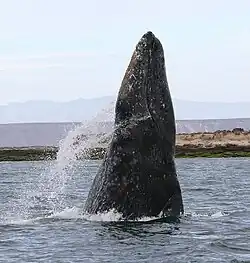 Their eyes are relatively small for their size.
- Species of the infraorder Cetacea (from Evolution of cetaceans)
 Pakicetus attocki skeleton (from Evolution of cetaceans)
 The heart of a blue whale with a person standing next to it
 Accessory baleen plates taper off into small hairs (from Baleen whale)
 An orca by the name of Ulises performing at SeaWorld, 2009 (from Toothed whale)
 Baleen whales vary considerably in size and shape, depending on their feeding behavior. (from Baleen whale)
 The nose of the whale is filled with a waxy substance that was widely used in candles, oil lamps, and lubricants (from Toothed whale)
 Dolphins (aquatic mammals) and ichthyosaurs (extinct marine reptiles) share a number of unique adaptations for fully aquatic lifestyle and are frequently used as extreme examples of convergent evolution (from Evolution of cetaceans)
 Anatomy of the bottlenose dolphin (from Toothed whale)
- Atlantic white-sided dolphin caught in a drive hunt in Hvalba on the Faroe Islands being taken away with a forklift (from Toothed whale)
 Archaeomysticetes, like Janjucetus, had teeth.
 Humpback whale illustration
 Orange whale lice on a right whale
 Blue whale illustration
 Fin whale illustration
 Common minke whale illustration
 Diagram illustrating sound generation, propagation and reception in a toothed whale. Outgoing sounds are red and incoming ones are green (from Toothed whale)
 A humpback whale skeleton. Notice how the jaw is split into two.
 Orca hunting a Weddell seal (from Toothed whale)
 Antarctic minke whale illustration
 Features of a sperm whale skeleton (from Toothed whale)
 Eden's whale illustration

 Bryde's whale (rorqual) (from Baleen whale)
 World population graph of blue whales
 Humpback whales lunge-feeding in the course of bubble net fishing
 Gray whale illustration
 Acrophyseter skull (from Evolution of cetaceans)
 Biosonar by cetaceans (from Toothed whale)
 Fossil of Squalodon (from Toothed whale)
 A protest against Japan's scientific whaling
 The remains of a North Atlantic right whale after it collided with a ship propeller
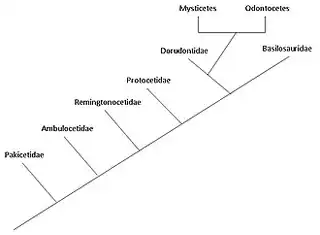 A phylogenetic tree showing the relationships among cetacean families. (from Evolution of cetaceans)
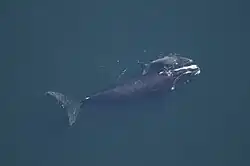 Female right whale with calf
 Japanese scientific whaling on a pair of Antarctic minke whales (from Baleen whale)
 Archaeocetes (like this Basilosaurus) had a heterodont dentition (from Evolution of cetaceans)
 Spectrogram of dolphin vocalizations. Whistles, whines, and clicks are visible as upside down V's, horizontal striations, and vertical lines, respectively. (from Toothed whale)
 Pygmy right whale illustration
 Possible relationships between cetaceans and other ungulate groups. (from Evolution of cetaceans)
 Bowhead whale illustration
 The skeleton of a bowhead whale with the hind limb and pelvic bone structure circled in red. This bone structure stays internal during the entire life of the species. (from Evolution of cetaceans)
 Sei whale illustration
Did you know (auto-generated)

- ... that a person required intensive care after being splashed with salt water by a beluga whale?
Selected media
List articles
Related portals
WikiProjects

The content you are reading was created by Wikipedia volunteers. See WikiProject Cetaceans for more.
- Tree of Life
- Biology
- Science
- Birds
- Mammals
- Marine Life
- Sharks
- See also: Wikispecies, a Wikimedia project dedicated to the classification of species.
Cetacean articles
Represents a Featured article, Represents a Good articleCategories

See also
For additional lists of marine life-related featured articles and good articles see:
Associated Wikimedia
The following Wikimedia Foundation sister projects provide more on this subject:
-
 Commons
Free media repository -
 Wikidata
Free knowledge base -
 Wikiquote
Collection of quotations -
 Wikisource
Free-content library -
 Wikispecies
Directory of species -
 Wikiversity
Free learning tools -
 Wikivoyage
Free travel guide -
 Wiktionary
Dictionary and thesaurus
-
 List of all portals
-

-

-

-

-

-

-

-

-

-
 Random portal
-
 WikiProject Portals