Portal:Bosnia and Herzegovina

Welcome to the Bosnia and Herzegovina Portal
 |
 |
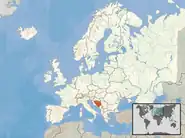 | |
Bosnia and Herzegovina, often referred to as Bosnia-Herzegovina or simply Bosnia, is a country in Southeast Europe. Situated on the Balkan Peninsula, it borders Serbia to the east, Montenegro to the southeast, and Croatia to the north and southwest, with a 20-kilometre-long (12-mile) coast on the Adriatic Sea in the south. Bosnia has a moderate continental climate with hot summers and cold, snowy winters. Its geography is largely mountainous, particularly in the central and eastern regions, which are dominated by the Dinaric Alps. Herzegovina, the smaller, southern region, has a Mediterranean climate and is mostly mountainous. Sarajevo is the capital and the largest city.
The area has been inhabited since at least the Upper Palaeolithic, with permanent human settlement traced to the Neolithic cultures of Butmir, Kakanj, and Vučedol. After the arrival of the first Indo-Europeans, the area was populated by several Illyrian and Celtic civilisations. Most of modern Bosnia was incorporated into the Roman province of Dalmatia by the mid-first century BCE. The ancestors of the modern South Slavic peoples arrived between the sixth and ninth centuries. In the 12th century, the Banate of Bosnia was established as the first independent Bosnian polity. It gradually evolved and expanded into the Kingdom of Bosnia, which became the most powerful state in the western Balkans by the 14th century. The Ottoman Empire annexed the region in 1463 and introduced Islam. From the late 19th century until World War I, the country was under Austro-Hungarian rule. In the interwar period, Bosnia and Herzegovina was part of the Kingdom of Yugoslavia. After World War II, it was granted full republic status in the newly formed Socialist Federal Republic of Yugoslavia. In 1992, following the breakup of Yugoslavia, the republic proclaimed independence. This was followed by the Bosnian War, which lasted until late 1995 and ended with the signing of the Dayton Agreement.
Bosnia and Herzegovina has around 3.4 million inhabitants, composed chiefly of three main ethnic groups: Bosniaks, who form one half of the population, followed by Serbs at one-third and Croats at one-sixth; minorities include Jews, Roma, Albanians, Montenegrins, Ukrainians and Turks, who are among 17 recognized "national minorities". Bosnia and Herzegovina has a bicameral legislature and a presidency made up of one member from each of the three major ethnic groups (directorial system). The central government's power is minimal, as the country is largely decentralised; it consists of two highly autonomous "entities"—the Federation of Bosnia and Herzegovina and Republika Srpska—and a third unit, the Brčko District, nominally under joint control, albeit governed by its own local government.
Bosnia and Herzegovina is a developing country and an upper-middle income economy, dominated by industry and agriculture, followed by tourism and services; tourism has increased significantly in recent years. The country has a social security and universal healthcare system, while primary and secondary education is free. It is a member of the United Nations, Council of Europe, OSCE, CEFTA, and is also a founding member of the SEECP. Bosnia and Herzegovina has been an EU candidate country since 2022, and a NATO membership candidate since 2010. (Full article...)
Selected article -
The human rights record of Bosnia and Herzegovina has been criticised over a number of years by intergovernmental organisations including the United Nations Human Rights Council, the European Court of Human Rights and the Organisation for Security and Co-operation in Europe, as well as international and domestic non-governmental organisations such as Human Rights Watch and Amnesty International. The government of Bosnia and Herzegovina has been criticised for ethnic and religious discrimination in its treatment of ethnic and religious minorities such as the Romani people and the Jewish people. The government has also been criticised for its treatment of Internally Displaced Persons following the Bosnian War and its failure to provide asylum seekers with resources such as food, shelter and medical assistance. According to BH Novinari, the Bosnian Journalists’ Association, freedom of the media is an issue in Bosnia and Herzegovina, with journalists facing attacks, threats and pressure from government. Human rights non-government organisations have also reported interference in their work from the government. The Bosnian government has been criticised by the European Union for its slow response to domestically prosecute war crimes from the Bosnian War following the closure of the International Criminal Tribunal for the Former Yugoslavia in December 2017. (Full article...)
General images
 Ottoman Bosnia - flag from 1878 (from History of Bosnia and Herzegovina)
 Alija Izetbegović during his visit to the United States in 1997. (from History of Bosnia and Herzegovina)
 Coat of Arms of the Republic of Bosnia and Herzegovina (from History of Bosnia and Herzegovina)
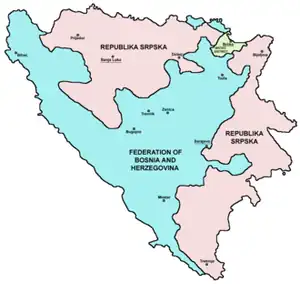 Administrative division of modern Bosnia and Herzegovina. (from History of Bosnia and Herzegovina)

 BHRT headquarters in Sarajevo (from Bosnia and Herzegovina)
 The Bosnia Eyalet in 1683 (from Bosnia and Herzegovina)

 Tuzla government building burning after anti-government clashes on 7 February 2014 (from History of Bosnia and Herzegovina)
 Vedran Smailović, the cellist of Sarajevo. (from Culture of Bosnia and Herzegovina)
 Bosnia in the Middle Ages spanning the Banate of Bosnia and the succeeding Kingdom of Bosnia (from Bosnia and Herzegovina)
 Eternal flame memorial to military and civilian World War II victims in Sarajevo (from Bosnia and Herzegovina)
 Bosnia within the Independent State of Croatia (NDH), 1942 (from History of Bosnia and Herzegovina)

 Ledger stone to Queen Catherine of Bosnia, the last queen of the House of Kosača. (from Bosnia and Herzegovina)

 The assassination of Archduke Franz Ferdinand of Austria and Sophie, Duchess of Hohenberg by Gavrilo Princip in Sarajevo, 28 June 1914 (from Bosnia and Herzegovina)
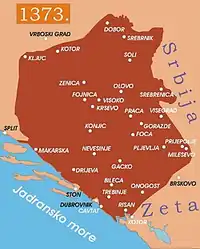 The Banate in 1373, shortly before its elevation to kingdom (from History of Bosnia and Herzegovina)
 The Herzegovina Uprising of 1875–77 (from History of Bosnia and Herzegovina)
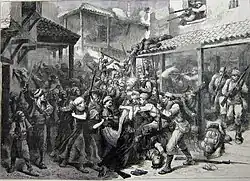 Austro-Hungarian troops enter Sarajevo, 1878 (from Bosnia and Herzegovina)
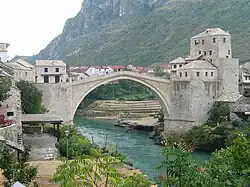 The Mostar Bridge was commissioned by Suleiman the Magnificent in 1557 (from Bosnia and Herzegovina)
- Territorial evolution of the Bosnian Kingdom (from History of Bosnia and Herzegovina)

 Dissolution of Yugoslavia (from Bosnia and Herzegovina)
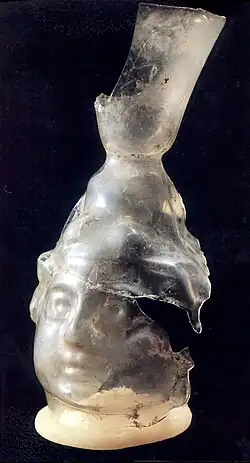
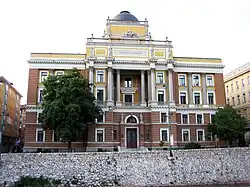
 The Jahorina Ski Resort, a 1984 Winter Olympics venue, is the biggest and most popular ski resort in Bosnia and Herzegovina (from Bosnia and Herzegovina)
 Hval's Codex, illustrated Slavic manuscript from medieval Bosnia (from Bosnia and Herzegovina)
- Coat of arms of Bosnia and Herzegovina (from History of Bosnia and Herzegovina)
 The Central Bank of Bosnia and Herzegovina in Sarajevo (from Bosnia and Herzegovina)
 Počitelj Citadel in Čapljina, built by King Tvrtko I of Bosnia in 1383. (from Bosnia and Herzegovina)
 Bosnian and Herzegovinian Partisans flag (1941-1945) (from History of Bosnia and Herzegovina)
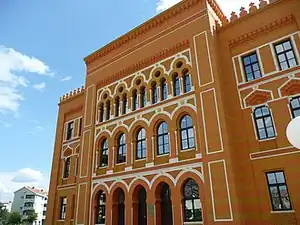
 People of Sarajevo in 1883 (from Bosnia and Herzegovina)
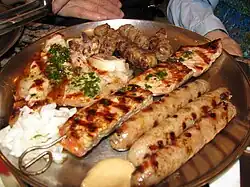 Bosnian meat platter that contains, among other things, ćevapi, which is considered the national dish of Bosnia and Herzegovina (from Bosnia and Herzegovina)
 Illustration from the French magazine Le Petit Journal on the Bosnian Crisis: Bulgaria declares its independence and its prince Ferdinand is named Tsar, Austria-Hungary, in the person of Franz Joseph, annexes Bosnia and Herzegovina, while the Ottoman Sultan Abdul Hamid II looks on helplessly (from History of Bosnia and Herzegovina)
 Bosnia and Herzegovina's flag while part of the Socialist Federal Republic of Yugoslavia (from Bosnia and Herzegovina)
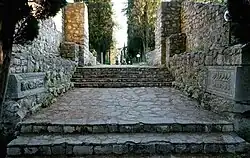 Mogorjelo, an ancient Roman suburban Villa Rustica from the 4th century, near Čapljina (from Bosnia and Herzegovina)
 Estimated development of real GDP per capita of Bosnia and Herzegovina, since 1952 (from Bosnia and Herzegovina)

 Coat of arms of Bosnia and Herzegovina during Habsburg times. (from History of Bosnia and Herzegovina)
 A lamb roast and "kolo" (circle) dancing - Bosnia and Herzegovina, 1895 (from Culture of Bosnia and Herzegovina)
 Coat of arms of the Socialist Republic of Bosnia and Herzegovina (from History of Bosnia and Herzegovina)
 The Avaz Twist Tower in Sarajevo, the tallest building in Bosnia and Herzegovina (from Bosnia and Herzegovina)
- Bosnia and Herzegovina consists of the Federation of Bosnia and Herzegovina (FBiH), Republika Srpska (RS) and Brčko District (BD) (from Bosnia and Herzegovina)
 Coat of arms of the Banate of Bosnia (from History of Bosnia and Herzegovina)
 The railway bridge over the Neretva River in Jablanica, twice destroyed during the 1943 Operation Weiss offensive (from Bosnia and Herzegovina)
 Tuzla government building burning after anti-government clashes on 7 February 2014 (from Bosnia and Herzegovina)

 Kingdom of Bosnia 1377-1463 (from History of Bosnia and Herzegovina)
More did you know
- ... that Iris Kadrić played international football for Sweden under-17s, before switching to play for Bosnia and Herzegovina?
Cities
- Banja Luka
- Bihać
- Berkovići
- Bijeljina
- Bosanska Krupa
- Bosanski Petrovac
- Brčko
- Brod
- Bugojno
- Cajnice
- Cazin
- Derventa
- Doboj
- Donji Vakuf
- Dubica
- Foča
- Goražde
- Gornji Vakuf
- Gračanica
- Gradačac
- Gradiška
- Ilidža
- Istočno Sarajevo
- Jajce
- Jablanica
- Kakanj
- Kalesija
- Konjic
- Kotor Varoš
- Laktaši
- Livno
- Ljubuški
- Lukavac
- Modriča
- Mostar
- Nevesinje
- Neum
- Novi Grad
- Novi Travnik
- Olovo
- Petrovo
- Prijedor
- Prnjavor
- Sanski Most
- Sarajevo
- Srebrenik
- Srebrenica
- Teslić
- Tešanj
- Travnik
- Trebinje
- Tuzla
- Velika Kladuša
- Visoko
- Vitez
- Zavidovići
- Zenica
- Zvornik
- Živinice
- Žepče
Selected biography -
Ismet Popovac (Serbian Cyrillic: Исмет Поповац; 8 December 1902 – 21 August 1943) was a Bosnian Muslim physician who led a Muslim Chetnik militia known as the Muslim People's Military Organization (MNVO) in Bosnia and Herzegovina during World War II. He was active in pre-war Yugoslav politics, becoming a member of the Serbian Muslim cultural organization Gajret and serving as the mayor of Konjic, a town in northern Herzegovina. He is also said to have been candidate for Vladko Maček's electoral list, but was left without a job in the Yugoslav state government after the creation of the Banovina of Croatia in August 1939.
Following the Axis invasion of Yugoslavia in April 1941, Popovac joined the Chetnik movement of Draža Mihailović. Popovac was a proponent of Bosnian Muslim cooperation with the Chetniks and suggested that they recruit Muslims into their ranks. In October 1942, he enlisted Italian aid in fighting the communist Partisans, and later visited Prozor to discourage further bloodshed after a Chetnik massacre that took the lives of as many as 2,500 Muslim and Croat civilians. In early 1943, he led an attack against a Muslim village. Later that year, he was killed in disputed circumstances near the town of Trebinje. (Full article...)
List of selected biographies |
|---|
Did you know (auto-generated)

- ... that Miroslav Kvočka was convicted of war crimes and crimes against humanity against non-Serb detainees in the Omarska concentration camp during the Bosnian War?
- ... that weightlifter Mehmed Skender was manning a machine gun when asked to join Bosnia and Herzegovina's first Olympic team?
- ... that the May 1995 Pale air strikes during the Bosnian War were the first offensive operations carried out by the Spanish Air Force since 1957?
- ... that Bosnian Olympic runners Islam Ðugum and Kada Delić were both nearly killed by snipers during their training?
- ... that Ivan Ančić was the first Bosnian Franciscan to use the Latin script to write in his native language?
- ... that Bosnian sitting volleyball players Sabahudin Delalić, Ismet Godinjak, Adnan Manko, Asim Medić, and Dževad Hamzić have won medals at every Paralympics this century?
Subcategories

Related portals
Religions in Bosnia and Herzegovina
Ex-Yugoslav countries
Other countries
Topics


| |||||||||||||||||||||||||||||||||||||||||||||||||||||||||||||||||||||










Recognized content
Extended content | ||
|---|---|---|
Featured articles
Good articles
Featured pictures
|


Things you can do

- Request images:
- Request maps:
- Sarajevo city location map
- Articles wanted:
- Clinical Center University of Sarajevo (Koševo hospital);
- Articles needing major work, Be Bold!: **
- Architecture of Bosnia and Herzegovina
- Health in Bosnia and Herzegovina
- Literature of Bosnia and Herzegovina
- List of universities in Bosnia and Herzegovina
- Foreign relations of Bosnia and Herzegovina
- Cinema of Bosnia and Herzegovina
- Subpages of List of settlements in the Federation of Bosnia and Herzegovina
- Stubs needing expansion:
- Featured Portals:
- Featured Pictures:
- Articles with Featured Article Candidate's status within reach:
- Current Featured Candidates:
- Featured Articles: (Don't be too bold!)
- Current Good Article Candidates:
- Good Articles:
- Former Good Articles:
Web resources
- B&H Tourism - Official Web Site
- Tourism Association of the Federation of Bosnia and Herzegovina - Official Web Site
- Tourism Association of Republika Srpska - Official Web Site
- Duga-Tehna
Other links:
- Bosnian National Monument - Muslibegovica House
- "Bosnia and Herzegovina". The World Factbook (2025 ed.). Central Intelligence Agency.
- Bosnia & Herzegovina Economy
- Bosnia and Herzegovina Map
- Bosnia News
- rjecnik.ba English-Bosnian and German-Bosnian On-line Dictionary (in Bosnian, English, and German)
- The State of Media Freedom in Bosnia and Herzegovina: The Public Service Broadcasting Report by the OSCE Representative on Freedom of the Media
Associated Wikimedia
The following Wikimedia Foundation sister projects provide more on this subject:
-
 Commons
Free media repository -
 Wikidata
Free knowledge base -
 Wikiquote
Collection of quotations -
 Wikisource
Free-content library -
 Wikiversity
Free learning tools -
 Wikivoyage
Free travel guide -
 Wiktionary
Dictionary and thesaurus
-
 List of all portals
-

-

-

-
-

-

-

-

-

-
 Random portal
-
 WikiProject Portals