Khu Bua
| Khu Bua | |
|---|---|
| เมืองคูบัว (Thai) | |
| Ban Khu Bua Mueang Khu Bua Khu Bua Ancient Town | |
 Wat Khlong, the remains of a stupa dating back to the Dvaravati period | |
Interactive map of Khu Bua | |
| Type | Human settlement |
| Periods | Ancient history |
| Cultures | Dvaravati |
| Associated with | Mon people |
| Location | Ratchaburi, Thailand |
| History | |
| Built | 6th century |
| Abandoned | 16th century |
| Site notes | |
| Area | 1.6 square kilometres (160 ha) |
| Excavation dates | 1957 |
| Condition | Partial restoration |
| Owner | Public |
| Management | Fine Arts Department, no entry fee |
| Public access | Yes |
Khu Bua (Thai: คูบัว, pronounced [kʰūː būa̯]) is an archaeological site located in the Khu Bua subdistrict, 12 km southeast of the city of Ratchaburi, Thailand. It dates from the 6th century Dvaravati culture and was one of the major cities of the kingdom.[1]: 299–300, 302, 307–309
Within the roughly rectangular site of around 800x2000 m surrounded by an earthen wall and a moat 44 archaeological sites were found within and outside the wall, with the foundations of Wat Khlong Suwankhiri being the largest and best preserved. In Karen Mudar's survey of the moated settlements of the central plain the enclosure measures 160 ha, which makes it the largest site in the Nakhon Pathom region after Nakhon Pathom itself.[2]: 24 Excavations were done in 1957, 1960, and 1961. The findings – ceramic figurines, wheels of law, and stone tablets – are now on display at the National Museum in Ratchaburi and Bangkok, as well as in the small museum next to Wat Khlong. The architectural and artistic features are those of the Indian Gupta Dynasty, which promoted Buddhism in the region after it was first introduced during the reign of Ashoka.
Evidence has been found to suggest that Buddhism has flourished in Thailand for over 1,000 years, with more than 60 traces of ancient sites, and most of them are places of worship related to Buddhism, both in the Theravada and Mahayana cults. The objects excavated in the Khu Bua city area include a sculpture of stucco and clay used to decorate buildings, such as Buddha images, Bodhisattva, angels, noble people, etc. There are also tools and various accessories that reflect the advanced technological developments of the time, and it can be assumed that the city of Khu Bua prospered in the Dvaravati period between roughly the 6th and the 11th centuries CE [11th–16th centuries BE]. Most of the artifacts found are currently preserved at the Ratchaburi National Museum. A stucco relief of female musicians, 66 cm high and of about the 7th or 8th century, was excavated at Stūpa no. 10 and is now in the Bangkok National Museum (inv. no. 311/2511).[3]: 36 Sculpture from Khu Bua has since acquired a wider significance for the art history of the period: Paul Lavy and Wesley Clarke found that numerous Khu Bua pieces share a facial morphology with the Viṣṇu of Pong Tuek, including continuous arching eyebrows, long broad noses with a pronounced ridge, and similarly shaped eyes and lips, and took the resemblance as evidence that the Pong Tuek image was carved in or near western Thailand rather than imported.[3]: 34 Khu Bua is also counted among the Dvaravati and Dvaravati-related centres that have yielded Brahmanical as well as Buddhist material, alongside U Thong, Nakhon Pathom, Si Thep, Si Mahosot and Chaiya.[3]: 24 The great rectangular platform of Wat Khlong has been compared with the Khao Khlang Nai monument at Si Thep, which is similar in character; Santi Leksukhum has suggested that both were originally chedi-wihan, with stupas at the western end and halls for worship at the eastern.[4]: 93 Hiram Woodward, who reports the comparison, also raises the possibility that Si Thep exercised some control over Khu Bua in the 8th century, though he offers it as a question rather than a conclusion.[4]: 93
Wat Khlong was registered as a historical site in 1962.[5]
 | Stucco relief found at Khu Bua archaeological site. 650–700 C.E., Dvaravati culture. Three female musicians on right are playing (from center) a 5-stringed lute, cymbals, a tube zither or bar zither with gourd resonator. |
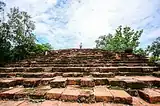 | The laterite stairs leading up to the temple base of the Wat Khlong Suwankhiri |
References
- ↑ Higham, C., 2014, Early Mainland Southeast Asia, Bangkok: River Books Co., Ltd., ISBN 9786167339443
- ↑ Karen M. Mudar (1999). "How Many Dvaravati Kingdoms? Locational Analysis of First Millennium A.D. Moated Settlements in Central Thailand" (PDF). Journal of Anthropological Archaeology. 18 (1): 1–28. Bibcode:1999JAnAr..18....1M. doi:10.1006/jaar.1998.0329.
- 1 2 3 Lavy, Paul A.; Clarke, Wesley (2015). "Integrating the Phong Tuek Viṣṇu: The Archaeology and Art History of a Forgotten Image". Journal of the Siam Society. 103.
- 1 2 Woodward, Hiram (2010). "Dvaravati, Si Thep, and Wendan". Bulletin of the Indo-Pacific Prehistory Association. 30: 87–97. Archived from the original on 15 October 2022.
- ↑ ประกาศกรมศิลปากร เรื่อง ขึ้นทะเบียนโบราณสถาน (PDF). Royal Gazette (in Thai). 79 (97 ง): 2279. 1962-10-30. Archived from the original (PDF) on June 1, 2012.
Further reading
- Saraya, Dhida (1999). (Sri) Dvaravati. Muang Boran Publishing House. ISBN 978-974-7381-34-4.
- "Kaleidoscopic Cross-sections - Western Mountain Ranges, Valleys, and Plains" (PDF). Thailand: Traits and Treasures: 413–414. Archived from the original (PDF) on 2011-07-20. Retrieved 2007-12-20.
- ธิติพงศ์ มีทอง (2019). "การศึกษาโบราณสถานเมืองโบราณคูบัวของจังหวัดราชบุรี" [The Study of Archaeological Sites in Kubua Town in Ratchaburi Province] (PDF) (in Thai). Nakhon Pathom Rajabhat University. Archived from the original (PDF) on 25 April 2024. Retrieved 26 April 2024.
External links

Dvaravati historical sites in Thailand | |||||||||
|---|---|---|---|---|---|---|---|---|---|
| |||||||||
| Supra-regional center |
| ||||||||
| Regional center |
| ||||||||
| Local settlement |
| ||||||||
| Architecture |
| ||||||||
