Close back unrounded vowel
| Close back unrounded vowel | |||
|---|---|---|---|
| ɯ | |||
| IPA number | 316 | ||
| Audio sample | |||
|
source · help | |||
| Encoding | |||
| Entity (decimal) | ɯ | ||
| Unicode (hex) | U+026F | ||
| X-SAMPA | M | ||
| Braille |   | ||
| |||


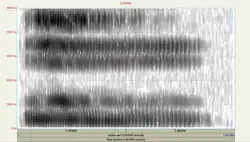
The close back unrounded vowel, or high back unrounded vowel,[1] is a type of vowel sound used in some spoken languages. The symbol in the International Phonetic Alphabet that represents this sound is ⟨ɯ⟩. Typographically, it is a turned letter ⟨m⟩.
The close back unrounded vowel can in many cases be considered the vocalic equivalent of the voiced velar approximant [ɰ].
Features
- Its vowel height is close, also known as high, which means the tongue is positioned close to the roof of the mouth without creating a constriction that would be classified as a consonant.
- Its vowel backness is back, which means the tongue is positioned back in the mouth without creating a constriction that would be classified as a consonant. Unrounded back vowels tend to be centralized, which means that often they are in fact near-back.
- Its place of articulation is velar, which means it is articulated with the back of the tongue (the dorsum) at the soft palate.
- It is unrounded, which means that the lips are not rounded.
Occurrence
| Language | Word | IPA | Meaning | Notes | |
|---|---|---|---|---|---|
| Acehnese[2] | eu | [ɯ] | 'see' | Also described as closer to [ɨ].[3][4] | |
| Arara[5] | îput | [ɯput̚] | 'my skin' | Frequent realisation of /ɨ/.[5] | |
| Arbëresh | Arbëreshë | [ɑɾbɯɾeʃ] | 'Arbëreshë' | /ə/ in standard Albanian. | |
| Azerbaijani | bahalı / باهالیٛ | [bɑhɑˈɫɯ] | 'expensive' | Closer to an [ɘ].[6] | |
| Bashkir | ҡыҙ / قىُث / qıđ | [qɯð] | 'girl' | ||
| Chinese | Mandarin | 刺 / cì | [t͡sʰɯ˥˩] | 'thorn' | |
| Wuhan dialect, Southwestern Mandarin | 去 / keu | [kʰɯ] | 'to go' | ||
| Some Wu dialects | 父 / vu | [vɯ] | 'father' | ||
| Xiang | 火 / xu | [xɯ] | 'fire' | ||
| Chuvash | ыхра / ıxra | [ɯɣra] | 'garlic' | ||
| Crimean Tatar | джаным / canım | [dʒanɯm] | 'my dear' | ||
| English | Some California speakers[7] | goose | [ɡɯˑs] | 'goose' | Corresponds to [uː] in other dialects. |
| New Zealand[8][9] | treacle | [ˈtɹ̝̊iːkɯ] | 'treacle' | Possible realization of the unstressed vowel /ɯ/, which is variable in rounding and ranges from central to (more often) back and close to close-mid.[8][9] Corresponds to /əl/ in other accents. Develops from dark L; See New Zealand English phonology | |
| Some Philadelphia speakers[10] | plus | [pɫ̥ɯs] | 'plus' | Used by some speakers; the exact height and backness is variable.[10] It corresponds to [ʌ] in other accents. See English phonology | |
| South African[11] | pill | [pʰɯ̞ɫ] | 'pill' | Near-close; possible allophone of /ɪ/ before the velarised allophone of /l/.[11] See South African English phonology | |
| Eastern Khanty | Vakh-Vasyugan[12] | пӛӈк | [pɯŋk] | 'hazel grouse' | See Eastern Khanty phonology |
| Estonian[13] | kõrv | [kɯrv] | 'ear' | Typically transcribed in IPA with ⟨ɤ⟩; can be close-mid central [ɘ] or close-mid back [ɤ] instead, depending on the speaker.[13] See Estonian phonology | |
| Irish | Ulster | caol | [kʰɯːl̪ˠ] | 'narrow' | See Irish phonology |
| Japanese[14] | 空気 / kūki | ⓘ | 'air' | May be compressed [ɯᵝ].[15] See Japanese phonology | |
| Katukina[16] | [babɯˈdʒɯ] | 'oscar (fish)' | |||
| Kazakh | қыс / qys / قىس | [qɯs] | 'winter' | May be pronounced as qəs | |
| Korean[17] | 음식 飮食 / eumsik | [ɯːmɕ͈ik̚] | 'food' | See Korean phonology | |
| Kurdish | Kurmanji (Northern) | tirş | [tˤɯɾʃ] | 'sour' | See Kurdish phonology. The "i" after "t" always uses this sound if the "t" is "tˤ". However, it can also appear at other places. |
| Sorani (Central) | ترش / tirş | ||||
| Kyrgyz | кыз / قىز / qyz | [qɯz] | 'girl' | See Kyrgyz phonology | |
| Livonian | Courland (Eastern) | kȭr | [kɯːr] | 'wheel' | |
| Minangkabau | Some speakers | mandudu | [mändɯdɯ] | 'to push ahead' | Normally [u] in standard Minangkabau language. |
| Panará[18] | [tɯˈsəʰ] | 'to breathe' | |||
| Romanian | Some speakers | când | [kɯnd] | 'when' | Typically described as ⟨ɨ⟩. See Romanian phonology |
| Scottish Gaelic | caol | [kʰɯːl̪ˠ] | 'thin' | See Scottish Gaelic phonology | |
| Sop | düm | [dɯm] | 'tree' | See Sop language | |
| Tamil | அழகு / aḻagu | [əɻəgɯ] | 'beauty' | Normally [u] elsewhere. | |
| Thai | Standard[19] | ขึ้น / khuen/khîn | [kʰɯn˥˩] | 'to go up' | |
| Turkish[20] | sığ | ⓘ | 'shallow' | Described variously as close back [ɯ],[20] near-close near-back [ɯ̽][21] and close central [ɨ].[22] See Turkish phonology | |
| Turkmen | ýaşyl / یاشیٛل | [jɑːˈʃɯl] | 'green' | ||
| Uyghur | تىلىم / tılım/tilim | [tɯlɯm] | 'my language' | In complementary distribution with /ɪ/. See Uyghur phonology | |
| Vietnamese | tư | [tɯ] | 'fourth' | See Vietnamese phonology | |
Near-close near-back unrounded vowel
| Near-close near-back unrounded vowel | |
|---|---|
| ɯ̽ | |
| Audio sample | |
|
source · help |
| Near-close back unrounded vowel | |
|---|---|
| ɯ̞ | |
| ɤ̝ |
Some languages have a near-close near-back unrounded vowel, or near-high near-back unrounded vowel, which is more centralized than a typical [ɯ].
The International Phonetic Alphabet has no dedicated symbol for this sound, but it may be represented as [ɯ̽] (mid-centralized ⟨ɯ⟩) or [ɯ̞̈] (lowered and centralized ⟨ɯ⟩). It may also be transcribed as [ʊ̜] (less rounded ⟨ʊ⟩), but because ⟨ʊ⟩ is defined by the Handbook of the International Phonetic Association as rounded (whereas ⟨ə⟩ and ⟨ɐ⟩ do not specify rounding),[23] the symbol [ʊ̜] can also signify a weakly rounded [ʊ], rather than the fully unrounded vowel that is described in this article. John C. Wells transcribes this vowel with the para-IPA symbol ⟨ω⟩ in his Accents of English,[24] though Sinological phonetic notation uses this symbol instead for a near-open back rounded vowel [ɒ̝]. John Esling uses ⟨ᵻ⟩ to represent this sound in his iPA Phonetics mobile application,[25] though this is more typically used to represent a near-close central unrounded vowel [ɪ̈].
For precision, a near-close back unrounded vowel, or near-high back unrounded vowel, may also be described, and is attested in a few spoken languages. This sound can be represented in the IPA as [ɯ̞] (lowered ⟨ɯ⟩) or [ɤ̝] (raised ⟨ɤ⟩). However, some phoneticians argue that all lip position inverses of the primary cardinal vowels are centralized (with the exception of ⟨ɒ⟩) based on formant acoustics,[26] so that there may be no substantial difference between a near-close near-back unrounded vowel [ɯ̽] and its fully back counterpart [ɯ̞].
Features
- Its vowel height is near-close, also known as near-high, which means the tongue is not quite so constricted as a close vowel (high vowel).
- Its vowel backness is back, which means the tongue is positioned back in the mouth without creating a constriction that would be classified as a consonant. Unrounded back vowels tend to be centralized, which means that often they are in fact near-back.
- Its place of articulation is velar, which means it is articulated with the back of the tongue (the dorsum) at the soft palate.
- It is unrounded, which means that the lips are not rounded.
Occurrence
| Language | Word | IPA | Meaning | Notes | |
|---|---|---|---|---|---|
| English | African-American[27] | hook | [hɯ̽k] | 'hook' | Possible realization of /ʊ/.[27] |
| California[7] | Often pronounced with spread lips. Corresponds to /ʊ/ in other accents.[7] See English phonology | ||||
| Tidewater[28] | May be rounded [ʊ] instead.[28] | ||||
| Cardiff[29] | [ɯ̽k] | Also described as close-mid central [ɘ ~ ɵ].[30] | |||
| New Zealand[8][9] | treacle | ⓘ | 'treacle' | Possible realization of the unstressed vowel /ɯ/, which is variable in rounding and ranges from central to (more often) back and close to close-mid.[8][9] It corresponds to /əl/ in other accents. See New Zealand English phonology | |
| Some Philadelphia speakers[10] | plus | [pɫ̥ɯ̞s] | 'plus' | Used particularly by male speakers; can be lower [ʌ̝ ~ ʌ] instead.[10] It corresponds to [ʌ] in other accents. See English phonology | |
| South African[11] | pill | [pʰɯ̽ɫ] | 'pill' | Possible allophone of /ɪ/ before the velarised allophone of /l/.[11] Also described as close-mid [ɤ].[31] See South African English phonology | |
| Irish | Ulster[32] | ag gail | [ə ˈɡɯ̽lˠ] | 'boiling' | Allophone of /ɪ/.[32] See Irish phonology |
| Korean[33] | 어른/eoreun | [ə̝ːɾɯ̞n] | 'seniors' | Typically transcribed in IPA with ⟨ɯ⟩. See Korean phonology | |
| Portuguese | European[34] | pegar | ⓘ | 'to grab' | Typically transcribed in IPA with ⟨ɨ⟩ or ⟨ə⟩. Appears only in unstressed syllables.[34] See Portuguese phonology |
| Scottish Gaelic | Lewis[35] | gaol | [kɯ̽ːl̪ˠ] | 'love' | Allophone of /ɯ/ when adjacent to velarized sonorants. |
| Turkish | Standard[36] | sığ | [sɯ̽ː] | 'shallow' | Also described as close back [ɯ] and close central [ɨ].[37] See Turkish phonology |
| Vietnamese | Hanoi[38] | từ | ⓘ | 'word' | Common allophone of /ɯ/.[38] See Vietnamese phonology |
| Yine[39] | [tɯ̽wɯ̽] | 'salt' | Typically transcribed in IPA with ⟨ɯ⟩.[39] | ||
See also
Notes
- ↑ While the International Phonetic Association prefers the terms "close" and "open" for vowel height, many linguists use "high" and "low".
- ↑ Durie, Mark (1990). "Proto-Chamic and Acehnese Mid Vowels: Towards Proto-Aceh-Chamic" (PDF). Bulletin of the School of Oriental and African Studies, University of London. LII, Part 1: 100–111. doi:10.1017/S0041977X00021297. S2CID 162224060. Archived from the original (PDF) on 14 July 2010.
- ↑ Asyik, Abdul Gani. "The Agreement System in Acehnese" (PDF). Mon-Khmer Studies. XI: 1–33. Archived from the original (PDF) on 30 July 2009. Retrieved 21 May 2012.
- ↑ Al-Harbi, Awwad Ahmad Al-Ahmadi (January 2003). "Acehnese Coda Condition: An Optimality-Theoretic Account" (PDF). Umm Al-Qura University Journal of Educational and Social Sciences and Humanities. 15 (1): 9–28.
- 1 2 Alves (2013), p. 269.
- ↑ Ghaffarvand-Mokari & Werner 2016, p. 514.
- 1 2 3 Ladefoged (1999), pp. 42–43.
- 1 2 3 4 Warren, Paul. NZE Phonology (PDF) (Report). Victoria University of Wellington. p. 3. Archived from the original (PDF) on 24 January 2024.
- 1 2 3 4 Bauer & Warren (2004), p. 585.
- 1 2 3 4 Gordon (2004), p. 290.
- 1 2 3 4 Bowerman (2004), p. 936.
- ↑ V.N. Solovar; G.L. Nakhracheva; A.A. Shiyanova (2016), Диалекты хантыйского языка., Khanty-Mansiysk
{{citation}}: CS1 maint: location missing publisher (link) - 1 2 Asu & Teras (2009), p. 369.
- ↑ Labrune (2012), p. 25.
- ↑ Okada (1999), p. 118.
- ↑ dos Anjos (2012), p. 129.
- ↑ Lee (1999), p. 122.
- ↑ Vasconcelos (2013), p. 182.
- ↑ Tingsabadh & Abramson (1993), p. 24.
- 1 2 Göksel & Kerslake (2005:10)
- ↑ Kılıç & Öğüt (2004)
- ↑ Zimmer & Orgun (1999:155)
- ↑ International Phonetic Association (1999), p. 180.
- ↑ Wells (1982:xvii)
- ↑ Esling, John H.; Moisik, Scott R.; Coey, Christopher (2015). iPA Phonetics: Multimodal iOS application for phonetics instruction and practice (PDF). 18th International Congress of Phonetic Sciences (ICPhS XVIII). ISSN 2412-0669.
- ↑ Geoff Lindsey (2013) The vowel space, Speech Talk
- 1 2 Wells (1982), p. 557.
- 1 2 Wells (1982), p. 536.
- ↑ Wells (1982), p. 386.
- ↑ Collins & Mees (1990), pp. 92, 94.
- ↑ Wells (1982), p. 617.
- 1 2 Ní Chasaide (1999), p. 114.
- ↑ Lee (1999), p. 121.
- 1 2 Cruz-Ferreira (1995), p. 91.
- ↑ Oftedal (1956), p. 81.
- ↑ Kılıç & Öğüt (2004)
- ↑ Zimmer & Orgun (1999), p. 155.
- 1 2 Kirby (2011), p. 384.
- 1 2 Urquía Sebastián & Marlett (2008), p. 366.
References
- Alves, Ana Carolina Ferreira (2013). "Aspectos do sistema fonológico de Arara (Karib)" (PDF). Boletim do Museu Paraense Emílio Goeldi. Ciências Humanas. 8 (2): 265–277. doi:10.1590/S1981-81222013000200003.
- Asu, Eva Liina; Teras, Pire (2009). "Estonian". Journal of the International Phonetic Association. 39 (3): 367–372. doi:10.1017/s002510030999017x.
- Bauer, Laurie; Warren, Paul (2004), "New Zealand English: phonology", in Schneider, Edgar W.; Burridge, Kate; Kortmann, Bernd; Mesthrie, Rajend; Upton, Clive (eds.), A handbook of varieties of English, vol. 1: Phonology, Mouton de Gruyter, pp. 580–602, ISBN 3-11-017532-0
- Bowerman, Sean (2004), "White South African English: phonology", in Schneider, Edgar W.; Burridge, Kate; Kortmann, Bernd; Mesthrie, Rajend; Upton, Clive (eds.), A handbook of varieties of English, vol. 1: Phonology, Mouton de Gruyter, pp. 931–942, ISBN 3-11-017532-0
- Collins, Beverley; Mees, Inger M. (1990), "The Phonetics of Cardiff English", in Coupland, Nikolas; Thomas, Alan Richard (eds.), English in Wales: Diversity, Conflict, and Change, Multilingual Matters Ltd., pp. 87–103, ISBN 1-85359-032-0
- Cruz-Ferreira, Madalena (1995), "European Portuguese", Journal of the International Phonetic Association, 25 (2): 90–94, doi:10.1017/S0025100300005223, S2CID 249414876
- dos Anjos, Zoraide (2012). "Fonologia Katukina-Kanamari". LIAMES: Línguas Indígenas Americanas. 12 (1): 123–156. doi:10.20396/liames.v0i12.1486.
- Ghaffarvand-Mokari, Payam; Werner, Stefan (2016), "An acoustic description of spectral and temporal characteristics of Azerbaijani vowels", Poznań Studies in Contemporary Linguistics, 52 (3), doi:10.1515/psicl-2016-0019, S2CID 151826061
- Göksel, Asli; Kerslake, Celia (2005), Turkish: a comprehensive grammar (PDF), Routledge, ISBN 978-0415114943, archived from the original (PDF) on 26 November 2014
- Gordon, Matthew J. (2004), "New York, Philadelphia, and other northern cities: phonology", in Schneider, Edgar W.; Burridge, Kate; Kortmann, Bernd; Mesthrie, Rajend; Upton, Clive (eds.), A handbook of varieties of English, vol. 1: Phonology, Mouton de Gruyter, pp. 282–299, ISBN 3-11-017532-0
- International Phonetic Association (1999), Handbook of the International Phonetic Association: A guide to the use of the International Phonetic Alphabet, Cambridge: Cambridge University Press, ISBN 0-521-65236-7
- Kılıç, Mehmet Akif; Öğüt, Fatih (June 2004). "A high unrounded vowel in Turkish: is it a central or back vowel?". Speech Communication. 43 (1–2): 143–154. doi:10.1016/j.specom.2004.03.001.
- Kirby, James P. (2011), "Vietnamese (Hanoi Vietnamese)" (PDF), Journal of the International Phonetic Association, 41 (3): 381–392, doi:10.1017/S0025100311000181
- Labrune, Laurence (2012), The Phonology of Japanese, Oxford, England: Oxford University Press, ISBN 978-0-19-954583-4
- Ladefoged, Peter (1999), "American English", Handbook of the International Phonetic Association, Cambridge University Press, pp. 41–44
- Lee, Hyun Bok (1999), "Korean", Handbook of the International Phonetic Association: A Guide to the Use of the International Phonetic Alphabet, Cambridge University Press, pp. 120–123, ISBN 0-521-63751-1
- Ní Chasaide, Ailbhe (1999), "Irish", Handbook of the International Phonetic Association, Cambridge University Press, pp. 111–16, ISBN 0-521-63751-1
- Okada, Hideo (1999), "Japanese", in International Phonetic Association (ed.), Handbook of the International Phonetic Association: A Guide to the Use of the International Phonetic Alphabet, Cambridge University Press, pp. 117–119, ISBN 978-0-52163751-0
- Oftedal, Magne (1956), A linguistic survey of the Gaelic dialects of Scotland, Vol. III: The Gaelic of Leurbost, Isle of Lewis, Oslo: Norsk Tidsskrift for Sprogvidenskap
- Tingsabadh, M.R. Kalaya; Abramson, Arthur S. (1993). "Thai". Journal of the International Phonetic Association. 23 (1): 24–26. doi:10.1017/S0025100300004746. S2CID 242001518.
- Urquía Sebastián, Rittma; Marlett, Stephen A. (2008), "Yine", Journal of the International Phonetic Association, 38 (3): 365–369, doi:10.1017/S0025100308003356
- Vasconcelos, Eduardo A. (2013). Investigando a hipótese Cayapó do Sul-Panará (PhD). Campinas: University of Campinas. doi:10.47749/T/UNICAMP.2013.929939. hdl:20.500.12733/1622968.
- Wells, John C. (1982). Accents of English. Vol. 2: The British Isles (pp. i–xx, 279–466), Vol. 3: Beyond the British Isles (pp. i–xx, 467–674). Cambridge University Press. doi:10.1017/CBO9780511611759, doi:10.1017/CBO9780511611766. ISBN 0-52128540-2, 0-52128541-0.
- Zimmer, Karl; Orgun, Orhan (1999), "Turkish" (PDF), Handbook of the International Phonetic Association: A guide to the use of the International Phonetic Alphabet, Cambridge: Cambridge University Press, pp. 154–158, ISBN 0-521-65236-7, archived from the original (PDF) on 25 July 2018, retrieved 20 November 2015
External links
- List of languages with [ɯ] on PHOIBLE
- List of languages with [ɯ̞] on PHOIBLE
- List of languages with [ɤ̝] on PHOIBLE
- List of languages with [ɯ̽] on PHOIBLE
- List of languages with [ʊ̜] on PHOIBLE