Bibliography of John Tyler
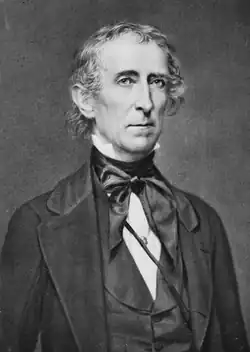
 Portrait, 1842 | |
| 10th President of the United States | |
| In office April 4, 1841 – March 4, 1845 | |
| Vice President | Vacant[a] |
| Preceded by | William Henry Harrison |
| Succeeded by | James K. Polk |
| 10th Vice President of the United States | |
| In office March 4, 1841 – April 4, 1841 | |
| President | William Henry Harrison |
| Preceded by | Richard Mentor Johnson |
| Succeeded by | George M. Dallas |
| United States Senator from Virginia | |
| In office March 4, 1827 – February 29, 1836 | |
| Preceded by | John Randolph |
| Succeeded by | William Cabell Rives |
| President pro tempore of the United States Senate | |
| In office March 3, 1835 – December 6, 1835 | |
| Preceded by | George Poindexter |
| Succeeded by | William R. King |
| 23rd Governor of Virginia | |
| In office December 10, 1825 – March 4, 1827 | |
| Preceded by | James Pleasants |
| Succeeded by | William Branch Giles |
| Member of the U.S. House of Representatives from Virginia's 23rd district | |
| In office December 17, 1816 – March 3, 1821 | |
| Preceded by | John Clopton |
| Succeeded by | Andrew Stevenson |
| Delegate from Virginia to the Provisional Congress of the Confederate States | |
| In office February 4, 1861 – January 17, 1862 | |
| Preceded by | Constituency established |
| Succeeded by | Constituency abolished |
| Personal details | |
| Born | March 29, 1790 Greenway Plantation, Charles City County, Virginia, U.S. |
| Died | January 18, 1862 (aged 71) Ballard House, Richmond, Virginia |
| Resting place | Hollywood Cemetery, Richmond, Virginia, U.S. |
| Party | Whig (1834–1841) |
Other political affiliations |
|
| Spouses | |
| Children | 15, including Robert, John Jr., Letitia, David, John Alexander and Lyon |
| Parents |
|
| Education | College of William & Mary |
| Profession |
|
| Signature |  |
| Military service | |
| Allegiance | United States |
| Branch/service | Virginia militia |
Years of service | 1813 |
| Rank | Captain |
| Unit | Charles City Rifles |
| Battles/wars | War of 1812 |
This is a bibliography of works about John Tyler, a governor of Virginia, and the tenth president of the United States.
John Tyler (March 29, 1790 – January 18, 1862) was the tenth president of the United States, serving from 1841 to 1845, after briefly holding office as the tenth vice president in 1841. He was elected vice president on the 1840 Whig ticket with William Henry Harrison and succeeded to the presidency following Harrison's death 31 days after taking office. Tyler was a staunch supporter of states' rights, including with regard to slavery, and adopted nationalist policies as president only when they did not infringe on state powers. His unexpected rise to the presidency threatened the presidential ambitions of Senator Henry Clay and other Whig politicians and left Tyler estranged from both major political parties of the time: the Whigs and the Democrats.
Tyler was a regional Whig vice-presidential nominee in the 1836 presidential election, which was won by Democrat Martin Van Buren. Four years later he was the party's sole nominee for vice president. Campaigning under the slogan "Tippecanoe and Tyler Too", the Harrison–Tyler ticket defeated Van Buren.
When the American Civil War began in 1861, Tyler sided with the Confederacy. He presided over the opening of the Virginia Secession Convention and served as a member of the Provisional Congress of the Confederate States. Tyler was subsequently elected to the Confederate House of Representatives but died before it convened.
Inclusion criteria
Works included are referenced in the notes or bibliographies of scholarly secondary sources or journals. Included works should either be published by an academic or widely distributed publisher, be authored by a notable subject matter expert as shown by scholarly reviews or have significant scholarly journal reviews about the work. Only items that clearly meet the criteria should be included.
Citation style
This bibliography uses APA style citations. Entries do not use templates. References to reviews and notes for entries do use citation templates. Where books which are only partially related to John Tyler are listed, the titles for chapters or sections should be indicated if possible, meaningful, and not excessive.
If a work has been translated into English, the translator should be included and a footnote with appropriate bibliographic information for the original language version should be included if possible.
When listing works with titles or names published with alternative English spellings, the form used in the latest published version should be used and the version and relevant bibliographic information noted if it previously was published or reviewed under a different title.
General works about Tyler
- Chitwood, O. P. (1939). John Tyler, champion of the Old South. D. Appleton-Century Company.[1][2][3]
- Crapol, E. P. (2006). John Tyler, the accidental president. University of North Carolina Press.[4][5]
- Leahy, C. J. (2020). President without a party: The life of John Tyler. Louisiana State University Press.[6]
- May, G. (2008). John Tyler. Times Books.
- Monroe, R. D. (2003). The republican vision of John Tyler. Texas A&M University Press.[7][8]
- Morgan, R. J. (1954). A Whig embattled: The presidency under John Tyler. University of Nebraska Press.[9][10][11]
- Peterson, N. L. (1989). The presidencies of William Henry Harrison and John Tyler. University Press of Kansas.[12][13][14]
- Seager, R., II. (1963). And Tyler too: A biography of John and Julia Gardiner Tyler. McGraw-Hill.[15][16][17]
Journal articles
- Callahan, D. P. (2021). The constitutional crisis that wasn't: The politics of John Tyler's presidential succession. The Virginia Magazine of History and Biography, 129(2), 122–155. JSTOR 27014474
- Cash, J. T. (2018). The isolated presidency: John Tyler and unilateral presidential power. American Political Thought, 7(1), 26–56. doi:10.1086/695644
- Crapol, E. P. (1997). John Tyler and the pursuit of national destiny. Journal of the Early Republic, 17(3), 467–491. JSTOR 3123944
- Dinnerstein, L. (1962). The accession of John Tyler to the presidency. The Virginia Magazine of History and Biography, 70(4), 447–458. JSTOR 4246893
- Gotlieb, H., & Grimes, G. (1959). President Tyler and the Gardiners: A new portrait. The Yale University Library Gazette, 34(1), 3–12. JSTOR 40859411
- Leahy, C. J. (2006). Torn between family and politics: John Tyler's struggle for balance. The Virginia Magazine of History and Biography, 114(3), 322–355.
- Leahy, C. J. (2012). Playing her greatest role: Priscilla Cooper Tyler and the politics of the White House social scene, 1841–44. The Virginia Magazine of History and Biography, 120(3), 236–269. JSTOR 41636706
- Maness, L. E., & Chesteen, R. D. (1980). The first attempt at presidential impeachment: Partisan politics and intra-party conflict at loose. Presidential Studies Quarterly, 10(1), 51–62. JSTOR 27547533
- Pugh, E. L. (1980). Women and slavery: Julia Gardiner Tyler and the Duchess of Sutherland. The Virginia Magazine of History and Biography, 88(2), 186–202. JSTOR 4248387
- Rathbun, L. (2001). The debate over annexing Texas and the emergence of Manifest Destiny. Rhetoric & Public Affairs, 4(3), 459–493. JSTOR 41940591
- Tyler, L. G. (1916). President John Tyler and the Ashburton Treaty. The William and Mary College Quarterly Historical Magazine, 25(1), 1–8. JSTOR 1915096
Background and context
The below items contain significant information about John Tyler or significant background and context for his life and presidency.
- Feller, D. (1995). The Jacksonian promise: America, 1815–1840. Johns Hopkins University Press.[18]
- Holt, M. F. (1999). The rise and fall of the American Whig Party: Jacksonian politics and the onset of the Civil War. Oxford University Press.[19]
- Howe, D. W. (2007). What hath God wrought: The transformation of America, 1815–1848. Oxford University Press.[20]
- McCormick, R. P. (1966). The second American party system: Party formation in the Jacksonian era. University of North Carolina Press.[21]
- Pessen, E. (1969). Jacksonian America: Society, personality, and politics. Dorsey Press.[22]
- Remini, R. V. (1988). The Jacksonian era. Harlan Davidson.[23]
- Schlesinger, A. M., Jr. (1945). The age of Jackson. Little, Brown and Company.[24]
- Sellers, C. (1991). The market revolution: Jacksonian America, 1815–1846. Oxford University Press.[25]
- Van Deusen, G. G. (1959). The Jacksonian era, 1828–1848. Harper.[26]
- Wilentz, S. (2005). The rise of American democracy: Jefferson to Lincoln. W. W. Norton & Company.[27]
William Henry Harrison
- Booraem, H., V. (2012). A child of the revolution: William Henry Harrison and his world, 1773–1798. Kent State University Press.[28]
- Burr, S. J. (1840). The life and times of William Henry Harrison. L. W. Ransom.
- Cleaves, F. (1939). Old Tippecanoe: William Henry Harrison and his time. Charles Scribner's Sons.[29]
- Collins, G. (2012). William Henry Harrison. Times Books.
- Ellis, R. J. (2020). Old Tip vs. the Sly Fox: The 1840 election and the making of a partisan nation. University Press of Kansas.[30]
- Gunderson, R. G. (1957). The log-cabin campaign. University of Kentucky Press.[31]
- Hurt, R. D. (1998). The Ohio frontier: Crucible of the Old Northwest, 1720–1830. Indiana University Press.[32][33]
- Jortner, A. (2012). The gods of Prophetstown: The Battle of Tippecanoe and the holy war for the American frontier. Oxford University Press.[34]
- Owens, R. M. (2007). Mr. Jefferson's hammer: William Henry Harrison and the origins of American Indian policy. University of Oklahoma Press.[35]
- Skaggs, D. C. (2014). William Henry Harrison and the conquest of the Ohio Country: Frontier fighting in the War of 1812. Johns Hopkins University Press.[36]
Primary sources
Collected papers and speeches
- The John Tyler Papers (digitized collection) at the Library of Congress[b]
- Tyler Family Papers, Group A, 1716–1944 at the Special Collections Research Center, William & Mary[c]
- The American Presidency Project – John Tyler (online collection) at the University of California, Santa Barbara
- Richardson, J. D. (Ed.). (1908). A compilation of the messages and papers of the presidents, 1789–1907 (Vol. 4). Bureau of National Literature and Art.[d]
- Tyler, L. G. (1884–1896). The letters and times of the Tylers (Vols. 1–3).[e]
Individual papers and speeches
- April 9, 1841: Address Upon Assuming the Office of President of the United States.
- June 1, 1841: Special Session Message.
- August 16, 1841: Veto Message (bill to incorporate the subscribers to the Fiscal Bank of the United States).
- September 9, 1841: Veto Message (bill to establish the Fiscal Corporation of the United States).
- December 7, 1841: First Annual Message.
- August 9, 1842: Veto Message (bill to provide revenue from imports and to change the tariff laws).
- August 11, 1842: Message to Senate on Negotiations with Britain (transmitting the Webster–Ashburton Treaty).
- August 30, 1842: Message to the House of Representatives (Tyler's protest against the report of the House select committee appointed to consider his veto of the tariff bill).
- December 6, 1842: Second Annual Message.
- December 30, 1842: Message to Congress Regarding US-Hawaiian Relations.
- December 5, 1843: Third Annual Message.
- April 22, 1844: Message to the Senate Transmitting a Treaty of Annexation Concluded Between the United States of America and the Republic of Texas.
- June 10, 1844: Message to the House of Representatives Transmitting the Rejected Treaty for the Annexation of the Republic of Texas to the United States.
- December 3, 1844: Fourth Annual Message.
Contemporary accounts
- Wise, H. A. (1872). Seven decades of the Union: The humanities and materialism, illustrated by a memoir of John Tyler, with reminiscences of some of his great cotemporaries. J. B. Lippincott.[f]
See also
References
Notes
- ↑ Tyler was vice president under President William Henry Harrison and became president upon Harrison's death on April 4, 1841. This was before the adoption of the Twenty-fifth Amendment in 1967, and a vacancy in the office of vice president was not filled until the next ensuing election and inauguration.
- ↑ More than 1,400 items dating from 1691 to 1918, chiefly correspondence to and from Tyler, together with papers of Julia Gardiner Tyler and the Gardiner family. Much of Tyler's correspondence was lost during the American Civil War; the surviving material was recovered by his son Lyon Gardiner Tyler and sold to the Library of Congress in 1919.
- ↑ Eleven linear feet (22 boxes), including Tyler's correspondence from 1818 to 1862 and the papers of Letitia Christian Tyler, Julia Gardiner Tyler and their children.
- ↑ Tyler's messages, veto messages and proclamations for April 4, 1841 – March 4, 1845 make up the second part of volume 4; that portion is separately available as a Project Gutenberg e-text.
- ↑ Volumes 1 and 2 were published by Whittet & Shepperson at Richmond, Virginia, in 1884; volume 3, issued as a supplement, appeared at Williamsburg, Virginia, in 1896. Compiled by Tyler's son from family papers, the work prints the texts of many letters that no longer survive in manuscript.
- ↑ Henry A. Wise represented Virginia in the House of Representatives during Tyler's presidency and led the small band of Tyler loyalists there known as the "Corporal's Guard". Tyler appointed him minister to Brazil in February 1844, a post he held until 1847.
Citations
- ↑ Sioussat, St. George L. (1940). "John Tyler, Champion of the Old South". The American Historical Review. 46 (1): 171. JSTOR 1839851.
- ↑ Abernethy, Thomas Perkins (1940). "John Tyler, Champion of the Old South". The Mississippi Valley Historical Review. 26 (4): 577. JSTOR 1896341.
- ↑ Sydnor, Charles S. (1940). "John Tyler: Champion of the Old South". The Journal of Southern History. 6 (2): 266. JSTOR 2191215.
- ↑ Belohlavek, John M. (2007). "John Tyler: The Accidental President". The Journal of American History. 93 (4): 1235. JSTOR 25094650.
- ↑ Smith, David A. (2008). "John Tyler: The Accidental President". The Historian. 70 (1): 101–102. doi:10.1111/j.1540-6563.2008.00205_8.x.
- ↑ Smith, Miles (2021). "President without a Party: The Life of John Tyler". Presidential Studies Quarterly. 51 (2): 453–454. doi:10.1111/psq.12718.
- ↑ Morrison, Michael A. (2004). "The Republican Vision of John Tyler". The American Historical Review. 109 (3): 904. doi:10.1086/ahr/109.3.904.
- ↑ Leahy, Christopher J. (2004). "The Republican Vision of John Tyler". The Journal of Southern History. 70 (3): 672. JSTOR 27648505.
- ↑ Hamilton, Holman (1955). "A Whig Embattled: The Presidency Under John Tyler". The American Historical Review. 60 (3): 623. JSTOR 1845617.
- ↑ Rayback, Joseph G. (1955). "A Whig Embattled: The Presidency under John Tyler". The Mississippi Valley Historical Review. 41 (4): 709. JSTOR 1889202.
- ↑ Watson, Richard L. (1955). "A Whig Embattled: The Presidency under John Tyler". The Journal of Southern History. 21 (2): 260. JSTOR 2955136.
- ↑ Klunder, Willard Carl (1990). "The Presidencies of William Henry Harrison and John Tyler". The American Historical Review. 95 (5): 1629. JSTOR 2162890.
- ↑ Kohl, Lawrence Frederick (1990). "The Presidencies of William Henry Harrison and John Tyler". The Journal of American History. 77 (2): 671. JSTOR 2079247.
- ↑ Johannsen, Robert W. (1990). "The Presidencies of William Henry Harrison and John Tyler". Journal of the Early Republic. 10 (1): 111. JSTOR 3123302.
- ↑ Hamilton, Holman (1964). "And Tyler Too: A Biography of John and Julia Gardiner Tyler". The Journal of Southern History. 30 (1): 113. JSTOR 2205388.
- ↑ Gunderson, Robert G. (1964). "And Tyler Too: A Biography of John and Julia Gardiner Tyler". The Mississippi Valley Historical Review. 50 (4): 700. JSTOR 1916672.
- ↑ Silver, James W. (1965). "And Tyler Too: A Biography of John and Julia Gardiner Tyler". The American Historical Review. 70 (2): 479. JSTOR 1845685.
- ↑ Sharp, James Roger (1997). "The Jacksonian Promise: America, 1815-1840". The American Historical Review. 102 (3): 888. JSTOR 2171651.
- ↑ Kohl, Lawrence Frederick (2000). "The Rise and Fall of the American Whig Party: Jacksonian Politics and the Onset of the Civil War". The American Historical Review. 105 (5): 1744. JSTOR 2652096.
- ↑ Larson, J. L. (2009). "What Hath God Wrought: The Transformation of America, 1815-1848". Journal of American History. 95 (4): 1125–1126. JSTOR 27694569.
- ↑ Cunningham, Noble E. (1966). "The Second American Party System: Party Formation in the Jacksonian Era". The American Historical Review. 72 (1): 299. JSTOR 1848369.
- ↑ Sellers, Charles (1970). "Jacksonian America: Society, Personality, and Politics". The American Historical Review. 75 (4): 1185. JSTOR 1852386.
- ↑ Rorabaugh, W. J. (1989). "The Jacksonian Era". Journal of the Early Republic. 9 (1): 134. JSTOR 3123543.
- ↑ Nye, Russel B. (1946). "The Age of Jackson". The American Historical Review. 51 (3): 510. JSTOR 1840130.
- ↑ Maizlish, Stephen E. (1993). "The Market Revolution: Jacksonian America, 1815-1846". The American Historical Review. 98 (1): 242. JSTOR 2166534.
- ↑ McCormick, Richard P. (1959). "The Jacksonian Era, 1828-1848". The American Historical Review. 64 (4): 967. JSTOR 1905166.
- ↑ Holt, M. F. (2006). "The Rise of American Democracy: Jefferson to Lincoln". Journal of American History. 93 (2): 491–493. JSTOR 4486245.
- ↑ Jeffers, Joshua J. (2014). "A Child of the Revolution: William Henry Harrison and His World, 1773–1798 by Hendrik Booraem V". Ohio History. 121 (1): 130–131. doi:10.1353/ohh.2014.0010.
- ↑ Roseboom, Eugene H. (1940). "Old Tippecanoe: William Henry Harrison and His Time". The Mississippi Valley Historical Review. 27 (2): 295–296. JSTOR 1896834.
- ↑ Egnal, Marc (2021). "Old Tip vs. the Sly Fox: The 1840 Election and the Making of a Partisan Nation". Journal of American History. 108 (2): 373–374. doi:10.1093/jahist/jaab155.
- ↑ Goebel, Dorothy Burne (1958). "The Log-Cabin Campaign". The American Historical Review. 63 (4): 1008–1009. JSTOR 1849007.
- ↑ Pocock, E. (1998). "Review of The Ohio Frontier: Crucible of the Old Northwest, 1720–1830, by R. D. Hurt". Indiana Magazine of History. 94 (1): 57–58. JSTOR 27792070.
- ↑ Winkle, Kenneth J. (1997). "Review of The Ohio Frontier: Crucible of the Old Northwest, 1720–1830, by R. D. Hurt". The Western Historical Quarterly. 28 (2): 232–233. doi:10.2307/970900.
- ↑ Nichols, David (2012). "The Gods of Prophetstown: The Battle of Tippecanoe and the Holy War for the American Frontier by Adam Jortner". Michigan Historical Review. 38 (2): 135–137. doi:10.1353/mhr.2012.0017.
- ↑ Ferguson, C. R. (2008). "Mr. Jefferson's Hammer: William Henry Harrison and the Origins of American Indian Policy". Journal of American History. 95 (1): 194–195. JSTOR 25095497.
- ↑ Bowes, John (2015). "William Henry Harrison and the Conquest of the Ohio Country: Frontier Fighting in the War of 1812". Michigan Historical Review. 41 (1): 115–116. doi:10.1353/mhr.2015.0000.
External links
- John Tyler at the Miller Center of Public Affairs, University of Virginia
- John Tyler: A Resource Guide at the Library of Congress
- Vice Presidents of the United States – John Tyler at the United States Senate Historical Office
- "Life Portrait of John Tyler", from C-SPAN's American Presidents: Life Portraits, May 17, 1999


| Secretary of State |
|  |
|---|---|---|
| Secretary of the Treasury |
| |
| Secretary of War |
| |
| Attorney General |
| |
| Postmaster General |
| |
| Secretary of the Navy |
| |
- Bibliographies of presidents of the United States
- Books about politics of the United States
- Bibliographies of people
- Political bibliographies
- Works about presidents of the United States
- John Tyler
- 19th-century presidents of the United States
- 19th-century vice presidents of the United States
- American proslavery activists
- Chancellors of the College of William & Mary
- Deputies and delegates to the Provisional Congress of the Confederate States
- Governors of Virginia
- Family of John Tyler
- Presidents of the United States
- Presidents of the United States who owned slaves
- Vice presidents of the United States
- Vice presidents of the United States who owned slaves
- William Henry Harrison administration cabinet members
- 19th-century members of the Virginia General Assembly
- 19th-century United States senators
- 19th-century United States representatives
- State governors of the United States who owned slaves