Bibliography of Franklin Pierce
Franklin Pierce | |
|---|---|
 Portrait c. 1855–65 | |
| 14th President of the United States | |
| In office March 4, 1853 – March 4, 1857 | |
| Vice President |
|
| Preceded by | Millard Fillmore |
| Succeeded by | James Buchanan |
| United States Senator from New Hampshire | |
| In office March 4, 1837 – February 28, 1842 | |
| Preceded by | John Page |
| Succeeded by | Leonard Wilcox |
| Member of the U.S. House of Representatives from New Hampshire's at-large district | |
| In office March 4, 1833 – March 3, 1837 | |
| Preceded by | Joseph Hammons |
| Succeeded by | Jared W. Williams |
| Speaker of the New Hampshire House of Representatives | |
| In office January 5, 1831 – January 2, 1833 | |
| Preceded by | Samuel C. Webster |
| Succeeded by | Charles G. Atherton |
| Member of the New Hampshire House of Representatives from Hillsborough | |
| In office January 7, 1829 – January 2, 1833 | |
| Preceded by | Thomas Wilson |
| Succeeded by | Hiram Monroe |
| Personal details | |
| Born | November 23, 1804 |
| Died | October 8, 1869 (aged 64) Concord, New Hampshire, U.S. |
| Resting place | Old North Cemetery, Concord |
| Party | Democratic |
| Spouse | |
| Children | 3 |
| Parent |
|
| Relatives | Benjamin Kendrick Pierce (brother) |
| Education | |
| Occupation |
|
| Signature | 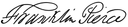 |
| Military service | |
| Branch/service | |
Years of service |
|
| Rank |
|
| Battles/wars | |
This is a select bibliography of academic level books and journal articles, published mainly after World War II,[b] about the history of Franklin Pierce and his historical context.
Inclusion criteria
Works included are referenced in the notes or bibliographies of scholarly secondary sources or journals. Included works should either be published by an academic or widely distributed publisher, be authored by a notable subject matter expert as shown by scholarly reviews or have significant scholarly journal reviews about the work. To keep the bibliography length manageable, only items that clearly meet the criteria should be included.
A brief selection of English translations of primary sources is included. Additional bibliographies can be found in many of the book-length works listed below; see Further reading for several book and chapter-length bibliographies. The External links section contains entries for publicly available select bibliographies from universities.
Citation style
This bibliography uses APA style citations. Entries do not use templates. References to reviews and notes for entries do use citation templates. Where books which are only partially related to Franklin Pierce are listed, the titles for chapters or sections should be indicated if possible, meaningful, and not excessive.
If a work has been translated into English, the translator should be included and a footnote with appropriate bibliographic information for the original language version should be included.
When listing works with titles or names published with alternative English spellings, the form used in the latest published version should be used and the version and relevant bibliographic information noted if it previously was published or reviewed under a different title.
Overview
Franklin Pierce (November 23, 1804 – October 8, 1869) was the 14th president of the United States, serving from 1853 to 1857. A northern Democrat who believed that the abolitionist movement was a fundamental threat to national unity, he alienated anti-slavery groups by signing the Kansas–Nebraska Act and enforcing the Fugitive Slave Act. Conflict between North and South continued after Pierce's presidency, and, following Abraham Lincoln's victory in the 1860 presidential election, the Southern states seceded, resulting in the American Civil War.
General works
- Eyal, Y. (2014). Franklin Pierce, Democratic partisan. In J. H. Silbey (Ed.), A companion to the antebellum presidents 1837–1861 (pp. 345–366). Wiley Blackwell.[1]
- Finkelman, P. (2016). Franklin Pierce. In K. Gormley (Ed.), The presidents and the Constitution: A living history (pp. 181–193). New York University Press.[2]
- Gara, L. (1991). The presidency of Franklin Pierce. University Press of Kansas.[3]
- Greenstein, F. I., & Anderson, D. (2013). Franklin Pierce and the Kansas-Nebraska Act. In Presidents and the dissolution of the Union: Leadership style from Polk to Lincoln. Princeton University Press.[4]
- Holt, M. F. (2010). Franklin Pierce. Times Books.[5]
- Nichols, R. F. (1931). Franklin Pierce: Young Hickory of the Granite Hills. University of Pennsylvania Press.[6]
- Wallner, P. A. (2004). Franklin Pierce: New Hampshire's favorite son. Plaidswede Publishing.
- Wallner, P. A. (2007). Franklin Pierce: Martyr for the Union. Plaidswede Publishing.
Background and context
The below items contain significant information about Franklin Pierce or significant background and context for his life and presidency.
- Brown, R. F. (1991). Charles Lennox Wyke and the Clayton-Bulwer formula in Central America, 1852–1860. The Americas, 47(4), 411–445.
- Eyal, Y. (2007). The Young America movement and the transformation of the Democratic Party, 1828–1861. Cambridge University Press.[7]
- Gienapp, W. E. (1979). The crime against Sumner: The caning of Charles Sumner and the rise of the Republican party. Civil War History, 25(3), 218–245.
- Greenberg, A. S. (2005). Manifest manhood and the antebellum American empire. Cambridge University Press.[8]
- Harlow, R. V. (1935). The rise and fall of the Kansas aid movement. The American Historical Review, 41(1), 1–25.
- Haynes, G. H. (1897). The causes of Know-Nothing success in Massachusetts. The American Historical Review, 3(1), 67–82.
- Holt, M. F. (1978). The political crisis of the 1850s. John Wiley.[9]
- Holt, M. F. (1999). The rise and fall of the American Whig Party: Jacksonian politics and the onset of the Civil War. Oxford University Press.[10]
- Huston, J. L. (1997). Democracy by scripture versus democracy by process: A reflection on Stephen A. Douglas and popular sovereignty. Civil War History, 43(3), 189–200.
- Johannsen, R. W. (1959). Stephen A. Douglas, "Harper's Magazine," and popular sovereignty. The Mississippi Valley Historical Review, 45(4), 606–631.
- Johannsen, R. W. (1973). Stephen A. Douglas. Oxford University Press.[11]
- Johnson, S. A. (1930). The genesis of the New England Emigrant Aid Company. The New England Quarterly, 3(1), 95–122.
- Keith, J. A. (2011). Civilization, race, and the Japan expedition's cultural diplomacy, 1853-1854. Diplomatic History, 35(2), 179–202.
- Landis, M. T. (2014). Northern men with southern loyalties: The Democratic Party and the sectional crisis. Cornell University Press.[12]
- Levine, B. (2001). Conservatism, nativism, and slavery: Thomas R. Whitney and the origins of the Know-Nothing party. The Journal of American History, 88(2), 455–488.
- May, R. E. (1973). The southern dream of a Caribbean empire, 1854–1861. Louisiana State University Press.[13]
- Nichols, R. F. (1948). The disruption of American democracy. Macmillan.[14]
- Potter, D. M. (1976). The impending crisis, 1848–1861 (D. E. Fehrenbacher, Ed.). Harper & Row.[15]
- Rippy, J. F. (1921). The boundary of New Mexico and the Gadsden Treaty. The Hispanic American Historical Review, 4(4), 715–742.
- Ritter, L. (2020). Inventing America's first immigration crisis: Political nativism in the antebellum West. Fordham University Press.[16]
- Silbey, J. H. (1991). The American political nation, 1838–1893. Stanford University Press.[17]
- Urban, C. S. (1957). The Africanization of Cuba scare, 1853-1855. The Hispanic American Historical Review, 37(1), 29–45.
- Webster, S. (1893). Mr. Marcy, the Cuban question and the Ostend Manifesto. Political Science Quarterly, 8(1), 1–32.
- Woods, M. E. (2011). "The indignation of freedom-loving people": The caning of Charles Sumner and emotion in antebellum politics. Journal of Social History, 44(3), 689–705.
- Woods, M. E. (2020). Arguing until doomsday: Stephen Douglas, Jefferson Davis, and the struggle for American democracy. University of North Carolina Press.[18]
Expansion, secession and slavery
- Balcerski, T. J. (2019). "A general concurrence in the propriety of the repeal": Male friendship, party, and section in the Kansas-Nebraska bill. Civil War History, 65(2), 157–183.
- Campney, B. M. S. (2024). "Driven out on the old charge of being a rebel": White-on-white sectional violence and the "long" Bleeding Kansas. Civil War History, 70(1), 27–49.
- Carey, A. G. (1995). Too southern to be Americans: Proslavery politics and the failure of the Know-Nothing party in Georgia, 1854-1856. Civil War History, 41(1), 22–40.
- Childers, C. (2012). The failure of popular sovereignty: Slavery, manifest destiny, and the radicalization of southern politics. University Press of Kansas.[19]
- Cooper, W. J., Jr. (1978). The South and the politics of slavery, 1828–1856. Louisiana State University Press.[20]
- Earle, J., & Mutti Burke, D. (Eds.). (2013). Bleeding Kansas, bleeding Missouri: The long Civil War on the border. University Press of Kansas.[21]
- Epps, K. (2016). Slavery on the periphery: The Kansas-Missouri border in the antebellum and Civil War eras. University of Georgia Press.[22]
- Etcheson, N. (2000). "Our lives, our fortunes, and our sacred honors": The Kansas civil war and the revolutionary tradition. American Nineteenth Century History, 1(1), 62–81.
- Etcheson, N. (2004). Bleeding Kansas: Contested liberty in the Civil War era. University Press of Kansas.[23]
- Fehrenbacher, D. E. (1978). The Dred Scott case: Its significance in American law and politics. Oxford University Press.[24]
- Foner, E. (1970). Free soil, free labor, free men: The ideology of the Republican Party before the Civil War. Oxford University Press.[25]
- Freehling, W. W. (2007). The road to disunion: Vol. 2. Secessionists triumphant, 1854–1861. Oxford University Press.[26]
- Hodder, F. H. (1925). The railroad background of the Kansas-Nebraska Act. The Mississippi Valley Historical Review, 12(1), 3–22.
- Janes, H. L. (1907). The Black Warrior affair. The American Historical Review, 12(2), 280–298.
- Johannsen, R. W. (1953). The Kansas-Nebraska Act and the Pacific Northwest frontier. Pacific Historical Review, 22(2), 129–141.
- Karp, M. (2016). This vast southern empire: Slaveholders at the helm of American foreign policy. Harvard University Press.[27]
- Learned, H. B. (1922). The relation of Philip Phillips to the repeal of the Missouri Compromise in 1854. The Mississippi Valley Historical Review, 8(4), 303–317.
- Levine, B. (2001). Conservatism, nativism, and slavery: Thomas R. Whitney and the origins of the Know-Nothing party. The Journal of American History, 88(2), 455–488.
- Maginnes, D. R. (1971). The case of the court house rioters in the rendition of the fugitive slave Anthony Burns, 1854. The Journal of Negro History, 56(1), 31–42.
- Maltz, E. M. (2007). Dred Scott and the politics of slavery. University Press of Kansas.[28]
- Maltz, E. M. (2010). Fugitive slave on trial: The Anthony Burns case and abolitionist outrage. University Press of Kansas.[29]
- May, R. E. (1973). The southern dream of a Caribbean empire, 1854–1861. Louisiana State University Press.[13]
- Moore, J. P. (1955). Pierre Soule: Southern expansionist and promoter. The Journal of Southern History, 21(2), 203–223.
- Morrison, M. A. (1997). Slavery and the American West: The eclipse of manifest destiny and the coming of the Civil War. University of North Carolina Press.[30]
- Pierson, M. D. (1995). "All southern society is assailed by the foulest charges": Charles Sumner's "The crime against Kansas" and the escalation of Republican anti-slavery rhetoric. The New England Quarterly, 68(4), 531–557.
- Potter, D. M. (1976). The impending crisis, 1848–1861 (D. E. Fehrenbacher, Ed.). Harper & Row.[15]
- Quaife, M. M. (1920). Bleeding Kansas and the Pottawatomie murders. The Mississippi Valley Historical Review, 6(4), 556–560.
- Radan, P. (2023). Creating a more perfect slaveholders' union: Slavery, the Constitution, and secession in antebellum America. University Press of Kansas.[31]
- Rawley, J. A. (1969). Race and politics: "Bleeding Kansas" and the coming of the Civil War. J. B. Lippincott.[32]
- Russel, R. R. (1963). The issues in the congressional struggle over the Kansas-Nebraska bill, 1854. The Journal of Southern History, 29(2), 187–210.
- Sewell, R. H. (1976). Ballots for freedom: Antislavery politics in the United States, 1837–1860. Oxford University Press.[33]
- Shapiro, S. (1959). The rendition of Anthony Burns. The Journal of Negro History, 44(1), 34–51.
- Smith, M. P. (2021). The Young America movement, the Koszta affair of 1853, and the construction of nationalism before the Civil War. Journal of the Early Republic, 41(1), 87–114.
- Varon, E. R. (2008). Disunion! The coming of the American Civil War, 1789–1859. University of North Carolina Press.[34]
- Wolff, G. W. (1972). Party and section: The Senate and the Kansas-Nebraska bill. Civil War History, 18(4), 293–311.
- Wunder, J. R., & Ross, J. M. (Eds.). (2008). The Nebraska-Kansas Act of 1854. University of Nebraska Press.[35]
Historiography
- Bogue, A. G. (1968). United States: The "new" political history. Journal of Contemporary History, 3(1), 5–27.
- Childers, C. (2011). Interpreting popular sovereignty: A historiographical essay. Civil War History, 57(1), 48–70.
- Foner, E. (1974). The causes of the American Civil War: Recent interpretations and new directions. Civil War History, 20(3), 197–214.
- Formisano, R. P. (1994). The invention of the ethnocultural interpretation. The American Historical Review, 99(2), 453–477.
- Nichols, R. F. (1956). The Kansas-Nebraska Act: A century of historiography. The Mississippi Valley Historical Review, 43(2), 187–212.
- Silbey, J. H. (1964). The Civil War synthesis in American political history. Civil War History, 10(2), 130–140.
- Towers, F. (2011). Partisans, new history, and modernization: The historiography of the Civil War's causes, 1861–2011. The Journal of the Civil War Era, 1(2), 237–264.
- Woods, M. E. (2012). What twenty-first-century historians have said about the causes of disunion: A Civil War sesquicentennial review of the recent literature. The Journal of American History, 99(2), 415–439.
Primary sources
- Hawthorne, N. (1852). Life of Franklin Pierce. Ticknor, Reed, and Fields.
- Pierce, F. (1820–1869). Franklin Pierce papers (MSS36194) [Manuscript collection]. Manuscript Division, Library of Congress.
See also
Further reading
- Drexler, K. (2025, April 25). Franklin Pierce: A resource guide: Print resources. Library of Congress.
- Floyd, S. (2014, February 20). The best biographies of Franklin Pierce. My Journey Through the Best Presidential Biographies.
- Miller Center. (2016, August 1). By the book: Franklin Pierce. University of Virginia.
References
Notes
- ↑ Vice President King died in office. As this was prior to the adoption of the Twenty-fifth Amendment in 1967, the vacancy was not filled until the next election.
- ↑ Works published during or before World War II should be limited to areas where there are no significant post-World War II books on the subject or when the work in question has significant historical merit.
Citations
- ↑ Peart, Daniel (2015). "Joel H. Silbey (ed.), A Companion to the Antebellum Presidents 1837–1861". Journal of American Studies. 49 (4): 914–916. doi:10.1017/s0021875815001401.
- ↑ Barilleaux, Ryan J. (2017). "Gormley, Ken, Ed. The Presidents and the Constitution: A Living History". Congress & the Presidency. 44 (3): 397–399. doi:10.1080/07343469.2017.1363562.
- ↑ Bergeron, Paul H. (1992). "The Presidency of Franklin Pierce". The American Historical Review. 97 (4): 1284. JSTOR 2165662.
- ↑ Dickinson, Matthew J. (2014). "Presidents and the Dissolution of the Union: Leadership Style from Polk to Lincoln". Political Science Quarterly. 129 (3): 515–517. doi:10.1002/polq.12223.
- ↑ Parsons, Lynn Hudson (2010). "Franklin Pierce". Civil War Book Review. 12 (2). doi:10.31390/cwbr.12.2.7.
- ↑ Richardson, James P. (1932). "Franklin Pierce: Young Hickory of the Granite Hills". American Political Science Review. 26 (3): 573–574. JSTOR 1946486.
- ↑ Winger, Stewart (2008). "The Young America Movement and the Transformation of the Democratic Party, 1828–1861". The American Historical Review. 113 (3): 834–835. doi:10.1086/ahr.113.3.834.
- ↑ Dean, Robert (2007). "Manifest Manhood and the Antebellum American Empire". Pacific Historical Review. 76 (2): 276–277. doi:10.1525/phr.2007.76.2.276.
- ↑ Foner, Eric (1979). "Michael F. Holt. The Political Crisis of the 1850s". The American Historical Review. 84 (2): 555–556. doi:10.1086/ahr/84.2.555-a.
- ↑ Kohl, Lawrence Frederick (2000). "Michael F. Holt. The Rise and Fall of the American Whig Party: Jacksonian Politics and the Onset of the Civil War". The American Historical Review. 105 (5): 1744–1745. doi:10.1086/ahr/105.5.1744.
- ↑ Gatell, Frank Otto (1975). "Robert W. Johannsen. Stephen A. Douglas". The American Historical Review. 80 (2): 497. doi:10.1086/ahr/80.2.497.
- ↑ Etcheson, Nicole (2016). "Michael Todd Landis. Northern Men with Southern Loyalties: The Democratic Party and the Sectional Crisis". The American Historical Review. 121 (1): 240–241. doi:10.1093/ahr/121.1.240.
- 1 2 Rauch, Basil (1975). "Robert E. May. The Southern Dream of a Caribbean Empire, 1854–1861". The American Historical Review. 80 (4): 1048–1049. doi:10.1086/ahr/80.4.1048.
- ↑ Milton, George Fort (1948). "The Disruption of American Democracy". The American Historical Review. 54 (1): 161–163. doi:10.1086/ahr/54.1.161.
- 1 2 Hamilton, Holman (1977). "David M. Potter. The Impending Crisis, 1848–1861". The American Historical Review. 82 (1): 182–183. doi:10.1086/ahr/82.1.182.
- ↑ Criblez, Adam (2022). "Inventing America's First Immigration Crisis: Political Nativism in the Antebellum West by Luke Ritter". Journal of the Early Republic. 42 (3): 467–469. doi:10.1353/jer.2022.0052.
- ↑ Baker, Jean H. (1992). "Joel H. Silbey. The American Political Nation, 1838–1893". The American Historical Review. 97 (5): 1594. doi:10.1086/ahr/97.5.1594.
- ↑ Rothera, Evan C. (2022). "Arguing until Doomsday: Stephen Douglas, Jefferson Davis, and the Struggle for American Democracy". Civil War History. 68 (2): 212–213. doi:10.1353/cwh.2022.0017.
- ↑ Ambrose, Douglas (2014). "Christopher Childers. The Failure of Popular Sovereignty: Slavery, Manifest Destiny, and the Radicalization of Southern Politics". The American Historical Review. 119 (3): 902–903. doi:10.1093/ahr/119.3.902.
- ↑ Alexander, Thomas B. (1979). "William J. Cooper, Jr. The South and the Politics of Slavery, 1828–1856". The American Historical Review. 84 (5): 1477. doi:10.1086/ahr/84.5.1477.
- ↑ Garrison, Zachary S. (2015). "Bleeding Kansas, Bleeding Missouri: The Long Civil War on the Border". Civil War History. 61 (2): 183–184. doi:10.1353/cwh.2015.0042.
- ↑ Harrold, Stanley (2018). "Kristen Epps. Slavery on the Periphery: The Kansas-Missouri Border in the Antebellum and Civil War Eras". The American Historical Review. 123 (1): 227–228. doi:10.1093/ahr/123.1.227.
- ↑ Ross, Michael A. (2005). "Bleeding Kansas: Contested Liberty in the Civil War Era". The Western Historical Quarterly. 36 (4): 520. JSTOR 25443255.
- ↑ Kutler, Stanley I. (1980). "The Dred Scott Case: Its Significance in American Law and Politics". The Journal of American History. 66 (4): 936. JSTOR 1887683.
- ↑ Sewell, Richard H. (1970). "Free Soil, Free Labor, Free Men: The Ideology of the Republican Party Before the Civil War". The Journal of American History. 57 (3): 716. JSTOR 1918018.
- ↑ Richards, Leonard L. (2008). "William W. Freehling. The Road to Disunion. Volume 2, Secessionists Triumphant, 1854–1861". The American Historical Review. 113 (2): 508. doi:10.1086/ahr.113.2.508.
- ↑ Jones, Howard (2017). "Matthew Karp. This Vast Southern Empire: Slaveholders at the Helm of American Foreign Policy". The American Historical Review. 122 (3): 838. doi:10.1093/ahr/122.3.838.
- ↑ Allen, Austin (2008). "Dred Scott and the Politics of Slavery". The Journal of Southern History. 74 (2): 455. JSTOR 27650171.
- ↑ Brooks, Corey M. (2011). "Fugitive Slave on Trial: The Anthony Burns Case and Abolitionist Outrage. By Earl M. Maltz". The Journal of Interdisciplinary History. 42 (3): 477–478. doi:10.1162/jinh_r_00284.
- ↑ Renda, Lex (1998). "Michael A. Morrison. Slavery and the American West: The Eclipse of Manifest Destiny and the Coming of the Civil War". The American Historical Review. 103 (2): 597–598. doi:10.1086/ahr/103.2.597.
- ↑ Nicoletti, Cynthia (2024). "Creating a More Perfect Slaveholders' Union: Slavery, the Constitution, and Secession in Antebellum America by Peter Radan". The Journal of the Civil War Era. 14 (4): 546–548. doi:10.1353/cwe.2024.a944718.
- ↑ Fehrenbacher, Don E. (1970). "Race & Politics: "Bleeding Kansas" and the Coming of the Civil War". The Journal of Southern History. 36 (3): 447. JSTOR 2206224.
- ↑ Dillon, Merton L. (1977). "Richard H. Sewell. Ballots for Freedom: Antislavery Politics in the United States, 1837–1860". The American Historical Review. 82 (1): 181–182. doi:10.1086/ahr/82.1.181-a.
- ↑ Etcheson, Nicole (2009). "Elizabeth R. Varon. Disunion! The Coming of the American Civil War, 1789–1859". The American Historical Review. 114 (4): 1083–1084. doi:10.1086/ahr.114.4.1083.
- ↑ Guelzo, Allen C. (2009). "John R. Wunder and Joann M. Ross, editors. The Nebraska-Kansas Act of 1854". The American Historical Review. 114 (4): 1084. doi:10.1086/ahr.114.4.1084.
External links
- American Presidency Project: Franklin Pierce
- Franklin Pierce Homestead
- Miller Center: Franklin Pierce
| |
| Life | |
| Presidency | |
| Public image | |
| Family |
|
| References | |


- Franklin Pierce
- 1850s in the United States
- 19th-century members of the New Hampshire General Court
- 19th-century United States representatives
- 19th-century presidents of the United States
- 19th-century United States senators
- American military personnel of the Mexican–American War
- Candidates in the 1852 United States presidential election
- Candidates in the 1856 United States presidential election
- Family of Franklin Pierce
- Presidents of the United States
- Speakers of the New Hampshire House of Representatives
- United States Army generals
- Bibliographies of presidents of the United States
- Books about politics of the United States
- Bibliographies of people
- Political bibliographies
- Works about presidents of the United States