Assas, Hérault
Assas | |
|---|---|
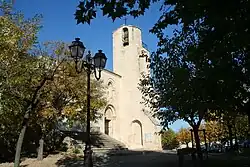 Saint-Martial church | |
 Coat of arms | |
Location of Assas | |
  Assas Location within France  Assas Location within Occitanie | |
| Coordinates: 43°42′10″N 3°54′00″E / 43.7028°N 3.9°E | |
| Country | France |
| Region | Occitania |
| Department | Hérault |
| Arrondissement | Lodève |
| Canton | Saint-Gély-du-Fesc |
| Intercommunality | CC Grand Pic Saint-Loup |
| Government | |
| • Mayor (2022–2026) | Benoit Amphoux[1] |
Area 1 | 19.11 km2 (7.38 sq mi) |
| Population (2023)[2] | 1,405 |
| • Density | 73.52/km2 (190.4/sq mi) |
| Time zone | UTC+01:00 (CET) |
| • Summer (DST) | UTC+02:00 (CEST) |
| INSEE/Postal code | 34014 /34820 |
| Elevation | 59–164 m (194–538 ft) (avg. 85 m or 279 ft) |
| 1 French Land Register data, which excludes lakes, ponds, glaciers > 1 km2 (0.386 sq mi or 247 acres) and river estuaries. | |
Assas (French pronunciation: [asas] ⓘ; Occitan: Assaç or Assats, [aˈsas]) is a town and commune in the Hérault department, region of Occitania, southern France.
Geography
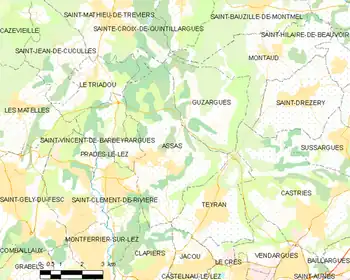
Located just north of Montpellier, Assas lies near Saint-Vincent de Barbeyrargues, Guzargues, Clapiers, Jacou, Castries and Teyran. The region near Assas is primarily scrubland, but it is watered by a number of streams and brooks and has a small wooded area that produces mushrooms in the fall.
The village of Assas is organized around the Château d'Assas, located on a hill overlooking the small but quaint old village.
Population
The inhabitants are called Assadins in French.
| Year | Pop. | ±% p.a. |
|---|---|---|
| 1968 | 352 | — |
| 1975 | 506 | +5.32% |
| 1982 | 815 | +7.05% |
| 1990 | 992 | +2.49% |
| 1999 | 1,305 | +3.09% |
| 2007 | 1,509 | +1.83% |
| 2012 | 1,505 | −0.05% |
| 2017 | 1,520 | +0.20% |
| 2023 | 1,405 | −1.30% |
| Source: INSEE[3] | ||
Viticulture
The region containing Assas is a productive wine-making area, and has the appellation Grès de Montpellier. This is part of the AOC Coteaux du Languedoc designation.
Sights
- Château d'Assas, an 18th-century folie montpellierraine, designed by the architect Jean-Antoine Giral (1700–1787), was built in 1759/1760 on the ruins of a feudal castle. It is a private residence, but can be toured either by appointment or on national holidays. A historic 18th century harpsichord is preserved in the Château, a favoured instrument of harpsichordist Scott Ross (1951–1989), who died in Assas. At the beginning of the 1920s, Sir Patrick Geddes (born Ballater, Scotland 2 October 1854, died Montpellier, France 17 April 1932), the Scottish botanist, bought the Château d'Assas to set up a centre for urban studies, as an extension of the Collège des Ecossais which he founded in Montpellier in 1890.
The château was used as a set in the filming of La Belle Noiseuse, a film by Jacques Rivette (1991). - A church of the 11th or 12th century, completely restored at the beginning of the 21st century.
- Remains of the 10th or 11th century fortifications.
- Old village.
See also
References
- ↑ "Répertoire national des élus: les maires" (in French). data.gouv.fr, Plateforme ouverte des données publiques françaises. 13 September 2022.
- ↑ "Populations de référence 2023" (in French). National Institute of Statistics and Economic Studies. 18 December 2025.
- ↑ Population municipale entre 1968 et 2023, INSEE
External links

