2026 in paleoichthyology
| List of years in paleoichthyology |
|---|
This list records new taxa of fossil fish that were announced or described in 2026. Other peer-reviewed publications on discoveries related to fish paleontology which occurred in that year are also detailed here.
Jawless vertebrates
| Name | Novelty | Status | Authors | Age | Type locality | Country | Notes | Images |
|---|---|---|---|---|---|---|---|---|
|
Gen. et sp. nov |
Valid |
Zhang et al. |
A member of Galeaspida belonging to the group Polybranchiaspiformes. The type species is A. brachyotus. |
|||||
|
Bataspis[2] |
Gen. et sp. nov |
Valid |
Meng et al. |
Devonian (Lochkovian) |
Xishancun Formation |
A member of Galeaspida belonging to the family Tridensaspidae. The type species is B. crux. |
||
|
Platyrhakis[3] |
Gen. et comb. nov |
Valid |
El Fassi El Fehri et al. |
Devonian (Lochkovian) |
Lower Old Red Sandstone |
A member of Zenaspidida of uncertain affinities. The type species is "Cephalaspis" traquairi Stensiö (1932). |
||
|
Rochtarge[3] |
Gen. et comb. nov |
Valid |
El Fassi El Fehri et al. |
Devonian (Lochkovian) |
Lower Old Red Sandstone |
A member of Osteostraci of uncertain affinities. The type species is "Cephalaspis" watsoni Stensiö (1932); genus also includes "Cephalaspis" spinifer Stensiö (1932) and "Cephalaspis" cwmmillensis White & Toombs (1983). |
||
|
Saigheadaspis[3] |
Gen. et comb. nov |
Valid |
El Fassi El Fehri et al. |
Devonian (Lochkovian) |
Lower Old Red Sandstone |
A member of Osteostraci of uncertain affinities. The type species is "Cephalaspis" websteri Stensiö (1932). |
||
|
Traquairosteus prius[4] |
Sp. nov |
Valid |
Glinskiy & Bolshiyanov in Glinskiy et al. |
Devonian (Givetian) |
A member of the family Psammosteidae. |
|||
|
Gen. et sp. nov |
Valid |
Zhang et al. |
Qingshui Formation |
A member of Galeaspida belonging to the family Dayongaspidae. The type species is X. wuningensis. |
||||
|
Ymersaspis[3] |
Gen. et comb. nov |
Valid |
El Fassi El Fehri et al. |
Devonian (Lochkovian) |
Lower Old Red Sandstone |
A member of Osteostraci of uncertain affinities. The type species is "Eucephalaspis" agassizi Lankester (1870). |
||


Jawless vertebrate research
- Evidence of presence of a pair of lateral eyes and pineal/parapineal organs likely functioning as camera-type eyes capable of image formation is reported in 6 specimens of Haikouichthys and 4 specimens of indeterminate myllokunmingids by Lei et al. (2026).[6]
- Evidence from the study of eyes of Gilpichthys greenei, Myxinikela siroka and Squirmarius testai, indicative of gradual reduction and loss of complexity of hagfish eyes throughout the Paleozoic that likely happened before hagfish colonization of the continental slope, is presented by McCoy et al. (2026).[7]
- Reeves et al. (2026) provide new information on the anatomy of Jamoytius and Lasanius, including evidence of vertebrate biomineralization in both taxa and evidence of presence of complex camera-eye vertebrate eyes in Jamoytius.[8]
Placoderms
| Name | Novelty | Status | Authors | Age | Type locality | Country | Notes | Images |
|---|---|---|---|---|---|---|---|---|
|
Gen. et sp. nov |
Valid |
Xue et al. |
Devonian (Pragian) |
An antarctaspid placoderm. The type species is P. eurycephala. |
||||
Placoderm research
- Redescription of the anatomy and a study on the affinities of Bothriolepis yunnanensis is published by Yan et al. (2026).[10]
- A study on the mandible biomechanical performance and dental complexity in eight eubrachythoracid placoderms from the Devonian Gogo Formation (Australia), providing evidence of different adaptations to feeding on hard objects in the studied taxa (interpreted as likely linked to the relative size of prey to predator), is published by Mitchell et al. (2026).[11]
Cartilaginous fishes
| Name | Novelty | Status | Authors | Age | Type locality | Country | Notes | Images |
|---|---|---|---|---|---|---|---|---|
|
Curvorudentis[12] |
Gen. et comb. nov |
Valid |
Begat et al. |
Middle and Late Jurassic (Callovian to Kimmeridgian) |
A member of Galeomorphii of uncertain affinities. The type species is "Synechodus" prorogatus Kriwet (2003). |
|||
|
Sp. nov |
Itano |
Carboniferous (Viséan) |
||||||
|
Eoscyllium[14] |
Gen. et comb. nov |
Valid |
Delsate |
Jurassic (Toarcian-Kimmeridgian) |
A carpet shark, probably a member of the family Hemiscylliidae. The type species is "Heterodontus" duffini Thies (1983). |
|||
|
Galeorhinus semiserratus[15] |
Sp. nov |
Valid |
Cicimurri, Ebersole & Bowman |
Eocene (Priabonian) |
A species of Galeorhinus. |
|||
|
Sp. nov |
Fang et al. |
Permian (Wuchiapingian) |
Longtan Formation |
|||||
|
Gen. et sp. nov |
Valid |
Vullo et al. |
Cretaceous (Barremian–Cenomanian) |
Tiout Formation |
A member of Hybodontiformes belonging to the family Lonchidiidae. The type species is L. trifurcatum. |
| ||
|
Magwayodus[18] |
Gen. et sp. nov |
Adnet et al. |
Eocene (Priabonian) |
Yaw Formation |
A requiem shark. The type species is M. boboi. |
|||
|
Palaeobrachaelurus vanessae[14] |
Sp. nov |
Valid |
Delsate |
Jurassic (Toarcian-Bajocian) |
A member of the family Brachaeluridae. |
|||
|
Sp. nov |
Ribeiro & França |
Late Jurassic |
Aliança Formation |
A member of Hybodontiformes belonging to the family Lonchidiidae. |
| |||
|
Polyacrodus microdon[20] |
Sp. nov |
Wen et al. |
Early Triassic |
Luolou Formation |
A member of Hybodontiformes. |
|||
|
Thiesoscyllium[14] |
Gen. et 2 sp. nov |
Valid |
Delsate |
Jurassic (Toarcian-Bajocian) |
A carpet shark, probably a member of the family Hemiscylliidae. The type species is T. underwoodi; genus also includes T. felteni. |
|||
|
Tuyuria[21] |
Gen. et sp. nov |
Lebedev in Lebedev et al. |
Carboniferous (Viséan) |
A member of Edestoidea. Genus includes new species T. insolita. |
||||


Cartilaginous fish research
- Maisey (2026) describes the internal morphology of the holotype braincase of Tamiobatis vetustus, and considers the species to be founded upon the type specimen inadequate for definitive diagnosis.[22]
- Bhat et al. (2026) describe a partially preserved Meckel's cartilage of a possible member of Eugeneodontiformes from the Permian strata of the Zewan Formation, representing the first finding of non-dental fossil material of a Permian cartilaginous fish in Kashmir.[23]
- Duffin & Schweigert (2026) report the first discovery of fossil material of Chimaeropsis paradoxa from the Kimmeridgian strata of the Nusplingen Limestone (Germany).[24]
- Manzanares et al. (2026) report evidence of preservation of whitlockite in dental plates of chimaeras from the Paleocene and Eocene strata in the United Kingdom.[25]
- New fossil material of Phoebodus saidselachus, providing new information on the anatomy of members of this species, is described from the Devonian (Famennian) strata from eastern Anti-Atlas (Morocco) by Klug et al. (2026) .[26]
- Zhao et al. (2026) describe teeth of members of four euselachian taxa from the Ladinian-Carnian strata of the Falang Formation (Guizhou and Yunnan, China) with three-dimensional preservation of dental microstructure, confirming that that the assemblage including the studied teeth was dominated by non-durophagous sharks.[27]
- The oldest fossil material of a hybodontiform shark from Mexico reported to date is described from the Permian (Wordian) strata of the Las Delicias Formation by Cantalice et al. (2026).[28]
- Trikolidi, Golubev & Novikov (2026) describe teeth of members of the genus Strophodus from the Lower Cretaceous (Valanginian and Hauterivian) strata from Crimea, expanding known geographical range of the genus.[29]
- New fossil material of distobatid, hybodontid and lonchidiid hybodontiform sharks is described from the Cenomanian Alcântara Formation (Brazil) by Neves et al. (2026), providing evidence of biogeographic links between Cretaceous shark assemblages from South America and Africa.[30]
- Gardiner et al. (2026) reconstruct changes of neoselachian diversity patterns throughout the last 145 million years, reporting evidence of a long-term diversity increase during the Cretaceous, approximately 10% decline in diversity during the Cretaceous–Paleogene extinction event, mid-Eocene diversity peak and gradual decline afterwards.[31]
- Evidence of complexity of microstructure of enameloid in teeth and in denticles covering the elongated rostra of members of Sclerorhynchoidei, present in members of the group with diverse morphologies, is presented by Chateauneuf-Gautier & Guinot (2026).[32]
- Türtscher, Jambura & Kriwet (2026) describe the skeletal anatomy of Myledaphus bipartitus, and recover it as a member of Rhinopristiformes.[33]
- Redescription and a study on the affinities of Bavariscyllium tischlingeri is published by Stumpf et al. (2026).[34]
- A new assemblage of lamniform shark fossils, including possibly the youngest record of Scapanorhynchus cf. raphiodon reported to date, is described from the Upper Cretaceous (Campanian) strata of the Duwi Formation (Egypt) by Yassin et al. (2026).[35]
- The first confirmed record of teeth of Ptychodus whipplei from South America is reported from the Upper Cretaceous (Campanian–Maastrichtian) Itamaracá Formation (Brazil) by Assumpção et al. (2026).[36]
- Santos Granzotti, Modesto Alves & Bampi (2026) revise the affinities of confirmed and purported fossil members of Alopiidae on the basis of the study of their dental characters.[37]
- Baptista et al. (2026) report the discovery of a tooth of Otodus megalodon at the Rio Grande Rise, providing evidence of presence of the species in southern Atlantic Ocean during the early–middle Miocene.[38]
- Herraiz et al. (2026) revise the fossil record of teeth of Otodus megalodon, finding no evidence of a significant differences of body size of members of Atlantic populations and Mediterranean populations other than the one known from the Miocene strata from the Reverté quarries (Spain), and interpret the Reverté assemblage as likely to be a fossil record of a nursery.[39]
- Shimada et al. (2026) report rediscovery of the vertebral specimen of Otodus megalodon NHMD 157890 from the Miocene Gram Formation (Denmark), and confirm the accuracy of the original report of the maximum vertebral diameter (23 cm).[40]
- Ferrón et al. (2026) reevaluate the dataset from the study of Shimada et al. (2023), [41] and find no evidence of a significant relationship between sea-surface temperatures and body size in the fossil record of Otodus megalodon, and interpret the assemblages of small-bodied individuals as likely to be nurseries.[42]
- Schwenk et al. (2026) compare zinc enrichment of the enameloid of Otodus obliquus and O. megalodon, finding evidence of higher concentrations of zinc in regions of teeth of O. megalodon affected by high stress during feeding and finding evidence of less pronounced spatial variation of zinc in teeth of O. obliquus, and interpret this finding as suggestive of a shift from a fish-based diet to preying on marine mammals during the evolutionary history of otodontid sharks.[43]
- Gašparič et al. (2026) report the discovery of a regurgitalite (likely produced by a mackerel or hexanchid shark) with remains of the basking shark Keasius cf. septemtrionalis from the Miocene (Burdigalian) strata from Slovenia, extending known geographical range of Keasius into southeastern part of central Paratethys.[44]
- McCormack et al. (2026) study the ecology of Late Cretaceous (Turonian–Coniacian) sharks from the Western Interior Seaway as indicated by enameloid zinc isotope values, providing evidence of high trophic positions of members of the genera Archaeolamna, Cretodus and Cretoxyrhina, and evidence of opportunistic and flexible dietary habits of members of the genus Cretalamna.[45]
- Feichtinger et al. (2026) study changes of composition of the elasmobranch assemblages from the Byala Formation (Bulgaria) during the Cretaceous-Paleogene transition, reporting evidence of stronger ecological restructuring in shallower environments compared to deep-marine and high-latitude settings, and report the first discovery of fossil material of Cretascymnus from the Danian strata, indicative of survival of members of this genus past the Cretaceous–Paleogene extinction event.[46]
- A new cartilaginous fish assemblage including taxa with European and North African affinites is reported from the Eocene strata from the Algarrobo Beds (Chile) by Otero et al. (2026).[47]
- Marramà et al. (2026) report the discovery of a diverse elasmobranch assemblage from the Miocene (Aquitanian) strata from the Tunga Formation (Peru), representing the oldest Neogene vertebrate assemblage from the Pisco Basin reported to date.[48]
- Lambert et al. (2026) report shark feeding traces on bones of cetacean specimens from the Pliocene Kattendijk Formation (Belgium), including evidence of a bluntnose sixgill shark feeding on a right whale Balaenella brachyrhynus and evidence of Carcharodon plicatilis feeding on a member of the genus Casatia.[49]
Ray-finned fishes
| Name | Novelty | Status | Authors | Age | Type locality | Location | Notes | Images |
|---|---|---|---|---|---|---|---|---|
| Acanthophleges[50] | Gen. et sp. nov | Valid | Calzoni, Giusberti & Carnevale in Calzoni et al. | Early Eocene (Ypresian) | Chiusole Formation |  Italy |
A member of the family Euzaphlegidae. The type species is A. lessiniae. |  |
|
Aijaichthys[51] |
Gen. et sp. nov |
Valid |
Ordóñez et al. |
Late Jurassic (Tithonian) |
Tinajones Formation |
A member of Ellimmichthyiformes belonging to the family Ancashichthyidae. The type species is A. brevis Ordóñez & Arratia. |
||
|
Aminiichthys[52] |
Gen. et comb. nov |
Valid |
Ebert |
Middle Jurassic (Callovian) |
A member of Pycnodontiformes belonging to the family Mesturidae. The type species is "Mesturus" leedsi Woodward (1895). |
|||
|
Ancashichthys[51] |
Gen. et sp. nov |
Valid |
Ordóñez et al. |
Late Jurassic (Tithonian) |
Tinajones Formation |
A member of Ellimmichthyiformes, the type genus of the new family Ancashichthyidae. The type species is A. peruensis Ordóñez & Arratia. |
||
|
Sp. nov |
Valid |
Marzouk et al. |
Late Cretaceous (Maastrichtian) |
|||||
| Bolcaichthys solanensis[50] | Sp. nov | Valid | Calzoni, Giusberti & Carnevale in Calzoni et al. | Early Eocene (Ypresian) | Chiusole Formation | Italy |
A member of the order Clupeiformes; a species of Bolcaichthys. |  |
|
Confoundichthys[54] |
Gen. et comb. nov |
Henderson & Giles |
Carboniferous |
An early ray-finned fish. The type species is "Elonichthys" aitkeni Traquair (1886). |
||||
| Contemptor[50] | Gen. et sp. nov | Valid | Calzoni, Giusberti & Carnevale in Calzoni et al. | Early Eocene (Ypresian) | Chiusole Formation | Italy |
A member of the family Gempylidae. The type species is C. mastinoi. |  |
|
Coryphaenoides richi[55] |
Sp. nov |
Valid |
Schwarzhans, Moritz & Goedert |
Oligocene |
A species of Coryphaenoides. |
|||
|
Dactylopterus decrozi[56] |
Sp. nov |
Aguilera, De Gracia, Buckup & Rodríguez in Aguilera et al. |
Miocene |
A member of the family Dactylopteridae. |
||||
|
Elnorichthys[57] |
Gen. et sp. nov |
Murray et al. |
Late Cretaceous (Maastrichtian) |
A beardfish, possibly a member of the family Boreiohydriidae. Genus includes new species E. pennockae. |
||||
|
Sp. nov |
Nelson, Murray & Sims |
Late Cretaceous |
||||||
| Exeomastix[50][59] | Gen. et sp. nov | Valid | Calzoni, Giusberti & Carnevale | Early Eocene (Ypresian) | Chiusole Formation | Italy |
A member of the family Trichiuridae. The type species is E. zabimaru Calzoni, Giusberti & Carnevale in Calzoni et al.[50] Its original generic name Eomastix is preoccupied by the fly Eomastix Jaschhof, 2009, necessitating creation of the replacement name. |  |
|
Franchessella[60] |
Gen. et sp. nov |
Valid |
Gonçalves et al. |
Permian |
A member of the family Aeduellidae. Genus includes new species F. pohlcremeri. |
|||
|
Gen. et sp. nov |
Valid |
Ribeiro et al. |
Early Cretaceous |
Morro do Chaves Formation |
A member of Acanthomorpha of uncertain affinities. The type species is G. decollatus. |
| ||
|
Goodichthys[52] |
Gen. et sp. nov |
Valid |
Ebert |
Late Jurassic (Tithonian) |
A member of Pycnodontiformes belonging to the family Mesturidae. The type species is G. prettii . |
 | ||
|
Gen. et sp. nov |
Gottfried et al. |
Red Bluff Tuff Formation |
A member of the family Megalopidae. The type species is I. koehleri. |
|||||
|
Sp. nov |
Liu & Zhang |
Eocene |
Huachong/Huayong Formation |
A member of Cypriniformes belonging to the family Jianghanichthyidae. |
||||
|
Karabalyk[64] |
Gen. et sp. nov |
Valid |
Bakaev & Kogan |
Permian (Wordian) |
A member of Palaeoniscimorpha belonging to the family Gonatodidae. The type species is K. esini. |
|||
| Landanaelops[65] | Gen. et sp. nov | Valid | Taverne & Smith | Paleocene (Selandian) | Landana Formation |  Angola |
A member of the family Elopidae. The type species is L. gunnelli. Announced online in 2024; the final version of the article naming it was published in 2026. | |
|
Leolepis[66] |
Gen. et sp. nov |
Gallo et al. |
Permian |
Corumbataí Formation |
A member of Paramblypteriformes. The type species is L. matogrossensis. |
|||
| Lepidoclupea[50] | Gen. et sp. nov | Valid | Calzoni, Giusberti & Carnevale in Calzoni et al. | Early Eocene (Ypresian) | Chiusole Formation | Italy |
A member of the family Dussumieriidae. The type species is L. renga. |  |
|
Mesonichthys culmensis[54] |
Sp. nov |
Henderson & Giles |
Carboniferous |
Bude Formation |
An early ray-finned fish. |
|||
|
Nazaria[67] |
Gen. et sp. nov |
Richter et al. |
Permian (Cisuralian) |
A deep-bodied ray-finned fish related to Blourugia and Paranaichthys. Genus includes new species N. limnica. |
||||
|
Neodapalis[68] |
Gen. et sp. nov |
Valid |
Bradić-Milinović, Schwarzhans & He |
Miocene (Serravallian) |
Valjevo-Mionica Basin |
A member of the family Ambassidae. The type species is N. haraldahnelti. |
||
|
Sp. nov |
Kanarkina, Zverkov & Varenov |
Late Jurassic |
||||||
|
Gen. et sp. nov |
Valid |
Franceschi, Marramà & Carnevale |
Early Jurassic (Sinemurian) |
A member of Palaeoniscimorpha. The type species is O. marianii. |
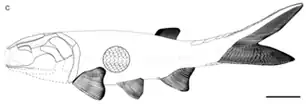 | |||
|
Sp. nov |
Decat et al. |
Miocene |
A member of the family Erythrinidae. |
|||||
|
Sp. nov |
Pimentel et al. |
Late Cretaceous (Campanian-Maastrichtian) |
A member of Elopiformes belonging to the family Phyllodontidae. |
|||||
|
Paraorthocormus[69] |
Gen. et comb. nov |
Kanarkina, Zverkov & Varenov |
Middle Jurassic (Callovian) |
A member of Pachycormiformes belonging to the family Protosphyraenidae. The type species is "Hypsocormus" tenuirostris Woodward (1889) |
||||
|
Gen. et sp. nov |
Valid |
Ridolfi et al. |
Eocene |
A member of the family Stylephoridae. The type species is P. anatoides. |
 | |||
|
Sp. nov |
Valid |
Franceschi, Marramà & Carnevale |
Early Jurassic (Sinemurian) |
Moltrasio Formation |
 | |||
|
Sp. nov |
Valid |
Franceschi, Marramà & Carnevale |
Early Jurassic (Sinemurian) |
Moltrasio Formation |
 | |||
|
Sp. nov |
Conedera et al. |
Middle Triassic (Anisian) |
||||||
|
Sp. nov |
Conedera et al. |
Middle Triassic (Anisian) |
||||||
|
Sp. nov |
Conedera et al. |
Middle Triassic (Ladinian) |
||||||
|
Sp. nov |
Conedera et al. |
Middle Triassic (Ladinian) |
||||||
|
Sp. nov |
Conedera et al. |
Middle Triassic (Anisian) |
||||||
|
Sp. nov |
Valid |
Ren & Xu |
Middle Triassic (Anisian) |
|||||
|
Sp. nov |
Valid |
Xu et al. |
Middle Triassic (Anisian) |
Guanling Formation |
||||
|
Rumsichthys[57] |
Gen. et sp. nov |
Murray et al. |
Late Cretaceous (Maastrichtian) |
Scollard Formation |
A member of Percomorpha of uncertain affinities. Genus includes new species R. novaspinus. |
|||
| Sabbathichthys[50] | Sp. nov | Valid | Calzoni, Giusberti & Carnevale in Calzoni et al. | Early Eocene (Ypresian) | Chiusole Formation | Italy |
A member of the family Phosichthyidae. The type species is S. osbournei. |  |
|
Spirinchus izumoensis[77] |
Sp. nov |
Valid |
Hamada et al. |
Miocene |
Kawai Formation |
A species of Spirinchus. |
||
|
Stephaniella[78] |
Gen. et sp. nov |
Gonçalves, Pouzadoux & Luccisano |
Carboniferous (Gzhelian) |
An aeduellid. Genus includes new species S. melanocephala. |
||||
|
Tatarstanichthys[79] |
Gen. et sp. nov |
Valid |
Taverne & Capasso |
Permian |
A member of Bobasatraniiformes. The type species is T. bannikovi. |
|||
| Thyrsitoides cangrandei[50] | Sp. nov | Valid | Calzoni, Giusberti & Carnevale in Calzoni et al. | Early Eocene (Ypresian) | Chiusole Formation | Italy |
A member of the family Gempylidae; a species of Thyrsitoides. |  |
|
Unionichthys[54] |
Gen. et sp. nov |
Henderson & Giles |
Carboniferous |
Pennine Lower Coal Measures Formation |
An early ray-finned fish. The type species is U. friedmani. |
|||
|
Uylyakushlyukia[80] |
Gen. et sp. nov |
Valid |
Bannikov |
Eocene (Ypresian) |
A probable stromateoid. Genus includes new species U. danatensis. |
|||
|
Valgarzaella[81] |
Gen. et sp. nov |
Valid |
Capasso et al. |
Late Triassic (Norian) |
A member of Gyrodontiformes. Genus includes new species V. antiquissima. |
|||
| Veronaphleges ambrosii[50] | Sp. nov | Valid | Calzoni, Giusberti & Carnevale in Calzoni et al. | Early Eocene (Ypresian) | Chiusole Formation | Italy |
A member of the family Euzaphlegidae; a species of Veronaphleges. |  |
|
Wadiichthys[82] |
Gen. et sp. nov |
Valid |
Abu El-Kheir et al. |
Late Cretaceous (Maastrichtian) |
A member of the family Saurodontidae. Genus includes new species W. anbaawyi. |
|||
| Zealandorhynchus[83] | Gen. et sp. nov | Rust et al. | Eocene | Kurinui Formation |  New Zealand |
A billfish. The type species is Z. fordycei. Announced in 2025; the final article version was published in 2026. |





Otolith taxa
| Name | Novelty | Status | Authors | Age | Type locality | Location | Notes | Images |
|---|---|---|---|---|---|---|---|---|
|
"Albula" aqualis[84] |
Sp. nov |
Valid |
Stringer et al. |
Paleocene |
A bonefish of uncertain generic placement. |
|||
|
Artediellus iutlandicus[85] |
Sp. nov |
Valid |
Schwarzhans et al. |
Oligocene |
Brejning Formation |
A species of Artediellus. |
||
|
Benthosema rarang[86] |
Sp. nov |
Valid |
Mediodia & Lin in Mediodia et al. |
Pliocene |
A species of Benthosema. |
|||
|
Centropomus neildouglasi[84] |
Sp. nov |
Valid |
Stringer et al. |
Paleocene |
Aquia Formation |
A species of Centropomus. |
||
|
Coelorinchus ignotus[85] |
Sp. nov |
Valid |
Schwarzhans et al. |
Oligocene |
Brejning Formation |
A species of Coelorinchus. |
||
|
Sp. nov |
Valid |
Schwarzhans et al. |
Oligocene |
A member of the family Ambassidae. |
||||
|
Enchelyopus dybkjaerae[85] |
Sp. nov |
Valid |
Schwarzhans et al. |
Oligocene |
Brejning Formation |
A species of Enchelyopus. |
||
|
Eomupus[85] |
Gen. et comb. nov |
Valid |
Schwarzhans et al. |
Eocene to Miocene |
A medusafish. The type species is "Mupus" neumanni Schwarzhans (1974); genus also includes "Scombrops" sinuosus Stinton (1965). |
|||
|
Hoplobrotuloides similisbartonensis[84] |
Sp. nov |
Valid |
Stringer et al. |
Paleocene |
Aquia Formation |
A cusk-eel. |
||
|
Lampanyctus morsensis[85] |
Sp. nov |
Valid |
Schwarzhans et al. |
Oligocene |
Brejning Formation |
A species of Lampanyctus. |
||
|
Lampanyctus vilsundensis[85] |
Sp. nov |
Valid |
Schwarzhans et al. |
Oligocene |
A species of Lampanyctus. |
|||
|
Lophiodes sliwinskae[85] |
Sp. nov |
Valid |
Schwarzhans et al. |
Oligocene |
Brejning Formation |
A species of Lophiodes. |
||
|
Macquaria pundalpa[87] |
Sp. nov |
Valid |
Schwarzhans |
Namba Formation |
A species of Macquaria. |
|||
|
Mareperca[84] |
Gen. et comb. nov |
Valid |
Stringer et al. |
Paleocene |
Aquia Formation |
A member of the family Serranidae. Genus includes M. remensis. |
||
|
Myctophum luzonicum[86] |
Sp. nov |
Valid |
Mediodia & Lin in Mediodia et al. |
Pliocene |
A species of Myctophum. |
|||
|
Myoxocephalus aculeatus[85] |
Sp. nov |
Valid |
Schwarzhans et al. |
Oligocene |
Brejning Formation |
A species of Myoxocephalus. |
||
|
Nomeus sternbergensis[85] |
Sp. nov |
Valid |
Schwarzhans et al. |
Oligocene |
A species of Nomeus. |
|||
|
Palaeoesox scandicus[85] |
Sp. nov |
Valid |
Schwarzhans et al. |
Oligocene |
Brejning Formation |
A member of the family Umbridae. |
||
|
Palaeomorrhua longus[84] |
Sp. nov |
Valid |
Stringer et al. |
Paleocene |
Aquia Formation |
A member of Gadiformes belonging to the family Phycidae. |
||
|
Palimphemus pinguis[85] |
Sp. nov |
Valid |
Schwarzhans et al. |
Oligocene |
Brejning Formation |
A member of the family Gadidae. |
||
|
Parambassis? pipperrae[88] |
Sp. nov |
Valid |
Gegg & Reichenbacher |
Miocene (Burdigalian) |
Kirchberg Formation |
Possibly a species of Parambassis. |
||
|
Paraulopus superstitius[85] |
Sp. nov |
Valid |
Schwarzhans et al. |
Oligocene |
A species of Paraulopus. |
|||
|
Platysepta compactus[84] |
Sp. nov |
Valid |
Stringer et al. |
Paleocene |
Aquia Formation |
A member of Osteichthyes of uncertain familial placement. |
||
|
Primitivusscomber[84] |
Gen. et sp. nov |
Valid |
Stringer et al. |
Paleocene |
Aquia Formation |
A member of the family Scombridae. Genus includes new species P. triangulum. |
||
|
Sardinella mecklenburgensis[85] |
Sp. nov |
Valid |
Schwarzhans et al. |
Oligocene |
A species of Sardinella. |
|||
|
Trisopterus brevicollum[85] |
Sp. nov |
Valid |
Gaemers & Schwarzhans in Schwarzhans et al. |
Oligocene |
A species of Trisopterus. |
|||
|
Trisopterus cylindratus[85] |
Sp. nov |
Valid |
Gaemers & Schwarzhans in Schwarzhans et al. |
Oligocene |
A species of Trisopterus. |
|||
|
Trisopterus weileri[85] |
Sp. nov |
Valid |
Gaemers & Schwarzhans in Schwarzhans et al. |
Oligocene |
A species of Trisopterus. |
|||


Ray-finned fish research
- Evidence from the study of endocasts of extant ray-finned fishes, indicating that endocasts are not reliable predictors of morphology of brains in extinct fishes, is presented by Figueroa & Pierce (2026).[89]
- Vanhaesebroucke & Cloutier (2026) study the morphological variation among Devonian and Carboniferous ray-finned fishes, and interpret their diversification as most likely driven by adaptations to diverse feeding strategies.[90]
- Caron, Tietjen & Coates (2026) provide new information on the neuroanatomy of Trawdenia planti, reporting evidence of presence of a large brain and phylogenetically informative characters in the endocast.[91]
- A revision of the aeduellid Puertollanichthys ritchiei is published by Gonçalves et al. (2026).[92]
- Murray et al. (2026) report the discovery of fossil material of bichirs from the Maastrichtian Maevarano Formation (Madagascar), representing the first known record of the group outside of South America and continental Africa.[93]
- Zhang et al. (2026) report the first fossil evidence of presence of Saurichthys in the Early Triassic Nanzhang-Yuan'an fauna (China).[94]
- Friedman & Giles (2026) study the cranial anatomy of Chondrosteus acipenseroides and reevaluate purported anatomical evidence of affinities of fishes such as saurichthyiforms, Birgeria, Errolichthys, coccolepidids and Eochondrosteus with Acipenseriformes, finding no compelling evidence for placement of taxa other than chondrosteids in the acipenseriform stem group.[95]
- Evidence from the study of abundance and contents of coprolites from the Kanguk Formation (Devon Island, Nunavut, Canada) and from the study of distribution of sturgeons and other taxa known from the Devon Island during the Cretaceous, interpreted as suggestive of migrations of sturgeons in the Arctic driven by seasonal planktonic blooms during the Late Cretaceous, is presented by Duffy et al. (2026).[96]
- Stack, Kligman & Stricklin (2026) provide new information on the anatomy of tubercles from the snout of Redfieldius gracilis, and interpret the studied structures as dermal odontodes that evolved independently from those seen in living fishes.[97]
- Tintori et al. (2026) redescribe "Peltopleurus" orientalis on the basis of data from new fossil material from the Ladinian strata of the Falang Formation (China), and assign the studied species to the genus Habroichthys.[98]
- Taxonomic revision and a study on the affinities of Macromesodon and Apomesodon is published by Ebert (2026).[99]
- Cawley, Villalobos-Segura & Kriwet (2026) study the phylogenetic relationships of members of Coccodontoidea, and recover the group as monophyletic.[100]
- Ebert & López-Arbarello (2026) revise members of the genus Ophiopsiella from the Jurassic Solnhofen Limestone (Germany), and interpret O. attenuata as a junior synonym of O. tenuiserrata.[101]
- Unwin et al. (2026) argue that the holotype of purported pterosaur Bakiribu waridza is actually fossil material of an indeterminate ray-finned fish (possibly an amiid).[102]
- Wilson et al. (2026) study the anatomy and affinities of a large gar specimen (the holotype of Atractosteus grandei) from the earliest Paleocene strata of the Fort Union Formation (North Dakota, United States), supporting its placement in the crown group of Lepisosteiformes and in the total group of the genus Atractosteus, and also cast doubt on its distinctiveness from Atractosteus simplex.[103]
- Cooper & Maxwell (2026) redescribe Sauropsis longimana, interpret it as the sole species belonging to the genus Sauropsis, and transfer "Sauropsis" depressus to the genus Simocormus.[104]
- Kanarkina et al. (2026) describe new pachycormiform fossil material from the Lower Cretaceous (Albian) Khadzhalmakhi Formation (Dagestan, Russia), sharing morphological similarities with Protosphyraena ferox and "Australopachycormus" hurleyi, and interpret "A." hurleyi as a species of Protosphyraena closely related to P. ferox, possibly even its junior synonym.[105]
- Drumheller et al. (2026) report the discovery of a fish tooth embedded in a cervical vertebra of a specimen of Polycotylus latipinnis from the Cretaceous Mooreville Chalk (Alabama, United States), interpreted as likely evidence of an attack by Xiphactinus.[106]
- Marramà & Carnevale (2026) revise the classification of extant and extinct members of Clupeomorpha, and name new taxa Clupeopsidae and Eollimmichthyinae.[107]
- Veiga et al. (2026) consider Tharrhias castellanoi to be a nomen dubium, and assign its fossil material to Tharrhias cf. araripis.[108]
- Yang et al. (2026) describe fossil material of an indeterminate cyprinid and an indeterminate member of Barbini from the Miocene strata of the Dingqing Formation (Lunpola Basin, Tibet, China), interpreted as indicative of greater diversity of cyprinids in the hinterland of the Qinghai–Tibet Plateau during the early–middle Miocene compared to the present.[109]
- Panzeri et al. (2026) describe cranial anatomy of Arhinolemur scalabrinii, and interpret Megaleporinus as a junior synonym of Arhinolemur.[110]
- Caron et al. (2026) report the discovery of fossil material of a member of the genus Yuskaichthys from the Paleocene Santa Lucía Formation (Bolivia), extending known geographic and temporal range ot the genus.[111]
- Tennenbaum et al. (2026) identify microfossil teeth indistinguishable from those of extant members of the genus Cyclothone in the Eocene strata from Campbell Plateau south of New Zealand, representing the oldest record of the genus or its stem lineage reported to date.[112]
- Fossil material of two members of the genus Enchodus (E. petrosus and E. cf. gladiolus), including the largest articulated skull of a member of the genus reported to date, is described from the Upper Cretaceous Bearpaw Formation (Alberta, Canada) by Nelson, Murray & Brinkman (2026).[113]
- Redescription of the anatomy and a study on the affinities of Palaeocentrotus boggildi is published by Schrøder, Lindow & Carnevale (2026).[114]
- A study on the phylogenetic relationships and evolutionary history of extant and extinct snakeheads is published by Murray & Holmes (2026).[115]
- Santaquiteria et al. (2026) reconstruct the evolutionary history of Acanthuriformes on the basis of genomic data from extant species and morphological data from fossil ones, reporting evidence of at least seven independent origins of planktivory, as well as evidence of links of dietary shifts to both climate changes and lineage-specific evolutionary histories.[116]
- The largest diodontid tooth plate batteries reported to date are described from the Pliocene Yorktown Formation on the continental shelf of Onslow Bay (North Carolina, United States) by Maisch et al. (2026).[117]
- The first fossil record of Arothron sp. is reported from the Pleistocene strata of the Liuchungchi Formation (Taiwan) by Lee et al. (2026).[118]
- A new, diverse fish assemblage, dominated by percomorphs which are represented by at least eight taxa and including the oldest confirmed representatives of Veliferidae, Syngnathidae, Scombridae, Trichuroidea, Carangidae and Menidae reported to date, is described from the Paleocene (Danian) strata from the Qreiya 3 Lagerstätte (Dakhla Formation; Egypt) by El-Sayed et al. (2026).[119]
- Kovalchuk et al (2026) document the paleofauna of a Middle Miocene-aged locality in Rivne Oblast, Ukraine, identifying 5 genera and 3 families of ray-finned fish, and finding evidence that it represented a marginal freshwater habitat on the outskirts of the Forecarpathian Basin.[120]
- Ballen et al. (2026) describe fish fossils from the Pliocene strata of the Sincelejo and Ware formations (Colombia), including fossils of members of lineages with extant representatives restricted to drainages east of the Andes.[121]
- Singh et al. (2026) report the first discovery of freshwater fish otoliths otoliths from the upper Pliocene strata of the Mohand section of Siwaliks (Uttar Pradesh, India).[122]
Lobe-finned fishes
| Name | Novelty | Status | Authors | Age | Type locality | Location | Notes | Images |
|---|---|---|---|---|---|---|---|---|
|
Aemilia[123] |
Gen. et sp. nov |
Junior homonym |
Mondéjar Fernández et al. |
Carboniferous (Gzhelian) |
A coelacanth. The type species is A. stellata. The generic name is preoccupied by Aemilia Kirby (1892). |
|||
|
Gen. et sp. nov |
Gess & Ahlberg |
Devonian (Famennian) |
A member of the family Onychodontidae. The type species is A. mallinsonia. |
 | ||||
|
Jumisodus[125] |
Gen. et sp. nov |
Valid |
Clement et al. |
Devonian (Famennian) |
Ketleri Formation |
A lungfish. The type species is J. latus. |
||
|
Gen. et sp. nov |
Manuelli et al. |
Middle Triassic |
Calcaire à Cératites Formation |
A coelacanth belonging to the group Latimerioidei. The type species is L. eucingulata. |
 | |||
|
Sp. nov |
Norton et al. |
Early Cretaceous (Albian) |
A latimeriid coelacanth. |
|||||
|
Sinoceratodus[128] |
Gen. et sp. nov |
Luo et al. |
Early Jurassic (Sinemurian) |
A lungfish belonging to the group Ceratodontoidei. The type species is S. fortunus. |
||||
|
Gen. et sp. nov |
Young & Lu |
Devonian |
Shogrãm Formation |
A lungfish belonging to the family Holodontidae. The type species is T. kuragh. |
 | |||


Lobe-finned fish research
- Gouiric-Cavalli et al. (2026) report the discovery of new actinistian material from the Carboniferous (Pennsylvanian) strata from the San Juan Province (Argentina), representing the oldest record of the group in southwestern Gondwana reported to date.[130]
- Evidence of preservation of internal bone tissues as tubular structures in bone fragments of Mawsonia from the Lower Cretaceous Quiricó Formation (Brazil) is presented by Rodrigues et al. (2026).[131]
- A study on the articulation between the palatoquadrate and the neurocranium in Youngolepis, Diabolepis and Paleolophus, providing evidence of stepwise evolution of lungfish cranial organization that was likely driven by biomechanical demands associated with durophagy, is published by Qiao et al. (2026).[132]
- Thiele et al. (2026) revise the fossil material of Cainocara enigma, and interpret it as a lungfish and a probable nomen dubium.[133]
- Branigan et al. (2026) study the histology of pectoral fin bones in Glyptolepis groenlandica and reconstruct their ossification patterns.[134]
- Pawlak et al. (2026) identify lungfish aestivation burrows in the Triassic strata of the Ørsted Dal Formation (Greenland), interpreted as indicative of a seasonally dry climate in the studied area during the late Norian.[135]
- Pawlak et al. (2026) describe fossil material of Ptychoceratodus sp. from the Upper Triassic Klettgau Formation (Switzetland) and reevaluate patterns of distribution of Late Triassic lungfishes from northwestern Pangaea, reporting evidence of latitudinal pattern of distribution of Ptychoceratodus and Arganodus, and linking the distribution of Ceratodus to the proximity of saline water.[136]
- Clement et al. (2026) study the morphological diversity of cranial endocasts of early members of Tetrapodomorpha, and report evidence of distinctive morphology of tristichopterids, megalichthyids and osteolepidids.[137]
- A new osteolepidid specimen with morphological similarities to Thursius wudingensis is described from the Devonian Xichong Formation (Yunnan, China) by Pu, Wang & Lu (2026).[138]
- Leong & Liu (2026) interpret Tinirau clackae as a member of the family Tristichopteridae, and interpret Bruehnopteron murphyi as a junior synonym of T. clackae.[139]
- Redescription of the anatomy and a study on the affinities of Koharalepis jarviki is published by Mensforth et al. (2026).[140]
- Redescription of Megalichthys pygmaeus, based on data from new fossil material from the Carboniferous Scottish Lower Coal Measures Formation (United Kingdom), is published by Elliott (2026).[141]
Other fishes
| Name | Novelty | Status | Authors | Age | Type locality | Location | Notes | Images |
|---|---|---|---|---|---|---|---|---|
|
Gen. et sp. nov |
Valid |
Zhu et al. |
Silurian (Telychian) |
Huixingshao Formation |
An early bony fish. The type species is E. chongqingensis. |
|||
Other fish research
- Fritzsch & Cavin (2026) compare the anatomy of Palaeospondylus with those of other jawed vertebrates, as argue that it might be a member of a previously unrecognized lineage.[143]
- Lu et al. (2026) report the discovery of new fossil material of Megamastax amblyodus providing new information on its anatomy, compare it with fossil material of Lophosteus and Andreolepis, and interpret the three taxa as likely stem-bony fishes.[144]
General research
- Evidence from the study of the fossil record of early to mid-Paleozoic fishes, interpreted as indicative of diversification of jawed vertebrates and their close jawless relatives in isolated refugia in the aftermath of the Late Ordovician mass extinction, is presented by Hagiwara & Sallan (2026).[145]
- Evidence of variable patterns of extinction selectivity of early fishes from the Silurian to the Carboniferous, including a phylogenetically clustered (affecting close relatives at the same time) extinction of jawless fishes during the Silurian-Devonian transition, clustered extinctions of several fish groups during the Late Devonian and a shift to non-clustered extinctions during the Carboniferous, is presented by Flannery-Sutherland et al. (2026).[146]
- Cai et al. (2026) determine that late Silurian fish from the Kuanti Formation (Yunnan, China) lived in a nearshore marine environment with humid tropical climatic conditions.[147]
- Shan et al. (2026) study the histology of the dermal skeleton of Moythomasia durgaringa and evaluate the distribution of cosmine-related characters in bony fishes, reporting evidence of sparse distribution of characters associated with cosmine among early bony fishes and evidence of presence of true cosmine only in Rhipidistia.[148]
- Xian et al. (2026) report the discovery of a new vertebrate site in the Devonian (Pragian) strata of the Posongchong Formation (Yunnan, China), preserving fossil material of galeaspids, antiarchs, petalichthyids and sarcopterygians.[149]
- Jobbins et al. (2026) study the composition of the fish (placoderm and sarcopterygian) assemblage from the Devonian (Eifelian) Elm Point Formation (Manitoba, Canada), and identify a possible osteolepiform postparietal shield representing the oldest record of a tetrapodomorph from Canada reported to date.[150]
- Coprolites likely produced by lobe-finned fishes similar to Eusthenopteron, Laccognathus and Glyptolepis, preserving remains of acanthodians, holoptychiids and lungfish from multiple trophic levels, are described from the Devonian (Givetian-Frasnian transition) Kumushka Formation (Nenets Autonomous Okrug, Russia) by Rebillard et al. (2026).[151]
- Gonçalves et al. (2026) study the composition of the Carboniferous (late Moscovian) fish assemblage from the Vaulnaveys-le-Bas locality (France), including the oldest occurrence of Aeduellidae, and interpret the studied assemblage as fossil evidence of faunal transition at the end of the Westphalian.[152]
- Gonçalves et al. (2026) describe new acanthodid, hybodontiform and actinopterygian fossil material from the Permian (Asselian) strata of the Cantemerle Formation (France), providing new information on the anatomy and affinities of Progyrolepis.[153]
- Karapunar et al. (2026) report the discovery of new fossil material of marine vertebrates from the Permian and Triassic strata of the Bellerophon and Werfen formations (Italy), including the youngest Paleozoic occurrence of Bobasatrania providing evidence that its geographical range included both equatorial and mid-latitudes before the Permian–Triassic extinction event, and interpret the fossil record as suggestive of decline in diversity of marine fishes in shallow tropical waters of western Paleo-Tethys Ocean during the extinction interval.[154]
- A study on the composition of the fish assemblage from the Callovian strata from the Vaches Noires cliffs (Normandy, France) is published by Beaufils et al. (2026).[155]
- A study on the composition and ecological characteristics of Aptian−Albian fish assemblages from the Romualdo Formation (Brazil) is published by Lopes et al. (2026).[156]
- Salih et al. (2026) describe hybodontiform, nurse shark and pycnodontid fossil material associated with the crocodyliform Brachiosuchus kababishensis from the Upper Cretaceous Kababish Formation (Sudan).[157]
- Comans, Tobin & Totten (2026) reconstruct the thermoregulatory modes of marine predatory fishes from the Smoky Hill Chalk Member of the Niobrara Formation (Kansas, United States) on the basis stable oxygen isotope composition of tooth enameloid, interpreted as consistent with ectothermy of the majority of the studied taxa, but suggestive of elevated body temperatures consistent with endothermy in Cretoxyrhina, Ptychodus and Xiphactinus.[158]
- Crothers et al. (2026) study the composition of a diverse, actinopterygian-dominated fish assemblage from the ReBecca's Hollow locality from the Upper Cretaceous Williams Fork Formation (Colorado, United States), different from contemporary assemblages from higher latitudes and interpreted as indicative of provincialism of fish assemblages from Laramidia dating to the Campanian-Maastrichtian transition.[159]
- López-Galán, Ferrón & Botella (2026) study ecomorphological variation of filter-feeding pachycormiforms, selachians and extant and extinct cetaceans, interpreting members of the three groups as repeatedly converging toward analogous functional designs, but also interpreting their convergent evolution as influenced by lineage-specific constraints.[160]
References
- ↑ Zhang, R.-R.; Zhang, N.; Li, Q.; Zhu, M.; Gai, Z.-K. (2026). "Asioaspis, a new genus of Polybranchiaspiformes (Galeaspida, stem-gnathostomes) from the Lower Devonian of Yunnan, China". Vertebrata PalAsiatica. 64 (2): 137–150. doi:10.19615/j.cnki.2096-9899.260113.
- ↑ Meng, X.; Ferrón, H. G.; Pisani, D.; Gai, Z.; Donoghue, P. C. J. (2026). "Bataspis crux, a galeaspid (jawless stem gnathostome) from the Lochkovian of Yunnan with a batwing-shaped head adapted for hydrodynamic efficiency". Palaeontology. 69 (4) e70081. doi:10.1111/pala.70081.
- 1 2 3 4 El Fassi El Fehri, A.; Grohganz, M.; Sansom, R. S.; Benton, M. J.; Keating, J. N. (2026). "The taxonomy and phylogeny of British 'cephalaspids'". Palaeontology. 69 (4) e70080. doi:10.1111/pala.70080.
- ↑ Glinskiy, V. N.; Bolshiyanov, I. P.; Newman, M. J.; Elliott, D. K.; Beznosov, P. A.; Plax, D. P.; Zaitsev, A. V.; Kalabin, R. V.; Kucher, D. B.; Akimov, E. A. (2026). "A review of the psammosteid genus Traquairosteus Tarlo, 1964 (Heterostraci: Pteraspidiformes) from the Givetian-Frasnian basins of Laurussia, with new data on the species composition, distribution and paleoecology". Proceedings of the Zoological Institute of the Russian Academy of Sciences. 330 (1): 145–174. doi:10.31610/trudyzin/2026.330.1.145.
- ↑ Zhang, Y.; Shan, X.; Lin, X.; Gai, Z.; Donoghue, P. C. J. (2026). "A New Dayongaspid Galeaspid from the Silurian of the Lower Yangtze Region: Implications for Biogeography and the Evolution of Key Adaptations in Galeaspids". Journal of Earth Science. 37 (1): 303–316. Bibcode:2026JEaSc..37..303Z. doi:10.1007/s12583-026-0504-6.
- ↑ Lei, X.; Zhang, S.; Cong, P.; Vinther, J.; Gabbott, S.; Wei, F.; Xu, X. (2026). "Four camera-type eyes in the earliest vertebrates from the Cambrian Period". Nature. 650 (8100): 150–155. Bibcode:2026Natur.650..150L. doi:10.1038/s41586-025-09966-0. PMID 41565803.
- ↑ McCoy, V. E.; Pardo, J. D.; Mann, A.; Young, A.; Lauer, R.; Lauer, B.; Miyashita, T. (2026). "Stepwise loss of complexity in hagfish eyes prior to deep sea colonization". Biology Letters. 22 (5) 20260127. doi:10.1098/rsbl.2026.0127.
- ↑ Reeves, J. C.; Wogelius, R. A.; Edwards, N. P.; Manning, P. L.; Sansom, R. S. (2026). "Early vertebrate biomineralization and eye structure determined by synchrotron X-ray analyses of Silurian jawless fish". Proceedings of the Royal Society B: Biological Sciences. 293 (2063) 20252248. doi:10.1098/rspb.2025.2248. PMID 41592772.
- ↑ Xue, Q.; Guan, Q.; Xian, Z.; Mo, X.; Zhao, Y.; Li, Q.; Zhu, Y.; Zhu, M. (2026). "A new antarctaspid (Placodermi, Arthrodira) from the Lower Devonian of Yunnan, China". Journal of Vertebrate Paleontology e2621682. doi:10.1080/02724634.2026.2621682.
- ↑ Yan, Y.; Zhao, W.; Luo, Y.; Yu, H.; Zhu, M. (2026). "Morphology and phylogeny of Bothriolepis yunnanensis (Placodermi, Antiarcha) from the Middle Devonian of China". Swiss Journal of Palaeontology. 145: 535–551. doi:10.3897/sjp.145.179243.
- ↑ Mitchell, D. R.; Trinajstic, K.; Long, J. A.; Fitzpatrick, A. N.; Bland, J.; Clement, A. M. (2026). "Hard-object feeding adaptations infer relative predator-prey size relationships in Devonian placoderms". Scientific Reports. doi:10.1038/s41598-026-57261-3.
- ↑ Begat, A.; Villalobos-Segura, E.; Amadori, M.; Klug, S.; Kriwet, J. (2026). "Revision of the extinct shark Synechodus prorogatus Kriwet, 2003 (Chondrichthyes, Elasmobranchii) and its galeomorph affiliation". Swiss Journal of Palaeontology. 145: 303–311. doi:10.3897/sjp.145.187852.
- ↑ Itano, W. M. (2026). "Five new holocephalan ichthyodorulites from the Viséan (Middle Mississippian) St. Louis Formation of Indiana, USA, including the fin spine of a new echinochimaerid". Canadian Journal of Zoology. doi:10.1139/cjz-2025-0147.
- 1 2 3 Delsate, D. (2026). "Toarcian shark and ray faunas (Chondrichthyans) from Luxembourg and Belgium in the aftermath of the T-OAE" (PDF). Ferrantia. 95: 85–119.
- ↑ Cicimurri, D. J.; Ebersole, J. A.; Bowman, A. R. (2026). "Late Eocene fishes from the Tupelo Bay Formation of South Carolina, USA". Rivista Italiana di Paleontologia e Stratigrafia. 132 (2): 431–512. doi:10.54103/2039-4942/30814.
- ↑ Fang, G.-Y.; Mu, L.; Ji, C.; Li, H.; Yang, T.; Yang, S.; Yang, C.-G.; Wu, F.-X. (2026). "Enigmatic Listracanthus (Chondrichthyes, incertae sedis) from the Lopingian (Permian) of Hunan Province, China". Vertebrata PalAsiatica. doi:10.19615/j.cnki.2096-9899.260615.
- ↑ Vullo, R.; Fragoso, L. G. C.; Bittencourt, J. S.; Pérez-García, A.; Bouchemla, I.; Benyoucef, M. (2026). "A new genus of lonchidiid hybodontiform sharks from the Cretaceous of North Africa and South America". Geological Magazine. 163 e5. Bibcode:2026GeoM..163....6V. doi:10.1017/S0016756825100484.
- ↑ Adnet, S.; Valentin, X.; Chaimanee, Y.; Soe, A. N.; Sein, C.; Jaeger, J.-J. (2026). "Upper Eocene elasmobranch assemblages from Myanmar: Evidence for the easternmost dispersal pathways across the Neotethys". Palaeoworld 201169. doi:10.1016/j.palwor.2026.201169.
- ↑ Ribeiro, L. S.; França, M. A. G. (2026). "A new species of Lonchidiidae (Hybodontiformes) from the Late Jurassic of Brazil (Aliança Formation, Jatobá Basin)". The Anatomical Record ar.70120. doi:10.1002/ar.70120. PMID 41498584.
- ↑ Wen, W.; Zhou, C.; Zhang, Q.; Hu, S.; Min, X. (2026). "New Discoveries of Chondrichthyan Microfossils from the Lower Triassic Luolou Formation in Daying Area,Ziyun County,Guizhou Province". Acta Palaeontologica Sinica. doi:10.19800/j.cnki.aps.2024046.
- ↑ Lebedev, O. A.; Itano, W. M.; Duffin, C. J.; Ivanov, A. O. (2026). "The earliest stem edestoid (Eugeneodontiformes, Chondrichthyes) from the Viséan (lower Carboniferous) of Tula Region, Central Russia, and a revision of Edestoidea". Canadian Journal of Zoology. 104: 1–24. doi:10.1139/cjz-2025-0140.
- ↑ Maisey, J. G. (2026). "The neurocranium of the Paleozoic 'chipmunk ray' Tamiobatis vetustus Eastman, 1897. A brief history of research and new morphological observations based on computerized tomography". Canadian Journal of Zoology. 104: 0124. Bibcode:2026CaJZ..104.0124M. doi:10.1139/cjz-2025-0124.
- ↑ Bhat, M. S.; Cullen, T. M.; Smith, S. M.; Pall, I. A.; Ganai, J. A.; Paul, A. Q.; Majeed, Z.; Uge, M. A. (2026). "A new fossil locality in the Late Permian Zewan Formation reveals evidence of marine chondrichthyan in Kashmir Himalaya". The Anatomical Record. doi:10.1002/ar.70277. PMID 42400236.
- ↑ Duffin, C. J.; Schweigert, G. (2026). "New record of the myriacanthoid holocephalian, Chimaeropsis paradoxa (Holocephali, Chimaeriformes), from the Kimmeridgian (Late Jurassic) of Nusplingen (SW Germany)". Neues Jahrbuch für Geologie und Paläontologie - Abhandlungen. doi:10.1127/njgpa/1306.
- ↑ Manzanares, E.; Johanson, Z.; Najorka, J.; Razzell Hollis, J.; Underwood, C. J.; Twitchett, R. J. (2026). "First report of the biomineral whitlockite from the fossil record of holocephalans". Royal Society Open Science. 13 (6) 252478. doi:10.1098/rsos.252478.
- ↑ Klug, C.; Greif, M.; Pohle, A.; Ginter, M.; Coates, M. I.; Bel Haouz, W.; Lagnaoui, A.; Pople, J.; Frey, L. (2026). "The oldest shark face—anatomy of the Devonian elasmobranch Phoebodus". Acta Palaeontologica Polonica. 71 (2): 399–430. doi:10.4202/app.01290.2025.
- ↑ Zhao, S.; Li, J.; Cuny, G.; Sun, Z. (2026). "New euselachian teeth from the Ladinian–Carnian interval of Guizhou and Yunnan Provinces, South China". Swiss Journal of Palaeontology. 145: 313–326. doi:10.3897/sjp.145.185785.
- ↑ Cantalice, K. M.; Barrientos-Lara, J. I.; Quiroz-Barragán, J.; Juárez-Aguilar, E. A.; Torres-Martínez, M. A. (2026). "On the presence of †Hybodontiform (Euselachii) remains in Permian outcrops from Coahuila, Mexico". Historical Biology: An International Journal of Paleobiology. doi:10.1080/08912963.2026.2666151.
- ↑ Trikolidi, F. A.; Golubev, V. K.; Novikov, I. V. (2026). "Hybodont Sharks of the Genus Strophodus (Elasmobranchii: Hybodontiformes) from the Lower Cretaceous of Crimea: New Data". Paleontological Journal. 60 (3): 195–207.
- ↑ Neves, G. S.; Medeiros, M. A.; Cupello, C.; Leite Filho, D.; Brito, P. M. (2026). "Hybodontiform sharks from the Late Cretaceous Alcântara Formation, São Luís Basin, Northeast Brazil". Historical Biology: An International Journal of Paleobiology: 1–15. doi:10.1080/08912963.2025.2582776.
- ↑ Gardiner, A.; Mathes, G. H.; Cooper, R.; Kocáková, K.; Villafaña, J. A.; Silvestro, D.; Pimiento, C. (2026). "Revealing the hidden patterns of shark and ray diversity over the past 145 million years". Current Biology. 36 (4): 1045–1053.e4. Bibcode:2026CBio...36.1045G. doi:10.1016/j.cub.2025.12.017. PMID 41576926.
- ↑ Chateauneuf-Gautier, E.; Guinot, G. (2026). "Widespread complex enameloid microstructure in teeth and rostral denticles of Cretaceous sclerorhynchoid skates (Rajiformes: †Sclerorhynchoidei)". Journal of Anatomy. doi:10.1111/joa.70215. PMID 42509671.
- ↑ Türtscher, J.; Jambura, P. L.; Kriwet, J. (2026). "Skeletal morphology and phylogenetic relationships of the Late Cretaceous freshwater ray Myledaphus bipartitus (Chondrichthyes; Batomorphii)". Journal of Systematic Palaeontology. 24 (2) 2679622. doi:10.1080/14772019.2026.2679622.
- ↑ Stumpf, S.; Türtscher, J.; López-Romero, F. A.; Villalobos-Segura, E.; Begat, A.; Amadori, M.; Dearden, R. P.; Lauer, B.; Lauer, R.; Hecker, A.; Kriwet, J. (2026). "Reappraisal of the extinct barbelthroat shark †Bavariscyllium and the nebulous origin of carcharhiniform galeomorphs". Communications Biology. 9 158. doi:10.1038/s42003-025-09272-5.
- ↑ Yassin, T.; Carrillo-Briceño, J. D.; Kindlimann, R.; Ibrahim, A.; AbdelGawad, M. K. (2026). "Egyptian shark graveyard: New Late Cretaceous Lamniform shark Assemblage from Duwi Formation of Abu-Tartur Area, Southwestern desert, Egypt". Cretaceous Research 106476. doi:10.1016/j.cretres.2026.106476.
- ↑ Assumpção, C.; Cupello, C.; da Silva, M. C.; Brito, P. M. (2026). "First detailed description of tooth remains of the fossil shark †Ptychodus from the Late Cretaceous of eastern Brazil with comments on its palaeobiogeographical distribution". Cretaceous Research 106445. doi:10.1016/j.cretres.2026.106445.
- ↑ Santos Granzotti, D.; Modesto Alves, Y.; Bampi, H. (2026). "Taxonomic and morphometric revision of Alopiidae (Lamniformes) shark family: a qualitative holistic approach based on dental characters". Historical Biology: An International Journal of Paleobiology. doi:10.1080/08912963.2026.2651906.
- ↑ Baptista, M. C.; Figueiredo Iza, E. R. H.; Dias Cavalcanti, J. A.; Simões, H. A.; Palmeira, L. C. M.; Pessoa, J. C. O.; Frazão, E. P.; Santos Sobrinho, V. R. (2026). "First in situ documentation of a fossil tooth attributed of †Otodus megalodon from the deep sea of Rio Grande Rise, South Atlantic Ocean". Journal of the Geological Survey of Brazil. 9. doi:10.29396/jgsb.2026.v9.n1.3.
- ↑ Herraiz, J. L.; Ferrón, H. G.; Botella, H.; Reolid, M.; Martínez-Pérez, C. (2026). "The Iberian fossil record of †Otodus megalodon rejects Mediterranean dwarfism and supports nursery use". Biology Letters. 22 (1) 20250640. doi:10.1098/rsbl.2025.0640. PMID 41560601.
- ↑ Shimada, K.; Elstrup, M.; Lauridsen, H.; Sørensen, T.; Siversson, M. (2026). "Rediscovery of the associated gigantic vertebrae of the extinct megatooth shark, Otodus megalodon, from the Upper Miocene Gram Formation in Denmark, and comments on its paleobiological significance and the maximum possible size of the species". Palaeontologia Electronica. 29 (2) 29.2.a27. doi:10.26879/1674.
- ↑ Shimada, K.; Maisch, H. M.; Perez, V. J.; Becker, M. A.; Griffiths, M. L. (2023). "Revisiting body size trends and nursery areas of the Neogene megatooth shark, Otodus megalodon (Lamniformes: Otodontidae), reveals Bergmann's rule possibly enhanced its gigantism in cooler waters". Historical Biology: An International Journal of Paleobiology. 35 (2): 208–217. Bibcode:2023HBio...35..208S. doi:10.1080/08912963.2022.2032024. S2CID 247311831.
- ↑ Ferrón, H. G.; Herraiz, J. L.; Martínez-Pérez, C.; Botella, H.; Ribé, J. (2026). "No evidence for Bergmann's rule in Otodus megalodon". Papers in Palaeontology. 12 (4) e70106. doi:10.1002/spp2.70106.
- ↑ Schwenk, J. L.; Perez, V. J.; Godfrey, S. J.; Bowers, G. M. (2026). "On the cutting edge: Otodus megalodon strengthened tooth edges through zinc incorporation in enameloid". Palaeontologia Electronica. 29 (1) 29.1.a6. doi:10.26879/1626.
- ↑ Gašparič, R.; Kovalchuk, O.; Mazuch, M.; Košťák, M.; Hitij, T.; Kočová Veselská, M.; Kočí, T.; Barkaszi, Z. (2026). "An Early Miocene regurgitalite containing basking shark remains from Slovenia: insight into cetorhinid paleoecology of the Central Paratethys". Swiss Journal of Palaeontology. 145: 839–849. doi:10.3897/sjp.145.203557.
- ↑ McCormack, J.; Maisch, H.; Becker, M. A.; Griffiths, M. L.; Knighton, J.; Eagle, R. A.; Stevens, K.; Müller, W.; Shimada, K. (2026). "Sharks as apex predators in the Late Cretaceous Western Interior Seaway empirically revealed by zinc isotope analyses". Gondwana Research. 155: 227–239. Bibcode:2026GondR.155..227M. doi:10.1016/j.gr.2026.01.022.
- ↑ Feichtinger, I.; Beaury, B.; Guinot, G.; Harzhauser, M.; Nichterl, T.; Stoykova, K.; Pollerspöck, J. (2026). "Revealing elasmobranch diversity across the Cretaceous-Paleogene boundary in the Central Tethys (Byala, Bulgaria)". Fossil Record. 29 (1): 57–70. Bibcode:2026FossR..29...57F. doi:10.3897/fr.29.182659.
- ↑ Otero, R. A.; Soto-Acuña, S.; Ugalde, R.; Ortiz, H. (2026). "A Paleogene chondrichthyan assemblage from central Chile supports a latitudinal and temporal boundary of the Weddellian Province along the southeastern Pacific". Acta Palaeontologica Polonica. 71 (2): 255–266. doi:10.4202/app.01299.2025.
- ↑ Marramà, G.; Collareta, A.; Bosio, G.; Bianucci, G.; Malinverno, E.; Di Celma, C.; Nobile, F.; Pellegrino, L.; Altamirano-Sierra, A.; Urbina, M.; Villa, I. M.; Villafaña, J. A.; Zanda, A.; Carnevale, G. (2026). "The earliest Neogene vertebrate assemblage of the Pisco Basin, Peru". Journal of South American Earth Sciences 106080. doi:10.1016/j.jsames.2026.106080.
- ↑ Lambert, O.; Stewart, J. R.; Louwye, S.; De Coninck, L.; Bosselaers, M.; Crété, L.; Goolaerts, S.; Mallet, C.; Mollen, F. H. (2026). "Evidence for different shark species feeding on a diminutive right whale and a relative of the beluga in the Early Pliocene of the southern North Sea". Acta Palaeontologica Polonica. 71 (1): 69–84. doi:10.4202/app.01297.2025.
- 1 2 3 4 5 6 7 8 9 Calzoni, Pietro; Giusberti, Luca; Fornaciari, Eliana; Luciani, Valeria; Boscolo-Galazzo, Flavia; Bernardi, Massimo; Tomasoni, Riccardo; Carnevale, Giorgio (March 4, 2026). Banerjee, Santanu (ed.). "The Ypresian ichthyofauna of the Monte Solane Lagerstätte (Verona, northern Italy): A deep dive into the western Tethys early Eocene mesopelagic setting". PLOS One. 21 (3) e0338490. Bibcode:2026PLoSO..2138490C. doi:10.1371/journal.pone.0338490. ISSN 1932-6203. PMC 12959715. PMID 41779693.
- 1 2 Ordóñez, E. K.; Arratia, G.; Tejada, L.; Chacaltana, C. (2026). "Oldest †ellimmichthyiform fishes from Peru and the early radiation of Clupei". Contributions from the Museum of Paleontology, University of Michigan. 37 (5): 93–115. doi:10.7302/28315.
- 1 2 Ebert, M. (2026). "Mesturidae Nursall, 1996 (Actinopterygii, Pycnodontiformes) from the Jurassic of England and Germany". Swiss Journal of Palaeontology. 145: 751–783. doi:10.3897/sjp.145.e193008.
- ↑ Marzouk, A.; Capasso, L.; Zahran, E.; Kasem, A. M.; Kamel, A.; Kamel, M.; Abu El-Kheir, G. A. (2026). "New material of pycnodonts (Actinopterygii, † Pycnodontiformes) from the Maastrichtian deposits of Dakhla Basin, Western Desert, Egypt". Thalassia Salentina. 48: 35–50.
- 1 2 3 Henderson, S.; Giles, S. (2026). "The many faces of 'Mesonichthys': new anatomical and taxonomic diversity among Carboniferous ray-finned fishes (Actinopterygii) from the U.K." Journal of Vertebrate Paleontology. 46 (2) e2661319. doi:10.1080/02724634.2026.2661319.
- ↑ Schwarzhans, W. W.; Moritz, T.; Goedert, J. L. (2026). "Coryphaenoides richi sp. nov. (Macrouridae, Teleostei) from the deep-marine, Oligocene Makah Formation of Washington State, U.S.A." Zitteliana. 100: 31–38. doi:10.3897/zitteliana.100.182311.
- ↑ Aguilera, O.; De Gracia, C.; Rodríguez, F.; Araújo, O. M. O.; Béarez, P.; Buckup, P. A.; Añino, Y.; Xing, Y.; Andrade Rodrigues, M.; Silveira, C. S.; Lopes, R. T. (2026). "Vicariant establishment of Dactylopterus in the western Atlantic linked to shallowing of Central American Seaway (CAS)". Scientific Reports. doi:10.1038/s41598-026-47283-2. PMID 42225667.
- 1 2 Murray, A. M.; Brinkman, D. B.; Scrøder, A. E.; Newbrey, M. G.; Van Loon, L. L.; Banerjee, N. R. (2026). "Early diversity of acanthomorph fishes in fresh waters of the Late Cretaceous". Canadian Journal of Zoology. 104: 1–18. doi:10.1139/cjz-2025-0127.
- ↑ Nelson, L. E.; Murray, A. M.; Sims, M. E. (2026). "A new species of Enchodus from the Western Interior Seaway of North America and a taxonomic revision of Enchodus dirus, Leidy, 1857". Journal of Vertebrate Paleontology e2676733. doi:10.1080/02724634.2026.2676733.
- ↑ Calzoni, P.; Giusberti, L.; Carnevale, G. (2026). "The new trichiurid genus Exeomastix (Teleostei: Scombriformes) from the lower Eocene of northeastern Italy: replacement name for the preoccupied genus Eomastix". Zootaxa. 5853 (1): 149–150. doi:10.11646/zootaxa.5853.1.12.
- ↑ Gonçalves, D.; Lemaître, G.; Štamberg, S.; Logghe, A.; Rebillard, A.; Pouillon, J.-M.; Fernandez, V.; Steyer, J.-S. (2026). "A new aeduellid from the Permian Franchesse Lagerstätte (Bourbon-l'Archambault Basin, Allier, France) highlights the evolution of Palaeozoic actinopterygians". Journal of Systematic Palaeontology. 24 2661930. doi:10.1080/14772019.2026.2661930.
- ↑ Ribeiro, A. C.; Mayrinck, D.; Bockmann, F. A.; Pinna, M. (2026). "The oldest acanthomorph fossil (Actinopterygii, Teleostei) from the Early Cretaceous of Gondwana (Morro do Chaves Formation, Sergipe–Alagoas Basin, NE Brazil)". Papers in Palaeontology. 12 (1) e70072. Bibcode:2026PPal...1270072R. doi:10.1002/spp2.70072.
- ↑ Gottfried, M. D.; Fordyce, R. E.; Robinson, J. H.; Lee, D. E. (2026). "A New Tarpon-Like Fish (Elopomorpha, Megalopidae) With Exceptional Preservation and Unusual Features From the Paleogene of Pitt Island, Chatham Islands, New Zealand". New Zealand Journal of Geology and Geophysics. 69 (1) e70022. Bibcode:2026NZJGG..6970022G. doi:10.1002/jgo2.70022.
- ↑ Liu, J.; Zhang, J.-Y. (2026). "New Eocene jianghanichthyid (Teleostei: Cypriniformes) from the Huachong Formation with description of its cephalic sensory canals". Canadian Journal of Zoology. 104: 1–11. doi:10.1139/cjz-2025-0098.
- ↑ Bakaev, A. S.; Kogan, I. (2026). "A new genus and species of basal actinopterygian fish (Osteichthyes) from the Permian of European Russia". Rivista Italiana di Paleontologia e Stratigrafia. 132 (2): 353–367. doi:10.54103/2039-4942/30634.
- ↑ Taverne, L.; Smith, T. (2026). "First Paleocene elopid fish (Teleostei, Elopiformes): Landanaelops gunnelli gen. and sp. nov. from the marine margin of the Congo Basin, Cabinda, Angola". Proceedings of the Royal Academy for Overseas Sciences. 4 (1): 131–148. doi:10.5281/zenodo.20623556.
- ↑ Gallo, V.; de Figueiredo, F. J.; Mutter, R. J.; Saes, G. S.; Sundaran, D.; Richter, M. (2026). "Leolepis matogrossensis gen. et sp. nov., a late Permian actinopterygian fish from the Corumbataí Formation, in the vicinity of the Araguainha impact crater, State of Mato Grosso, mid-western Brazil". Journal of South American Earth Sciences 106176. doi:10.1016/j.jsames.2026.106176.
- ↑ Richter, M.; Cisneros, J. C.; Kammerer, C. F.; Pardo, J. D.; Marsicano, C. A.; Fröbisch, J. M.; Smith, R. M. H.; Angielczyk, K. D. (2026). "A new deep bodied ray-finned fish (Osteichthyes/Actinopterygii) from the Permian Pedra do Fogo Formation (Northeastern Brazil) and its phylogenetic and paleogeographic affinities". Journal of Vertebrate Paleontology e2697805. doi:10.1080/02724634.2026.2697805.
- ↑ Bradić-Milinović, K.; Schwarzhans, W.; He, Y. (2026). "The last glassfish (Teleostei: Ambassidae: Neodapalis n. gen.) from Europe". Palaeontologia Electronica. 29 (2) 29.2.a22. doi:10.26879/1665.
- 1 2 Kanarkina, A.; Zverkov, N. G.; Varenov, D. V. (2026). "A new species of the Late Jurassic pachycormiform fish Orthocormus and comments on the beta taxonomy and phylogenetic systematics of the Pachycormiformes". Zoological Journal of the Linnean Society. 206 (2) zlag009. doi:10.1093/zoolinnean/zlag009.
- 1 2 3 Franceschi, F.; Marramà, G.; Carnevale, G. (2026). "Bony fishes (Osteichthyes) from the Sinemurian (Jurassic) Osteno Konservat-Lagerstätte (Como, NW Italy)". Rivista Italiana di Paleontologia e Stratigrafia. 132 (1): 9–58. Bibcode:2026RIPS..13229058F. doi:10.54103/2039-4942/29058.
- ↑ Decat, B.; Aguilera, O.; Silva, R. C.; Araújo, O. O.; De Gracia, C.; Lopes, R. T. (2026). "Fossil record and paleogeography of Erythrinidae (Characiformes): new fossil evidence of Paleohoplias from Solimões Formation". Journal of South American Earth Sciences. 174 105957. Bibcode:2026JSAES.17405957D. doi:10.1016/j.jsames.2026.105957.
- ↑ Pimentel, R. J.; Barroso-Barcenilla, F.; Berrocal-Casero, M.; Callapez, P. M. (2026). "Paralbulinae (Elopiformes: Phyllodontidae) from the Upper Cretaceous of Iberian Peninsula: description of a new Paralbula species from the upper Campanian-Maastrichtian of Portugal". Cretaceous Research. 183 106343. Bibcode:2026CrRes.18306343P. doi:10.1016/j.cretres.2026.106343.
- ↑ Ridolfi, L.; Schrøder, A. E.; Bahrami, A.; Yazdi, M.; Roa-Varón, A.; Marramà, G.; Carnevale, G. (2026). "A new fossil from the Eocene of Iran provides new insights regarding the evolution of the morphologically bizarre tube-eye fish". Papers in Palaeontology. 12 (4) e70114. doi:10.1002/spp2.70114.
- 1 2 3 4 5 Conedera, D.; Hitij, T.; Lombardo, C.; Andreetti, M.; Gatto, R.; Tintori, A. (2026). "New species of the miniature fish Placopleurus (Neopterygii) from the Middle Triassic of Italy and Slovenia reveal the oldest near-homocercal tail". Canadian Journal of Zoology. 104: 1–23. doi:10.1139/cjz-2025-0136.
- ↑ Ren, Y.; Xu, G.-H. (2026). "Pteronisculus luopingensis sp. nov., a new stem actinopterygian fish from the Middle Triassic (Anisian) of Luoping, Yunnan, China". Mesozoic. 3 (2): 196–206. doi:10.11646/mesozoic.3.2.6.
- ↑ Xu, G.-H.; Luo, B.; Ma, X.-Y.; Ren, T.-C.; Wang, Q.-D.; Liao, J.-L. (2026). "A new species of Ptycholepis (Ptycholepiformes, Actinopterygii) from the Middle Triassic (Anisian) of Luxi, Yunnan Province, China". Mesozoic. 3 (1): 66–73. doi:10.11646/mesozoic.3.1.5.
- ↑ Hamada, M.; Yabumoto, Y.; Arita, N.; Irizuki, T.; Takao, A. (2026). "A new Miocene smelt fish, Spirinchus izumoensis sp. nov. (Osmeriformes, Osmeridae) from Hiebara in Izumo, Shimane, Japan". Paleontological Research. 30 (1): 76–76. doi:10.2517/prpsj.250030.
- ↑ Gonçalves, D.; Pouzadoux, M.; Luccisano, V. (2026). "A new Late Carboniferous aeduellid genus (Actinopterygii: Aeduelliformes) from Saint-Étienne basin (France) and the phylogeny and palaeobiogeography of variscan actinopterygians". Zoological Journal of the Linnean Society. 207 (2) zlag069. doi:10.1093/zoolinnean/zlag069.
- ↑ Taverne, L.; Capasso, L. (2026). "Tatarstanichthys bannikovi gen. and sp. nov., a new Bobasatraniid fish (Actinopterygii, Bobasatraniiformes) from the Late Permian (Kazanian) deposits of the Kama river (Tatarstan, Russia)". Thalassia Salentina. 48: 25–34.
- ↑ Bannikov, A. F. (2026). "Uylyakushlyukia danatensis, a New Genus and Species of Presumably Stromateoid Fish (Percomorpha, Stromateoidei) from the Lower Eocene of Turkmenistan". Paleontological Journal. 60 (2): 168–177. doi:10.1134/S0031030126600800.
- ↑ Capasso, L.; Schirolli, P.; Brunetti, M.; Taverne, L. P. (2026). "Valgarzaella antiquissima n. gen. and n. sp. (Actinopterygii, †Gyrodontiformes): the oldest representative of the pycnodont fishes (early Norian, Late Triassic, Garza Valley, Brescia, North Italy)". Historical Biology: An International Journal of Paleobiology. doi:10.1080/08912963.2026.2694476.
- ↑ Abu El-Kheir, G. A.; Marzouk, A.; Capasso, L.; Zahran, E.; Kasem, A. M.; Kamel, A.; Mousa, M. K.; Elbsebeshi, A. (2026). "A new saurodontid fish from the Late Cretaceous of the Western Desert, Egypt". Acta Palaeontologica Polonica. 71 (1): 85–94. doi:10.4202/app.01277.2025.
- ↑ Rust, Seabourne; Wium, Morne; Otero, Rodrigo A.; Terezow, Marianna (2026-02-01). "Fossil billfish (Xiphioidei) from the Eocene of Hampden, North Otago, New Zealand". Gondwana Research. 150: 301–311. Bibcode:2026GondR.150..301R. doi:10.1016/j.gr.2025.09.021. ISSN 1342-937X.
- 1 2 3 4 5 6 7 Stringer, G. L.; Grimsley, G. J.; Fonger, G. C.; Carpenter, J. D. (2026). "Taxonomy, palaeoecology and biostratigraphy of the Palaeocene teleostean otolith assemblages of the Aquia Formation (Selandian Piscataway and Thanetian Paspotansa members), Maryland, USA, including new genera and species". Historical Biology: An International Journal of Paleobiology. doi:10.1080/08912963.2026.2645139.
- 1 2 3 4 5 6 7 8 9 10 11 12 13 14 15 16 17 Schwarzhans, W. W.; Schnetler, K. I.; Nielsen, K. A.; Nielsen, M. S.; Madsen, H. (2026). "Otoliths from the late Oligocene Brejning Formation of Denmark – a testimony of a deep, cool-water fish fauna". Bulletin of the Geological Society of Denmark. 75: 73–133. Bibcode:2026BuGSD..75...73S. doi:10.37570/bgsd-2026-75-05.
- 1 2 Mediodia, D. P.; Torralba, L. A. S.; Baguio, J. P. R.; De Silva, L. P.; Fernando, A. G. S.; Lin, C.-H. (2026). "Lower Pliocene fish otoliths from the Cabarruyan Island, Northern Philippines". Rivista Italiana di Paleontologia e Stratigrafia. 132 (2): 513–540. doi:10.54103/2039-4942/30891.
- ↑ Schwarzhans, W. (2026). "Otoliths of freshwater bony fish family Percichthyidae (Teleostei: Percomorpha) from the Namba Formation (late Oligocene–Early Miocene) of South Australia". Transactions of the Royal Society of South Australia. doi:10.1080/03721426.2026.2693233.
- ↑ Gegg, L.; Reichenbacher, B. (2026). "Otolith morphometry of Ambassidae (Teleostei: Perciformes) reveals species diversity and faunal exchange in the late Burdigalian of the North Alpine Foreland Basin and the Central Paratethys". Neues Jahrbuch für Geologie und Paläontologie - Abhandlungen. doi:10.1127/njgpa/1305.
- ↑ Figueroa, R. T.; Pierce, S. E. (2026). "The ray-finned fish blackbox: unprecedented morphological diversity and the interplay between brain and endocast". Proceedings of the Royal Society B: Biological Sciences. 293 (2070) 20253277. doi:10.1098/rspb.2025.3277.
- ↑ Vanhaesebroucke, O.; Cloutier, R. (2026). "Morphological Disparity and Evolutionary Radiation of Early Actinopterygians Through the Devonian–Carboniferous Crisis". Diversity. 18 (2) 83. Bibcode:2026Diver..18...83V. doi:10.3390/d18020083.
- ↑ Caron, A. M.; Tietjen, K.; Coates, M. I. (2026). "Neural tissues and chondrostean traits in a Carboniferous actinopterygian". Proceedings of the National Academy of Sciences of the United States of America. 123 (27) e2610438123. doi:10.1073/pnas.2610438123.
- ↑ Gonçalves, D.; Pouzadoux, M.; Luccisano, V. (2026). "A new Late Carboniferous aeduellid genus (Actinopterygii: Aeduelliformes) from Saint-Étienne basin (France) and the phylogeny and palaeobiogeography of variscan actinopterygians". Zoological Journal of the Linnean Society. 207 (2) zlag069. doi:10.1093/zoolinnean/zlag069.
- ↑ Murray, A. M.; Brinkman, D. B.; Gottfried, M. D.; Krause, D. W. (2026). "Late Cretaceous bichirs from Madagascar provide the first documentation of Polypteriformes (Actinopterygii, Cladistia) in Eastern Gondwana". Cretaceous Research. 184 106370. doi:10.1016/j.cretres.2026.106370.
- ↑ Zhang, Y.-T.; Wu, F.-X.; Li, Q.; Qiao, Y.; Hu, Y.-W.; Shen, X.-Y.; Liu, J. (2026). "First record of predatory fish Saurichthys from the late Early Triassic Nanzhang-Yuan'an fauna, South China". Historical Biology: An International Journal of Paleobiology: 1–10. doi:10.1080/08912963.2025.2588256.
- ↑ Friedman, M.; Giles, S. (2026). "Cranial structure of †Chondrosteus acipenseroides re-examined: implications for upper jaw homologies in acipenseriform fishes". Contributions from the Museum of Paleontology, University of Michigan. 37 (6): 117–143. doi:10.7302/28802.
- ↑ Duffy, F.; Chin, K.; Cumbaa, S.; Wilson, L. (2026). "Coprolite evidence for marine vertebrate migration in the warm Cretaceous Arctic". Historical Biology: An International Journal of Paleobiology. doi:10.1080/08912963.2026.2670771.
- ↑ Stack, J.; Kligman, B. T.; Stricklin, M. L. (2026). "A bristle-nosed Jurassic ray-finned fish (Actinopterygii) bears true dermal odontodes on its snout". Journal of Anatomy. doi:10.1111/joa.70152.
- ↑ Tintori, A.; Conedera, D.; Zhou, M.; Tan, Y.; Jiang, D. (2026). "The miniature fish Habroichthys orientalis (Su, 1959) (Peltopleuriformes) from the Ladinian Xingyi Fauna (China): new data on ontogeny, sexual dimorphism, and CT-scanned otoliths". Swiss Journal of Palaeontology. 145: 327–342. doi:10.3897/sjp.145.184656.
- ↑ Ebert, M. (2026). "Macromesodon Blake, 1905 and Apomesodon Poyato-Ariza & Wenz, 2002 (Actinopterygii, Pycnodontiformes) from the Jurassic and lowermost Cretaceous of England, France, and Germany". Swiss Journal of Palaeontology. 145: 97–129. doi:10.3897/sjp.145.177263.
- ↑ Cawley, J. J.; Villalobos-Segura, E.; Kriwet, J. (2026). "Is Coccodontoidea valid? The systematic placement of the armoured Lebanese pycnodonts within Pycnodontiformes and the utility of homoplasy in resolving relationships using cladistic principles". Papers in Paleontology. 12 (4) e70122. doi:10.1002/spp2.70122.
- ↑ Ebert, M.; López-Arbarello, A. (2026). "New insights into the genus Ophiopsiella (Neopterygii: Halecomorphi) from the Upper Jurassic of the Solnhofen Archipelago". Journal of Vertebrate Paleontology. 46 (3) e2669648. doi:10.1080/02724634.2026.2669648.
- ↑ Unwin, D. M.; Smith, R. E.; Cooper, S. L. A.; Martill, D. M. (2026). "Reinterpretation of Bakiribu waridza from the Romualdo Formation (Lower Cretaceous) of Brazil: a fish not a pterosaur". Anais da Academia Brasileira de Ciências. 98 (2). e20251374. doi:10.1590/0001-3765202620251374.
- ↑ Wilson, J. D.; Imperial, J. L.; Cancio Trelfa, A. S.; Lyson, T. R.; Bever, G. S. (2026). "The skull and pectoral girdle of a large gar that lived ∼2000 years after the Cretaceous/Paleogene mass extinction event". Journal of Vertebrate Paleontology. 46 (1) e2642798. doi:10.1080/02724634.2026.2642798.
- ↑ Cooper, S. L. A.; Maxwell, E. E. (2026). "Redescription of Sauropsis longimana Agassiz, 1843 from the Upper Jurassic Solnhofen Archipelago (Tithonian, Germany) and the taxonomic diversity of Sauropsis Agassiz, 1832 (Actinopterygii: Pachycormidae)". Journal of Systematic Palaeontology. 24 2625151. doi:10.1080/14772019.2026.2625151.
- ↑ Kanarkina, A.; Zverkov, N. G.; Khapisov, O. K.; Bolshiyanova, J. A. (2026). "Endemism that never was? Australian swordfish-like pachycormiform in the Northern Hemisphere". Fossil Record. 29 (1): 249–268. doi:10.3897/fr.29.191551.
- ↑ Drumheller, S. K.; O'keefe, F. R.; Mayhall, M. L.; Stalker, E.; Brochu, C. A. (2026). "A bite to the throat: A probable Xiphactinus attack on a Polycotylus from the Cretaceous Mooreville Chalk of Alabama, U.S.A." Journal of Vertebrate Paleontology e2625732. doi:10.1080/02724634.2026.2625732.
- ↑ Marramà, G.; Carnevale, G. (2026). "A phylogeny and revised classification of clupeomorph fishes (Teleostei, Otomorpha)". Zoosystema. 48 (17): 401–556. doi:10.5252/zoosystema2026v48a17.
- ↑ Veiga, I. M.; De Mayrinck, D.; Bergqvist, L. P.; Brito, P. M. (2026). "On the taxonomic status of Tharrhias castellanoi Duarte and Santos, 1962 (Gonorynchiformes, Chanidae)". Journal of Vertebrate Paleontology. 45 (5) e2604599. doi:10.1080/02724634.2025.2604599.
- ↑ Yang, T.; Li, Y.; Yang, S.; Wu, F. (2026). "New Fossil Cyprinids from the Miocene of the Lunpola Basin, Northern Tibet, and their Implications". Acta Geologica Sinica (English Edition). 100 (1): 1–12. Bibcode:2026AcGlS.100....1Y. doi:10.1111/1755-6724.70024.
- ↑ Panzeri, K. M.; Andrelino, H. L.; Bogan, S.; O'Gorman, J. P.; Agnolín, F.; Sidlauskas, B. L.; Vega, N.; Martinelli, A. G.; Birindelli, J. L. (2026). "MicroCT reinvestigation of the only articulated fossil anostomid fish reveals synonymy of Arhinolemur Ameghino, 1898 and Megaleporinus Ramirez et al., 2017". The Anatomical Record ar.70178. doi:10.1002/ar.70178. PMID 41891158.
- ↑ Caron, E.; Mayrinck, D.; Cespedes, R.; Otero, O. (2026). "Early Paleocene siluroid catfish from Bolivia and its evolutionary and paleogeographic importance". Acta Palaeontologica Polonica. 71 (1): 109–118. doi:10.4202/app.01300.2025.
- ↑ Tennenbaum, K.; Cohen, K. E.; Bissell, I. C.; Sibert, E. C. (2026). "Microfossil spiral teeth reveal mesopelagic Cyclothone (bristlemouths) fish evolved during the early Palaeogene greenhouse". Proceedings of the Royal Society B: Biological Sciences. 293 (2069) 20253032. doi:10.1098/rspb.2025.3032.
- ↑ Nelson, L. E.; Murray, A. M.; Brinkman, D. B. (2026). "Description of large, well-preserved Enchodus specimens from the Bearpaw Formation of Alberta, Canada". The Anatomical Record. doi:10.1002/ar.70248.
- ↑ Schrøder, A. E.; Lindow, B. E. K.; Carnevale, G. (2026). "A reappraisal of the lampridiform Palaeocentrotus boggildi Kühne, 1941 from the Eocene Fur Formation, Denmark". Bulletin of the Geological Society of Denmark. 75: 33–51. Bibcode:2026BuGSD..75...33S. doi:10.37570/bgsd-2026-75-03.
- ↑ Murray, A. M.; Holmes, R. B. (2026). "Osteology, phylogenetic relationships, and historical biogeography of the fossil and living snakeheads (Teleostei: Anabantomorpha: Channidae)". Vertebrate Anatomy Morphology Palaeontology. 14: 104–160. doi:10.18435/vamp29419.
- ↑ Santaquiteria, A.; Arcila, D.; Carnevale, G.; Rincon-Sandoval, M.; Melendez-Vazquez, F.; White, W. T.; Baldwin, C. C.; Westneat, M. W.; Ortí, G.; Tyler, J. C.; Betancur-R, R. (2026). "Ecological and genomic signatures of the convergent evolution of planktivory in fossil and living reef fishes over deep time". Nature Communications. doi:10.1038/s41467-026-73110-3.
- ↑ Maisch, H. M.; Narducci, R. E.; Proulx, E.; Becker, M. A.; Shimada, K. (2026). "Gigantic burrfish (Tetraodontiformes: Diodontidae) tooth plate batteries from the Pliocene Yorktown Formation on the submerged continental shelf, North Carolina, U.S.A.". Journal of Vertebrate Paleontology e2612762. doi:10.1080/02724634.2026.2612762.
- ↑ Lee, Chieh-Hsuan; Přikryl, Tomáš; Hsu, Yu-Chieh; Lin, Chien-Hsiang (2026). "First skeletal record of the pufferfish Arothron (Tetraodontiformes: Tetraodontidae) from the Early Pleistocene of southern Taiwan". Palaeontologia Electronica. 29 (1) 29.1.a14. doi:10.26879/1668.
- ↑ El-Sayed, S.; Friedman, M.; Salem, B. S.; Gohar, A. S.; Al-Ashqar, S. F.; Amin, M.; El-Saka, H.; Saad, H.; Speijer, R. P.; Sallam, H. M. (2026). "Rise of modern marine fishes captured in an early Paleocene Lagerstätte". Science Advances. 12 (23) eaec8978. doi:10.1126/sciadv.aec8978. PMC 13232593. PMID 42234753.
- ↑ Kovalchuk, Oleksandr; Tuzyak, Yaryna; Gorobets, Leonid; Yanenko, Vadym; Świdnicka, Ewa; Dubikovska, Anastasiia; Stefaniak, Krzysztof; Barkaszi, Zoltán (2026-01-02). "A new Sarmatian (late Middle Miocene) vertebrate assemblage from the periphery of the Forecarpathian Basin". Historical Biology. 38 (1): 279–291. Bibcode:2026HBio...38..279K. doi:10.1080/08912963.2025.2461156. ISSN 0891-2963.
- ↑ Ballen, G. A.; Montes, C.; Carrillo-Briceño, J. D.; Bogan, S.; Reinales, S.; de Pinna, M. C. C.; Jaramillo, C. (2026). "Fossil freshwater fishes from the Pliocene of northern Colombia and the palaeogeography of northern South America". Papers in Palaeontology. 12 (4) e70101. doi:10.1002/spp2.70101.
- ↑ Singh, N. P.; Lin, C.-H.; Sehgal, R. K.; Singh, A. P.; Devi, K. N.; Angmo, R.; Nazir, H.; Patnaik, R.; Sharma, K. M. (2026). "Pliocene otoliths from NW India reveal first fossil osphronemid and structure of a Himalayan freshwater ecosystem". Palaeobiodiversity and Palaeoenvironments. doi:10.1007/s12549-026-00698-1.
- ↑ Mondéjar Fernández, J.; Mansuit, R.; Flament, R.; Cloutier, R.; Mapes, R. H.; Clément, G.; Pradel, A. (2026). "A new Carboniferous coelacanth illuminates the evolution of the actinistian hyobranchial skeleton". Geodiversitas. 48 (11): 185–226. doi:10.5252/geodiversitas2026v48a11.
- ↑ Gess, R. W.; Ahlberg, P. E. (2026). "High paleolatitude onychodont and rhizodont remains from the upper Famennian (Upper Devonian) Waterloo Farm lagerstätte of South Africa". Journal of Vertebrate Paleontology. 45 (5) e2576738. doi:10.1080/02724634.2025.2576738.
- ↑ Clement, A. M.; Lukševičs, E.; Ahlberg, P. E.; Alksnītis, V.; Keirnan, A. R.; Niedźwiedzki, G. (2026). "A new Late Devonian dipnoan from the Ketleri Formation of Latvia". Journal of Vertebrate Paleontology e2706194. doi:10.1080/02724634.2026.2706194.
- ↑ Manuelli, L.; Clément, G.; Herbin, M.; Fritzsch, B.; Ahlberg, P. E.; Dollman, K.; Cavin, L. (2026). "A dual respiratory and auditory function for the coelacanth lung". Communications Biology. 9 (1) 400. doi:10.1038/s42003-026-09708-6. PMC 13003144. PMID 41691076.
- ↑ Norton, J. L.; Bernard, E. L.; Wood, C.; Martill, D. M.; Cooper, S. L. A. (2026). "Oldest Cretaceous latimeriid elucidates cranial evolution in derived and extant coelacanths (Actinistia, Latimeriidae)". Papers in Palaeontology. 12 (2) e70076. doi:10.1002/spp2.70076.
- ↑ Luo, B.; Xu, G.-H.; Ren, T.-C.; Ma, X.-Y.; Wang, Q.-D.; Qiao, T.; Tan, F.-T.; Tan, Y.; Wei, G.-B. (2026). "A new lungfish (Ceratodontoidei, Dipnoi) from the Early Jurassic of Chongqing, China". Scientific Reports. doi:10.1038/s41598-026-48164-4. PMID 41963493.
- ↑ Young, G. C.; Lu, J. (2026). "A new Devonian lungfish from the western Karakoram of northern Pakistan". Palaeoworld 201130. doi:10.1016/j.palwor.2026.201130.
- ↑ Gouiric-Cavalli, S.; Conde, O.; Correa, G.; Balarino, L.; Apaldetti, C.; Abelin, D.; Carnicero, A.; Alsina, T.; Braeckman, A. (2026). "A new window into Carboniferous from southwestern Gondwana". Historical Biology: An International Journal of Paleobiology. doi:10.1080/08912963.2026.2650483.
- ↑ Rodrigues, G. A.; Da Silva, J. N.; Langer, M. C.; Bittencourt, J. S. (2026). "Unusual alteration of fish bones in the Lower Cretaceous lacustrine palaeoenvironment of the Sanfranciscana Basin, Brazil". Lethaia. 60 (2): 1–16. doi:10.18261/let.60.2.1.
- ↑ Qiao, T.; Liu, C.-X.; Cui, X.-D.; Zhu, M. (2026). "Stepwise formation of autostyly in lungfishes revealed by comparative analysis of palatoquadrate". Vertebrata PalAsiatica. 64 (2): 167–182. doi:10.19615/j.cnki.2096-9899.260408.
- ↑ Thiele, H. S.; Long, J. A.; Bevitt, J. J.; Clement, A. M. (2026). "Deciphering Cainocara enigma from the Late Devonian Gogo Formation, Australia". Canadian Journal of Zoology. 104: 1–13. doi:10.1139/cjz-2025-0109.
- ↑ Branigan, M. K.; Bijl, S.; Ahlberg, P. E.; Tafforeau, P.; Mansuit, R.; Leyhr, J.; Clement, A. M.; Stundl, J.; Dutel, H.; Hirasawa, T.; Haitina, T.; Sanchez, S. (2026). "Ossification of the pectoral fin of Glyptolepis groenlandica: implications for the evolution of the lungfish appendicular skeleton". EvoDevo. 17 16. doi:10.1186/s13227-026-00264-y.
- ↑ Pawlak, W.; Tałanda, M.; Sulej, T.; Qvarnström, M.; Niedźwiedzki, G. (2026). "High-latitude dipnoan aestivation burrows suggest seasonal aridity for early dinosaur ecosystems in the Late Triassic of East Greenland". Palaeogeography, Palaeoclimatology, Palaeoecology. 689 113624. Bibcode:2026PPP...68913624P. doi:10.1016/j.palaeo.2026.113624.
- ↑ Pawlak, W.; Rytel, A.; Carrillo-Briceño, D.; Bachmann, U.; Pabst, B. (2026). "First dipnoan remains from the Late Triassic of Frick (Switzerland) and the re-evaluation of lungfish palaeobiogeography controls in the Late Triassic". Swiss Journal of Palaeontology. 145: 655–663. doi:10.3897/sjp.145.186528.
- ↑ Clement, A. M.; Cloutier, R.; Lebedev, O.; Challands, T. J.; Lu, J.; Bevitt, J. J.; Houle, L.; Collin, S. P.; Long, J. A. (2026). "Ethmosphenoid endocasts elucidate evolutionary brain divergences and interrelationships of stem tetrapods (Sarcopterygii, Tetrapodomorpha)". Papers in Palaeontology. 12 (3) e70094. doi:10.1002/spp2.70094.
- ↑ Pu, Y.; Wang, M.-J.; Lu, J. (2026). "A new tetrapodomorph specimen from the Middle Devonian of Qujing, Yunnan, China". Vertebrata PalAsiatica. doi:10.19615/j.cnki.2096-9899.260804.
- ↑ Leong, D. M.; Liu, J. (2026). "Taxonomic reassessment of tristichopterid materials (Sarcopterygii, Tetrapodomorpha) from Middle Devonian Red Hill, Nevada, USA". Journal of Systematic Palaeontology. 24 2651827. doi:10.1080/14772019.2026.2651827.
- ↑ Mensforth, C. L.; Long, J. A.; Bevitt, J. J.; Clement, A. M. (2026). "New data on the sarcopterygian Koharalepis jarviki (Tetrapodomorpha; Canowindridae) from the Late Devonian of Antarctica, revealed via synchrotron and neutron tomography". Frontiers in Ecology and Evolution. 14 1765271. doi:10.3389/fevo.2026.1765271.
- ↑ Elliott, F. M. (2026). "Recent research into the morphology of the megalichthyid Megalichthys pygmaeus Traquair, from the Midland Valley of Scotland". Scottish Journal of Geology. 62 sjg2025-005. doi:10.1144/sjg2025-005.
- ↑ Zhu, Y.-A.; Chen, Y.; Li, Q.; Zhao, W.-J.; Zhou, Z.-D.; Jia, L.-T.; Yu, Y.-L.; Yu, H.-X.; Wei, G.-B.; Ahlberg, P. E.; Lu, J.; Zhu, M. (2026). "The oldest articulated bony fish from the early Silurian period". Nature. 651 (8104): 128–134. Bibcode:2026Natur.651..128Z. doi:10.1038/s41586-026-10125-2. PMID 41781739.
- ↑ Fritzsch, B.; Cavin, L. (2026). "Palaeospondylus may be a new lineage of jawed vertebrates". Journal of Vestibular Research. doi:10.1177/09574271261471611. PMID 42527153.
- ↑ Lu, J.; Choo, B.; Zhao, W.; Zhu, Y.-A.; Cui, X.; Pan, Z.; Chen, D.; Liu, X.; Yu, Y.; Qiao, T.; Li, Q.; Jia, L.; Ahlberg, P.; Zhu, M. (2026). "Largest Silurian fish illuminates the origin of osteichthyan characters". Nature. 651 (8104): 122–127. Bibcode:2026Natur.651..122L. doi:10.1038/s41586-025-10008-y. PMID 41781738.
- ↑ Hagiwara, W.; Sallan, L. (2026). "Mass extinction triggered the early radiations of jawed vertebrates and their jawless relatives (gnathostomes)". Science Advances. 12 (2) eaeb2297. Bibcode:2026SciA...12b2297H. doi:10.1126/sciadv.aeb2297. PMC 12787538. PMID 41512057.
- ↑ Flannery-Sutherland, J. T.; Tims, A. R.; Clarke, J.; Friedman, M.; Giles, S. (2026). "The phylogenetic signal of extinction through the rise and fall of early vertebrates: field of bullets or clustered strike?". Evolution qpag116. doi:10.1093/evolut/qpag116. PMID 42303238.
- ↑ Cai, J.-C.; Sun, H.-R.; Zhao, W.-J.; Zhu, M. (2026). "The late Silurian Xiaoxiang Vertebrate Fauna in South China inhabited a tropical nearshore marine environment". Frontiers in Ecology and Evolution. 14 1860860. doi:10.3389/fevo.2026.1860860.
- ↑ Shan, X.; Pape, E.; Keating, J. N.; Rücklin, M.; Pisani, D.; Donoghue, P. C. J. (2026). "The Dermal Skeleton of Stem-Actinopterygian Moythomasia durgaringa and Its Implications for the Nature of the Ancestral Osteichthyan". Journal of Morphology. 287 (3) e70120. doi:10.1002/jmor.70120. PMC 13003200. PMID 41858103.
- ↑ Xian, Z.-M.; Mo, X.; Guan, Q.; Zhao, Y.-T.; Xue, Q.-Y.; Li, Q.; Liu, J.-P.; Zhu, M. (2026). "Early Devonian fish material from Posongchong Formation of Guangnan, Yunnan, China". Vertebrata PalAsiatica. 64 (2): 151–166. doi:10.19615/j.cnki.2096-9899.260206.
- ↑ Jobbins, M.; Mondéjar Fernández, J.; Durkin, P.; Louro Silva, R.; Brink, K. (2026). "Early vertebrate diversity of the Elm Point Formation of Manitoba, Canada, and evidence of fish faunal diversification in the Middle Devonian of North America". Canadian Journal of Zoology. 104: 0113. Bibcode:2026CaJZ..104.0113J. doi:10.1139/cjz-2025-0113.
- ↑ Rebillard, A.; Dupret, V.; Beznosov, P.; Ahlberg, P. E. (2026). "Investigating a Devonian vertebrate assemblage with synchrotron microtomography of coprolites". Scientific Reports. 16 24728. doi:10.1038/s41598-026-63718-2.
- ↑ Gonçalves, D.; Rastel, D.; Delfosse-Allain, M.; Durand, C.; Luccisano, V. (2026). "Understanding the Westphalo-Stephanian ichthyofaunal turnover with the contribution of the Vaulnaveys-le-Bas locality (Isère, France)". Journal of Vertebrate Paleontology e2625733. doi:10.1080/02724634.2026.2625733.
- ↑ Gonçalves, D.; Delsahut, B.; Hamann, C.; Rebillard, A. (2026). "New palaeontological remains from the early Permian Réalmont Basin (Tarn, France): implications for late-Variscan palaeobiogeography and Progyrolepis taxonomy (Actinopterygii)". Fossil Record. 29 (2): 469–497. doi:10.3897/fr.29.197176.
- ↑ Karapunar, B.; Wolniewicz, A. S.; Romano, C.; Ozsvárt, P.; Rochín-Bañaga, H.; Kustatscher, E.; Buchwald, S. Z.; Galasso, F.; Davis, D.; López-Arbarello, A.; Prinoth, H.; Bernardi, M.; Foster, W. J. (2026). "New insights into the extinction and recovery of marine vertebrates across the Permian–Triassic mass extinction event in the Dolomites, Southern Alps, Italy". Journal of Vertebrate Paleontology e2685335. doi:10.1080/02724634.2026.2685335.
- ↑ Beaufils, S.; Vullo, R.; Gendry, D.; Picot, L.; Cavin, L. (2026). "Composition and paleoecology of the mid-Jurassic bony fish assemblage of the Vaches Noires cliffs (Normandy, France)". PLOS ONE. 21 (5) e0344519. doi:10.1371/journal.pone.0344519.
- ↑ Lopes, G. L. B.; Gallo, V.; de Figueiredo, F. J.; Barletta, M.; Barreto, A. M. F. (2026). "Diversity and distribution of the palaeoichthyofauna of the Aptian−Albian Romualdo formation of the Araripe Basin, in Northeastern Brazil". Palaeobiodiversity and Palaeoenvironments. doi:10.1007/s12549-026-00721-5.
- ↑ Salih, K.; Evans, D. C.; Bussert, R.; Klein, N.; Nafi, M.; Müller, J. (2026). "First Late Cretaceous ichthyofauna from the Kababish Formation and its paleoenvironmental significance and paleogeographic implications". Fossil Record. 29 (2): 589–598. doi:10.3897/fr.29.188705.
- ↑ Comans, C. M.; Tobin, T. S.; Totten, R. L. (2026). "Evidence for endothermy from tooth enamel(oid) oxygen isotopes in marine predators of the Late Cretaceous Western Interior Seaway, USA". Palaeogeography, Palaeoclimatology, Palaeoecology. 687 113578. Bibcode:2026PPP...68713578C. doi:10.1016/j.palaeo.2026.113578.
- ↑ Crothers, J.; Eberle, J.; Brinkman, D.; Wurtz, A.; Heckert, A. B.; Hunt-Foster, R. K.; Foster, J. R.; Dirkes, I. C.; Dunn, R. (2026). "An actinopterygian-dominated fish fauna from the Upper Cretaceous Williams Fork Formation, northwestern Colorado, and evidence for provinciality across Laramidia at the Campanian/Maastrichtian boundary". Cretaceous Research. 182 106313. Bibcode:2026CrRes.18206313C. doi:10.1016/j.cretres.2026.106313.
- ↑ López-Galán, J.; Ferrón, H. G.; Botella, H. (2026). "Determinism and contingency in the evolution of giant filter-feeding vertebrates". Evolution qpag078. doi:10.1093/evolut/qpag078. PMID 42089459.