Carcharodon plicatilis
| Carcharodon plicatilis Temporal range: Late Miocene-Early Pliocene, | |
|---|---|
 | |
| Jaws reconstruction of C. plicatilis. | |
Scientific classification  | |
| Kingdom: | Animalia |
| Phylum: | Chordata |
| Class: | Chondrichthyes |
| Subclass: | Elasmobranchii |
| Division: | Selachii |
| Order: | Lamniformes |
| Family: | Lamnidae |
| Genus: | Carcharodon |
| Species: | †C. plicatilis |
| Binomial name | |
| †Carcharodon plicatilis | |
| Synonyms | |
| |
Carcharodon plicatilis (meaning "Bended japped/shapped-tooth" in Ancient Greek), also known as giant white shark, or broad-toothed mako, is an extinct species of giant lamnid shark that lived between the Late Miocene and Early Pliocene epochs, probably between 7.1 and 3.6 million years ago.[1] It is also considered one of, if not, the largest species of shark of the family Lamnidae, and is considered a related species to the modern great white shark (Carcharodon carcharias), and possibly a direct ancestor to it, or a transitional species between C. hubbelli and C. hastalis.[2][3][4]
The largest individual possibly reached up to 6–7.6 meters (20–25 ft) long. The validity of this species is in dispute, often considered as a junior synonym of C. hastalis, but some studies have suggested that C. plicatilis is a valid species and very closely related to the former. C. plicatilis is also known as Isurus xiphodon, depending on the classification.
Taxonomy
History
The classification of C. plicatilis is in debate. It was originally named by Louis Agassiz as species of the genus Oxyrhina , as "Oxyrhina xiphodon" or "Oxyrhina plicatilis". Glickman (1964) reclassified this species in a separate genus, Cosmopolitodus. He named the type species C. hastalis, and three other species, C. plicatilis, C. xiphodon, and C. trigonodon. In 2017 the names C. plicatilis and C. xiphodon were recombined by Alberto Collareta as junior synonyms of Carcharodon plicatilis.[5] The name C. trigonodon is considered a junior synonym of C. hastalis, in part.[6]
Today, the C. plicatilis is placed in the genus Carcharodon , and a possible synonym of C. hastalis or a nomen dubium.[7][8][9] But some studies of 2021 and 2023 challenged this view, suggesting that C. plicatilis is a valid species, closely related to C. hastalis, C. hubbelli, and the modern great white shark (Carcharodon carcharias).[10][11]
Description
Size
C. plicatilis is a large species of Carcharodon, with an estimated maximum body length of 6–7.6 meters (20–25 ft).[12]
Teeth
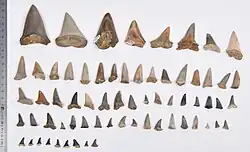
The teeth of C. plicatilis are more robust than C. hastalis, and the shape of the teeth varies greatly from individual to individual. The largest tooth reached 10.3 centimeters (4.1 in) and, Its teeth are quite similar to those of C. hastalis, which is why it is some palaeontologists suspect that it is not a distinct species, but rather a synonym or individual variation.
Distribution
Fossils of C. plicatilis have been found in deposits dated to the Miocene and Pliocene of North America, Europe, Australia, as well as possibly Asia, the Pacific Ocean, Portugal and South America. Fossils of C. plicatilis are very rare and that is why it is difficult to distinguish it from other species, as well as to synonymize it, especially with C. hastalis.
Paleobiology

The largest Lamnidae C. plicatilis was one of the top predators in the Miocene to Pliocene ecosystems. According to various fossil evidence, it had a macroraptorial diet, preying on medium-sized fish, dolphins, pinnipeds, and baleen whales 4–6 meters (13–20 ft) long.[13] It targeted prey similar to C. hastalis and the extant C. carcharias, but was able to target larger prey.
Hunting
According to the fossil record, C. plicatilis preyed on large marine mammals, such as small fin whales and beluga whales related species, during the Miocene. Tooth marks remaining on the skull indicate that C. plicatilis bit into the dolphin's head and crushed it instantly. This suggests that the genus Carcharodon possessed the ability to hunt marine mammals despite the absence of teeth side saw blade.[14] C. plicatilis found in is primarily found in the same areas as pinnipeds. This suggests that C. plicatilis preferred pinnipeds.[15]
References
- ↑ Pieter J. De Schutter; Rene W.N. van der Vliet; Taco J. Bor (2021). "Dental evolution of the 'serrated' mako shark, Isurus subserratus aka I. escheri (Chondrichthyes, Lamnidae) in the late Neogene of the North Sea Basin". Cainozoic Research. 21 (2): 173–192.
- ↑ Agassiz, L. (1843) Recherches sur les poissons fossiles, 15th and 16th livraisons (March 1843). Jent and Gassmann, Soleure (text) and H. Nicolet, Neuchâtel (planches). – vol. 3: [i]-[iv], 157-390, 382*-382**, 1–32, [33]-[34], pl. 1, 18, 22, 22a, 22b, 26a, 38, 40b, 40c, 40d, 45, 47
- ↑ "iDigBio Specimen Record | Carcharodon plicatilis". iDigBio Specimen Portal. Retrieved 2025-08-21.
- ↑ "A Morphometric Approach for Addressing Tooth-Based Species Delimitation in Fossil Mako Sharks, Isurus (Elasmobranchii: Lamniformes".
We suggest that an available and valid name for this species is Isurus plicatilis Agassiz, 1843 (Cione, 1988). ... Oldest record of the Great White ...)
- ↑ Collareta, Alberto; Landini, Walter; Chacaltana, César; Valdivia, Waldir; et al. "A well preserved skeleton of the fossil shark Cosmopolitodus hastalis from the late Miocene of Peru, featuring fish remains as fossilized stomach contents". Rivista Italiana di Paleontologia e Stratigrafia. Rivista Italiana di Paleontologia e Stratigrafia. Retrieved 5 October 2025.
- ↑ Joleaud, Léonce (1907). "Géologie et paléontologie de la Plaine du Comtat et de ses abords" (in French). Avignon: François Segon. Retrieved 5 October 2025 – via Gallica.
- ↑ Kowinsky, Jayson. "Prehistoric White Sharks: Learn about extinct White sharks and their Evolution". FossilGuy.com. Retrieved 2025-01-10.
- ↑ "Carcharodon plicatilis (Agassiz, 1843)". Shark-References. Retrieved 2024-11-12.
- ↑ "iDigBio Specimen Record | Carcharodon plicatilis". iDigBio Specimen Portal. Retrieved 2025-07-07.
- ↑ Alberto Collera; Marco Merella; Simone Casati; Giovanni Colleti; Andrea Di Cencio (2023). "Another thermophilic "Miocene survivor" from the Italian Pliocene: A geologically young occurrence of the pelagic eagle ray Aetobatus in the Euro-Mediterranean region". Carnets de Géologie.
- ↑ Malyshkina, T.P.; Nazarkin, M.V.; Solovyow, A.V. (2023). "An Oldest Record of the Shark Cosmopolitodus planus (Lamnidae) from the Lower Miocene of the Sakhalin, Russia". Journal of Ichthyology.
- ↑ Purdy, R. W.; Schneider, V. P.; Applegate, S. P.; Mclellan, J. H.; Meyer, R. L.; Slaughter, B. H (2001). "The Neogene Shark, Ray, and Bony Fishes from Lee Creek Mina, Aurora North Carolina". In Clayton, E. R.; Bohaska, D. J. (eds.). Geology and Paleontology of the Lee Creek Mine, North Carolina. 90. Vol. 3. Washington: Smithsonian Institution Press. pp. 71–202. hdl:10088/2006.
- ↑ Rivista Italiana di Paleontologia e Stratigrafia (Research in Paleontology and Stratigraphy) vol. 123(1): 11-22. March 2017
- ↑ Evidence for different shark species feeding on a diminutive right whale and a relative of the beluga in the Early Pliocene of the southern North Sea OLIVIER LAMBERT, JOHN R. STEWART, STEPHEN LOUWYE, LUC DE CONINCK, MARK BOSSELAERS, LUCILE CRÉTÉ, STIJN GOOLAERTS, CHRISTOPHE MALLET, and FREDERIK H. MOLLEN
- ↑ Perea, Daniel; Corona, Andrea; Ubilla, Martín; Manzuetti, Aldo; Badín, Ana Clara; Montenegro, Felipe; Toriño, Pablo; Rinderknecht, Andrés (2023-10-01). "The Camacho Formation of Uruguay (Late Miocene): New vertebrate findings, biostratigraphic update, associated environments, and chronostratigraphic remarks". Journal of South American Earth Sciences. 130 104585. Bibcode:2023JSAES.13004585P. doi:10.1016/j.jsames.2023.104585. ISSN 0895-9811.
External links
- Cosmopolitodus plicatilis (Agassiz, 1843) in Paleobiology Database (2024). The Paleobiology Database. Checklist dataset The Paleobiology Database accessed via GBIF.org on 2025-07-07.