2026 in arthropod paleontology
| List of years in arthropod paleontology |
|---|
This list records new taxa of fossil arthropods that were announced or described in 2026 (for insects, see 2026 in paleoentomology). Other peer-reviewed publications on discoveries related to arthropod paleontology which occurred in that year are also detailed here.
Chelicerates
Arachnids
Araneae
| Name | Novelty | Status | Authors | Age | Type locality | Country | Notes | Images |
|---|---|---|---|---|---|---|---|---|
|
Rovnopholcomma[1] |
Gen. et sp. nov |
Valid |
Eskov et al. |
A spider belonging to the family Theridiidae. Genus includes new species R. wunderlichi. |
||||

Ixodida
Tick research
- Chitimia-Dobler et al. (2026) redescribe Haemaphysalis (Alloceraea) cretacea on the basis of data from a new specimen from the Cretaceous amber from Myanmar, and recombine the species as Alloceraea cretacea.[2]
Opilioacarida
| Name | Novelty | Status | Authors | Age | Type locality | Country | Notes | Images |
|---|---|---|---|---|---|---|---|---|
|
Plesioacarus[3] |
Gen. et sp. nov |
Xuan et al. |
Cretaceous |
Kachin amber |
The type genus of the new family Plesioacaridae. The type species is P. minutus. |
|||

Opiliones
| Name | Novelty | Status | Authors | Age | Type locality | Country | Notes | Images |
|---|---|---|---|---|---|---|---|---|
|
Gen. et sp. nov |
Valid |
Bartel et al. |
Eocene |
Baltic amber |
Europe (Baltic Sea region) |
A harvestman belonging to the family Nemastomatidae. The type species is B. wunderlichi. |
 | |
Opiliones research
- A harvestman with pedipalp morphology distinct from those of other fossil and extant members of the group is described from the Eocene Baltic amber by Gerbe et al. (2026).[5]
Pseudoscorpiones
| Name | Novelty | Status | Authors | Age | Type locality | Country | Notes | Images |
|---|---|---|---|---|---|---|---|---|
|
Baltochthonius[6] |
Gen. et sp. nov |
Valid |
Turbanov et al. |
Eocene |
Baltic amber |
Europe (Baltic Sea region) |
A member of the family Chthoniidae. Genus includes new species B. andrushchenkoi. |
|
|
Burmachernes[7] |
Gen. et sp. nov |
Valid |
Willmott, Kotthoff & Harms |
Late Cretaceous (Cenomanian) |
Kachin amber |
A member of the family Chernetidae. The type species is B. cenomanium. |
||
|
Heterolophus eridanus[6] |
Sp. nov |
Valid |
Turbanov et al. |
Eocene |
Baltic amber |
Europe (Baltic Sea region) |
A species of Heterolophus. |
|
Pseudoscorpion research
- A female pseudoscorpion belonging to the group Iocheirata that carried a brood sac while grasping a leg of a fly is reported from a piece of the Eocene Baltic amber by Feng et al. (2026).[8]
Ricinulei
| Name | Novelty | Status | Authors | Age | Type locality | Country | Notes | Images |
|---|---|---|---|---|---|---|---|---|
|
Protoricinus[9] |
Gen. et comb. nov |
Valid |
Gamarra-Cuba, Selden & Delcls |
Late Cretaceous (Cenomanian) |
Kachin amber |
A new genus for "Poliochera" cretacea Wunderlich (2012). |
||
Sarcoptiformes
| Name | Novelty | Status | Authors | Age | Type locality | Country | Notes | Images |
|---|---|---|---|---|---|---|---|---|
|
Haplochthonius nortoni[10] |
Sp. nov |
Valid |
Vorontsov & Kolesnikov |
Late Cretaceous (Cenomanian) |
Kachin amber |
A member of the family Haplochthoniidae. |
||
Scorpiones
| Name | Novelty | Status | Authors | Age | Type locality | Country | Notes | Images |
|---|---|---|---|---|---|---|---|---|
|
Betaburmesebuthus andreschmidti[11] |
Sp. nov |
Valid |
Lourenço in Lourenço & Velten |
Cretaceous |
Kachin amber |
A scorpion belonging to the family Palaeoburmesebuthidae. |
||
|
Chaerilobuthus muelleri[12] |
Sp. nov |
Valid |
Lourenço in Lourenço & Velten |
Cretaceous |
Kachin amber |
A scorpion belonging to the family Chaerilobuthidae. |
||
|
Spinochaerilobuthus[13] |
Gen. et sp. nov |
Valid |
Lourenço in Lourenço & Velten |
Cretaceous |
Kachin amber |
A scorpion belonging to the family Chaerilobuthidae. The type species is S. andreschmidti. |
||
Scorpion research
- Howard et al. (2026) redescribe Praearcturus gigas, and interpret Brontoscorpio anglicus and Bennettarthra annwnensis as junior synonyms of P. gigas.[14]
Trombidiformes
| Name | Novelty | Status | Authors | Age | Type locality | Country | Notes | Images |
|---|---|---|---|---|---|---|---|---|
|
Acarohystrix[15] |
Gen. et sp. nov |
Valid |
Xuan et al. |
Late Cretaceous (Cenomanian) |
Kachin amber |
A mite distantly related to the extant Chyzeriidae; the type genus of the new family Acarohystricidae. The type species is A. magnifica. |
||
|
Calidothrombium[16] |
Gen. et sp. nov |
Valid |
Costa et al. |
Cretaceous |
Kachin amber |
A mite belonging to the family Tanaupodidae. The type species is C. burmiticum. |
||
|
Erythrites longifemoralis[17] |
Sp. nov |
Valid |
Liu, Fan & Ren |
Late Cretaceous (Cenomanian) |
Kachin amber |
A mite belonging to the family Erythraeidae. |
||
|
Erythrites multifoveolatus[17] |
Sp. nov |
Valid |
Liu, Fan & Ren |
Late Cretaceous (Cenomanian) |
Kachin amber |
A mite belonging to the family Erythraeidae. |
||
|
Protofilum[18] |
Gen. et sp. nov |
Valid |
Xuan, Zhang and Huang in Xuan et al. |
Cretaceous |
A mite belonging to the family Erythraeidae. The type species is P. ordinatum. |
|||
|
Punkochyzeria obtuse[15] |
Sp. nov |
Valid |
Xuan et al. |
Late Cretaceous (Cenomanian) |
Kachin amber |
A mite belonging to the family Acarohystricidae. |
||
Xiphosurans
| Name | Novelty | Status | Authors | Age | Type locality | Country | Notes | Images |
|---|---|---|---|---|---|---|---|---|
|
Polonolimulus[19] |
Gen. et sp. nov |
Valid |
Audycki et al. |
Zagnańsk/Goleniawy Formation |
A member of the family Austrolimulidae. The type species is P. zaleziankensis. |
 | ||

Xiphosuran research
- Fossils of large-bodied horseshoe crabs, associated with trace fossils assigned to the new ichnospecies Selenichnites sursumdeorsum, are described from the Ordovician (Darriwilian) Saq Formation (Saudi Arabia) by Bicknell et al. (2026), who interpret the presence of the studied specimens in a nearshore environment and their preservation in storm-deposited layers as possible evidence of similarity of spawning behaviors of Ordovician and modern horseshoe crabs.[20]
- Feng et al. (2026) report trace fossils from the Lower Triassic Daye Formation (China) interpreted as evidence of predation of horseshoe crabs on polychaetes.[21]
Other chelicerates
| Name | Novelty | Status | Authors | Age | Type locality | Country | Notes | Images |
|---|---|---|---|---|---|---|---|---|
| Magnicornaspis[22] | Gen. et sp. nov | Bicknell, Kimmig, Goodman, Turner & Smith | Cambrian Stage 10 | Rivière-du-Loup Formation |  Canada (  Quebec) |
A corcoraniid chelicerate. The type species is M. garwoodi. |  | |
|
Gen. et sp. nov |
Valid |
Lerosey-Aubril & Ortega-Hernández |
Cambrian |
A stem-chelicerate. The type species is M. cousteaui. |
 |


Other chelicerate research
- New information on the anatomy and affinities of the stem-chelicerate Urokodia aequalis is provided by Liu et al. (2026).[24]
Crustaceans
Malacostracans
| Name | Novelty | Status | Authors | Age | Type locality | Country | Notes | Images |
|---|---|---|---|---|---|---|---|---|
|
Bittnerilia lucentumensis[25] |
Sp. nov |
Valid |
Artal, Onetti & Àlex |
Eocene |
A crab belonging to the family Calappidae. |
|||
|
Cicero[26] |
Gen. et sp. nov |
Valid |
Lima et al. |
Early Cretaceous (Aptian) |
An isopod belonging to the family Archaeoniscidae. The type species is C. spectabilis. |
|||
|
Sp. nov |
Valid |
Clark |
Carboniferous |
A member of Peracarida belonging to the group Mysidacea. Published online in 2026, but the issue date is listed as October 2025. |
||||
|
Sp. nov |
Valid |
Clark |
Carboniferous |
A member of Peracarida belonging to the group Mysidacea. Published online in 2026, but the issue date is listed as October 2025. |
||||
|
Joeranina scheitzi[28] |
Sp. nov |
Valid |
Charbonnier et al. |
Early Cretaceous (Albian) |
A crab belonging to the family Palaeocorystidae. |
|||
|
Karumballichirus birmanica[29] |
Comb. nov |
Valid |
(Noetling) |
Miocene |
A member of the family Callichiridae; moved from Callianassa birmanica Noetling (1901). |
|||
|
Karumballichirus dijki[29] |
Comb. nov |
Valid |
(Martin) |
Miocene |
A member of the family Callichiridae; moved from Callianassa dijki Martin (1883). |
|||
|
Karumballichirus pseudoniloticus[29] |
Comb. nov |
Valid |
(Lőrenthey in Lőrenthey & Beurlen) |
Eocene |
A member of the family Callichiridae; moved from Callianassa pseudonilotica Lőrenthey in Lőrenthey & Beurlen (1929). |
|||
|
Karumballichirus pustulatus[29] |
Comb. nov |
Valid |
(Withers) |
Eocene-Oligocene |
A member of the family Callichiridae; moved from Callianassa pustulata Withers (1926). |
|||
|
Karumballichirus trechmanni[29] |
Comb. nov |
Valid |
(Withers) |
Eocene |
A member of the family Callichiridae; moved from Callianassa trechmanni Withers (1924). |
|||
|
Karumballichirus vidali[29] |
Comb. nov |
Valid |
(Vía Boada) |
Eocene |
A member of the family Callichiridae; moved from Callianassa vidali Vía Boada (1959). |
|||
|
Latheticocarcinus sergeevi[30] |
Sp. nov |
Valid |
Mychko & Schweitzer |
Paleocene (Thanetian) |
Saratov Formation |
A crab belonging to the family Homolidae. |
||
|
Lucentiplax[31] |
Gen. et sp. nov |
Valid |
Ferratges |
Eocene |
A crab belonging to the family Euryplacidae. Genus includes new species L. bravoi. |
|||
|
Nephropsis larryi[32] |
Sp. nov |
Valid |
Zollinger & Schweitzer |
Oligocene |
A species of Nephropsis. |
|||
|
Orgianopsus[33] |
Gen. et sp. nov |
Valid |
De Angeli & Garassino |
Eocene |
A crab belonging to the group Grapsoidea. Genus includes new species O. bericus. |
|||
|
Paranecrocarcinus perchati[28] |
Sp. nov |
Valid |
Charbonnier et al. |
Early Cretaceous (Albian) |
A crab belonging to the family Necrocarcinidae. |
|||
|
Pinnotheres prochowniki[34] |
Sp. nov |
Groff et al. |
Miocene |
A crab belonging to the family Pinnotheridae. |
||||
|
Polybius appeldoornae[35] |
Sp. nov |
Valid |
Coole & De Angeli |
Miocene |
A crab, a species of Polybius. |
|||
|
Pygocephalus brymboensis[36] |
Sp. nov |
Valid |
Astrop |
Carboniferous |
A member of Pygocephalomorpha. |
|||
|
Rathbunopon brisaci[28] |
Sp. nov |
Valid |
Charbonnier et al. |
Early Cretaceous (Albian) |
A crab belonging to the group Homolodromioidea and the family Prosopidae. |
|||
|
Gen. et sp. nov |
Valid |
Mychko & Schweitzer |
Paleocene (Thanetian) |
Saratov Formation |
A crab belonging to the family Necrocarcinidae. The type species is V. longispinus. |
|||


Malacostracan research
- Evidence of sexual dimorphism in the length and shape of the carapace of Soomicaris ordosensis is presented by Liu et al. (2026).[37]
- Revision of pygocephalomorphs belonging to the genus Pygocephalus from the Carboniferous strata from Nova Scotia (Canada) is published by Laville, Andréo & Atkins (2026).[38]
- Purported tanaidacean Cretitanais giganteus is reinterpreted as an isopod and a junior synonym of Urda stemmerbergensis by Schädel (2026).[39]
- A study on the moulting patterns and growth of Cretapenaeus berberus from the Cretaceous Kem Kem Group (Morocco) is published by Lynch et al. (2026).[40]
- Evidence of reduction of morphological diversity of extant members of Polychelida compared to their extinct relatives is presented by König et al. (2026).[41]
- Burrow casts interpreted as the first evidence of crayfish activity in the main Karoo Basin are reported from the Middle Triassic Burgersdorp Formation (South Africa) by Wolvaardt et al. (2026).[42]
- Luque et al. (2026) report the discovery of new fossil material of tepexicarcinoid crabs from the Cenomanian–Turonian strata of the Eagle Ford succession in Coahuila (Mexico), providing new information on the morphology of members of the superfamily.[43]
- Bicknell et al. (2026) study the exoskeletal elemental composition of Bombur complicatus, Caryocaris curvilata, Mecochirus sp., Sculda syriaca and Tealliocaris woodwardi, reporting evidence of higher levels of phosphorus in the studied taxa compared with modern crustaceans, either resulting from diagenetic phosphatization of fossil crustaceans or reflecting genuine composition of their original exoskeletons.[44]
- A study on changes of diversity of decapod crustaceans throughout their evolutionary history, as indicated by their fossil record, is published by Schweitzer, De Grave & Hyžný (2026).[45]
Ostracods
| Name | Novelty | Status | Authors | Age | Type locality | Country | Notes | Images |
|---|---|---|---|---|---|---|---|---|
|
Brasacypris mourae[46] |
Sp. nov |
Almeida-Lima et al. |
||||||
|
Cypridea buraigensis[47] |
Sp. nov |
Díez-Somolinos et al. |
Early Cretaceous (Barremian) |
Tragacete Formation |
A member of Podocopida belonging to the family Cyprideidae. |
|||
|
Cypridea cisnerosi[47] |
Sp. nov |
Díez-Somolinos et al. |
Early Cretaceous (Barremian) |
Tragacete Formation |
A member of Podocopida belonging to the family Cyprideidae. |
|||
|
Cypridea mohgi[47] |
Sp. nov |
Díez-Somolinos et al. |
Early Cretaceous (Barremian) |
Tragacete Formation |
A member of Podocopida belonging to the family Cyprideidae. |
|||
|
Cypridea plutoi[47] |
Sp. nov |
Díez-Somolinos et al. |
Early Cretaceous (Barremian) |
Tragacete Formation |
A member of Podocopida belonging to the family Cyprideidae. |
|||
|
Cypridea superposita[46] |
Sp. nov |
Almeida-Lima et al. |
||||||
|
Cypridea trapezoidalis[46] |
Sp. nov |
Almeida-Lima et al. |
||||||
|
Daleiella? cincinnatiensis[48] |
Sp. nov |
Valid |
Zhang et al. |
Ordovician |
A member of Podocopida belonging to the family Pachydomellidae. |
|||
|
Damonella bennui[47] |
Sp. nov |
Díez-Somolinos et al. |
Early Cretaceous (Barremian) |
Tragacete Formation |
A member of the family Candonidae. |
|||
|
Deyangia rhodopetra[49] |
Sp. nov |
Choi & Wang |
Early Cretaceous (Valanginian–Hauterivian) |
Cangxi Formation |
||||
|
Glyptocythere khabarovae[50] |
Sp. nov |
Valid |
Tesakova |
Middle Jurassic |
||||
|
Glyptocythere kiklica[50] |
Sp. nov |
Valid |
Tesakova |
Middle Jurassic |
||||
|
Glyptocythere scissa[50] |
Sp. nov |
Valid |
Tesakova |
Middle Jurassic |
||||
|
Glyptocythere transversa[50] |
Sp. nov |
Valid |
Tesakova |
Middle Jurassic |
||||
|
Gutschickia? araucaria[51] |
Sp. nov |
Valid |
Bergue et al. |
Permian (Lopingian) |
||||
|
Gutschickia? joelcastroi[51] |
Sp. nov |
Valid |
Bergue et al. |
Permian (Guadalupian) |
Teresina Formation |
|||
|
Jhurancythere[52] |
Gen. et sp. nov |
Valid |
Kumari & Mahalakshmi in Kumari, Mahalakshmi & Muduli |
Late Jurassic (Kimmeridgian) |
Jhuran Formation |
A member of the family Cytherideidae. Genus includes new species J. austerata. Published online in 2026, but the issue date is listed as December 2025. |
||
|
Milleratia binodosa[48] |
Sp. nov |
Valid |
Zhang et al. |
Ordovician |
Liberty Formation |
A member of Platycopida belonging to the family Primitiidae. |
||
|
Nostromo[47] |
Gen. et sp. nov |
Díez-Somolinos et al. |
Early Cretaceous (Barremian) |
Tragacete Formation |
A member of the family Notodromadidae. The type species is N. weaverae. |
|||
|
Petasobairdia scylla[53] |
Sp. nov |
Valid |
Forel, Sciuto & Reitano |
Late Triassic (Carnian) |
Mufara Formation |
A member of the family Bairdiidae. |
||
|
Rhinocypris? rlyehensis[47] |
Sp. nov |
Díez-Somolinos et al. |
Early Cretaceous (Barremian) |
Tragacete Formation |
A member of Podocopida belonging to the family Ilyocyprididae. |
|||
|
Rhinocypris spinacurtis[46] |
Sp. nov |
Almeida-Lima et al. |
||||||
|
Salvadoriella naharensis[47] |
Sp. nov |
Díez-Somolinos et al. |
Early Cretaceous (Barremian) |
Tragacete Formation |
A member of the family Candonidae. |
|||
|
Theriosynoecum compressum[46] |
Sp. nov |
Almeida-Lima et al. |
||||||
|
Theriosynoecum rodriguezlazaroi[47] |
Sp. nov |
Díez-Somolinos et al. |
Early Cretaceous (Barremian) |
Tragacete Formation |
A member of the family Limnocytheridae. |
|||
|
Triadohealdia kharybdis[53] |
Sp. nov |
Valid |
Forel, Sciuto & Reitano |
Late Triassic (Carnian) |
Mufara Formation |
A member of the family Healdiidae. |
||
|
Whipplella sanjeronimensis[51] |
Sp. nov |
Valid |
Bergue et al. |
Permian (Lopingian) |
Rio do Rasto Formation |
|||


Ostracod research
- A study on the composition of the Devonian (Pragian) ostracod assemblage from the Lilydale Limestone (Australia) is published by Camilleri et al. (2026).[54]
- Golfinopoulos et al. (2026) report the first discovery of ostracods from the Lower Jurassic strata exposed in Greece.[55]
- Evidence of impact of environmental changes in the Lake Pannon area on diversification of members of the genus Cyprideis during the middle and late Miocene is presented by Pipík, Gross & Starek (2026).[56]
Thecostracans
| Name | Novelty | Status | Authors | Age | Type locality | Country | Notes | Images |
|---|---|---|---|---|---|---|---|---|
|
Angulalepas[57] |
Gen. et comb. nov |
Valid |
Gale |
Late Cretaceous (Campanian) |
A barnacle, the type genus of the new family Angulalepadidae. The type species is "Pollicipes" nilssoni Steenstrup (1839); genus also includes "Calantica (Scillaelepas)" angulata Withers (1935). |
|||
|
Arcuatoscalpellum carlssoni[57] |
Sp. nov |
Valid |
Gale |
Late Cretaceous (Campanian) |
A barnacle belonging to the family Scalpellidae. |
|||
|
Bosquetlepas schneideri[58] |
Sp. nov |
Valid |
Gale & Jagt |
Late Cretaceous (Campanian) |
||||
|
Crithmumlepas alifer[59] |
Sp. nov |
Valid |
Gale |
|||||
|
Epibrachylepas lineatus[57] |
Sp. nov |
Valid |
Gale |
Late Cretaceous (Campanian) |
A barnacle belonging to the family Brachylepadidae. |
|||
|
Jagtscalpellum kaeckei[58] |
Sp. nov |
Valid |
Gale & Jagt |
Late Cretaceous (Campanian) |
||||
|
Microcorona[60] |
Gen. et sp. nov |
Valid |
Gale & Jagt |
Late Cretaceous (Campanian and Maastrichtian) |
A barnacle belonging to the family Brachylepadidae. The type species is M. girodi. |
|||
|
Protochelonibia collaretai[61] |
Sp. nov |
Valid |
Gale & Sadorf |
Pliocene |
Probably Yorktown Formation |
A barnacle belonging to the family Chelonibiidae. |
||
|
Regioscalpellum ahlbergi[57] |
Sp. nov |
Valid |
Gale |
Late Cretaceous (Campanian) |
A barnacle belonging to the family Scalpellidae. |
|||
|
Striatobalanus makiyamai[62] |
Sp. nov |
Valid |
Karasawa & Kobayashi |
Pleistocene |
A barnacle belonging to the family Balanidae. |
|||
|
Tubicinella nodai[62] |
Sp. nov |
Valid |
Karasawa & Kobayashi |
Pleistocene |
Shinzato Formation |
|||
|
Zeugmatolepas alifera[57] |
Sp. nov |
Valid |
Gale |
Late Cretaceous (Campanian) |
A barnacle belonging to the family Zeugmatolepadidae. |
|||
|
Zulloconcavus icenicus[59] |
Sp. nov |
Valid |
Gale |
|||||


Thecostracan research
- Cadena (2026) identifies borings produced by acrothoracican barnacles in a shell of the bivalve Ceratostreon boussingaulti from the Lower Cretaceous Rosablanca Formation (Colombia).[63]
Other crustaceans
| Name | Novelty | Status | Authors | Age | Type locality | Country | Notes | Images |
|---|---|---|---|---|---|---|---|---|
|
Magnitocyclus trearnensis[64] |
Sp. nov |
Clark, Hoare & Privitera Murdoch |
Carboniferous (Viséan) |
Hurlet Limestone |
A member of Cyclida. |
|||
|
Weichangiops squamosus[65] |
Sp. nov |
in press |
Wang, Ren & Zhao |
A notostracan. |
||||
Other crustacean research
- Gerbe, Zwanzig & Nützel (2026) study the composition of the Ordovician pentastomidan assemblage from the Öland island (Sweden), identifying two new morphotypes.[66]
- Wang et al provide an detailed description update for Weichangiops trangularis Yang & Hong, 1980 based on new fossil materials. The new fossils allow for the discussion of early Notostraca evolutionary processes.[65]
Insects
Trilobites
| Name | Novelty | Status | Authors | Age | Type locality | Country | Notes | Images |
|---|---|---|---|---|---|---|---|---|
|
Belgibole complanata[67] |
Sp. nov |
Valid |
Brezinski |
Carboniferous (Tournaisian) |
||||
|
Belgibole? madisonensis[67] |
Sp. nov |
Valid |
Brezinski |
Carboniferous (Tournaisian) |
Madison Group |
|||
|
Bohemilla xesta[68] |
Sp. nov |
Valid |
Ingham & Owen |
Ordovician (Katian) |
Published online in 2026, but the issue date is listed as October 2025. |
|||
|
Bollandia iugurtha[69] |
Sp. nov |
Valid |
Müller, Hahn & Becker |
Carboniferous (Tournaisian) |
||||
|
Brachymetopus swimmingwomanensis[67] |
Sp. nov |
Valid |
Brezinski |
Carboniferous (Tournaisian) |
Madison Group |
|||
|
Branikarges euanclarksoni[70] |
Sp. nov |
Valid |
Feist |
Devonian (Emsian) |
Izarne Formation |
Published online in 2026, but the issue date is listed as October 2025. |
||
|
Brevibole iuba[69] |
Sp. nov |
Valid |
Müller, Hahn & Becker |
Carboniferous (Tournaisian) |
||||
|
Brevibole numidiana[69] |
Sp. nov |
Valid |
Müller, Hahn & Becker |
Carboniferous (Viséan) |
||||
|
Buttsia mala[71] |
Sp. nov |
Valid |
Varlamov & Makarova |
|||||
|
Ceeops[72] |
Gen. et sp. nov |
Valid |
Adrain |
Ordovician (Tremadocian) |
A trilobite of uncertain affinities. The type species is C. housensis. |
|||
|
Ceratonurus janae[73] |
Sp. nov |
Valid |
Van Viersen & Müller |
Devonian (Emsian) |
Abadía Formation |
A member of the family Odontopleuridae. |
||
|
Changqingia andersonorum[74] |
Sp. nov |
Smith et al. |
Coonigan Formation |
|||||
|
Dadaops[73] |
Gen. et sp. nov |
Valid |
Van Viersen & Müller |
Devonian (Emsian) |
Abadía Formation |
A member of the family Acastidae. Genus includes new species D. nubeiru. |
||
|
Dinesus shergoldi[74] |
Sp. nov |
Smith et al. |
Cambrian Stage 4 |
Coonigan Formation |
||||
|
Dinesus whitehousei[74] |
Sp. nov |
Smith et al. |
Cambrian Stage 4 |
Coonigan Formation |
||||
|
Eoameura[67] |
Gen. et sp. nov |
Valid |
Brezinski |
Carboniferous (Tournaisian) |
Madison Group |
Genus includes new species E. kollari. |
||
|
Eoapatokephalus antiquus[71] |
Sp. nov |
Valid |
Varlamov & Makarova |
|||||
|
Gandlops apateon[73] |
Sp. nov |
Valid |
Van Viersen & Müller |
Devonian (Emsian) |
Abadía Formation |
A member of the family Acastidae. |
||
|
Sp. nov |
Valid |
Van Viersen & Müller |
Devonian (Emsian) |
Abadía Formation |
A member of the family Acastidae. |
|||
|
Jimlochaspis[75] |
Gen. et sp. et comb. nov |
Adrain & Pérez-Peris |
Ordovician |
Fillmore Limestone |
A member of the family Bathyuridae. The type species is J. copei; genus also includes "Goniurus" boggildi Poulsen (1927). |
|||
|
Sp. nov |
Valid |
Westrop, Dengler & Cuggy |
Cambrian |
Grosses-Roches Formation |
||||
|
Sp. nov |
Valid |
Westrop, Dengler & Cuggy |
Cambrian |
|||||
|
Koldinia arealica[71] |
Sp. nov |
Valid |
Varlamov & Makarova |
|||||
|
Koldiniura[71] |
Gen. et comb. nov |
Valid |
Varlamov & Makarova |
Genus includes "Koldiniella" prolixa Lazarenko (1968). |
||||
|
Koneprusia davidi[73] |
Sp. nov |
Valid |
Van Viersen & Müller |
Devonian (Emsian) |
Abadía Formation |
A member of the family Odontopleuridae. |
||
|
Latibole budili[69] |
Sp. nov |
Valid |
Müller, Hahn & Becker |
Carboniferous (Tournaisian) |
||||
|
Sp. nov |
Valid |
Van Viersen & Müller |
Devonian (Emsian) |
Abadía Formation |
A member of the family Odontopleuridae. |
|||
|
Sp. nov |
Valid |
Van Viersen & Müller |
Devonian (Emsian) |
Abadía Formation |
A member of the family Odontopleuridae. |
|||
|
Sp. nov |
Valid |
Van Viersen & Müller |
Devonian (Emsian) |
Abadía Formation |
A member of the family Odontopleuridae. |
|||
|
Sp. nov |
Valid |
Van Viersen & Müller |
Devonian (Emsian) |
Abadía Formation |
A member of the family Odontopleuridae. |
|||
|
Sp. nov |
Valid |
Müller, Hahn & Becker |
Carboniferous (Tournaisian) |
|||||
|
Liobolina montanaensis[67] |
Sp. nov |
Valid |
Brezinski |
Carboniferous (Tournaisian) |
Madison Group |
|||
|
Sp. nov |
Valid |
Van Viersen & Müller |
Devonian (Emsian) |
Abadía Formation |
A member of the family Harpetidae. |
|||
|
Sp. nov |
Smith et al. |
Cambrian Stage 4 |
Coonigan Formation |
|||||
|
Sp. nov |
Smith et al. |
Cambrian Stage 4 |
Coonigan Formation |
|||||
|
Omegops armeniensis[77] |
Sp. nov |
Valid |
Crônier et al. |
Devonian (Famennian) |
Published online in 2026, but the issue date is listed as October 2025. |
|||
|
Omegops paucilenticulatus[78] |
Sp. nov |
Valid |
Crônier & Mottequin |
Devonian (Famennian) |
Étrœungt Formation |
|||
|
Onaraspis cymbricensis[74] |
Sp. nov |
Smith et al. |
Cambrian Stage 4 |
Coonigan Formation |
||||
|
Onchocephalus? warrisi[74] |
Sp. nov |
Smith et al. |
Cambrian Stage 4 |
Coonigan Formation |
||||
|
Panibole begaaensis[69] |
Sp. nov |
Valid |
Müller, Hahn & Becker |
Carboniferous (Tournaisian) |
||||
|
Perexigupyge angusticapitalis[67] |
Sp. nov |
Valid |
Brezinski |
Carboniferous (Tournaisian) |
Madison Group |
|||
|
Perunaspis pachyprymna[73] |
Sp. nov |
Valid |
Van Viersen & Müller |
Devonian (Emsian) |
Abadía Formation |
A member of the family Lichidae. |
||
|
Phillibole? acutis[67] |
Sp. nov |
Valid |
Brezinski |
Carboniferous (Tournaisian) |
Madison Group |
|||
|
Piltonia douglassi[67] |
Sp. nov |
Valid |
Brezinski |
Carboniferous (Tournaisian) |
Madison Group |
|||
|
Piltonia sandoi[67] |
Sp. nov |
Valid |
Brezinski |
Carboniferous (Tournaisian) |
Madison Group |
|||
|
Proetides raymondi[67] |
Sp. nov |
Valid |
Brezinski |
Carboniferous (Tournaisian) |
Madison Group |
|||
|
Sp. nov |
Valid |
Basse & Schöning |
Silurian |
|||||
|
Sp. nov |
Valid |
Basse & Schöning |
Silurian |
|||||
|
Sp. nov |
Valid |
Basse & Schöning |
Silurian |
|||||
|
Sp. nov |
Valid |
Basse & Schöning |
Silurian |
|||||
|
Pseudokotuia[80] |
Gen. et sp. nov |
Valid |
Ren et al. |
Cambrian (Paibian) |
Chaumitien Formation |
A member of the family Anomocaridae. Genus includes new species P. quadrata. The final version of the article naming it was published online in 2026, but the issue date is listed as December 2025. |
||
|
Pulcherproetus inexspectatus damsdorfensis[79] |
Ssp. nov |
Valid |
Basse & Schöning |
Silurian |
||||
|
Pulcherproetus rudolphi[79] |
Sp. nov |
Valid |
Basse & Schöning |
Silurian |
||||
|
Radiantospina[81] |
Gen. et sp. nov |
Valid |
Pérez-Peris in Pérez-Peris et al. |
Ordovician (Tremadocian) |
A member of the family Cheiruridae. The type species is R. helioaspis. |
|||
|
Sp. nov |
Smith et al. |
Cambrian Stage 4 |
Coonigan Formation |
|||||
|
Rhyncholamproetus[73] |
Gen. et comb. nov |
Valid |
Van Viersen & Müller |
Devonian (Emsian to Eifelian) |
A member of Proetida. The type species is "Cornuproetus (Diademaproetus)" antatlasius Alberti (1969). |
|||
|
Signatoproetus leviconvexus[79] |
Sp. nov |
Valid |
Basse & Schöning |
Silurian |
||||
|
Signatoproetus muelleri[79] |
Sp. nov |
Valid |
Basse & Schöning |
Silurian |
||||
|
Smoothcanyonops[72] |
Gen. et 2 sp. nov |
Valid |
Adrain |
Ordovician (Tremadocian) |
Fillmore Limestone |
A trilobite of uncertain affinities. The type species is S. smoothcanyonensis; genus also includes S. middlensis. |
||
|
Sp. nov |
Smith et al. |
Cambrian Stage 4 |
Coonigan Formation |
|||||
|
Thigriffides? andersoni[67] |
Sp. nov |
Valid |
Brezinski |
Carboniferous (Tournaisian) |
Madison Group |
|||
|
Sp. nov |
Valid |
Yuan, Ren & Gao in Yuan et al. |
Cambrian (Guzhangian) |
Changhia Formation |
A member of Ptychopariida belonging to the family Diceratocephalidae. |
|||
|
Tropidocoryphe acanthonota[73] |
Sp. nov |
Valid |
Van Viersen & Müller |
Devonian (Emsian) |
Abadía Formation |
A member of the family Tropidocoryphidae. |
||
|
Wenlowiproetus[79] |
Gen. et 5 sp. et comb. et ssp. nov |
Valid |
Basse & Schöning |
Silurian |
The type species is W. ruegenianus; genus also includes new species W. glaciportans, W. hiddenseeensis, W. lupus and W. polonicus, as well as W. erraticus (including new subspecies W. erraticus sueselensis). |
|||
|
Sp. nov |
Valid |
Yuan in Yuan et al. |
Cambrian (Guzhangian) |
Kushan Formation |
A member of Ptychopariida belonging to the family Diceratocephalidae. |
|||
|
Sp. nov |
Valid |
Yuan in Yuan et al. |
Cambrian (Guzhangian) |
Changhia Formation |
A member of Ptychopariida belonging to the family Diceratocephalidae. |
|||
|
Xingrenaspis krusei[74] |
Sp. nov |
Smith et al. |
Cambrian Stage 4 |
Coonigan Formation |
||||


Trilobite research
- Evidence supporting the interpretation of trilobite exopodites as having respiratory function is presented by Losso et al. (2026).[83]
- A study on the evolution of the morphological diversity of cephala and pygidia in Cambrian and Ordovician trilobites is published by Suárez & Esteve (2026).[84]
- Collantes et al. (2026) reconstruct the ventral anatomy of Yunnanocephalus yunnanensis, reporting evidence of preservation of uniramous antennae and a series of cephalic and thoracic appendages in the studied fossil material.[85]
- New information on the soft tissue anatomy of Palaeolenus douvillei is provided by Zhang & Liu (2026).[86]
- A study on changes in the morphology of Kaotaia globosa during its life history is published by Chen et al. (2026).[87]
- Tortello et al. (2026) study the composition of two trilobite assemblages from the Umachiri Inlier of the Peruvian Altiplano, providing evidence of presence of cosmopolitan taxa in the Cambrian Llallahue Formation and presence of taxa with Gondwanan affinities in the Ordovician Umachiri Formation.[88]
- Evidence of preservation of remains of the digestive system is reported in specimens of Ptychoparioides henkli from the Cambrian Buchava Formation (Czech Republic) by Fatka, Budil & Micka (2026).[89]
- Zhu (2026) reports the discovery of an internal mold of Archikainella vomerinus from the Cambrian (Furongian) Sandu Formation (China), providing new information on the ventral structure of lichakephalid trilobites.[90]
- Beech et al. (2026) evaluate possible functions of cephalic brims of trilobites of the order Harpetida and the superfamily Trinucleioidea, finding no evidence that the brims were an adaptation that prevented sinking into soft sediments, and finding no evidence of clear evolutionary trend in the evolution of the brims that would make them more efficient at ploughing through sediments.[91]
- Vargas-Parra & Hopkins (2026) report evidence of decrease of modularity of the head Lonchodomas chaziensis across its metamorphosis from three to two modules, and evidence of mosaic shifts in shape and degree of integration of modules before and during metamorphosis.[92]
- Mahata & Pates (2026) revise the fossil record of abnormalities in specimens of Paradoxides davidis, and interpret the studied abnormalities as more likely resulting from injuries than from developmental aberrations.[93]
- A study on changes of geographical distribution of olenid trilobites throughout their evolutionary history, and on factors influencing their expansion and eventual decline, is published by Monti & Serra (2026).[94]
- Evidence from the study of the spatio-temporal distribution of trilobites during the Ordovician-Silurian transition, indicating that trilobites began to recover immediately following the second episode of the Late Ordovician mass extinction, is presented by Wei et al. (2026).[95]
- A study on the phylogenetic relationships of members of the family Homalonotidae is published by Martins et al. (2026).[96]
- Bel Haouz et al. (2026) report the discovery of a diverse assemblage of trace fossils from the Devonian (Famennian) strata of the Aoufilal Formation (Morocco) dominated by trilobite traces, preserving evidence of gregarious behavior of trilobites and possible evidence of tracemaker of Diplichnites gouldi stalking producers of other traces, and name a new ichnotaxon Rusophycus antiatlasensis.[97]
- Jordan-Burmeister (2026) reconstructs changes of connectivity of proetid trilobite assemblages from different regions in the time interval from the Devonian (Famennian) to the end of the Carboniferous.[98]
- Kudo & Shiino (2026) study the taphonomy of fossils of members of the genus Pseudophillipsia from the Permian Kamiyasse Formation (Japan), interpreted as indicative of adaptations of the two studied species to different benthic conditions.[99]
- Bicknell et al. (2026) revise the record of trilobite specimens with malformations from the collections of the Yale Peabody Museum.[100]
Other arthropods
| Name | Novelty | Status | Authors | Age | Type locality | Country | Notes | Images |
|---|---|---|---|---|---|---|---|---|
|
Atropicaris sinensis[101] |
Sp. nov |
Zhao & Hu in Zhao et al. |
Middle Triassic |
A member of Thylacocephala. |
||||
|
Gen. et sp. nov |
Valid |
Guo et al. |
Cambrian |
Hongjingshao Formation |
A bivalved arthropod belonging to the group Odaraiida and the family Pectocarididae. The type species is C. clarksoni. Published online in 2026, but the issue date is listed as October 2025. |
 | ||
|
Cretohenicops[103] |
Gen. et sp. nov |
Valid |
Hu, Jin & Di |
Cretaceous |
Kachin amber |
A centipede belonging to the family Henicopidae. Genus includes new species C. calcaratus. |
||
|
Cryptops leachi[104] |
Sp. nov |
Valid |
Mao & Di |
Mid-Cretaceous |
A centipede. |
|||
|
Eoanajapyx[105] |
Gen. et sp. nov |
Wang et al. |
Cretaceous |
A member of Diplura belonging to the family Anajapygidae. Genus includes new species E. yinae. |
||||
|
Sp. nov |
Valid |
Yoshino & Oji |
Ordovician |
Fezouata Formation |
||||
|
Gen. et sp. nov |
Valid |
Liu et al. |
Cambrian |
An arthropod with a morphology intermediate between those seen in radiodonts and in upper stem-group euarthropods. Genus includes new species O. bergstroemi. |
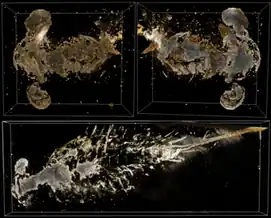 | |||
|
Quadrangulucaris[108] |
Gen. et comb. et sp. nov |
Valid |
Laville & Bicknell |
Carboniferous |
A member of Thylacocephala. The type species is "Concavicaris" georgeorum Schram (1990); genus also includes new species Q. rostellata. |
|||
|
Rotundaparma[108] |
Gen. et comb. nov |
Valid |
Laville & Bicknell |
Carboniferous |
A member of Thylacocephala. The type species is "Ceratiocaris" sinuatus Meek & Worthen (1868). |
|||
|
Sp. nov |
Valid |
Laibl et al. |
Ordovician (Katian) |
Králův Dvůr Formation |
A member of the family Naraoiidae. |
|||
|
Sp. nov |
Valid |
Zhai et al. |
Cambrian Stage 3 |
Yu'anshan Formation |
Possibly a member of Pancrustacea related to ostracods or to the clade including Ostracoda and Leptostraca;[110] a member of the family Sunellidae. |
 | ||
|
Sp. nov |
Nomen nudum[110] |
Liu et al. |
Helinpu Formation |
Initially being described as a basal arthropod of the family Sunellidae. Later considered invalid and conspecific with S. chimera by Zhai et al. 2026[110] |  | |||
|
Triangulusinus[108] |
Gen. et sp. nov |
Valid |
Laville & Bicknell |
Carboniferous |
Linton Formation |
A member of Thylacocephala. The type species is T. pustulosus. |
||
|
Sp. nov |
In press |
Izquierdo-López et al. |
Cambrian |
A non-trilobite arthropod. |
||||
|
Sp. nov |
Sun, Zeng & Zhao |
Cambrian |
||||||
|
Gen. et sp. nov |
Valid |
Briggs et al. |
Silurian |
 | ||||


- Purported bradoriid "Liangshanella" qassutit is reinterpreted as a phosphatocopid and transferred to the genus Comleyopsis by Streng & Peel (2026).[115]
- Evidence from the study of the anatomy of Zonozoe drabowiensis and Zonoscutum solum, interpreted as supporting their placement within Artiopoda and strengthening the case for a their affinity with Vicissicaudata, is presented by Lustri et al. (2026).[116]
- Yang et al. (2026) provide new information on the morphology of Acanthomeridion serratum and study its phylogenetic affinities, recovering it as a member of Vicissicaudata closely related to Sidneyia.[117]
- Mai et al. (2026) revise Pisinnocaris subconigera and interpret it as a valid, distinct taxon within Fuxianhuiida.[118]
- Le Cadre et al. (2026) study the fossil record of polyxenid and synxenid millipedes, reporting evidence of increase of their body size Cretaceous to the Eocene, and its subsequent decrease.[119]
General research
- Baucon et al. (2026) interpret trace fossils assigned to the ichnogenus Paleodictyon as most likely produced by marine arthropods.[120]
- Izquierdo-López, Jiao & Pates (2026) describe rake-like appendages from the Cambrian Wulongqing Formation (Yunnan, China) interpreted as belonging to a previously unknown suspension-feeding arthropod and review known diversity of suspension-feeding arthropods, identifying two functional groups from Cambrian and Ordovician that lack modern representatives.[121]
- Daley et al. (2026) describe new arthropod material from the Ordovician Cabrières Biota (France), refute purported evidence of presence of phyllocarids in the Cabrières Biota, and interpret the studied arthropod assemblage as including trilobites, a probable member of Aglaspidida and a possible member of Chasmataspidida and spiny appendage fragments.[122]
- Lakeram et al. (2026) describe borings in a coal ball from the Carboniferous strata from the Mt. Rorah Coal Member of the Tradewater Formation (Illinois, United States), interpreted as produced by arthropods (possibly roachoid insects or millipedes) feeding on the roots of Psaronius, and report preservation of two types of arthropod-produced coprolites in the studied borings, including smaller pellets possibly produced by oribatid mites feeding on larger pellets.[123]
- Review of progress in the study of relationships and evolution of Cambrian euarthropods from the preceding years is published by Ortega-Hernández (2026).[124]
References
- ↑ Eskov, K. Y.; Vorontsov, D. D.; Marusik, Y. M.; Perkovsky, E. E. (2026). "First pholcommatine cobweb spider from Eocene Rovno amber, with a delimitation of the subfamily Pholcommatinae (Araneae: Theridiidae)". Palaeoentomology. 9 (1): 45–55. Bibcode:2026Plegy...9...45E. doi:10.11646/palaeoentomology.9.1.6.
- ↑ Chitimia-Dobler, L.; Mey, C.; Harms, D.; Hammel, J.; Dunlop, J. A.; Kotthoff, U.; Mans, B. J. (2026). "Redescription of Alloceraea cretacea (Acari: Ixodida) with an additional nymphal fossil added to this species: Novel insights into the evolution of the Haematobothrion". Parasitology. 153 (5): 625–632. doi:10.1017/S0031182026101826. PMC 13315209. PMID 41782212.
- ↑ Xuan, Q.; Zhang, Z.-Q.; Cai, C.-Y.; Huang, D.-Y. (2026). "A new Cretaceous opilioacarid family sheds light on early evolution of Parasitiformes (Arthropoda: Arachnida)". Journal of Systematics and Evolution.
- ↑ Bartel, C.; Mitov, P. G.; Dunlop, J. A.; Hammel, J. U. (2026). "3D analyses of the first ortholasmatine harvestmen from European Eocene ambers". Acta Palaeontologica Polonica. 71 (1): 95–107. doi:10.4202/app.01283.2025.
- ↑ Gerbe, A.; Bartel, C.; Haug, C.; Arce, S. I.; Dunlop, J.; Haug, J. T. (2026). "An unusual harvestman from Eocene Baltic amber presenting a previously unknown morphology of the pedipalps". Fossil Record. 29 (1): 1–9. Bibcode:2026FossR..29....1G. doi:10.3897/fr.29.174226.
- 1 2 Turbanov, I. S.; Kolesnikov, V. B.; Shadrin, D. S.; Vorontsov, D. D. (2026). "A new contribution to the study of subfamily Tridenchthoniinae Balzan, 1892 (Pseudoscorpiones: Chthoniidae) from the late Eocene Baltic amber with the description of Baltochthonius andrushchenkoi gen. et sp. nov. and Heterolophus eridanus sp. nov". Zootaxa. 5807 (1): 125–149. doi:10.11646/zootaxa.5807.1.5. PMID 42408397.
- ↑ Willmott, L. A.; Kotthoff, U.; Harms, D. (2026). "First fossil of the pseudoscorpion family Chernetidae Menge, 1855 (Arachnida, Pseudoscorpiones) from mid-Cretaceous Burmese amber". Evolutionary Systematics. 10 (1): 101–111. doi:10.3897/evolsyst.10.190572.
- ↑ Feng, C.; Jouault, C.; Zhang, Q.; Boom, A.; Christophoryová, J.; Guo, X.; Gao, Y.; Xu, C.; Liu, Y. (2026). "Frozen parental care behavior in a pseudoscorpion trapped in Eocene Baltic amber". iScience. 29 (9) 117264. doi:10.1016/j.isci.2026.117264.
- ↑ Gamarra-Cuba, M.; Selden, P. A.; Delcls, X. (2026). "New ricinuleids from Cenomanian Kachin amber (Myanmar) and a reassessment of †?Poliochera cretacea (Arachnida: Ricinulei)". Palaeoentomology. 9 (4): 213–216. doi:10.11646/palaeoentomology.9.4.5.
- ↑ Vorontsov, D. D.; Kolesnikov, V. B. (2026). "Wet or dry: A new fossil species of Haplochthonius (Acari: Enarthronota: Haplochthoniidae) provides new evidence for paleoclimate of Cretaceous Myanmar amber forest". Acarologia. 66 (3): 637–652. doi:10.24349/ljn4-x21m.
- ↑ Lourenço, W. R.; Velten, J. (2026). "Reanalysis of the family Palaeoburmesebuthidae Lourengo, 2015, the first described scorpion lineage from Cretaceous Myanmar amber". Faunitaxys. 14 (52): 1–9. doi:10.57800/faunitaxys-14(52).
- ↑ Lourenço, W. R.; Velten, J. (2026). "New considerations about the outstanding variability of the genus Chaerilobuthus Lourenco & Beigel, 2011 (Scorpiones: Chaerilobuthidae) and the description of one more new species from Early Cretaceous Burmite". Faunitaxys. 14 (11): 1–6. doi:10.57800/faunitaxys-14(11).
- ↑ Lourenço, W. R.; Velten, J. (2026). "Description of a new genus and species associated to the family Chaerilobuthidae Lourenco & Beigel, 2011 from Early Cretaceous Burmite (Chelicerata: Scorpiones)". Faunitaxys. 14 (29): 1–8. doi:10.57800/faunitaxys-14(29).
- ↑ Howard, R. J.; Garwood, R. J.; Edgecombe, G. D.; Legg, D. A. (2026). "A revision of Praearcturus gigas: a giant scorpion from the Lower Devonian (Lochkovian) of Britain". Palaeontology. 69 (3) e70064. Bibcode:2026Palgy..6970064H. doi:10.1111/pala.70064.
- 1 2 Xuan, Q.; Zhang, Z.-Q.; Cai, C.-Y.; Huang, D.-Y. (2026). "Looks can be deceiving: convergent hair tufts mask a new lineage of Cretaceous mites". Mesozoic. 3 (1): 1–43. doi:10.11646/mesozoic.3.1.1.
- ↑ Costa, S. G. S.; Klimov, P. B.; Moreira, D. B. P.; Wang, H.; Assis-Silva, M. H.; Pepato, A. R. (2026). "From warm to cold habitats: a Cretaceous Tanaupodidae fossil reveals a major climatic niche shift and wider past distribution in winter-active mites". Proceedings of the Royal Society B: Biological Sciences. 293 (2075) 20261497. doi:10.1098/rspb.2026.1497. PMID 42481057.
- 1 2 Liu, Y.; Fan, Q.-H.; Ren, D. (2026). "New fossils of Erythraeidae (Acari: Trombidiformes: Parasitengona) from Cretaceous Myanmar amber". Systematic and Applied Acarology. 31 (5): 885–898. doi:10.11158/saa.31.5.13.
- ↑ Xuan, Q.; Zhang, Z.-Q.; Cai, C.; Li, S.; Huang, D. (2026). "Silk-mediated queueing migration in Cretaceous mites". Proceedings of the Royal Society B: Biological Sciences. 293 (2071) 20260271. doi:10.1098/rspb.2026.0271. PMID 42191160.
- ↑ Audycki, J.; Bicknell, R. D. C.; Niedźwiedzki, G.; De Baets, K. (2026). "A new Triassic austrolimulid from Poland presents insight into xiphosurid evolution and palaeobiogeography at the dawn of the Mesozoic". PeerJ. 14 e20950. Bibcode:2026PeerJ..1420950A. doi:10.7717/peerj.20950. PMC 13032753. PMID 41907462.
- ↑ Bicknell, R. D. C.; Kimmig, J.; Cuomo, C.; Goodman, A.; Edgecombe, G. D.; Issautier, B.; Freedman, J. (2026). "Ordovician horseshoe crab body and trace fossil association preserved in a unique taphonomic setting". Gondwana Research. 153: 377–386. Bibcode:2026GondR.153..377B. doi:10.1016/j.gr.2025.11.011.
- ↑ Feng, X.; Chen, Z.-Q.; Benton, M. J.; Bottjer, D. J.; Cribb, A. T.; Su, L.; Zhao, L.; Jiang, Y.; Zhao, H.; Yan, P.; Huang, Y. (2026). "Predator-prey interactions in the Early Triassic ocean". GSA Bulletin. doi:10.1130/B38121.1.
- ↑ Bicknell, Russell D. C.; Kimmig, Julien; Goodman, Aaron; Turner, Thomas; Smith, Patrick M. (2026-05-28). "New exceptionally preserved arthropod from the Furongian of Canada". BMC Biology. 24 (1): 119. doi:10.1186/s12915-026-02617-4. ISSN 1741-7007. PMC 13220627. PMID 42210270.
- ↑ Lerosey-Aubril, R.; Ortega-Hernández, J. (2026). "A chelicera-bearing arthropod reveals the Cambrian origin of chelicerates". Nature. 652 (8111): 931–937. Bibcode:2026Natur.652..931L. doi:10.1038/s41586-026-10284-2. PMID 41922763.
- ↑ Liu, Y.; Lustri, L.; Mai, H.; Williams, M.; Liu, L.; Tang, Y.; Harvey, T. H. P.; Hou, X. (2026). "Urokodia sheds light on the origin of chelicerae and book gills of Chelicerata". Nature. 656 (8128): 653–658. doi:10.1038/s41586-026-10713-2. PMID 42386960.
- ↑ Artal, P.; Onetti, A.; Àlex, O. (2026). "A new calappid crab (Crustacea: Decapoda) from the Lutetian (middle Eocene) of Alicante (Spain)". Bulletin of the Mizunami Fossil Museum. 53 (1): 1–7. doi:10.50897/bmfm.53.1_1.
- ↑ Lima, D.; Anker, A.; Heads, S. W.; Pinheiro, A. P.; Santana, W. (2026). "Aptian archaeoniscid isopod from the Araripe Basin supports Tethyan-linked dispersal into Gondwanan lacustrine systems". Scientific Reports. 16 (1) 23631. Bibcode:2026NatSR..1623631L. doi:10.1038/s41598-026-59890-0. PMC 13424305. PMID 42471379.
- 1 2 Clark, N. D. L. (2026). "Review of the genus Crangopsis (Crustacea: Malacostraca: Peracarida) with a description of two new species from the Carboniferous of Scotland". Earth and Environmental Science Transactions of the Royal Society of Edinburgh. 116 (3–4): 252–266. doi:10.1017/S1755691025100789.
- 1 2 3 Charbonnier, S.; Garassino, A.; Devillez, J.; Brochet, R. (2026). "New record of crabs and lobsters from the Early Cretaceous (Albian) of Haute-Marne, France". Geodiversitas. 48 (8): 145–157. Bibcode:2026Geodv..48v48a8C. doi:10.5252/geodiversitas2026v48a8.
- 1 2 3 4 5 6 Poore, G. C. B.; Dworschak, P. C.; Robles, R.; Hyžný, M. (2026). "Extant and fossil species of Karumballichirus (Decapoda: Axiidea: Callichiridae)". Nauplius. 34 e20260605. Bibcode:2026Naup...3460605P. doi:10.1590/2358-2936e20260605.
- 1 2 Mychko, E. V.; Schweitzer, C. E. (2026). "Discovery of decapods from the Paleocene of Russia (Saratov Oblast) with review of all known Paleocene decapods". Palaeontologia Electronica. 29 (1) 29.1.a9. doi:10.26879/1585.
- ↑ Ferratges, F. A. (2026). "Paleobiogeographic implications of a new goneplacoid crab (Goneplacoidea, Euryplacidae) from the middle Eocene of Spain". Historical Biology: An International Journal of Paleobiology. 38 (8): 2435–2445. Bibcode:2026HBio...38.2435F. doi:10.1080/08912963.2026.2621121.
- ↑ Zollinger, N.; Schweitzer, C. E. (2026). "A new species of Nephropsis (Decapoda: Nephropidae) from the Late Oligocene of the Lincoln Creek Formation". Bulletin of the Mizunami Fossil Museum. 53 (1): 65–75. doi:10.50897/bmfm.53.1_65.
- ↑ De Angeli, A.; Garassino, A.; Àlex, O. (2026). "Orgianopsus bericus n. gen., n. sp. (Decapoda, Grapsoidea) from the late Eocene of San Feliciano hill (Orgiano, Monti Berici, Vicenza, NE Italy)". Neues Jahrbuch für Geologie und Paläontologie - Abhandlungen. doi:10.1127/njgpa/1325.
- ↑ Groff, S. C.; Perez, V. J.; Schweitzer, C. E.; Nance, J. R.; Deltrove, C. C. (2026). "Exceptionally preserved pea crabs (Decapoda, Brachyura, Pinnotheroidea) from the Miocene St. Marys Formation, eastern USA, exhibiting preferential symbiosis with the surf clam Mactrodesma subponderosa (Ward, 1992)". Journal of Crustacean Biology. 46 (3) ruag041. doi:10.1093/jcbiol/ruag041.
- ↑ Coole, Y.; De Angeli, A. (2026). "Polybius appeldoornae n. sp. (Decapoda, Brachyura, Polybiidae) from the Miocene of Savigné-sur-Lathan (France)". Neues Jahrbuch für Geologie und Paläontologie - Abhandlungen. 317 (3): 265–270. Bibcode:2026NJGPA.317..265C. doi:10.1127/njgpa/1314.
- ↑ Astrop, T. (2026). "A new pygocephalomorph crustacean from the Brymbo Fossil Forest (Moscovian), North Wales, UK and a reassessment of the genus Pygocephalus". Journal of Systematic Palaeontology. 24 (2) 2699904. doi:10.1080/14772019.2026.2699904.
- ↑ Liu, Y.; Hegna, T. A.; Liu, Y.; Fan, R.; Zong, R.; Gong, Y. (2026). "Sexual dimorphism in a Late Ordovician caryocaridid (Malacostraca, Phyllocarida) identified by carapace geometric morphometrics". Paleobiology. 52 (2): 254–264. Bibcode:2026Pbio...52..254L. doi:10.1017/pab.2026.10092.
- ↑ Laville, T.; Andréo, A.; Atkins, J. B. (2026). "Pygocephalid pancrustaceans from the late Carboniferous of Nova Scotia, Canada, with comments on the cuticular microstructures of Pygocephalamorpha". Atlantic Geoscience. 62: 001–020. doi:10.4138/atlgeo.2026.001.
- ↑ Schädel, M. (2026). "The largest fossil tanaidacean is not a tanaidacean – Cretitanais giganteus (Malzahn, 1979) is a junior synonym of Urda stemmerbergensis (Malzahn, 1968)". Open Palaeontology. 3 (1): 1–9. doi:10.26034/la.opal.2026.9328.
- ↑ Lynch, S.; Gueriau, P.; Drage, H. B.; Dutheil, D. B.; Charbonnier, S.; Corthésy, N.; Luque, J.; Martin Olmos, C.; Daley, A. C. (2026). "Moulting and development in a freshwater prawn from the Cretaceous of Morocco". PeerJ. 14 e20463. Bibcode:2026PeerJ..1420463L. doi:10.7717/peerj.20463. PMC 13070322. PMID 41978883.
- ↑ König, C.; Haug, C.; Haug, J. T.; Braig, F. (2026). "Morphological diversity of extant polychelidan lobsters does not reach former heights despite the evolution of morphological differentiation during development". Bulletin of Geosciences. 101 (2): 247–261.
- ↑ Wolvaardt, F. P.; Smith, R. M. H.; Hancox, P. J.; Browning, C.; Strong, M. (2026). "Palaeoenvironmental significance of vertebrate and invertebrate burrow casts in the Middle Triassic Burgersdorp Formation of the main Karoo Basin". Journal of African Earth Sciences. 237 106048. Bibcode:2026JAfES.23706048W. doi:10.1016/j.jafrearsci.2026.106048.
- ↑ Luque, J.; Porras-Múzquiz, H.; Omaña, L.; Nyborg, T. G.; González-León, O.; Vega, F. J. (2026). "Cretaceous eubrachyuran crabs (superfamily Tepexicarcinoidea n. status) associated to the Oceanic Anoxic Event 2 (OAE2) event in NE Mexico". Journal of South American Earth Sciences. 176 106043. Bibcode:2026JSAES.17606043L. doi:10.1016/j.jsames.2026.106043.
- ↑ Bicknell, R. D. C.; Smith, P. M.; Klompmaker, A. A.; Hegna, T. (2026). "Surveying the elemental composition of fossil malacostracan crustacean cuticle". American Museum Novitates (4046): 1–36. hdl:2246/7530.
- ↑ Schweitzer, C. E.; De Grave, S.; Hyžný, M. (2026). "Benchmarking the global biodiversity of decapod crustaceans in the fossil record". Journal of Crustacean Biology. 46 (1) ruag007. doi:10.1093/jcbiol/ruag007.
- 1 2 3 4 5 de Almeida-Lima, D. S.; Piovesan, E. K.; Mendes Britto, D. M.; Sousa, A. S. (2026). "Taxonomy of Ostracods from the Late Jurassic–Early Cretaceous Gondwanan Rift Basins of Northeastern Brazil". Historical Biology: An International Journal of Paleobiology: 1–33. doi:10.1080/08912963.2025.2585358.
- 1 2 3 4 5 6 7 8 9 Díez-Somolinos, M.; Sames, B.; Berrocal-Casero, M.; Barroso-Barcenilla, F. (2026). "New species and a new genus of non-marine ostracods (Crustacea, Ostracoda) in the upper Barremian (Lower Cretaceous) of the Cuenca Ranges, Central Spain". Cretaceous Research. 188 106459. Bibcode:2026CrRes.18806459D. doi:10.1016/j.cretres.2026.106459.
- 1 2 Zhang, Y.; Yasuhara, M.; Hunda, B. R.; Schwalbach, C. E.; Hu, J.; Zhang, J. (2026). "Late Ordovician ostracods from the "butter shale" Lagerstätten of the Cincinnati Arch region, Ohio, USA". Journal of Paleontology: 1–29. doi:10.1017/jpa.2026.10259.
- ↑ Choi, B.-D.; Wang, Y. (2026). "Ostracod fauna from the Lower Cretaceous Cangxi Formation of the Sichuan Basin, southwestern China: taxonomy, biostratigraphy and palaeobiogeography". Papers in Palaeontology. 12 (2) e70083. Bibcode:2026PPal...1270083C. doi:10.1002/spp2.70083.
- 1 2 3 4 Tesakova, E. M. (2026). "The Genus Glyptocythere Brand et Malz, 1962 (Ostracoda) in the Late Bajocian and Early Bathonian of the East European Platform. Part 1: Systematics and Paleogeography". Stratigraphy and Geological Correlation. 34 (3): 288–324. Bibcode:2026SGC....34..288T. doi:10.1134/S086959382670005X.
- 1 2 3 Bergue, C. T.; Forel, M.-B.; Maranhão, M. S. A. S.; Silva, R. C.; Ng, C. (2026). "Permian non-marine ostracods (Crustacea: Ostracoda) of the Paraná Basin, Brazil". Historical Biology: An International Journal of Paleobiology: 1–16. doi:10.1080/08912963.2026.2663152.
- ↑ Kumari, M.; Mahalakshmi, T.; Muduli, G. P. (2026). "A New Ostrocoda Genus Jhurancythere from the Kimmeridgian Beds of Jhuran Formation, Kachchh Basin, Gujarat, India". Paleontological Journal. 59 (7): 738–744. doi:10.1134/S0031030125600283.
- 1 2 Forel, M.-B.; Sciuto, F.; Reitano, A. (2026). "Carnian (Upper Triassic) ostracods of the Mufara Formation (Sicily): taxonomy and comparative analysis". Rivista Italiana di Paleontologia e Stratigrafia. 132 (2): 369–407. Bibcode:2026RIPS..13229194F. doi:10.54103/2039-4942/29194.
- ↑ Camilleri, T. T. A.; Weldon, E. A.; Schmidt, R.; Warne, M. T. (2026). "Reassessment of Ostracoda from the Lower Devonian Lilydale Limestone of southeastern Australia". Alcheringa: An Australasian Journal of Palaeontology. 50 (1): 342–373. Bibcode:2026Alch...50..342C. doi:10.1080/03115518.2026.2646606.
- ↑ Golfinopoulos, V.; Papadopoulou, P.; Zelilidis, A.; Iliopoulos, G. (2026). "Paleoenvironmental interpretation of the Lower Jurassic formations in the Ionian Basin: First record of benthic foraminifera and ostracods assemblages from Greece". Revue de Micropaléontologie. 90 100906. Bibcode:2026RvMic..9000906G. doi:10.1016/j.revmic.2026.100906.
- ↑ Pipík, R.; Gross, M.; Starek, D. (2026). "Morphometric divergence in Cyprideis (Ostracoda) during the Middle and Late Miocene of the Central Paratethys realm". Journal of Micropalaeontology. 45 (1): 33–50. Bibcode:2026JMicP..45...33P. doi:10.5194/jm-45-33-2026.
- 1 2 3 4 5 Gale, A. S. (2026). "Cirripedia (Crustacea) from the Upper Cretaceous (Campanian) of the Kristianstad Basin and Vomb Trough, southern Sweden". Acta Geologica Polonica. 76 (1) e69. doi:10.24425/agp.2026.158183.
- 1 2 Gale, A. S.; Jagt, J. W. M. (2026). "New cirripedes (Crustacea, Thoracica) from the Campanian (Upper Cretaceous) of the Hannover area, Germany". Zootaxa. 5828 (1): 117–124. doi:10.11646/zootaxa.5828.1.6. PMID 42408087.
- 1 2 Gale, A. S. (2026). "British fossil Cirripedia. Part 3, Verrucomorpha and Balanomorpha". Monographs of the Palaeontographical Society. 180 (674): 194–280. Bibcode:2026MPalS.180..194G. doi:10.1080/02693445.2026.2623715.
- ↑ Gale, A. S.; Jagt, J. W. M. (2026). "A new basal balanomorph cirripede (Thoracica, Brachylepadidae) from the Upper Cretaceous and its bearing on the evolutionary origins of the group". Acta Geologica Polonica. 76 (1) e68. doi:10.24425/agp.2026.158182.
- ↑ Gale, A. S.; Sadorf, E. (2026). "Cirripedes (Crustacea) from the Neogene and Pleistocene of Lee Creek Mine, Beaufort County, North Carolina, USA". Acta Geologica Polonica. 76 (2) e80. Bibcode:2026AcGlP..76..e80G. doi:10.24425/agp.2026.158194.
- 1 2 Karasawa, H.; Kobayashi, N. (2026). "Some new records for cirripedes from the Pliocene–Pleistocene of Southwest Japan, with two new species of Balanomorpha". Bulletin of the Mizunami Fossil Museum. 53 (1): 9–21. doi:10.50897/bmfm.53.1_9.
- ↑ Cadena, E.-A. (2026). "Acrothoracican bioerosion as evidence of Early Cretaceous barnacles (Cirripedia) in northwestern Gondwana". PeerJ. 14 e21433. Bibcode:2026PeerJ..1421433C. doi:10.7717/peerj.21433. PMC 13277627. PMID 42328671.
- ↑ Clark, N. D. L.; Hoare, G.; Privitera Murdoch, M. (2026). "A new occurrence of Britanniclus (Pancrustacea, Multicrustacea) from Blairskaith Quarry, East Dunbartonshire, and a redescription of Cyclidae from Trearne, North Ayrshire, from the Lower Limestone Formation (Brigantian, Visean, Carboniferous) of Scotland". Scottish Journal of Geology. 62 (1) sjg2025-016. Bibcode:2026ScJG...62...16C. doi:10.1144/sjg2025-016.
- 1 2 Wang, W.; Ren, D.; Zhao, Z. (2025). "New fossil notostracans (Branchiopoda, Notostraca) from the Lower Cretaceous of Inner Mongolia, China". Cretaceous Research. 178 106216. doi:10.1016/j.cretres.2025.106216.
- ↑ Gerbe, A.; Zwanzig, M.; Nützel, A. (2026). "Hidden diversity in Early Palaeozoic parasites: new indication from Orsten-type Ordovician pentastomidans (tongue-worms)". PalZ. Bibcode:2026PalZ..tmp...39G. doi:10.1007/s12542-026-00799-4.
{{cite journal}}: CS1 maint: bibcode (link) - 1 2 3 4 5 6 7 8 9 10 11 Brezinski, D. K. (2026). "Trilobites from the Lower Mississippian (Tournaisian) Madison Group of Montana". Journal of Paleontology: 1–25. doi:10.1017/jpa.2026.10228.
- ↑ Ingham, J. K.; Owen, A. W. (2026). "The rare and enigmatic trilobite Bohemilla from the Upper Ordovician of the Girvan district, SW Scotland". Earth and Environmental Science Transactions of the Royal Society of Edinburgh. 116 (3–4): 160–169. doi:10.1017/S175569102510100X.
- 1 2 3 4 5 6 Müller, P.; Hahn, G.; Becker, R. T. (2026). "New trilobites from the upper Tournaisian and Viséan (Mississippian) pelagic facies of the eastern Anti-Atlas (southern Morocco)". Neues Jahrbuch für Geologie und Paläontologie - Abhandlungen. doi:10.1127/njgpa/1328.
- ↑ Feist, R. (2026). "The lichid trilobite Branikarges euanclarksoni sp. nov. from the Lower Devonian of the Montagne Noire (southern France) with aspects on early growth". Earth and Environmental Science Transactions of the Royal Society of Edinburgh. 116 (3–4): 243–251. doi:10.1017/S1755691025100959.
- 1 2 3 4 Varlamov, A. I.; Makarova, A. L. (2026). "New Finds of Cambrian and Lower Ordovician Trilobites in the Kulyumbe River Section and Their Significance for the Correlation of Different Facies Deposits". Paleontological Journal. 60 (3): 148–164.
- 1 2 Adrain, J. M. (2026). "The trilobites Smoothcanyonops gen. nov. and Ceeops gen. nov. from the Early Ordovician (mid-Tremadocian; Stairsian) of the Great Basin, western USA". Bulletin of Geosciences. 101 (1): 49–64.
- 1 2 3 4 5 6 7 8 9 10 11 12 13 van Viersen, A. P.; Müller, P. (2026). "Revised and new Emsian (Lower Devonian) trilobites from Polentinos, Cantabrian Mountains, northern Spain". Neues Jahrbuch für Geologie und Paläontologie - Abhandlungen. doi:10.1127/njgpa/1326.
- 1 2 3 4 5 6 7 8 9 10 Smith, P. M.; Jell, P. A.; Leu, M. R.; Zhen, Y. Y. (2026). "Trilobites from the Ordian (Cambrian Series 2, Stage 4) First Discovery Limestone Member in western New South Wales, Australia". Alcheringa: An Australasian Journal of Palaeontology. 50 (1): 109–169. Bibcode:2026Alch...50..109S. doi:10.1080/03115518.2026.2633798.
- ↑ Adrain, J. M.; Pérez-Peris, F. (2026). "The Early Ordovician (Floian) bathyurid trilobite Jimlochaspis n. gen., with species from western Utah and Greenland". Palaeoworld. 35 (4) 201110. Bibcode:2026Palae..3501110A. doi:10.1016/j.palwor.2026.201110.
- 1 2 Westrop, S. R.; Dengler, A. A.; Cuggy, M. B. (2026). "The Cambrian (Guzhangian; Marjuman) kingstoniid trilobite Kingstonia Walcott, 1924 in Laurentian North America". Zootaxa. 5789 (1): 1–61. doi:10.11646/zootaxa.5789.1.1. PMID 42408975.
- ↑ Crônier, C.; Serobyan, V.; Tsatryan, M.; Hambardzumyan, T.; Harutyunyan, L.; Danelian, T.; Witt, C.; Grigoryan, A.; Galoyan, G. (2026). "A new species of Omegops (phacopid trilobite) from the Famennian of Armenia and its implications for biostratigraphy and phylogeny". Earth and Environmental Science Transactions of the Royal Society of Edinburgh. 116 (3–4): 230–242. doi:10.1017/S1755691025100881.
- ↑ Crônier, C.; Mottequin, B. (2026). "On the presence of the phacopid trilobite Omegops in the uppermost Famennian of northern France (Avesnois)". Geologica Belgica. 29 (1–2): 27–35. doi:10.20341/gb.2026.006.
- 1 2 3 4 5 6 7 8 9 Basse, M.; Schöning, H. (2026). "The Silurian proetines and crassiproetines (Trilobita) of the German Pleistocene glacial erratic boulders, with notes on related taxa from other northern European sites". Neues Jahrbuch für Geologie und Paläontologie - Abhandlungen. 317 (2): 155–223. Bibcode:2026NJGPA.317..155B. doi:10.1127/njgpa/1311.
- ↑ Ren, G.; Yuan, J.; Gao, J.; Wang, Y. (2026). "A New Genus Pseudokotuia (Trilobita: Anomocaridae) from the Chaumitien Formation (Cambrian Paibian Stage), Central Shandong, North China". Paleontological Journal. 59 (10): 1411–1416. Bibcode:2025PalJ...59.1411G. doi:10.1134/S0031030124601695.
- ↑ Pérez-Peris, F.; Losso, S. R.; Richards, J. C.; Nanglu, K.; Álvaro, J. J.; Vidal, M.; Ortega-Hernández, J. (2026). "New cheirurid trilobites from the Lower Ordovician Fezouata Biota, Radiantospina gen. nov. (Pilekiinae) and Foulonia (Eccoptochilinae)". Bulletin of Geosciences. 101 (1): 65–81.
- 1 2 3 Yuan, J.; Ren, G.; Gao, J.; Zhu, X.; Sun, H.; Wang, Y. (2026). "Diceratocephalid trilobites from the uppermost Changhia and Kushan formations (Guzhangian, Mialolingian, Cambrian) in North China Platform". Acta Palaeontologica Polonica. 71 (2): 297–322. doi:10.4202/app.01288.2025.
- ↑ Losso, S. R.; Vallefuoco, F.; Foglia, I.; Laborieux, L.; Muñoz-García, A. B.; Ortega-Hernández, K. (2026). "Lamellar surface area calculations support respiratory function of trilobite exopodites". Biology Letters. 22 (4) 20260071. doi:10.1098/rsbl.2026.0071. PMID 42014113.
- ↑ Suárez, M. G.; Esteve, J. (2026). "Morphological disparity in Cambrian–Ordovician trilobite cephala and pygidia suggests functional canalization is taxonomically controlled". Royal Society Open Science. 13 (8) rsos250464. doi:10.1098/rsos.250464.
- ↑ Collantes, L.; Losso, S. R.; Hou, X.; Mai, H.; Schmidt, M.; Liu, Y. (2026). "Three-dimensionally preserved appendages of the early Cambrian trilobite Yunnanocephalus yunnanensis". PeerJ. 14 e21095. Bibcode:2026PeerJ..1421095C. doi:10.7717/peerj.21095. PMC 13310485. PMID 42371547.
- ↑ Zhang, Y.; Liu, J. (2026). "Soft tissues of the trilobite Palaeolenus douvillei from the early Cambrian Guanshan Biota, South China". Journal of Paleontology: 1–18. doi:10.1017/jpa.2026.10230.
- ↑ Chen, S.; Wang, D.; Sun, Z.; Chen, Z.; Yang, X.; Zhao, F. (2026). "Ontogeny of the ptychopariid trilobite Kaotaia globosa from the Cambrian Kaili Biota of eastern Guizhou, China". Swiss Journal of Palaeontology. 145: 801–822. doi:10.3897/sjp.145.188479.
- ↑ Tortello, F.; Hodgin, E. B.; Rábano, I.; Gutiérrez-Marco, J. C. (2026). "Late Cambrian and Early Ordovician trilobites from the Peruvian Altiplano and their significance to the Central Andean region of South America". Journal of Paleontology. 99 (6): 1384–1400. doi:10.1017/jpa.2025.10205.
- ↑ Fatka, O.; Budil, P.; Micka, V. (2026). "Remains of the digestive system in the middle Cambrian trilobite Ptychoparioides henkliKordule, 2006 (Barrandian area, Czech Republic)". Geodiversitas. 48 (9): 159–177. Bibcode:2026Geodv..48v48a9F. doi:10.5252/geodiversitas2026v48a9.
- ↑ Zhu, X. (2026). "Ventral cephalic structure of Archikainiella (Trilobita, Lichida, Lichakephalidae) from the Cambrian of South China". Journal of Paleontology: 1–5. doi:10.1017/jpa.2025.10197.
- ↑ Beech, J.; Hebdon, N.; Dorgan, K.; Soni, P.; Duncan, J. L.; Bottjer, D. J. (2026). "Organism–sediment interactions and the evolution of a unique trilobite morphology". Proceedings of the Royal Society B: Biological Sciences. 293 (2063) 20252073. doi:10.1098/rspb.2025.2073. PMID 41592771.
- ↑ Vargas-Parra, E. E.; Hopkins, M. J. (2026). "Modular reorganization of the trilobite Lonchodomas chaziensis demonstrates mosaic patterns of phenotypic change underlie metamorphosis". Evolution. 80 (4) qpag018. doi:10.1093/evolut/qpag018. PMID 41614959.
- ↑ Mahata, A.; Pates, S. (2026). "Revisiting abnormalities of trilobite Paradoxides davidis from Manuels River, Canada, alongside additional abnormal specimens from Porth-y-rhaw, Wales". Royal Society Open Science. 13 (2) 251904. Bibcode:2026RSOS...1351904M. doi:10.1098/rsos.251904.
- ↑ Monti, D. S.; Serra, F. (2026). "Biogeographical patterns and ecological differentiation of Olenidae across the Cambrian-Ordovician transition". Lethaia. 59 (4): 1–17. Bibcode:2026Letha..59..4.5M. doi:10.18261/let.59.4.5.
- ↑ Wei, X.; Zhan, R.; Rong, J.; Huang, B.; Yan, G. (2026). "Rapid recovery of trilobites after the Late Ordovician mass extinction (LOME)". Earth-Science Reviews. 278 105486. Bibcode:2026ESRv..27805486W. doi:10.1016/j.earscirev.2026.105486.
- ↑ Martins, H. B.; Geroto, C. F. C.; Leme, J. M.; Ghilardi, R. P. (2026). "Phylogenetic systematics of the Homalonotidae (Trilobita): taxonomic reassessment and implications for Devonian trilobites". Cladistics cla.70052. doi:10.1111/cla.70052. PMID 42400195.
- ↑ Bel Haouz, W.; Lagnaoui, A.; Klug, C.; Maanan, M.; Baidder, L. (2026). "An exceptional diverse trilobite ichnofauna from the uppermost Devonian of Anti-Atlas, Morocco". Acta Palaeontologica Polonica. 71 (2): 273–295. doi:10.4202/app.01312.2025.
- ↑ Jordan-Burmeister, K. (2026). "Connectivity of proetid trilobites among geographic regions across the Late Devonian and Carboniferous". In E.M. Dowding; D.A.T. Harper; M.J. Betts; T.H. Torsvik (eds.). Geography and Life Before Pangaea: a Volume in Honour of Robin Cocks. Geological Society, London, Special Publications. Vol. 565. The Geological Society of London. doi:10.1144/gslspecpub2025-100.
- ↑ Kudo, N.; Shiino, Y. (2026). "Taphonomy and environmental distribution of Pseudophillipsia in the middle Permian Kamiyasse Formation of the Southern Kitakami Terrane, Japan". Journal of Paleontology: 1–18. doi:10.1017/jpa.2026.10223.
- ↑ Bicknell, R. D. C.; Utrup, J.; Cuomo, C.; Smith, P. M. (2026). "An atlas of malformed trilobites from North American repositories. Part 4. The Yale Peabody Museum". American Museum Novitates (4047): 1–15. hdl:2246/7531.
- ↑ Zhao, J.-L.; Hu, S.-X.; Huang, J.-Y.; Zhang, Q.-Y.; Zhou, C.-Y.; Wen, W.; Min, X.; Schweitzer, C. E. (2026). "Thylacocephalan arthropods from the Luoping Biota (Middle Triassic) of Southwest China". Palaeoworld. 35 (5) 201131. Bibcode:2026Palae..3501131Z. doi:10.1016/j.palwor.2026.201131.
- ↑ Guo, Q.; Yang, J.; Schoenemann, B.; Zhang, X. (2026). "An early Cambrian bivalved euarthropod with specialised limbs and highly sclerotised abdomen". Earth and Environmental Science Transactions of the Royal Society of Edinburgh. 116 (3–4): 102–114. doi:10.1017/S1755691025101011.
- ↑ Hu, Y.; Jin, X.; Di, Z.-Y. (2026). "Cretohenicops calcaratus (Lithobiomorpha: Henicopidae): A new genus and species of lithobiomorphan centipede from mid-Cretaceous Myanmar amber". Palaeoentomology. 9 (3): 268–278. Bibcode:2026Plegy...9..268H. doi:10.11646/palaeoentomology.9.3.9.
- ↑ Mao, H.-Y.; Di, Z.-Y. (2026). "A new species of Cryptops Leach, 1814 (Chilopoda) from Myanmar amber provides evidence of morphological stasis spanning at least 99 million years". Palaeoentomology. 9 (4): 352–363. doi:10.11646/palaeoentomology.9.4.7.
- ↑ Wang, Y.; Sánchez-García, A.; Sendra, A.; Huang, D.; Cai, C. (2026). "A new projapygoid from mid-Cretaceous amber of northern Myanmar (Diplura: Projapygoidea)". PalZ. Bibcode:2026PalZ..tmp...25W. doi:10.1007/s12542-026-00776-x.
{{cite journal}}: CS1 maint: bibcode (link) - ↑ Yoshino, S.; Oji, T. (2026). "A bivalved arthropod from the lower Ordovician Fezouata Shale suggests the post Cambrian survival and gigantism of Isoxys (Isoxyda, Isoxyidae)". Historical Biology: An International Journal of Paleobiology: 1–12. doi:10.1080/08912963.2026.2663158.
- ↑ Liu, Y.; O'Flynn, R. J.; Yu, M.; Mai, H.; Hou, X.; Edgecombe, G. D. (2026). "A transitional, early Cambrian species bridges radiodonts and upper stem-group euarthropods". Current Biology. 36 (12): 2980–2989.e2. Bibcode:2026CBio...36.2980L. doi:10.1016/j.cub.2026.05.002. PMID 42208528.
- 1 2 3 Laville, T.; Bicknell, R. D. C. (2026). "Reassessing Concavicaris (Pancrustacea: Thylacocephala) from the Carboniferous of USA". Journal of Paleontology: 1–19. doi:10.1017/jpa.2026.10250.
- ↑ Laibl, L.; Bruthansová, J.; Kraft, P.; Bicknell, R. D. C. (2026). "A new species of Soomaspis (Naraoiidae) from the Upper Ordovician of Bohemia". Bulletin of Geosciences. 101 (1): 83–91.
- 1 2 3 4 Zhai, D.; Mai, H.; Jin, C.; Zhang, C.; Hou, X. (2026). "The Cambrian crown-group pancrustacean Sunella chimera sp. nov. with raptorial anteriormost appendages". Communications Biology. doi:10.1038/s42003-026-10772-1.
- ↑ Liu, C.; Pates, S.; Zhang, M.; Wu, Y.; Ma, J.; Fu, D.; Zhang, X. (2026). "3D morphology of the Cambrian bivalved arthropod Sunella informs about head segmentation, arthrodization, and arthropodization". Communications Biology. 9 (1) 647. doi:10.1038/s42003-026-09909-z. PMC 13172534. PMID 41865192.
- ↑ Izquierdo-López, A.; Liñán, E.; Gámez Vintaned, J. A.; Gozalo, R. (2025). "Cambrian (Stage 4–Drumian) non-trilobite arthropods from the Murero biota (Spain)". Journal of the Geological Society. 183 (1) jgs2025-095. doi:10.1144/jgs2025-095.
- ↑ Sun, Z.; Zeng, H.; Zhao, F. (2026). "Middle Cambrian large bivalved arthropods from Shandong, North China and their paleogeographic implications". Palaeogeography, Palaeoclimatology, Palaeoecology. 687 113594. Bibcode:2026PPP...68713594S. doi:10.1016/j.palaeo.2026.113594.
- ↑ Briggs, D. E. G.; Lamsdell, J. C.; Kluessendorf, J.; Mikulic, D. C. (2026). "A marine stem-myriapod from the Silurian Waukesha Lagerstätte, Wisconsin, USA: terrestrial traits pre-date the transition to land". Proceedings of the Royal Society B: Biological Sciences. 293 (2070) 20260131. doi:10.1098/rspb.2026.0131. PMID 42089347.
- ↑ Streng, M.; Peel, J. S. (2026). "A bradoriid arthropod from the Wuliuan (middle Cambrian) of North Greenland turns phosphatocopid". Bulletin of Geosciences.
- ↑ Lustri, L.; Laibl, L.; Collantes, L.; Bruthansová, J.; Nohejlová, M.; Liu, Y.; Pates, S. (2026). "A morphometric approach to the taxonomic dilemma of Zonozoe drabowiensis Barrande, 1872 and Zonoscutum solum Chlupáč, 1999 (Upper Ordovician, Czech Republic)". Swiss Journal of Palaeontology. 145: 145–155. doi:10.3897/sjp.145.179154.
- ↑ Yang, Y.; Vannier, J.; Lhéritier, M.; Ou, Q. (2026). "Rethinking artiopod evolution: insights from the anatomy of Acanthomeridion from the early Cambrian of China". Royal Society Open Science. 13 (2) 250956. Bibcode:2026RSOS...1350956Y. doi:10.1098/rsos.250956.
- ↑ Mai, H.; Chen, H.; Chen, A.; Guo, J.; Hou, X.; Liu, Y. (2026). "Pisinnocaris subconigera—a valid species of early Cambrian fuxianhuiid". PeerJ. 14 e20483. Bibcode:2026PeerJ..1420483M. doi:10.7717/peerj.20483. PMC 12880106. PMID 41660102.
- ↑ Le Cadre, J.; Gietl, D.; Dupuis, A.; Rappsilber, I.; Strom, A.; Melzer, R. R.; Huang, D.; Perkovsky, E. E.; Haug, C.; Haug, J. T. (2026). "Past "giants" and extant dwarfs, more like the opposite: deep-time investigation of bristly millipedes reveals reduced sizes during the Cretaceous". Developmental Biology Advances. 17 14. doi:10.1186/s13227-026-00269-7.
- ↑ Baucon, A. C.; Neto de Carvalho, C.; Uchman, A.; Lo Russo, G.; Guerrini, F.; Moreira, N.; Meloni, M. A.; Barucci, A.; Piazza, M. (2026). "Can arthropods produce Paleodictyon?". Earth-Science Reviews. 281 105639. doi:10.1016/j.earscirev.2026.105639.
- ↑ Izquierdo-López, A.; Jiao, D.-G.; Pates, S. (2026). "A new arthropod appendage from the Guanshan Biota (Cambrian) and the functional diversity of arthropod suspension-feeding over the Phanerozoic". Royal Society Open Science. 13 (7) rsos260608. doi:10.1098/rsos.260608.
- ↑ Daley, A. C.; Gueriau, P.; Lustri, L.; Drage, H. B.; Lynch, S.; Monceret, E.; Monceret, S. (2026). "Euarthropods from the Early Ordovician Cabrières Biota, including a new aglaspidid and freshly moulted trilobite material". Lethaia. 59 (2): 1–10. doi:10.18261/let.59.2.12.
- ↑ Lakeram, S. R.; Donovan, M.; Labandeira, C. C.; Elrick, S. D.; Punyasena, S. W. (2026). "Coprolite-filled borings: insight into the life history of detritivorous Pennsylvanian terrestrial arthropods". Journal of Paleontology. 99 (6): 1369–1383. doi:10.1017/jpa.2025.10201.
- ↑ Ortega-Hernández, J. (2026). "A decade after Deuteropoda – insights into the systematics, evolution and dynamics of Cambrian euarthropods". Journal of Systematic Palaeontology. 24 (1) 2663907. Bibcode:2026JSPal..2463907O. doi:10.1080/14772019.2026.2663907.