2011 Navarrese regional election
 | |||||||||||||||||||||||||||||||||||||||||||||||||||||||||||||||||||||||||||||||||||||||||||||
22 May 2011
| |||||||||||||||||||||||||||||||||||||||||||||||||||||||||||||||||||||||||||||||||||||||||||||
All 50 seats in the Parliament of Navarre 26 seats needed for a majority | |||||||||||||||||||||||||||||||||||||||||||||||||||||||||||||||||||||||||||||||||||||||||||||
|---|---|---|---|---|---|---|---|---|---|---|---|---|---|---|---|---|---|---|---|---|---|---|---|---|---|---|---|---|---|---|---|---|---|---|---|---|---|---|---|---|---|---|---|---|---|---|---|---|---|---|---|---|---|---|---|---|---|---|---|---|---|---|---|---|---|---|---|---|---|---|---|---|---|---|---|---|---|---|---|---|---|---|---|---|---|---|---|---|---|---|---|---|---|
| Opinion polls | |||||||||||||||||||||||||||||||||||||||||||||||||||||||||||||||||||||||||||||||||||||||||||||
| Registered | 485,386  2.9% | ||||||||||||||||||||||||||||||||||||||||||||||||||||||||||||||||||||||||||||||||||||||||||||
| Turnout | 327,281 (67.4%) 6.4 pp | ||||||||||||||||||||||||||||||||||||||||||||||||||||||||||||||||||||||||||||||||||||||||||||
| |||||||||||||||||||||||||||||||||||||||||||||||||||||||||||||||||||||||||||||||||||||||||||||
| |||||||||||||||||||||||||||||||||||||||||||||||||||||||||||||||||||||||||||||||||||||||||||||

A regional election was held in Navarre on 22 May 2011 to elect the 8th Parliament of the chartered community. All 50 seats in the Parliament were up for election. It was held concurrently with regional elections in twelve other autonomous communities and local elections all across Spain.
The election was the first since 1987 to see the People's Party (PP) fielding a separate list to that of the Navarrese People's Union (UPN), with the latter having served as the PP's sister party in Navarre since their 1991 agreement. The breakup of this alliance followed a dispute in October 2008 over a parliamentary vote in the Congress of Deputies, in which UPN chose not to support a PP's amendment to the 2009 budget of José Luis Rodríguez Zapatero's government. Concurrently, incumbent president Miguel Sanz had announced his intention not to run for a fifth term in office, being replaced as UPN leader and candidate by mayor of Pamplona Yolanda Barcina.
The election saw UPN remaining the first political party of Navarre, albeit with a diminished result, scoring 34.5% and 19 seats. The Socialist Party of Navarre (PSN–PSOE) obtained the worst result of its history up until that point, but recovered the second place it had lost in 2007 to Nafarroa Bai (NaBai), which suffered from the abertzale left's legalization by the Constitutional Court of Spain under the Bildu umbrella and an internal split which saw Basque Solidarity (EA) and Assembly (Batzarre) leaving the alliance. Both UPN and the PSN formed a coalition government, electing Barcina as president.
Overview
Under the 1982 Reintegration and Improvement of the Chartered Regime, the Parliament of Navarre was the unicameral legislature of the homonymous chartered community, having legislative power in devolved matters, as well as the ability to grant or withdraw confidence from a regional president.[1] The electoral and procedural rules were supplemented by national law provisions.[2]
Date
The term of the Parliament of Navarre expired four years after the date of its previous election, unless it was dissolved earlier. If no snap election was called before the last year of the legislative term, the election decree was required to be issued no later than 54 days before the scheduled election date and published on the following day in the Official Gazette of Navarre (BON), with election day taking place on the fourth Sunday of May four years after the previous election.[3] The previous election was held on 27 May 2007, setting the latest possible date for election day on the fourth Sunday of May four years later, which was 22 May 2011.
The regional president had the prerogative to dissolve the Parliament of Navarre at any given time and call a snap election, provided that no motion of no confidence was in process, no nationwide election was due and some time requirements are met: namely, that dissolution did not occur either during the first legislative session or during the last year of parliament before its planned expiration, nor before one year after a previous one under this procedure.[4] In the event of an investiture process failing to elect a regional president within a three-month period from election day, the Parliament was to be automatically dissolved and a fresh election called.[5][6]
The election to the Parliament of Navarre was officially called on 29 March 2011 with the publication of the corresponding decree in the BON, setting election day for 22 May and scheduling for the chamber to reconvene on 15 June.[7]
Electoral system
Voting for the Parliament was based on universal suffrage, comprising all Spanish nationals over 18 years of age, registered in Navarre and with full political rights, provided that they had not been deprived of the right to vote by a final sentence, nor were legally incapacitated.[8] Amendments earlier in 2011 required non-resident citizens to apply for voting, a system known as "begged" voting (Spanish: Voto rogado).[9][10]
The Parliament of Navarre had a minimum of 40 and a maximum of 60 seats, with electoral provisions fixing its size at 50. All were elected in a single multi-member constituency—corresponding to the chartered community's territory—using the D'Hondt method and closed-list proportional voting, with a three percent-threshold of valid votes (including blank ballots) regionally.[11]
The law did not provide for by-elections to fill vacant seats; instead, any vacancies arising after the proclamation of candidates and during the legislative term were filled by the next candidates on the party lists or, when required, by designated substitutes.[12]
Outgoing parliament
The table below shows the composition of the parliamentary groups in the chamber at the time of the election call.[13][14]
| Groups | Parties | Legislators | |||
|---|---|---|---|---|---|
| Seats | Total | ||||
| Navarrese People's Union Parliamentary Group | UPN | 22 | 22 | ||
| Navarre Yes Parliamentary Group | Aralar | 5 | 12 | ||
| EA | 4 | ||||
| EAJ/PNV | 1 | ||||
| Batzarre | 1 | ||||
| INDEP | 1 | ||||
| Socialists of the Parliament of Navarre Parliamentary Group |
PSN–PSOE | 12 | 12 | ||
| Mixed Group | CDN | 2 | 4 | ||
| IU | 2 | ||||
Parties and candidates
The electoral law allowed for parties and federations registered in the interior ministry, alliances and groupings of electors to present lists of candidates. Parties and federations intending to form a coalition ahead of an election were required to inform the relevant electoral commission within 10 days of the election call, whereas groupings of electors needed to secure the signature of at least one percent of the electorate in Navarre, disallowing electors from signing for more than one list.[15] Additionally, a balanced composition of men and women was required in the electoral lists, so that candidates of either sex made up at least 40 percent of the total composition.[16]
Below is a list of the main parties and alliances which contested the election:


Opinion polls
The tables below list opinion polling results in reverse chronological order, showing the most recent first and using the dates when the survey fieldwork was done, as opposed to the date of publication. Where the fieldwork dates are unknown, the date of publication is given instead. The highest percentage figure in each polling survey is displayed with its background shaded in the leading party's colour. If a tie ensues, this is applied to the figures with the highest percentages. The "Lead" column on the right shows the percentage-point difference between the parties with the highest percentages in a poll.
Voting intention estimates
The table below lists weighted voting intention estimates. Refusals are generally excluded from the party vote percentages, while question wording and the treatment of "don't know" responses and those not intending to vote may vary between polling organisations. When available, seat projections determined by the polling organisations are displayed below (or in place of) the percentages in a smaller font; 26 seats were required for an absolute majority in the Parliament of Navarre.
| Polling firm/Commissioner | Fieldwork date | Sample size | Turnout |  |
 |
 |
CDN |  |
 |
 |
Bildu | Lead |
|---|---|---|---|---|---|---|---|---|---|---|---|---|
| 2011 regional election | 22 May 2011 | N/a | 67.4 | 34.5 19 |
15.4 8 |
15.9 9 |
1.4 0 |
5.7 3 |
7.3 4 |
0.7 0 |
13.3 7 |
18.6 |
| Gizaker/Grupo Noticias[p 1] | 14 May 2011 | ? | 79.7 | 30.6 16/17 |
17.0 9/10 |
17.9 9/10 |
3.0 0/1 |
5.2 2/3 |
10.0 5 |
– | 13.2 6 |
11.7 |
| Sigma Dos/El Mundo[p 2] | 10–12 May 2011 | 400 | ? | 35.3 19/20 |
19.3 10 |
17.8 9/10 |
– | 4.0 2 |
11.4 6 |
– | 5.4 3 |
16.0 |
| NC Report/La Razón[p 3][p 4] | 3–10 May 2011 | ? | ? | 30.2 18/19 |
19.7 10/11 |
16.9 8/9 |
– | ? 2/3 |
17.0 9/10 |
– | ? 2 |
10.5 |
| CIES/Diario de Navarra[p 5] | 26 Apr–6 May 2011 | 1,500 | 68.2 | 35.8 19/20 |
17.3 9/10 |
19.3 10/11 |
2.4 0 |
5.1 2 |
8.7 4/5 |
0.8 0 |
9.2 4/5 |
16.5 |
| TNS Demoscopia/Antena 3[p 6] | 5 May 2011 | ? | ? | 33.2 18/19 |
21.5 11/12 |
17.5 9/10 |
3.0 0/1 |
5.2 2/3 |
13.8 7/8 |
– | – | 11.7 |
| NC Report/La Razón[p 7][p 8] | 25 Apr 2011 | ? | ? | 31.5 18/20 |
? 10 |
? 9/10 |
– | – | 17.8 9/10 |
– | – | ? |
| Celeste-Tel/Terra[p 9] | 13–20 Apr 2011 | 400 | ? | 33.5 17 |
17.6 10 |
17.8 10 |
– | 5.1 2 |
9.1 5 |
– | 11.8 6 |
15.7 |
| CIS[p 10][p 11] | 17 Mar–17 Apr 2011 | 790 | ? | 29.0 16/17 |
20.7 11/12 |
19.3 11 |
2.6 0 |
7.3 4 |
11.3 6 |
1.1 0 |
3.9 0/2 |
8.3 |
| Sigma Dos/El Mundo[p 12][p 13] | 12–15 Apr 2011 | 400 | ? | 32.7 18 |
22.0 12 |
21.5 11/12 |
– | 4.3 2 |
12.6 6/7 |
– | – | 10.7 |
| Ikerfel/Vocento[p 14][p 15] | 11–13 Apr 2011 | 1,200 | ? | 25.7 14 |
21.1 11 |
21.8 12 |
– | 5.2 2 |
13.2 7 |
– | 7.8 4 |
3.9 |
| Gizaker/Grupo Noticias[p 16][p 17][p 18] | 4–6 Apr 2011 | ? | 75 | 31.6 17 |
15.7 8/9 |
19.9 10/11 |
2.9 0/1 |
4.2 2/3 |
10.1 5 |
– | 14.2 6/7 |
11.7 |
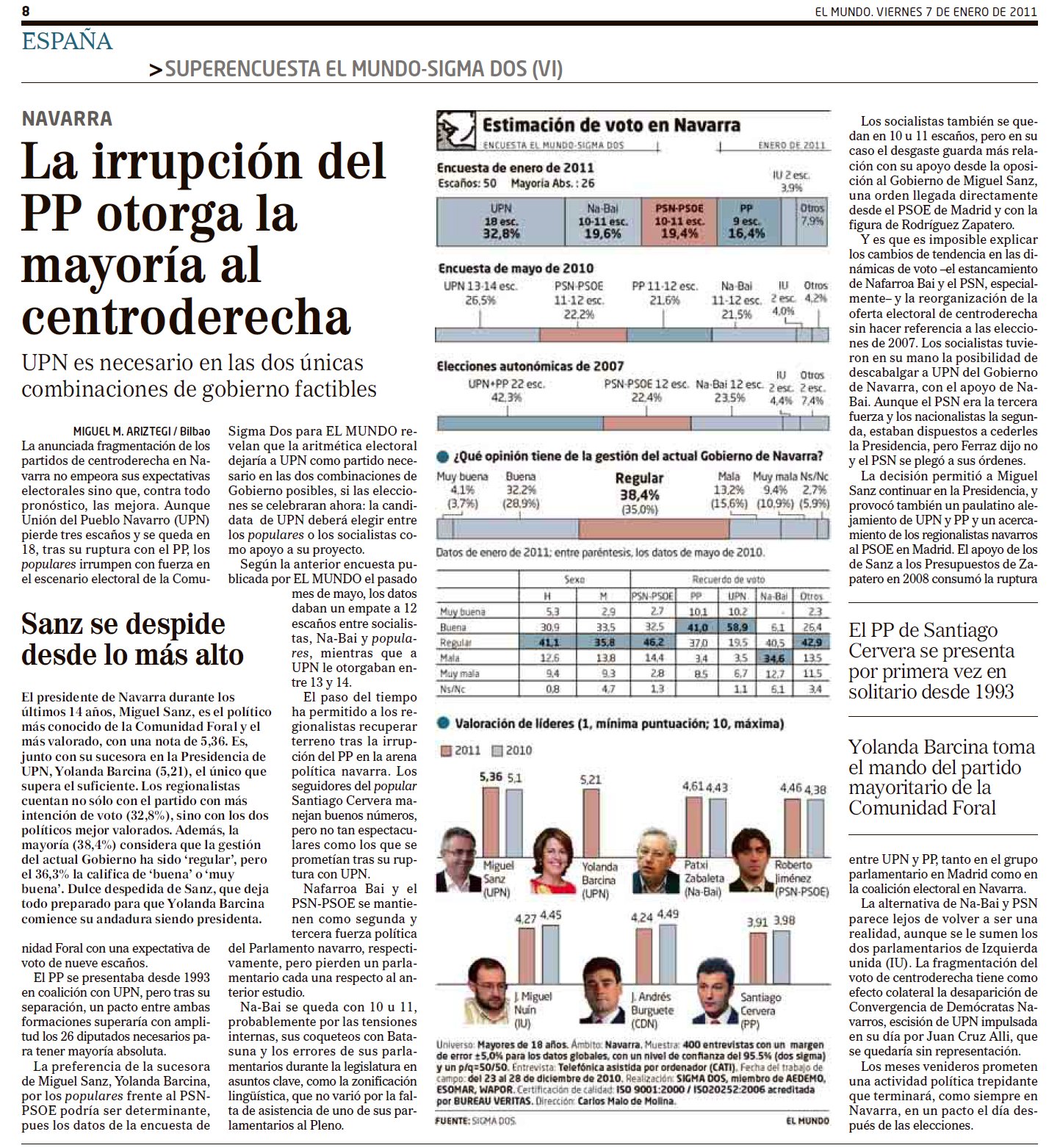
| Sigma Dos/El Mundo[p 19][p 20] | 23–28 Dec 2010 | 400 | ? | 32.8 18 |
19.6 10/11 |
19.4 10/11 |
– | 3.9 2 |
16.4 9 |
– | – | 13.2 |
| Ikerfel/Parliament of Navarre[p 21][p 22] | 19–26 Oct 2010 | 1,500 | 69.9 | 34.0 17/18 |
24.1 12/13 |
23.8 12/13 |
1.1 0 |
4.0 2 |
11.0 5 |
0.5 0 |
– | 9.9 |
| CIES/UPN[p 23][p 24] | 19 Oct 2010 | ? | ? | ? 18 |
? 12/14 |
? 10/11 |
? 0 |
? 2 |
? 4/5 |
– | ? 0/3 |
? |
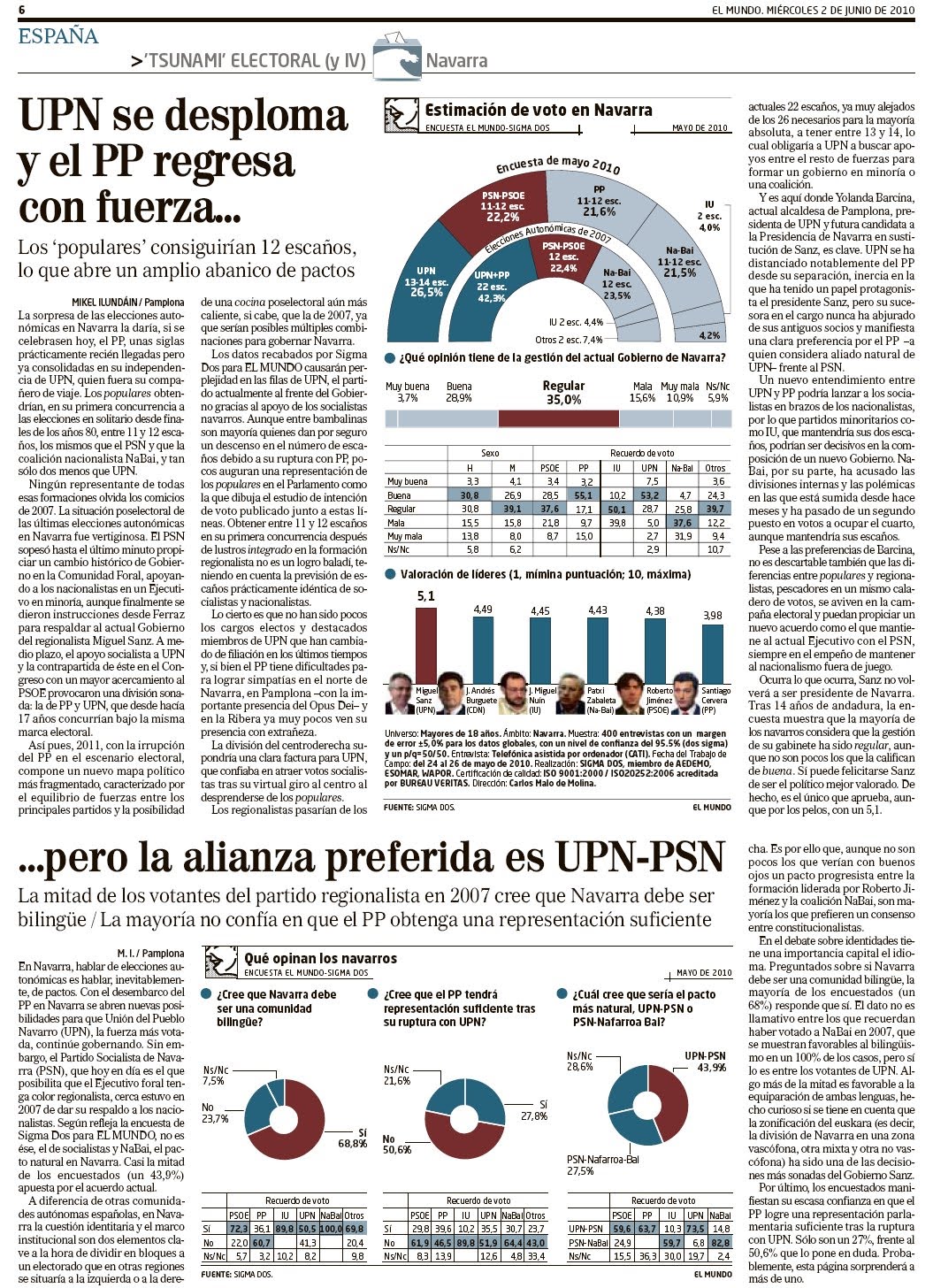
| Sigma Dos/El Mundo[p 25][p 26] | 24–26 May 2010 | 400 | ? | 26.5 13/14 |
21.5 11/12 |
22.2 11/12 |
– | 4.0 2 |
21.6 11/12 |
– | – | 4.3 |
| CIES/Parliament of Navarre[p 27] | 19–27 Oct 2009 | 1,500 | 64.0 | 34.4 18 |
24.2 13 |
23.5 12 |
2.4 0 |
4.3 2 |
9.2 5 |
1.1 0 |
– | 10.2 |
| UPN[p 28][p 29] | 30 Sep 2009 | ? | ? | ? 16/17 |
? 14 |
? 12 |
? 0 |
? 1/2 |
? 6/7 |
– | – | ? |
| 2009 EP election | 7 Jun 2009 | N/a | 42.7 | – | 8.8 (5) |
31.5 (17) |
– | 3.3 (1) |
37.8 (21) |
2.1 (0) |
11.4 (6) |
6.3 |
| CIES/Diario de Navarra[p 30] | 13–19 Nov 2008 | 900 | 68 | 32.8 17 |
24.2 12 |
24.9 13 |
3.1 1 |
4.6 2 |
9.5 5 |
– | – | 7.9 |
| 2008 general election | 9 Mar 2008 | N/a | 72.1 | 39.2 (21) |
18.4 (10) |
34.8 (18) |
– | 3.3 (1) |
[b] | 0.8 (0) |
– | 4.4 |
| 2007 regional election | 27 May 2007 | N/a | 73.8 | 42.2 22 |
23.6 12 |
22.5 12 |
4.4 2 |
4.3 2 |
[b] | – | – | 18.6 |
Voting preferences
The table below lists raw, unweighted voting preferences.
| Polling firm/Commissioner | Fieldwork date | Sample size | |
|
|
CDN | |
|
|
Bildu |  |
 |
Lead |
|---|---|---|---|---|---|---|---|---|---|---|---|---|---|
| 2011 regional election[c] | 22 May 2011 | N/a | 23.8 | 10.6 | 10.9 | 1.0 | 3.9 | 5.0 | 0.5 | 9.1 | N/a | 30.3 | 12.9 |
| Gizaker/Grupo Noticias[p 1] | 14 May 2011 | ? | 19.9 | 13.1 | 11.5 | – | – | 5.0 | – | 10.2 | – | – | 6.8 |
| CIS[p 10] | 17 Mar–17 Apr 2011 | 790 | 14.1 | 8.9 | 9.9 | 0.4 | 3.0 | 3.8 | 0.5 | 2.7 | 36.3 | 15.2 | 4.2 |
| Ikerfel/Parliament of Navarre[p 21] | 19–26 Oct 2010 | 1,500 | 16.7 | 13.7 | 13.4 | 0.9 | 2.7 | 5.3 | 0.3 | – | 27.1 | 12.7 | 3.0 |
| CIES/Parliament of Navarre[p 27] | 19–27 Oct 2009 | 1,500 | 18.8 | 14.1 | 14.2 | 1.0 | 2.8 | 4.5 | 0.3 | – | 23.9 | 15.3 | 4.6 |
| 2009 EP election[c] | 7 Jun 2009 | N/a | – | 3.8 | 13.5 | – | 1.4 | 16.4 | 0.9 | 5.0 | N/a | 56.4 | 2.9 |
| 2008 general election[c] | 9 Mar 2008 | N/a | 28.6 | 13.5 | 25.2 | – | 2.4 | [b] | 0.6 | – | N/a | 26.7 | 3.4 |
| 2007 regional election[c] | 27 May 2007 | N/a | 30.1 | 16.9 | 16.0 | 3.1 | 3.1 | [b] | – | – | N/a | 24.6 | 13.2 |
Victory preferences
The table below lists opinion polling on the victory preferences for each party in the event of a regional election taking place.
| Polling firm/Commissioner | Fieldwork date | Sample size | |
|
|
CDN | |
|
|
Bildu | Other/ None |
|
Lead |
|---|---|---|---|---|---|---|---|---|---|---|---|---|---|
| CIS[p 10] | 17 Mar–17 Apr 2011 | 790 | 21.3 | 13.3 | 12.2 | 0.5 | 3.5 | 5.2 | 0.5 | 2.6 | 14.0 | 26.9 | 8.0 |
Victory likelihood
The table below lists opinion polling on the perceived likelihood of victory for each party in the event of a regional election taking place.
| Polling firm/Commissioner | Fieldwork date | Sample size | |
|
|
CDN | |
|
|
Bildu | Other/ None |
|
Lead |
|---|---|---|---|---|---|---|---|---|---|---|---|---|---|
| CIS[p 10] | 17 Mar–17 Apr 2011 | 790 | 56.3 | 2.2 | 5.4 | 0.0 | 0.1 | 8.7 | 0.1 | 0.2 | 1.1 | 25.8 | 47.6 |
Preferred President
The table below lists opinion polling on leader preferences to become president of the Government of Navarre.
| Polling firm/Commissioner | Fieldwork date | Sample size |  |
 |
 |
 |
 |
 |
Other/ None/ Not care |
|
Lead |
|---|---|---|---|---|---|---|---|---|---|---|---|
| Barcina UPN |
Zabaleta NaBai |
Jiménez PSN |
Burguete CDN |
Nuin I–E (n) |
Cervera PP | ||||||
| CIS[p 10] | 17 Mar–17 Apr 2011 | 790 | 26.7 | 12.8 | 10.9 | 1.0 | 2.0 | 2.2 | 11.0 | 33.4 | 13.9 |
Results
 | ||||||
| Parties and alliances | Popular vote | Seats | ||||
|---|---|---|---|---|---|---|
| Votes | % | ±pp | Total | +/− | ||
| Navarrese People's Union (UPN) | 111,474 | 34.48 | −7.70 | 19 | −3 | |
| Socialist Party of Navarre (PSN–PSOE) | 51,238 | 15.85 | −6.64 | 9 | −3 | |
| Navarre Yes 2011 (NaBai 2011) | 49,827 | 15.41 | −8.21 | 8 | −4 | |
| Gather–Basque Solidarity–Alternative (Bildu–EA/AE–EA–Alternatiba) | 42,916 | 13.28 | New | 7 | +7 | |
| People's Party (PP) | 23,551 | 7.29 | New | 4 | +4 | |
| Left (I–E (n))1 | 18,457 | 5.71 | +1.36 | 3 | +1 | |
| Convergence of Democrats of Navarre (CDN) | 4,654 | 1.44 | −2.93 | 0 | −2 | |
| Greens of Navarre (VN–NB) | 4,235 | 1.31 | New | 0 | ±0 | |
| Navarrese Cannabis Representation (RCN/NOK) | 3,166 | 0.98 | −0.45 | 0 | ±0 | |
| Union, Progress and Democracy (UPyD) | 2,212 | 0.68 | New | 0 | ±0 | |
| Initiative for Navarre (IxN) | 1,332 | 0.41 | New | 0 | ±0 | |
| Internationalist Solidarity and Self-Management (SAIn) | 1,054 | 0.33 | New | 0 | ±0 | |
| Navarrese and Spanish Right (DNE) | 977 | 0.30 | New | 0 | ±0 | |
| Blank ballots | 8,161 | 2.52 | +1.14 | |||
| Total | 323,254 | 50 | ±0 | |||
| Valid votes | 323,254 | 98.77 | +4.03 | |||
| Invalid votes | 4,027 | 1.23 | −4.03 | |||
| Votes cast / turnout | 327,281 | 67.43 | −6.36 | |||
| Abstentions | 158,105 | 32.57 | +6.36 | |||
| Registered voters | 485,386 | |||||
| Sources[13][26][27] | ||||||
Footnotes:
| ||||||
Aftermath
Government formation
| Investiture Nomination of Yolanda Barcina (UPN) | ||
| Ballot → | 23 June 2011 | |
|---|---|---|
| Required majority → | 26 out of 50  | |
28 / 50 | ||
22 / 50 | ||
| Abstentions | 0 / 50 | |
| Absentees | 0 / 50 | |
| Sources[13] | ||
2013 motion of no confidence
| Motion of no confidence Nomination of Juan Carlos Longás (NaBai) | ||
| Ballot → | 18 April 2013 | |
|---|---|---|
| Required majority → | 26 out of 50 | |
18 / 50 | ||
23 / 50 | ||
Abstentions
|
9 / 50 | |
| Absentees | 0 / 50 | |
| Sources[13] | ||
Notes
References
- Opinion poll sources
- 1 2 "NaBai está a un paso de ser la segunda fuerza más votada en Nafarroa tras UPN". Deia (in Spanish). 14 May 2011. Archived from the original on 25 December 2011.
{{cite web}}: CS1 maint: bot: original URL status unknown (link) - ↑ "Bildu logra tres escaños". El Mundo (in Spanish). 16 May 2011.
- ↑ "El PP doblega al PSOE a siete días de la cita electoral". La Razón (in Spanish). 15 May 2011. Archived from the original on 3 September 2011.
{{cite web}}: CS1 maint: bot: original URL status unknown (link) - ↑ "Vuelco en Cantabria (La Razón)". Electómetro (in Spanish). 15 May 2011. Archived from the original on 19 May 2011.
{{cite web}}: CS1 maint: bot: original URL status unknown (link) - ↑ "UPN lograría 19-20 escaños por 10-11 del PSN y entran PP y Bildu con 4-5 escaños cada uno". Diario de Navarra (in Spanish). 14 May 2011. Archived from the original on 17 May 2011.
{{cite web}}: CS1 maint: bot: original URL status unknown (link) - ↑ "UPN debería pactar con el PP para poder gobernar en Navarra". Antena 3 (in Spanish). 5 May 2011.
- ↑ "Los cuatro inexpugnables". La Razón (in Spanish). 25 April 2011. Archived from the original on 26 April 2011.
- ↑ "El PSOE se rinde al PP". La Razón (in Spanish). 25 April 2011. Archived from the original on 25 June 2011. Retrieved 2 March 2021.
- ↑ "Barómetro electoral autonómico" (PDF). Celeste-Tel (in Spanish). 9 May 2011. Archived from the original (PDF) on 24 April 2025. Retrieved 21 May 2015.
- 1 2 3 4 5 "Preelectoral elecciones autonómicas, 2011. Comunidad Foral de Navarra (Estudio nº 2881. Marzo-Abril 2011)" (PDF). CIS (in Spanish). 5 May 2011.
- ↑ "Rajoy se vuelca a por su billete a la Moncloa". La Vanguardia (in Spanish). 6 May 2011.
- ↑ "UPN, obligada a entenderse con el PP o el PSOE". El Mundo (in Spanish). 26 April 2011.
- ↑ "El Mundo 25-27 de Abril 2011". El Mundo (in Spanish). 25 April 2011.
- ↑ "Los socialistas tienen la llave para unirse a UPN o pactar con los nacionalistas". ABC (in Spanish). 9 May 2011.
- ↑ "Solo un pacto entre UPN y PSN garantizaría la mayoría absoluta en Navarra". El Correo (in Spanish). 9 May 2011.
- ↑ "UPN es primera fuerza en Nafarroa, pero solo conseguiría la mayoría si cuenta con el apoyo del PSN". Deia (in Spanish). 18 April 2011. Archived from the original on 21 April 2011.
{{cite web}}: CS1 maint: bot: original URL status unknown (link) - ↑ "El Parlamento de Navarra se fragmenta (Diario de Noticias)". Electómetro (in Spanish). 17 April 2011. Archived from the original on 4 September 2011.
{{cite web}}: CS1 maint: bot: original URL status unknown (link) - ↑ "Navarra y su Parlamento. Estudio político en Navarra (Abril 2011, Grupo Noticias)" (PDF). Gizaker (in Spanish). 18 April 2011.
- ↑ "La irrupción del PP otorga la mayoría al centroderecha". El Mundo (in Spanish). 7 January 2011.
- ↑ "Un pacto de UPN con el PP podría darles mayoría absoluta en Navarra (El Mundo)". Electómetro (in Spanish). 7 January 2011. Archived from the original on 27 July 2011.
{{cite web}}: CS1 maint: bot: original URL status unknown (link) - 1 2 "Estudio sobre la actualidad de Navarra (año 2010)" (PDF). Ikerfel (in Spanish). 12 November 2010.
- ↑ "CDN quedaría fuera del Parlamento de Navarra (Navarrometro)". Electómetro (in Spanish). 12 November 2010. Archived from the original on 24 August 2011.
{{cite web}}: CS1 maint: bot: original URL status unknown (link) - ↑ "Una encuesta de CIES le da 14 escaños a Nabai". Ezkerreko Nabaizaleok (in Spanish). 19 October 2010.
- ↑ "Encuesta Cies para el parlamento de Navarra". Foro Diario de Noticias Navarra (in Spanish). 19 October 2010.
- ↑ "UPN se desploma y el PP regresa con fuerza, pero la alianza preferida es UPN-PSN". El Mundo (in Spanish). 2 June 2010.
- ↑ "Cuarta entrega de sondeos de El Mundo: Navarra, Aragón y Canarias". Electómetro (in Spanish). 2 June 2010. Archived from the original on 24 March 2015.
- 1 2 "Estudio sobre la actualidad de Navarra 2009" (PDF). CIES (in Spanish). 7 November 2009.
- ↑ ""UPN buscaba una excusa para echarnos o para forzar a CDN a integrarse en sus filas"". Diario de Navarra (in Spanish). 30 September 2009.
- ↑ "El dilema de UPN ante las cuentas del Estado". Diario de Navarra (in Spanish). 11 October 2009. Archived from the original on 12 December 2009.
- ↑ "CDN, posibles consecuencias de su hipotética desaparición". Navarra Confidencial (in Spanish). 11 February 2009.


- Other
- ↑ LORAFNA (1982), arts. 11–13 & 19–22.
- ↑ LFEPN (1986), art. 2.
- ↑ LORAFNA (1982), art. 15; LFEPN (1986), arts. 12–14 (suppl. by LOREG (1985), art. 42).
- ↑ LORAFNA (1982), art. 30; LFGNP (2004), arts. 7, 22 & 30.
- ↑ LORAFNA (1982), art. 29.
- ↑ Arnedo, Beatriz (21 May 2011). "El presidente deberá ser elegido antes del 22 de agosto o se repetirán las elecciones". Diario de Navarra (in Spanish). Pamplona. Retrieved 23 June 2022.
- ↑ Foral Decree 1/2011 (2011), arts. 1 & 3.
- ↑ LORAFNA (1982), art. 15; LFEPN (1986), art. 3 (suppl. by LOREG (1985), arts. 2–3).
- ↑ LOREG (1985), art. 75.
- ↑ Reig Pellicer, Naiara (16 December 2015). "Spanish elections: Begging for the right to vote". cafebabel.co.uk. Archived from the original on 31 August 2021. Retrieved 17 July 2017.
- ↑ LORAFNA (1982), art. 15; LFEPN (1986), arts. 1 & 9–10.
- ↑ LFEPN (1986), art. 11 (suppl. by LOREG (1985), arts. 46 & 48).
- 1 2 3 4 Lozano, Carles. "Elecciones al Parlamento de Navarra (Nafarroako Parlamentua) (desde 1979)". Historia Electoral.com (in Spanish). Retrieved 3 May 2026.
- ↑ "Parlamento de Navarra. VII Legislatura. Memoria de Actividades (27-mayo-2010 a 27-mayo-2011)" (PDF) (in Spanish). Parliament of Navarre. Retrieved 3 May 2026.
- ↑ LFEPN (1986), art. 18 (suppl. by LOREG (1985), art. 44).
- ↑ LOREG (1985), art. 44 bis.
- ↑ Reviriego, José Mari (30 October 2008). "Sanz descarta presentarse a la reelección como presidente de UPN". El Correo (in Spanish). Pamplona. Retrieved 23 June 2022.
- ↑ "Yolanda Barcina, elegida presidenta de UPN con el 89% de los votos". Diario de Navarra (in Spanish). Pamplona. Agencias. 19 April 2009. Retrieved 20 February 2021.
- ↑ Álvarez, Amaia (27 August 2010). "Aralar propone a Patxi Zabaleta como cabeza de lista de NaBai al Parlamento". Noticias de Gipuzkoa (in Spanish). Pamplona. Retrieved 23 June 2022.
- ↑ Menéndez, María (6 May 2011). "Las escisiones de partidos marcan las elecciones en Navarra con UPN como favorita" (in Spanish). RTVE. Retrieved 23 June 2022.
- ↑ "Miguel Sanz dice que no le 'preocupa en exceso' que el PP se presente en Navarra". El Mundo (in Spanish). Pamplona. Europa Press. 14 October 2008. Retrieved 20 February 2021.
- ↑ "El PP rompe su pacto con UPN por no apoyar su enmienda a los Presupuestos del Gobierno" (in Spanish). RTVE. 22 October 2008. Retrieved 20 February 2021.
- ↑ "Santiago Cervera, elegido presidente del Partido Popular de Navarra". El Imparcial (in Spanish). 12 December 2009. Retrieved 23 June 2022.
- ↑ "Sortu intenta burlar la ilegalización con una coalición llamada Bildu". El País (in Spanish). 26 March 2011. Retrieved 12 February 2020.
- ↑ "El Constitucional da vía libre a Bildu para acudir a las elecciones". El País (in Spanish). 5 May 2011. Retrieved 12 February 2020.
- ↑ "Resultados Electorales y Composición del Parlamento de Navarra. VIII Legislatura (2011-2015)" (in Spanish). Parliament of Navarre. Retrieved 3 May 2026.
- ↑ "Resolución 311/2011, de 21 de junio, del Director General de Presidencia, por la que se procede a la publicación del resumen de los resultados de las elecciones al Parlamento de Navarra celebradas el 22 de mayo de 2011, conforme al acta de proclamación remitida por la Junta Electoral Provincial de Navarra" (PDF). Official Gazette of Navarre (in Spanish) (147): 11310–11311. 26 July 2011. ISSN 2253-9646. Retrieved 3 May 2026.
Bibliography
- Ley Orgánica 13/1982, de 10 de agosto, de reintegración y amejoramiento del Régimen Foral de Navarra (Organic Law 13/1982). Official State Gazette (in Spanish). 10 August 1982 [version as of 28 October 2010]. BOE-A-1982-20824. Retrieved 3 May 2026.
- Ley Orgánica 5/1985, de 19 de junio, del Régimen Electoral General (Organic Law 5/1985). Official State Gazette (in Spanish). 19 June 1985 [version as of 30 April 2011]. BOE-A-1985-11672. Retrieved 5 October 2025.
- Ley Foral 16/1986, de 17 de noviembre, reguladora de las elecciones al Parlamento de Navarra (Foral Law 16/1986). Official State Gazette (in Spanish). 17 November 1986 [version as of 11 June 2004]. BOE-A-1987-1255. Retrieved 3 May 2026.
- Ley Foral 14/2004, de 3 de diciembre, del Gobierno de Navarra y de su Presidente (Foral Law 14/2004). Official State Gazette (in Spanish). 3 December 2004 [version as of 23 May 2008]. BOE-A-2005-1576. Retrieved 3 May 2026.
- Decreto Foral 1/2011, de 28 de marzo, del Presidente del Gobierno de Navarra, por el que se convocan elecciones al Parlamento de Navarra (Foral Decree 1/2011). Official State Gazette (in Spanish). 28 March 2011. BOE-A-2011-5622. Retrieved 3 May 2026.