1944 Hungarian parliamentary election
 | |||||||||||||||||||||||||||||||||||||||||||||||
November 1944–June 1945
| |||||||||||||||||||||||||||||||||||||||||||||||
All 498 elected seats in the Diet 250 seats needed for a majority | |||||||||||||||||||||||||||||||||||||||||||||||
|---|---|---|---|---|---|---|---|---|---|---|---|---|---|---|---|---|---|---|---|---|---|---|---|---|---|---|---|---|---|---|---|---|---|---|---|---|---|---|---|---|---|---|---|---|---|---|---|
| |||||||||||||||||||||||||||||||||||||||||||||||
| |||||||||||||||||||||||||||||||||||||||||||||||


 |
|---|

Elections for the National Interim Assembly were held in Hungary in November 1944.[1] Members were elected at public meetings held in 45 cities and towns in areas under the control of the Red Army.[1] An additional 160 members were elected in liberated areas on 2 April and 24 June 1945.[2]
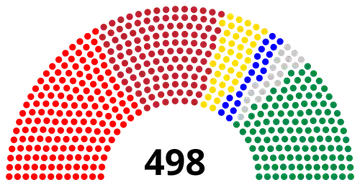
The Hungarian Communist Party won 89 of the 230 seats, increasing to 166 of the 498 seats after the 1945 elections.[1] The Assembly first convened in Debrecen on 21 and 22 December 1944, establishing a new government and declaring war on Nazi Germany.[1] Its second session was held in Budapest in September 1945, establishing fresh elections and passing legislation on land redistribution.[1]
Results
 | ||||||
|---|---|---|---|---|---|---|
| Party | Seats | |||||
| Nov 1944 | Apr 1945 | Jun 1945 | Total | |||
| Hungarian Communist Party | 89 | 36 | 41 | 166 | ||
| Social Democratic Party of Hungary | 42 | 38 | 45 | 125 | ||
| Independent Smallholders Party | 57 | 16 | 51 | 124 | ||
| National Peasant Party | 16 | 6 | 20 | 42 | ||
| Civic Democratic Party | 12 | 6 | 3 | 21 | ||
| Independents | 14 | 6 | 0 | 20 | ||
| Total | 230 | 108 | 160 | 498 | ||
| Source: Nohlen & Stöver | ||||||
The activity of the parliament
The Interim National Assembly declared itself as the exclusive representative of sovereignty,[3] and transferred the powers of the head of state to the High National Council, which was composed of the Prime Minister, the Speaker of the House and a delegate from the Political Committee of the National Assembly.[4] The rules of the parliamentary elections were amended: single-member districts were abolished, the national list was introduced and the multi-member constituencies were extended to the entire country. Members of organizations and parties classified as fascist, (including the Hungarian Life Party, which was in government until 1944), were excluded from the electors.[5]
References
- 1 2 3 4 5 Dieter Nohlen & Philip Stöver (2010) Elections in Europe: A data handbook, p914 ISBN 978-3-8329-5609-7
- ↑ Nohlen & Stöver, p900
- ↑ "Act I of 1945 on the Exercise of hungarian state sovereignty" (in Hungarian). Retrieved 21 May 2026.
- ↑ "Act III of 1945 on the National Supreme Council" (in Hungarian). Retrieved 21 May 2026.
- ↑ "Act VIII of 1945 on National Assembly Elections" (in Hungarian). Retrieved 21 May 2026.
| Parliamentary elections |
|
|---|---|
| European elections | |
| Local elections | |
| Referendums | |
See also: List of Hungarian by-elections | |