1901 Hungarian parliamentary election
 | |||||||||||||||||||||||||||||
2–9 October 1901
| |||||||||||||||||||||||||||||
All 413 seats in the Diet 207 seats needed for a majority | |||||||||||||||||||||||||||||
|---|---|---|---|---|---|---|---|---|---|---|---|---|---|---|---|---|---|---|---|---|---|---|---|---|---|---|---|---|---|
| |||||||||||||||||||||||||||||
| |||||||||||||||||||||||||||||



 |
|---|

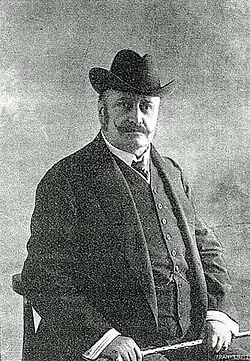
Parliamentary elections were held in Hungary between 2 and 9 October 1901.[1] Prime Minister Kálmán Széll, who came to power in 1899, reached an agreement with the opposition through the mediation of Dezső Szilágyi. As a result, the ex lex situation due to the lack of a budget was lifted and the customs and trade alliance with Cisleithania was renewed. The government pursued a protectionist policy by raising agricultural tariffs, thus ensuring the saleability of domestic products against American imports. According to the laws adopted in 1901, members of parliament could no longer play a leading economic role in the industrial and commercial spheres. The government paid special attention to the modernization of agriculture. In the south and southeast of the country, arable land was provided to the poor, while the employment relations of agricultural workers and servants, tobacco growers and forestry workers were regulated. Before the elections, the National Party led by Count Albert Apponyi was dissolved and its members joined the governing Liberal Party. The new parliament convened on October 26, 1901.[2]
Parties and leaders
| Party | Leader | |
|---|---|---|
| Liberal Party (SZP) | Frigyes Podmaniczky | |
| Party of Independence and '48 (F48P) | Ferenc Kossuth | |
| Catholic National Party (KNP) | János Zichy | |
| Ugron Party of Independence and '48 (F48UP) | Gábor Ugron | |
| Slovak National Party (SNS) | Pavol Mudroň | |
| Civic Democratic Party (PDP) | Vilmos Vázsonyi | |
| Serb People's Radical Party (SNRS) | Jaša Tomić | |
Electoral system
The elections were based on property, income and education census. Landowners with a ¼ plot of land, rural industrialists paying a tax of 6 Ft, urban industrialists paying a tax of 10.50 Ft, house tenants paying a tax of 15.75 Ft, land and house owners paying a tax of 5 Ft, landless house owners paying a tax of 6 Ft, employed priests, officials, teachers, tutors, writers, artists, lawyers, notaries and health workers with a degree were electors. 20 years older men were eligible to vote and 24 years older men could be elected. Women had no right for the participation. The elections were held exclusively in single-member district by open voting.[3][4]
Results
 | |||
|---|---|---|---|
| Party | Seats | +/– | |
| Liberal Party | 280 | -11 | |
| Party of Independence and '48 | 76 | +28 | |
| Catholic People's Party | 22 | +2 | |
| Ugron Party of Independence and '48 | 14 | +3 | |
| Independent Saxons | 11 | +11 | |
| Independent moderate | 5 | -2 | |
| Slovak National Party | 3 | New | |
| Civic Democratic Party | 1 | New | |
| Serb People's Radical Party | 1 | New | |
| Total | 413 | – | |
| Source: Ballabás-Pap-Pál[5] | |||
The group of independents are classified by their political position as moderate opposition or ethnic minority.
Aftermath
The court annulled the mandates of 5 representatives, 4 from the Liberal Party and 1 from the Independent Party. In each case, by-elections were held.[6]
References
- ↑ Szabó Pál Csaba, ed. (2006). A Magyar állam története 1711–2006 [History of the Hungarian State: 1711-2006] (PDF) (in Hungarian). Budapest: Bölcsész konzorcium. p. 375. ISBN 963-9704-08-3.
- ↑ Kozári, Monika (2009). "A dualizmus kora / The age of dualism". Magyarország története / The history of Hungary. Vol. 16. Budapest: Kossuth Kiadó. p. 88-89. ISBN 978-963-09-5694-9.
- ↑ Kozári, Monika (2009). "A dualizmus kora / The age of dualism". Magyarország története / The history of Hungary. Vol. 16. Budapest: Kossuth Kiadó. p. 11. ISBN 978-963-09-5694-9.
- ↑ Ballabás, Dániel; Pap, József; Pál, Judit (2020). "Az országgyűlés tagjainak archontológiája / Archontology of the members of parliament". Képviselők és főrendek a dualizmus kori Magyarországon / Representatives and high nobles in Hungary during the Dualist era. Vol. 2. Eger: Líceum Kiadó. p. 493-509. ISBN 978-963-496-144-4.
- ↑ Ballabás, Dániel; Pap, József; Pál, Judit (2020). "Az országgyűlés tagjainak archontológiája / Archontology of the members of parliament". Képviselők és főrendek a dualizmus kori Magyarországon / Representatives and high nobles in Hungary during the Dualist era. Vol. 2. Eger: Líceum Kiadó. p. 85-491. ISBN 978-963-496-144-4.
- ↑ Ballabás, Dániel; Pap, József; Pál, Judit (2020). "Az országgyűlés tagjainak archontológiája / Archontology of the members of parliament". Képviselők és főrendek a dualizmus kori Magyarországon / Representatives and high nobles in Hungary during the Dualist era. Vol. 2. Eger: Líceum Kiadó. p. 85-491. ISBN 978-963-496-144-4.
| Parliamentary elections |
|
|---|---|
| European elections | |
| Local elections | |
| Referendums | |
See also: List of Hungarian by-elections | |