Close-mid central unrounded vowel
| Close-mid central unrounded vowel | |||
|---|---|---|---|
| ɘ | |||
| IPA number | 397 | ||
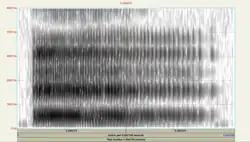
| Audio sample | |||
|
source · help | |||
| Encoding | |||
| Entity (decimal) | ɘ | ||
| Unicode (hex) | U+0258 | ||
| X-SAMPA | @\ | ||
| Braille |   | ||
| |||


The close-mid central unrounded vowel, or high-mid central unrounded vowel,[1] is a type of vowel sound used in some spoken languages. The symbol in the International Phonetic Alphabet that represents this sound is ⟨ɘ⟩. This is a mirrored letter e and should not be confused with the schwa ⟨ə⟩, which is a turned e. It was added to the IPA in 1993; before that, this vowel was transcribed ⟨ë⟩. Certain older sources[2] transcribe this vowel ⟨ɤ̈⟩.
The letter ⟨ɘ⟩ may be used with a lowering diacritic ⟨ɘ̞⟩, to denote the mid central unrounded vowel.
Features
- Its vowel height is close-mid, also known as high-mid, which means the tongue is positioned halfway between a close vowel (a high vowel) and a mid vowel.
- Its vowel backness is central, which means the tongue is positioned halfway between a front vowel and a back vowel.
- It is unrounded, which means that the lips are not rounded.
Occurrence
| Language | Word | IPA | Meaning | Notes | |
|---|---|---|---|---|---|
| Chuvash | пӗррехинче | [pɘrrɛχint͡ɕɛ] | 'once' | ||
| Cotabato Manobo[3] | May be transcribed in IPA with ⟨ə⟩. | ||||
| Dinka | Luanyjang[4] | ŋeŋ | [ŋɘ́ŋ] | 'jawbone' | Short allophone of /e/.[4] |
| English | Australian[5][6] | bird | [bɘːd] | 'bird' | Typically transcribed in IPA with ⟨ɜː⟩. Optionally rounded. See Australian English phonology |
| Cardiff[7] | foot | [fɘt] | 'foot' | Less often rounded [ɵ];[8] corresponds to [ʊ] in other dialects. See English phonology | |
| New Zealand[9] | bit | [bɘt] | 'bit' | Merger of /ə/ and /ɪ/ found in other dialects. See New Zealand English phonology | |
| Southern American[10] | nut | [nɘt] | 'nut' | Some dialects.[10] Corresponds to /ʌ/ in other dialects. See English phonology | |
| Estonian[11] | kõrv | [kɘrv] | 'ear' | Typically transcribed in IPA with ⟨ɤ⟩; can be close-mid back [ɤ] or close back [ɯ] instead, depending on the speaker.[11] See Estonian phonology | |
| Irish | Munster[12] | sáile | [ˈsˠɰaːlʲə̝] | 'salt water' | Usually transcribed in IPA with [ɪ̽]. It is an allophone of /ə/ next to non-palatal slender consonants.[12] See Irish phonology |
| Jebero[13] | ɨx[e/ï][k/c/q] | [ˈiʃɘk] | 'bat' | ||
| Kaingang[14] | me | [ˈᵐbɘ] | 'tail' | Varies between central [ɘ] and back [ɤ].[15] | |
| Kalagan Kaagan[16] | [miˈwə̝ːʔ] | 'lost' | Allophone of /ɨ/ in word-final stressed syllables before /ʔ/; can be transcribed in IPA with ⟨ə⟩.[16] | ||
| Katë[17] | Katë | [kaˈt̪ɘ] | 'Katë' | Can also be realized as /ɨ/. | |
| Kazakh[18] | тілі | [tʰɘˈlɘ]] | 'language' | ||
| Kensiu[19] | [ɟɚ̝h] | 'to trim' | Rhotacized; may be transcribed in IPA with ⟨ɚ⟩.[19] | ||
| Kera[20] | [t͡ʃə̝̄wā̠a̠] | 'fire' | Allophone of /a/; typically transcribed in IPA with ⟨ə⟩.[20] | ||
| Korean[21] | 어른/eoreun | [ə̝ːɾɯ̽n] | 'adult' | May be transcribed in IPA with ⟨əː⟩. See Korean phonology | |
| Kurdish | Kurmanji | dil/دل | [dɘl] | 'heart' | Allophone of /ɪ/. Sorani alphabet does not transcribe this vowel phoneme in text. |
| Sorani | |||||
| Lizu[22] | [Fkə̝] | 'eagle' | Allophone of /ə/ after velar stops.[22] | ||
| Mapudungun[23] | elün | [ë̝ˈlɘn] | 'to give (something)' | ||
| Mongolian[24] | үсэр | [usɘɾɘ̆] | 'jump' | ||
| Mono[25] | dœ | [də̝] | 'be (equative)' | May be transcribed in IPA with ⟨ə⟩.[25] | |
| Polish[26] | mysz | ⓘ | 'mouse' | Somewhat fronted;[26] typically transcribed in IPA with ⟨ɨ⟩. See Polish phonology | |
| Romanian | Moldavian dialect[27] | casă | [ˈkäsɘ] | 'house' | Corresponds to [ə] in standard Romanian. See Romanian phonology |
| Scottish Gaelic | Harris | bhuaipe | [ˈvuɘhpə] | 'from her' | Allophone of /e/ in the diphthong /ue/, which in other dialects is /uə/ or /uæ/. May be closer as [ɨ̞]. |
| Uist | |||||
| Shiwiar[28] | |||||
| Temne[29] | pər | [pə̝́r] | 'incite' | Typically transcribed in IPA with ⟨ə⟩.[29] | |
| Vietnamese[30] | vợ | [vɘ˨˩ˀ] | 'wife' | Typically transcribed in IPA with ⟨ɤ⟩. See Vietnamese phonology | |
| Xumi | Upper[31] | [LPmɘ̃dɐ] | 'upstairs' | Nasalized; occurs only in this word.[31] It is realized as mid [ə̃] in Lower Xumi.[32] | |
| Zapotec | Tilquiapan[33] | ne | [nɘ] | 'and' | Most common realization of /e/.[33] |
Notes
- ↑ While the International Phonetic Association prefers the terms "close" and "open" for vowel height, many linguists use "high" and "low".
- ↑ For example Collins & Mees (1990).
- ↑ Kerr (1988:110)
- 1 2 Remijsen & Manyang (2009:117, 119)
- ↑ Cox (2006:?)
- ↑ Durie & Hajek (1994:?)
- ↑ Collins & Mees (1990:93)
- ↑ Collins & Mees (1990:92)
- ↑ Bauer et al. (2007)
- 1 2 Roca & Johnson (1999:186)
- 1 2 Asu & Teras (2009), pp. 368–369.
- 1 2 Ó Sé (2000)
- ↑ Valenzuela & Gussenhoven (2013:101)
- ↑ Jolkesky (2009:676–677 and 682)
- ↑ Jolkesky (2009:676 and 682)
- 1 2 Wendel & Wendel (1978:198)
- ↑ Halfmann, Jakob (2024). A Grammatical Description of the Katë Language (Nuristani) (PhD thesis). Köln: Universität zu Köln.
- ↑ Vajda, Edward (1994), "Kazakh phonology", in Kaplan, E.; Whisenhunt, D. (eds.), Essays presented in honor of Henry Schwarz, Washington: Western Washington, pp. 603–650
- 1 2 Bishop (1996:230)
- 1 2 Pearce (2011:251)
- ↑ Lee (1999:121)
- 1 2 Chirkova & Chen (2013a:79)
- ↑ Sadowsky et al. (2013:92)
- ↑ Iivonen & Harnud (2005:62, 66–67)
- 1 2 Olson (2004:235)
- 1 2 Jassem (2003:105) The source transcribes this sound with the symbol ⟨ɨ⟩ but one can see from the vowel chart at pag. 105 that the Polish sound is closer to [ɘ] than to [ɨ].
- ↑ Pop (1938), p. 29.
- ↑ Fast Mowitz (1975:2)
- 1 2 Kanu & Tucker (2010:249)
- ↑ Hoang (1965:24)
- 1 2 Chirkova, Chen & Kocjančič Antolík (2013:389)
- ↑ Chirkova & Chen (2013b:370)
- 1 2 Merrill (2008:109–110)
References
- Asu, Eva Liina; Teras, Pire (2009), "Estonian", Journal of the International Phonetic Association, 39 (3): 367–372, doi:10.1017/s002510030999017x
- Bauer, Laurie; Warren, Paul; Bardsley, Dianne; Kennedy, Marianna; Major, George (2007), "New Zealand English", Journal of the International Phonetic Association, 37 (1): 97–102, doi:10.1017/S0025100306002830
- Bishop, Nancy (1996), "A preliminary description of Kensiu (Maniq) phonology" (PDF), Mon-Khmer Studies, 25
- Chirkova, Katia; Chen, Yiya (2013a), "Lizu", Journal of the International Phonetic Association, 43 (1): 75–86, doi:10.1017/S0025100312000242
- Chirkova, Katia; Chen, Yiya (2013b), "Xumi, Part 1: Lower Xumi, the Variety of the Lower and Middle Reaches of the Shuiluo River" (PDF), Journal of the International Phonetic Association, 43 (3): 363–379, doi:10.1017/S0025100313000157
- Chirkova, Katia; Chen, Yiya; Kocjančič Antolík, Tanja (2013), "Xumi, Part 2: Upper Xumi, the Variety of the Upper Reaches of the Shuiluo River" (PDF), Journal of the International Phonetic Association, 43 (3): 381–396, doi:10.1017/S0025100313000169
- Collins, Beverley; Mees, Inger M. (1990), "The Phonetics of Cardiff English", in Coupland, Nikolas; Thomas, Alan Richard (eds.), English in Wales: Diversity, Conflict, and Change, Multilingual Matters Ltd., pp. 87–103, ISBN 1-85359-032-0
- Cox, F.M. (2006), "The acoustic characteristics of /hVd/ vowels in the speech of some Australian teenagers", Australian Journal of Linguistics, 26: 147–179, doi:10.1080/07268600600885494, S2CID 62226994
- Durie, M.; Hajek, J. (1994), "A revised standard phonemic orthography for Australian English vowels", Australian Journal of Linguistics, 14 (1): 93–107, doi:10.1080/07268609408599503
- Fast Mowitz, Gerhard (1975), Sistema fonológico del idioma achual, Lima: Instituto Lingüístico de Verano
- Hoang, Thi Quynh Hoa (1965), A phonological contrastive study of Vietnamese and English (PDF), Lubbock, Texas: Texas Technological College, archived from the original (PDF) on 2015-10-01, retrieved 2015-09-30
- Iivonen, Antti; Harnud, Huhe (2005), "Acoustical comparison of the monophthong systems in Finnish, Mongolian and Udmurt", Journal of the International Phonetic Association, 35 (1): 59–71, doi:10.1017/S002510030500191X, S2CID 145733117
- Jassem, Wiktor (2003), "Polish", Journal of the International Phonetic Association, 33 (1): 103–107, doi:10.1017/S0025100303001191
- Jolkesky, Marcelo Pinho de Valhery (2009), "Fonologia e prosódia do Kaingáng falado em Cacique Doble", Anais do SETA, 3, Campinas: Editora do IEL-UNICAMP: 675–685
- Kanu, Sullay M.; Tucker, Benjamin V. (2010), "Temne", Journal of the International Phonetic Association, 40 (2): 247–253, doi:10.1017/S002510031000006X
- Kerr, Harland (1988), "Cotabato Manobo Grammar" (PDF), Studies in Philippine Linguistics, 7 (1): 1–123, archived from the original (PDF) on 2015-05-11
- Krech, Eva Maria; Stock, Eberhard; Hirschfeld, Ursula; Anders, Lutz-Christian (2009), Deutsches Aussprachewörterbuch, Berlin, New York: Walter de Gruyter, ISBN 978-3-11-018202-6
- Lee, Hyun Bok (1999), "Korean", Handbook of the International Phonetic Association, Cambridge University Press, pp. 120–122, ISBN 0-521-63751-1
- Merrill, Elizabeth (2008), "Tilquiapan Zapotec" (PDF), Journal of the International Phonetic Association, 38 (1): 107–114, doi:10.1017/S0025100308003344
- Mokari, Payam Ghaffarvand; Werner, Stefan (2016), Dziubalska-Kolaczyk, Katarzyna (ed.), "An acoustic description of spectral and temporal characteristics of Azerbaijani vowels", Poznań Studies in Contemporary Linguistics, 52 (3), doi:10.1515/psicl-2016-0019, S2CID 151826061
- Olson, Kenneth S. (2004), "Mono" (PDF), Journal of the International Phonetic Association, 34 (2): 233–238, doi:10.1017/S0025100304001744
- Ó Sé, Diarmuid (2000), Gaeilge Chorca Dhuibhne (in Irish), Dublin: Institiúid Teangeolaíochta Éireann, ISBN 0-946452-97-0
- Pearce, Mary (2011), "Kera", Journal of the International Phonetic Association, 41 (2): 249–258, doi:10.1017/S0025100311000168, S2CID 232344047
- Pop, Sever (1938), Micul Atlas Linguistic Român, Muzeul Limbii Române Cluj
- Remijsen, Bert; Manyang, Caguor Adong (2009), "Luanyjang Dinka", Journal of the International Phonetic Association, 39 (1): 113–124, doi:10.1017/S0025100308003605, hdl:20.500.11820/ccca8aff-adb2-42c0-9daa-f1e5777ee69f
- Roca, Iggy; Johnson, Wyn (1999), A Course in Phonology, Blackwell Publishing, ISBN 0-631-21345-7
- Sadowsky, Scott; Painequeo, Héctor; Salamanca, Gastón; Avelino, Heriberto (2013), "Mapudungun", Journal of the International Phonetic Association, 43 (1): 87–96, doi:10.1017/S0025100312000369
- Valenzuela, Pilar M.; Gussenhoven, Carlos (2013), "Shiwilu (Jebero)" (PDF), Journal of the International Phonetic Association, 43 (1): 97–106, doi:10.1017/S0025100312000370
- Wendel, Åsa; Wendel, Dag (1978), "Kaagan-Kalagan phonemic statement" (PDF), Studies in Philippine Linguistics, 2 (1): 191–203, archived from the original (PDF) on 2015-05-11
External links
Categories: