Transition metal trifluorophosphine complexes
Transition metal trifluorophosphine complexes are transition metal coordination complexes containing one or more trifluorophosphine (PF3) ligands. These complexes are a subclass of transition metal-phosphine complexes. Although trifluorophosphine complexes lack commercial applications, they have been of enduring fundamental interest. As one distinctive feature, they form many simple homoleptic complexes with zero-valence metals, more so than does carbon monoxide (CO).[1]
Ligand properties
Trifluorophosphine is classified as an L ligand in the covalent bond classification method. In the usual electron counting method, it is a two-electron ligand. With respect to HSAB theory, it is soft, reflecting its significant properties as a pi-acceptor ligand. The presence of three electronegative fluorine substituents gives rise to relatively low energy P-F σ* orbitals, which are well positioned to overlap with metal-based orbitals of π-symmetry.
Preparative routes and compounds
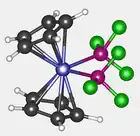
Synthetic methodology is complicated by the fact that trifluorophosphine is a highly toxic colorless gas. As the first trifluorophosphine complex to be reported, Ni(PF3)4, an analog of Ni(CO)4, was originally prepared by the reaction of Ni(PCl3)4 with excess PF3, a ligand exchange process. It is a colorless volatile liquid that is stable to water.[3] The same complex can be prepared by combining nickel metal with PF3 at 35 MPa pressure and 100 °C. Cr(PF3)6, the analogue of Cr(CO)6, can be prepared by displacement of benzene from dibenzenechromium:
- Cr(C6H6)2 + 6 PF3 → Cr(PF3)6 + 2 C6H6
The analogue of iron pentacarbonyl is Fe(PF3)5, a yellow volatile solid. It was first prepared by reducing ferrous iodide with zinc under a pressure of trifluorophosphine. The approach is analogous to the reductive carbonylation route to metal carbonyls.[4]
In addition to forming analogs of simple metal carbonyls, trifluorophosphine forms a variety of complexes for which the corresponding CO derivatives are unstable or nonexistent. Thus, Pd(PF3)4 is known, but Pd(CO)4 is not.[5][6]
Reactions
Photolysis of Fe(PF3)5 under an atmosphere of hydrogen furnishes the dihydride:
- Fe(PF3)5 + H2 → H2Fe(PF3)4 + PF3
This dihydride is a colorless liquid with a boiling point of 87 °C.[7] By contrast, iron tetracarbonyl dihydride (H2Fe(CO)4) decomposes near its boiling point of -20 °C.
Further reading
- More modern perspectives and computational analysis: Zou, Rong; Li, Qian-shu; Xie, Yaoming; King, R. Bruce; Schaefer, Henry F. (2008). "Unexpected Direct Iron-Fluorine Bonds in Trifluorophosphane Iron Complexes: An Alternative to Bridging Trifluorophosphane and Difluorophosphido Groups". Chemistry – A European Journal. 14 (35): 11149–11157. doi:10.1002/chem.200801248. PMID 18956396.
- Some early observations: Clark, R. J.; Busch, M. A. (1973). "Stereochemical Studies of Metal Carbonylphosphorus Trifluoride Complexes". Accounts of Chemical Research. 6 (7): 246–252. doi:10.1021/ar50067a005.
References
- ↑ Greenwood, Norman N.; Earnshaw, Alan (1997). Chemistry of the Elements (2nd ed.). Butterworth-Heinemann. p. 494. doi:10.1016/C2009-0-30414-6. ISBN 978-0-08-037941-8.
- ↑ Edwards, Bruce H.; Rogers, Robin D.; Sikora, David J.; Atwood, Jerry L.; Rausch, Marvin D. (1983). "Formation, Reactivities, and Molecular Structures of Phosphine Derivatives of Titanocene. Isolation and Characterization of a Titanium Monoolefin π Complex". Journal of the American Chemical Society. 105 (3): 416–426. doi:10.1021/ja00341a021.
- ↑ Wilkinson, Geoffrey (1951). "The Preparation and Properties of Tetrakistribromophosphine Nickel and Tetrakistrifluorophosphine Nickel". Journal of the American Chemical Society. 73 (11): 5501–5502. doi:10.1021/ja01155a566.
- ↑ Kruck, Th.; Prasch, A. (1968). "Über pentakoordinierte Metall(0)trifluorphosphine des Eisens, Rutheniums und Osmiums". Zeitschrift für Anorganische und Allgemeine Chemie. 356 (3–4): 118–131. doi:10.1002/zaac.19683560303.
- ↑ Nicholls, D. (1973). Complexes and First-Row Transition Elements. London: Macmillan Press.
- ↑ Kruck, T. (1967). "Trifluorphosphin-Komplexe von Übergangsmetallen". Angewandte Chemie. 79 (1): 27–43. Bibcode:1967AngCh..79...27K. doi:10.1002/ange.19670790104.
- ↑ Kruck, Thomas; Kobelt, Reinhard (1972). "Über Metalltrifluorphosphin-Komplexe, XXXII zur Kenntnis von Tetrakis(trifluorphosphin)-eisendihydrid". Chemische Berichte. 105 (12): 3765–3771. doi:10.1002/cber.19721051203.