Transition metal complexes of dienes, trienes, and tetraenes
In organometallic chemistry, a transition metal complexes of dienes, trienes, and tetraenes are coordination complexes containing one or more diene, triene, or tetraene ligands. The inventory is large.[1] Such compounds are intermediates in many catalytic reactions that convert dienes to other organic products.[2]
Dienes
Butadiene and isoprene, two abundantly available dienes, both form a wide range of complexes. These complexes include species such as (butadiene)iron tricarbonyl. A homoleptic example is Mo(1,3-butadiene)3.[3]
- Representative metal complexes of dienes.
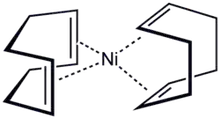 Bis(cyclooctadiene)nickel(0), a catalyst and source of "naked nickel."
 A complex of trans-butadiene[4]
 Crabtree's catalyst, a catalyst for hydrogenation of hindered alkenes.
 (Norbornadiene)molybdenum tetracarbonyl, a source of "Mo(CO)4"
 (Xylylene)Fe(CO)3, illustrating the stabilization of a labile dialkene by complexation
A large number of complexes are known of the type (diene)iron tricarbonyl.
Trienes and tetraenes
Trienes and even some tetraenes can bind to metals through several adjacent carbon centers. Common examples of such ligands are cycloheptatriene and cyclooctatetraene. Benzene and other arenes, which are trienes, forms a variety of complexes.
- Representative metal complexes of trienes and tetraenes.
 Mo(C7H8)(CO)3, a complex of cycloheptatriene
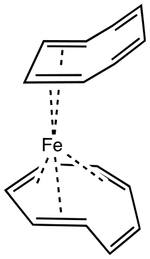 Fe(C8H8)2, a complex of cyclooctatetraene
 Cr(η6-C6H6)2, bis(benzene)chromium
Synthesis
Complexes of dienes, trienes, and tetraenes are typically prepared by treating metal complexes with preformed alkenes. These ligands are not highly nucleophilic, thus complexes are often prepared using labile precursors.[5]
Bonding and structure
The bonding between di-and polyenes to transition metals is described by the Dewar–Chatt–Duncanson model.
Focusing on dienes (tri- and tetraenes would be still more complex), their binding to metals is described using hapticity notation: in an η2 and η4 modes, the latter having four M-C bonds. η4-Dienes are 4-electron ligands, η6-trienes are 6-electron ligands, and η8-tetraenes are 8-electron ligands.
Butadiene more commonly binds in its cisoid rotamer, but transoid butadiene ligands have been observed.[4] In both cases, the rotation about the two vinyl subunits is blocked.

Reactions and applications
Diene complexes are precursors to many other organometallic derivatives. Addition of proton or hydride gives allyl complexes.[6] The interaction of metals with cyclopentadiene readily gives cyclopentadienyl complexes.
In terms of applications, dienes are substrates for a variety of catalytic reactions,[7] where it is assumed that the diene binds to the metal center. For example, polymerization and oligomerization. Ni(0) complexes convert butadiene to cyclododecatriene. In the Kuraray process, palladium(II) catalyzes the conversion of butadiene and water to octenols. Palladium complexes also catalyze the carboxylation of two equivalents of butadiene to give unsaturated lactones.[8]
Chiral dienes support asymmetric catalysis.[9]
References
- ↑ Elschenbroich, C. "Organometallics" (2006) Wiley-VCH: Weinheim. ISBN 3-527-29390-6
- ↑ John Hartwig (10 February 2010). Organotransition Metal Chemistry: From Bonding to Catalysis. University Science Books. ISBN 978-1-891389-53-5.
- ↑ Kaupp, Martin; Kopf, Thomas; Murso, Alexander; Stalke, Dietmar; Strohmann, Carsten; Hanks, John R.; Cloke, F. Geoffrey N.; Hitchcock, Peter B. (2002). "Trigonal Prismatic Structure of Tris(butadiene)molybdenum and Related Complexes Revisited: Diolefin or Metallacyclopentene Coordination?". Organometallics. 21 (23): 5021–5028. doi:10.1021/om020525v.
- 1 2 Dahlmann, Marc; Erker, Gerhard; Fröhlich, Roland; Meyer, Oliver (1999). "Structural Characterization of an ( s - trans -η4-Butadiene) Group 4 a nsa -Metallocene Complex". Organometallics. 18 (21): 4459–4461. doi:10.1021/om990498h.
- ↑ Knölker, Hans-Joachim (2000). "Efficient Synthesis of Tricarbonyliron−Diene Complexes Development of an Asymmetric Catalytic Complexation". Chemical Reviews. 100 (8): 2941–2962. doi:10.1021/cr990267k. PMID 11749311.
- ↑ Sato, Fumie; Urabe, Hirokazu; Okamoto, Sentaro (2000). "Synthesis of Organotitanium Complexes from Alkenes and Alkynes and Their Synthetic Applications". Chemical Reviews. 100 (8): 2835–2886. doi:10.1021/cr990277l. PMID 11749307.
- ↑ Piet W. N. M. van Leeuwen "Homogeneous Catalysis: Understanding the Art", 2004, Wiley-VCH, Weinheim. ISBN 1-4020-2000-7
- ↑ Dahlmann, Marc; Grub, Joachim; Löser, Eckhard (2011). "Butadiene". Ullmann's Encyclopedia of Industrial Chemistry. pp. 1–24. doi:10.1002/14356007.a04_431.pub2. ISBN 978-3-527-30673-2.
- ↑ Huang, Yinhua; Hayashi, Tamio (2022). "Chiral Diene Ligands in Asymmetric Catalysis". Chemical Reviews. 122 (18): 14346–14404. doi:10.1021/acs.chemrev.2c00218. PMID 35972018.