Transition metal complexes of carbon disulfide
Transition metal complexes of carbon disulfide are coordination complexes containing carbon disulfide as a ligand. Carbon disulfide is a well established commodity chemical with extensive reactivity, so it is logical that its interactions with metal complexes have been investigated.
In terms of ligand properties, carbon disulfide has no Lewis basicity. It is weakly electrophilic as shown by its reduction and its reactions with amines. It follows logically that carbon disulfide reacts with electron-rich complexes.[1]
η2-CS2 complexes
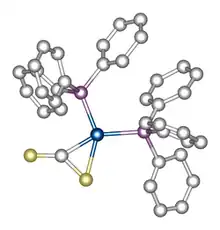
The history of this area begins with the reaction of zero-valent M[P(C6H5)3]3 with CS2 (M = Pd, Pt) to give M(η2-CS2)[P(C6H5)3]2.[2] The resulting complex is square planar. The metal-bound C–S distance is 171 pm, and the exo C=S bond length is 154 pm, almost identical to that of free carbon disulfide. The S–C–S is bent, with an angle of 136°.[3] Many related complexes are known, including a derivative of vanadocene (C5H5)2V(η2-CS2) and the iron-trimethylphosphine complex Fe(P(CH3)3)2(CO)2(η2-CS2).
Reactions
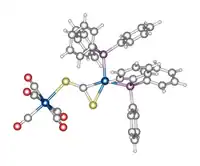
The exo sulfur of η2-CS2 complexes is basic. This effect manifested in the formation of bimetallic complexes where CS2 is a bridging ligand.
- Pt(CS2)[P(C6H5)3]2 + W(CO)5(thf) → Pt(CS2)[P(C6H5)3]2W(CO)5 + thf
In some cases, carbon disulfide is a precursor to thiocarbonyl complexes. An early example resulted from the dissolution of Wilkinson's catalyst in CS2:[2]
- RhCl(P(C6H5)3)3 + CS2 → RhCl(CS)(P(C6H5)3)2 + SP(C6H5)3
This transformation may proceed by the intermediacy of a CS2 complex.
A host of structurally complex derivatives have been obtained from treating carbon disulfide with iron and cobalt carbonyls.[4]
C–C coupling
Treating titanocene dicarbonyl with carbon disulfide gives the tetrathiooxalate derivative:[5]
- 2 (C5H5)2Ti(CO)2 + 2 CS2 → [(C5H5)2Ti]2(C2S4) + 4 CO
A related example is the ethylenetetrathiolate C2S4(Fe2(CO)6)2 derived from iron carbonyls and carbon disulfide.[4]
References
- ↑ Pandey, Krishna K. (1995). "Reactivities of carbonyl sulfide (COS), carbon disulfide (CS2) and carbon dioxide (CO2) with transition metal complexes". Coordination Chemistry Reviews. 140: 37–114. doi:10.1016/0010-8545(94)01120-z.
- 1 2 Butler, I.S.; Fenster, A.E. (1974). "Activation of Carbon Disulphide by transition metal complexes". Journal of Organometallic Chemistry. 66 (2): 161–194. doi:10.1016/s0022-328x(00)91482-7.
- ↑ Mason, R.; Rae, A. I. M. (1970). "The Bonding of Carbon Disulphide to Transition Metals: The Crystal Structure of (Carbon disulphide)bis(triphenylphosphine)platinum(0)". Journal of the Chemical Society A. 1970 (5): 1767. doi:10.1039/j19700001767.
- 1 2 Broadhurst, Peter V.; Johnson, Brian F. G.; Lewis, Jack; Raithby, Paul R. (1982). "Reaction of CS2 with metal cluster carbonyls of the iron triad: Synthesis and X-ray crystal structure of [Fe4(CO)12(C2S4)]". Journal of the Chemical Society, Chemical Communications (2): 140. doi:10.1039/C39820000140.
- ↑ Harris, Holly A.; Rae, A. David; Dahl, Lawrence F. (1987). "Titanium-Activated Carbon-Carbon Bond Formation by Reductive Head-to-Head Coupling of Carbon Disulfide: Synthesis of (η5-C5H5)2Ti]2(C2S4) and Comparative Analysis of this Electron-Delocalized Tetrathiolene-Bridged Dititanium Complex with the Electronically Equivalent, Electron-Localized Oxalate- and Tetra-p-tolyloxalylamidine-Bridged Dititanium Complexes". Journal of the American Chemical Society. 109 (15): 4739–4741. doi:10.1021/ja00249a058.