Transition metal oxy chloride complexes

In inorganic chemistry, transition metal oxy chloride complexes are coordination complexes that consists of a transition metal coordinated to chloride and oxide ligands. These complexes are molecular (discrete) in contrast to the ternary phase metal oxychloride. The class of complexes is extensive.[1]
Bonding
Chloride and oxide are X-type ligands in coordination chemistry. Chloride is both σ-donor and a weak π-donor. Oxide is strong σ-donor and a strong π-donor. Both occur as terminal ligand and a bridging ligand.
Molecular M-O-Cl complexes
A selection of transition metal oxochloride complexes.[2]
| Metal | examples | comment |
|---|---|---|
| Ti | [TiOCl4]2−, Cl3TiOTiCl3 | exclusively Ti(IV) |
| V | VOCl3, [VOCl4]2− | exclusively V(V), NbOCl3 is polymeric |
| Ta | [Ta2OCl10]2− | |
| Cr | CrO2Cl2, [CrO3Cl]− | exclusively Cr(VI) |
| Mo | MoOCl4, | exclusively Mo(VI) |
| W | WOCl4, [W2O4Cl6]2− | exclusively W(VI)[3] |
| Re | ReO3Cl, Re2O4Cl6 | see[4] |
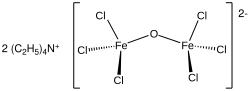
| Fe | [Fe2OCl6]2-[5][6] | corner-shared bitetrahedral |
| Ru | [Ru2OCl10]4−[7] | corner-shared biooctahedral |
| Os | [Os2OCl10]4−[8][OsO2Cl4]2−[9] | osmium oxides are numerous, exception to the pattern that terminal oxo ligands are associated with d0 metal centers. |
The compounds [Ta2OCl10]2− and [M2OCl10]4− (M = W, Ru, Os) have two MCl5 groups joined by a bridging oxygen atom.[10] Each metal has an octahedral environment. The linear M−O−M structure can be rationalized in terms of molecular orbital theory, indicating the presence of dπ — pπ bonding between the metal and oxygen atoms.[11]
References
- ↑ Greenwood, Norman N.; Earnshaw, Alan (1997). Chemistry of the Elements (2nd ed.). Butterworth-Heinemann. doi:10.1016/C2009-0-30414-6. ISBN 978-0-08-037941-8.
- ↑ Greenwood & Earnshaw, Chapters 22–25, section halides and oxohalides
- ↑ Willing, Wolfgang; Schmock, Fritjof; Müller, Ulrich; Dehnicke, Kurt (1986). "(PPH4)2[WO2Cl3]2 · 2 CH2Cl2: Synthese, Schwingungsspektrum und Kristallstruktur". Zeitschrift für Anorganische und Allgemeine Chemie. 532: 137–144. doi:10.1002/zaac.19865320119.
- ↑ Supeł, Joanna; Seppelt, Konrad (2006). "Rhenium Trichloride Dioxide, ReO2Cl3". Angewandte Chemie International Edition. 45 (28): 4675–4677. doi:10.1002/anie.200504468. PMID 16789054.
- ↑ Haselhorst, Gabriele; Wieghardt, Karl; Keller, Stefan; Schrader, Bernhard (1993). "The (μ-Oxo)bis[trichloroferrate(III)] Dianion Revisited". Inorganic Chemistry. 32 (5): 520–525. doi:10.1021/ic00057a006.
- ↑ Do, Y.; Simhon, E. D.; Holm, R. H. (1983). "Improved Syntheses of Tetrachlorodi-μ-sulfidodiferrate Dianion ([Fe2S2Cl4]2-) and Hexachloro-μ-oxodiferrate2- ([Fe2OCl6]2-) and Oxo/Sulfido Ligand Substitution by Use of Silylsulfide Reagents". Inorg. Chem. 22: 3809-12. doi:10.1021/ic00167a027.μ
- ↑ Li+ saltMudiyanselage, Ranuri S Dissanayaka; Marshall, Madalynn; Kong, Tai; Xie, Weiwei (2020). "Li4Ru2OCl10·10H2O: Crystal structure, magnetic properties and bonding interactions in ruthenium-oxo complexes". Acta Crystallographica Section B Structural Science, Crystal Engineering and Materials. 76 (5): 884–891. doi:10.1107/S2052520620010914. OSTI 1851622. PMID 33017321.
- ↑ NH4+)4 saltRudnitskaya, O. V.; Kultyshkina, E. K.; Popova, M. S.; Stash, A. I. (2013). "Structure of ammonium decachloro-μ-oxodiosmate(IV) (NH4)4[Os2OCl10] and its behavior in solutions". Russian Journal of Inorganic Chemistry. 58 (10): 1227–1230. doi:10.1134/S0036023613100185.
- ↑ Kruse, F. H. (1961). "Potassium osmyl chloride – refinement of the crystal structure". Acta Crystallographica. 14 (10): 1035–1041. doi:10.1107/S0365110X61003004.
- ↑ Housectroft & Sharpe, Figure 22.5.
- ↑ Housectroft & Sharpe, Figure 22.15.