Tau Herculis
  | |
| Observation data Epoch J2000 Equinox ICRS | |
|---|---|
| Constellation | Hercules |
| Right ascension | 16h 19m 44.43666s[1] |
| Declination | +46° 18′ 48.1123″[1] |
| Apparent magnitude (V) | 3.91[2] 3.83 to 3.86[3] |
| Characteristics | |
| Evolutionary stage | Main sequence[4] |
| Spectral type | B5 IV[5] |
| U−B color index | −0.569[2] |
| B−V color index | −0.151±0.009[2] |
| Variable type | SPB[3] |
| Astrometry | |
| Radial velocity (Rv) | −15.5±0.5[2] km/s |
| Proper motion (μ) | RA: −13.33[1] mas/yr Dec.: 38.48[1] mas/yr |
| Parallax (π) | 10.61±0.11 mas[1] |
| Distance | 307 ± 3 ly (94.3 ± 1.0 pc) |
| Absolute magnitude (MV) | −0.96[2] |
| Details | |
| Mass | 4.01[6] M☉ |
| Radius | 3.55±0.19 R☉[7] 3.80±0.25[8] R☉ |
| Luminosity | 574[2] L☉ |
| Surface gravity (log g) | 4.02±0.05[7] cgs |
| Temperature | 15,615±301[7] K |
| Metallicity [Fe/H] | 0.15[9] dex |
| Rotational velocity (v sin i) | 32[6] km/s |
| Age | 26[6] Myr |
| Other designations | |
| Asuusiha, τ Her, 22 Her, BD+46°2169, FK5 608, GC 21987, HD 147394, HIP 79992, HR 6092, SAO 46028, CCDM J16197+4619A[10] | |
| Database references | |
| SIMBAD | data |
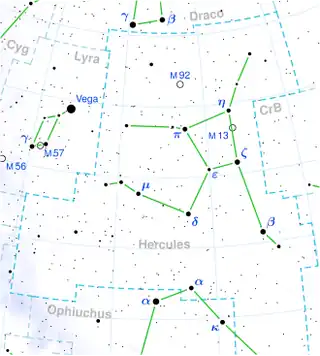
Tau Herculis, also named Asuusiha (Manchu: ᠠᠰᡠ ᡠᠰᡳᡥᠠ, Möllendorff: asu usiha),[11] is a variable star in the northern constellation of Hercules. It has a blue-white hue and is visible to the naked eye at night with an apparent visual magnitude that fluctuates around 3.91.[2] The star is located at a distance of approximately 307 light-years from the Sun based on parallax,[1] but it is drifting closer with a radial velocity of −16 km/s.[2]
Nomenclature
Tau Herculis, Latinized from τ Herculis and abbreviated Tau Her or τ Her, is the star's Bayer designation.
In Chinese astronomy, 七公 (Qī Gōng), meaning Seven Excellencies, refers to an asterism consisting of τ Herculis, 42 Herculis, φ Herculis, χ Herculis, ν1 Boötis, μ1 Boötis and δ Boötis.[12] Consequently, the Chinese name for τ Herculis itself is 七公二 (Qī Gōng èr, English: the Second Star of Seven Excellencies).[13] This star is also part of the Manchu constellation Asu Usiha (Manchu: ᠠᠰᡠ ᡠᠰᡳᡥᠠ, Möllendorff: asu usiha), representing a net used to hunt sables. The IAU Working Group on Star Names adopted the name Asuusiha for τ Herculis on 14 May 2026.[11]
Properties

The stellar classification of Tau Herculis is B5 IV,[5] and it serves as a standard spectrum in the modern Morgan–Keenan (MK) classification.[15] It is estimated to be just 26 million years old with a relatively low projected rotational velocity of 32 km/s.[6] Slowly rotating B-type stars are often chemically peculiar, so the mostly normal spectra of this star suggests we may be viewing it from near pole-on.[16] The abundance of most heavier elements in this star are about 85% of those in the Sun.[17] The star has four times the mass of the Sun[6] and around 3.8[8] times the Sun's radius. On average, it is radiating 574[2] times the luminosity of the Sun from its photosphere at an effective temperature of 15,615 K.[7]
During the Hipparcos mission,[4] Tau Herculis was discovered to be a variable star of the slowly pulsating B-type. These are mid-B main sequence stars that vary with a period of about a day;[4] the brightness of Tau Herculis varies by 0.03 magnitude[3] over a period of 1.24970±0.00008 days. The radial velocity of the star varies at a different rate than the photometric period, with the object showing both radial and non-radial pulsation modes.[4][18]
Pole star
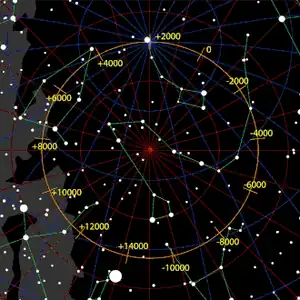
Tau Herculis is located within 1° of the precessional path traced across the celestial sphere by the Earth's North pole. It could have served the northern pole star around the year 7400 BCE, a phenomenon which is expected to reoccur in the year 18,400 due to precession.[16]
| Preceded by | Pole Star | Succeeded by |
|---|---|---|
| Iota Herculis | 18,400 AD | Alpha Draconis |
References
- 1 2 3 4 5 6 van Leeuwen, F. (November 2007), "Validation of the new Hipparcos reduction", Astronomy and Astrophysics, 474 (2): 653–664, arXiv:0708.1752, Bibcode:2007A&A...474..653V, doi:10.1051/0004-6361:20078357, S2CID 18759600.
- 1 2 3 4 5 6 7 8 9 Anderson, E.; Francis, Ch. (2012), "XHIP: An extended hipparcos compilation", Astronomy Letters, 38 (5): 331, arXiv:1108.4971, Bibcode:2012AstL...38..331A, doi:10.1134/S1063773712050015, S2CID 119257644.
- 1 2 3 Samus', N. N; et al. (2017), "General catalogue of variable stars: Version GCVS 5.1", Astronomy Reports, 61 (1): 80, Bibcode:2017ARep...61...80S, doi:10.1134/S1063772917010085, S2CID 125853869.
- 1 2 3 4 Masuda, Seiji; Hirata, Ryuko (April 2000), "Line-profile variation in tau Herculis", Astronomy and Astrophysics, 356: 209–212, Bibcode:2000A&A...356..209M.
- 1 2 Morgan, W. W.; Keenan, P. C. (1973), "Spectral Classification", Annual Review of Astronomy and Astrophysics, 11: 29, Bibcode:1973ARA&A..11...29M, doi:10.1146/annurev.aa.11.090173.000333.
- 1 2 3 4 5 David, Trevor J.; Hillenbrand, Lynne A. (2015), "The Ages of Early-Type Stars: Strömgren Photometric Methods Calibrated, Validated, Tested, and Applied to Hosts and Prospective Hosts of Directly Imaged Exoplanets", The Astrophysical Journal, 804 (2): 146, arXiv:1501.03154, Bibcode:2015ApJ...804..146D, doi:10.1088/0004-637X/804/2/146, S2CID 33401607.
- 1 2 3 4 Fitzpatrick, E. L.; Massa, D. (March 2005), "Determining the Physical Properties of the B Stars. II. Calibration of Synthetic Photometry", The Astronomical Journal, 129 (3): 1642–1662, arXiv:astro-ph/0412542, Bibcode:2005AJ....129.1642F, doi:10.1086/427855, S2CID 119512018.
- 1 2 Gordon, Kathryn D.; et al. (2019), "Angular Sizes, Radii, and Effective Temperatures of B-type Stars from Optical Interferometry with the CHARA Array", The Astrophysical Journal, 873 (1): 91, Bibcode:2019ApJ...873...91G, doi:10.3847/1538-4357/ab04b2, S2CID 125181833.
- ↑ Smith, K. C.; Dworetsky, M. M. (1993), "Elemental Abundances in Normal Late B-Stars and Hgmn-Stars from Co-Added IUE Spectra - Part One - Iron Peak Elements", Astronomy and Astrophysics, 274 (2): 335, Bibcode:1993A&A...274..335S
- ↑ "* tau Her". SIMBAD. Centre de données astronomiques de Strasbourg. Retrieved 2010-06-10.
- 1 2 "IAU Catalog of Star Names". Retrieved 18 May 2026.
- ↑ (in Chinese) 中國星座神話, written by 陳久金. Published by 台灣書房出版有限公司, 2005, ISBN 978-986-7332-25-7.
- ↑ (in Chinese) AEEA (Activities of Exhibition and Education in Astronomy) 天文教育資訊網 2006 年 6 月 26 日 Archived 2011-05-22 at the Wayback Machine
- ↑ MAST: Barbara A. Mikulski Archive for Space Telescopes, Space Telescope Science Institute, retrieved 24 September 2022.
- ↑ Garcia, B. (June 1989), "A list of MK standard stars", Bulletin d'Information du Centre de Donnees Stellaires, 36: 27, Bibcode:1989BICDS..36...27G.
- 1 2 Kaler, James B., "TAU HER (Tau Herculis)", Stars, University of Illinois, retrieved 2018-04-27.
- ↑ Adelman, Saul J.; et al. (June 2001), "Elemental abundance analyses with DAO spectrograms. XXV. The superficially normal B and A stars alpha Draconis, tau Herculis, gamma Lyrae, and HR 7926", Astronomy and Astrophysics, 371 (3): 1078–1083, Bibcode:2001A&A...371.1078A, doi:10.1051/0004-6361:20010408
- ↑ Briquet, M.; et al. (April 2003), "Spectroscopic mode identification for the slowly pulsating B star HD 147394", Astronomy and Astrophysics, 401: 281–288, Bibcode:2003A&A...401..281B, doi:10.1051/0004-6361:20030086.
