Portal:Energy

| Main page | New articles & Tasks |
 The Energy Portal Welcome to Wikipedia's Energy portal, your gateway to energy. This portal is aimed at giving you access to all energy related topics in all of its forms. |
Page contents: Selected article • Selected image • Selected biography • Did you know? • General images • Quotations • Related portals • Wikiprojects • Major topics • Categories • Help • Associated Wikimedia |
Introduction

Energy (from Ancient Greek ἐνέργεια (enérgeia) 'activity') is the quantitative property that is transferred to a body or to a physical system, recognizable in the capacity to do work and in the form of heat and light. Energy is a conserved quantity—the law of conservation of energy states that energy can be converted in form, but not created or destroyed. The unit of measurement for energy in the International System of Units (SI) is the joule (J).
Forms of energy include the kinetic energy of a moving object, the potential energy stored by an object (for instance due to its position in a field), the elastic energy stored in a solid object, chemical energy associated with chemical reactions, the radiant energy carried by electromagnetic radiation, the internal energy contained within a thermodynamic system, and rest energy associated with an object's rest mass. These are not mutually exclusive.
All living organisms constantly take in and release energy. The Earth's climate and ecosystems processes are driven primarily by radiant energy from the Sun. (Full article...)
Selected article

As farmers worldwide respond to higher crop prices in order to maintain the global food supply-and-demand balance, pristine lands are cleared to replace the food crops that were diverted elsewhere to biofuels' production. Because natural lands, such as rainforests and grasslands, store carbon in their soil and biomass as plants grow each year, clearance of wilderness for new farms translates to a net increase in greenhouse gas emissions. Due to this off-site change in the carbon stock of the soil and the biomass, indirect land use change has consequences in the greenhouse gas (GHG) balance of a biofuel. (Full article...)
Selected image

Photo credit: Charliebrown7034
Skyglow over New York City, one form of light pollution.
Did you know?
- Samuel Andrews (1836–1904) was an English-born chemist and inventor whose request for investment capital to build an oil refinery in 1862 led to a partnership with John D. Rockefeller and the formation of the Standard Oil companies?
- Golar Spirit (pictured) is the world's first floating storage and regasification vessel converted from a LNG carrier?
- The Rockies Express Pipeline, currently under construction, will be one of the largest natural gas pipelines ever built in North America?
- Syncrude Canada Ltd. is the world's largest producer of synthetic crude oil from oil sands?
- During World War II, Australia produced almost 500,000 barrels of shale oil by operating the Nevada–Texas–Utah type of oil-shale retorts?
- The Sangtuda 1 Hydroelectric Power Plant is expected to provide up to 12% of the total energy output of Tajikistan?
Selected biography
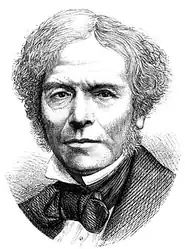
In 1831, Faraday began his great series of experiments in which he discovered electromagnetic induction. He established that a changing magnetic field produces an electric field, a relation mathematically modelled by Faraday's law. Faraday later used the principle to construct the electric dynamo, the ancestor of modern power generators. He went on to investigate the fundamental nature of electricity, concluding in 1839 that, contrary to opinions at the time, only a single "electricity" exists, and the changing values of quantity and intensity (voltage and charge) would produce different groups of phenomena.
Some historians refer to Faraday as the best experimentalist in the history of science. Despite this his mathematical ability did not extend so far as trigonometry or any but the simplest algebra. He nevertheless possessed the ability to present his ideas in clear and simple language. During his lifetime, Faraday rejected a knighthood and twice refused to become President of the Royal Society.
In the news
- 17 August 2026 –
- California's energy commission approves the United States's first energy-efficiency standards for replacement tires, aiming to reduce rolling resistance and lower driver fuel costs by 2029. However, manufacturers warn the strict limits could eliminate up to 70% of current replacement tire options by 2033. (The New York Times) (Fox Business)
- 11 August 2026 – Syria and weapons of mass destruction
- The Syrian transitional government confirms their cooperation with the International Atomic Energy Agency to purge nuclear materials at a hidden facility following a report by Axios on such plan after an agreement between Israel, Syria, and the United States. Conversely, Israel threatens to bombard the site again if the materials remain, and to prevent access to the site. (AA) (Axios) (The Jerusalem Post)
- 7 August 2026 – International sanctions during the Russian invasion of Ukraine, United States and the Russo-Ukrainian war
- The United States Senate votes 86–11 to pass a bill imposing sanctions on Russia's energy revenues, financial institutions, officials, and shadow fleet, while authorizing tariffs of up to 100% on major buyers of Russian oil and gas. The legislation will head to the U.S. House of Representatives for a vote. (Reuters)
General images
 Natural gas burning on a gas stove (from Natural gas)
 Seasonal cycle of capacity factors for wind and photovoltaics in Europe shown under idealized assumptions. The figure illustrates the balancing effects of wind and solar energy at the seasonal scale (Kaspar et al., 2019). (from Solar power)


 A breakdown of the products made from a typical barrel of US oil (from Oil refinery)
 Nuclear fuel assemblies being inspected before entering a pressurized water reactor in the United States (from Nuclear power)
 Deaths caused by use of fossil fuels such as natural gas (areas of rectangles in chart) greatly exceed those resulting from production of wind energy, nuclear energy or solar energy (rectangles barely visible in chart). (from Natural gas)
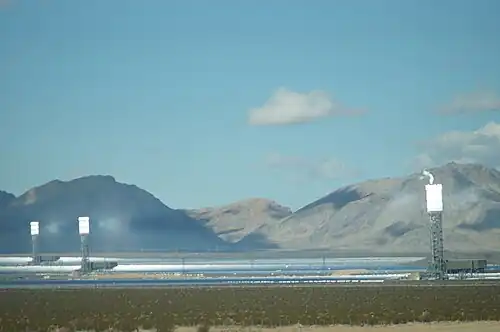 Ivanpah Solar Electric Generating System with all three towers under load (from Solar power)
 Sample of diesel fuel (from Oil refinery)
 Global geothermal electric capacity. Upper red line is installed capacity; lower green line is realized production. (from Geothermal power)
 Life-cycle greenhouse gas emissions of electricity supply technologies, median values calculated by IPCC (from Nuclear power)
 Sample of kerosene (from Oil refinery)
 The Warwick Castle water-powered generator house, used for the generation of electricity for the castle from 1894 until 1940 (from Hydroelectricity)
 Most waste packaging, small-scale experimental fuel recycling chemistry and radiopharmaceutical refinement is conducted within remote-handled hot cells. (from Nuclear power)
 Kenyan dairy farmer lighting a biogas lamp. Biogas produced from biomass is a renewable energy source that can be burned for cooking or light. (from Sustainable energy)
 Natural gas processing plant in Aderklaa, Lower Austria (from Natural gas)
 Utility cycling infrastructure, such as this bike lane in Vancouver, encourages sustainable transport. (from Sustainable energy)
 The Three Gorges Dam in Central China is the world's largest power-producing facility of any kind. (from Hydroelectricity)
 The map shows the commercial nuclear power plants in the world. Research reactors are not considered nuclear power plants.Operating reactors, building new reactorsOperating reactors, planning new buildNo reactors, building new reactorsNo reactors, new in planningOperating reactors, stableOperating reactors, decided on phase-outCivil nuclear power prohibitedNo reactors(from Nuclear power)
 Sample of crude oil (petroleum) (from Oil refinery)
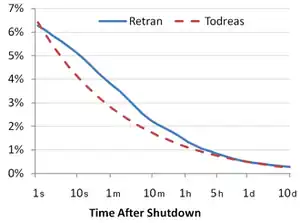 Reactor decay heat as a fraction of full power after the reactor shutdown, using two different correlations. To remove the decay heat, reactors need cooling after the shutdown of the fission reactions. A loss of the ability to remove decay heat caused the Fukushima accident. (from Nuclear power)
 The location of shale gas compared to other types of gas deposits (from Natural gas)
 Buildings in the Solar Settlement at Schlierberg, Germany, produce more energy than they consume. They incorporate rooftop solar panels and are built for maximum energy efficiency. (from Sustainable energy)

 Countries' proven natural gas reserves (2014), based on data from The World Factbook (from Natural gas)
 The Ffestiniog Power Station can generate 360 MW of electricity within 60 seconds of the demand arising. (from Hydroelectricity)
 Burning of natural gas coming out of the ground (from Natural gas)
 Honda Civic GX, a natural gas-powered automobile sold in North America from 1998 to 2015 (from Natural gas)
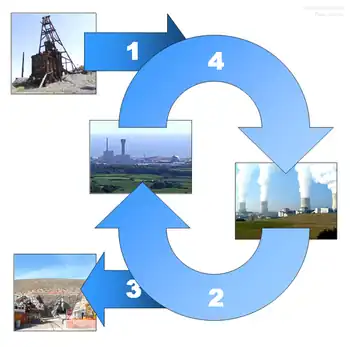 The nuclear fuel cycle begins when uranium is mined, enriched, and manufactured into nuclear fuel (1), which is delivered to a nuclear power plant. After use, the spent fuel is delivered to a reprocessing plant (2) or to a final repository (3). In nuclear reprocessing, 95% of spent fuel can potentially be recycled to be returned to use in a power plant (4). (from Nuclear power)
 Production of technology such as renewable energy sources starts a positive feedback loop to form what has been called a virtuous cycle—the opposite of a vicious cycle. For example, as more and more solar modules are deployed, prices fall because of the economies of scale, allowing the technology to become cost-competitive in new applications that in turn increase demand for more deployment. (from Sustainable energy)
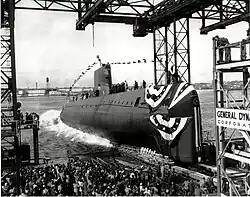 The launching ceremony of USS Nautilus January 1954. In 1958 it would become the first vessel to reach the North Pole. (from Nuclear power)
 Anti-nuclear protest near nuclear waste disposal centre at Gorleben in northern Germany (from Nuclear power)
 The growth of solar PV on a semi-log scale since 1996 (from Solar power)
- Deaths caused as a result of fossil fuel use (areas of rectangles in chart) greatly exceed those resulting from production of sustainable energy (rectangles barely visible in chart). (from Sustainable energy)
 Motor oil (from Oil refinery)
 Electrified transport and renewable energy are key areas of investment for the renewable energy transition. (from Sustainable energy)
 The Calder Hall nuclear power station in the United Kingdom, the world's first commercial nuclear power station (from Nuclear power)
 Acceptance of wind and solar facilities in one's community is stronger among U.S. Democrats (blue), while acceptance of nuclear power plants is stronger among U.S. Republicans (red). (from Solar power)
 Passive cooling features, such as these windcatcher towers in Iran, bring cool air into buildings without any use of energy. (from Sustainable energy)
 A woman in rural Rajasthan, India, collects firewood. The use of wood and other polluting fuels for cooking causes millions of deaths each year from indoor and outdoor air pollution. (from Sustainable energy)
 Yearly solar generation by continent (from Solar power)
 A photovoltaic power station in California, United States
 Dry cask storage vessels storing spent nuclear fuel assemblies (from Nuclear power)
 Death rates per unit of electricity production for different energy sources (from Nuclear power)
 The outdoor section of a heat pump. In contrast to oil and gas boilers, they use electricity and are highly efficient. As such, electrification of heating can significantly reduce emissions. (from Sustainable energy)
 Crude oil is separated into fractions by fractional distillation. The fractions at the top of the fractionating column have lower boiling points than the fractions at the bottom. The heavy bottom fractions are often cracked into lighter, more useful products. All of the fractions are processed further in other refining units. (from Oil refinery)
 Map of solar resources from World bank (from Solar power)
 Sample of gasoline (from Oil refinery)
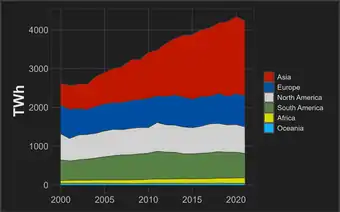 Yearly hydro generation by continent (from Hydroelectricity)
Quotations
- "We must not waste time and energy disputing the IPCC's report or debating the right machinery for making progress. The International Panel's work should be taken as our sign post: and the United Nations Environment Programme and the World Meteorological Organisation as the principal vehicles for reaching our destination." – Margaret Thatcher, 1990
- "The Kyoto treaty would have wrecked our economy, if I can be blunt." – George W. Bush, 2005
- "We strongly believe that the efforts needed to combat climate change do not have to be regarded as constraints on the economy. Instead, they can be used as a lever for new, green technology." – Maud Olofsson, 2007
Related portals
WikiProjects
WikiProjects connected with energy:
- WikiProject Energy
- Oil megaprojects task force
Other WikiProjects that may be of interest:
- WikiProject Environment
- WikiProject Technology
- WikiProject Biography
Major topics






Major categories
National energy supply, use & conservation
National electricity sector
Politics, economics, environment
- Climate change
- Energy conservation
- Energy economics
- Energy crises
- Energy development
- Energy policy
- Peak oil
Energy sources
- Fuels
- Biofuels
- Fossil fuels
- Fusion power
- Nuclear technology
- Renewable energy
- Energy conversion
- Electric power
- Energy storage
Energy-related design
Scientific usage
Category browser

Help

Puzzled by energy?
Can't answer your question?
Don't understand the answer?
- Ask at the reference desk
- Read the Wikipedia help pages
For further ideas, to leave a comment, or to learn how you can help improve and update this portal, see the talk page.
Associated Wikimedia
The following Wikimedia Foundation sister projects provide more on this subject:
-
 Commons
Free media repository -
 Wikidata
Free knowledge base -
 Wikiquote
Collection of quotations -
 Wikisource
Free-content library -
 Wikiversity
Free learning tools -
 Wiktionary
Dictionary and thesaurus
-
 List of all portals
-

-

-

-

-

-

-

-

-

-
 Random portal
-
 WikiProject Portals