Thai people
ไทยสยาม/คนภาคกลาง | |
|---|---|
 Thais at a cremation ceremony in Wat Chedi Luang | |
| Total population | |
| c. 65 million[a] | |
| Regions with significant populations | |
 | |
| Diaspora | |
 United States | 343,265[4] (2023) |
 South Korea | 193,462[5] (2024) |
 Australia | 115,000[6](2021) |
 Germany | 115,000[7] (2020) |
 Malaysia | 105,312[8] (2022) |
 Japan | 65,398[9] (2024) |
 Taiwan | 65,297[5] (2024) |
 United Kingdom | 55,000[5] (2024) |
 Sweden | 45,940[10] (2023) |
 Norway | 34,540[5] (2024) |
 France | 30,000[11] (2023) |
 Israel | 24,369[5] (2024) |
 Indonesia | 24,000[12] (2020) |
 Singapore | 23,705[8] (2022) |
 Netherlands | 23,648[5] (2024) |
 Canada | 22,275[13] (2021) |
 Belgium | 17,822[14] (2023) |
 Hong Kong | 17,753[5] (2024) |
 United Arab Emirates | 16,337[5] (2024) |
 Laos | 15,497[15] (2015) |
 Denmark | 10,951[16] (2024) |
 Finland | 10,594[5] (2024) |
 New Zealand | 10,251 (born), c. 50,000 (ancestry)[17] (2018) |
 Switzerland | 9,961[18] (2023) |
 Italy | 7,385[5] (2024) |
 Cambodia | 7,224[19] (2023) |
 Saudi Arabia | 7,190[5] (2024) |
 China | 6,195[5] (2024) |
 Austria | 4,844[5] (2014) |
 Qatar | 4,408[5] (2024) |
 India | 3,133[5] (2014) |
 Egypt | 3,000[5] (2024) |
 Bahrain | 2,564[5] (2024) |
 Ireland | 2,405[5] (2024) |
 Brazil | 2,280[20] (2025) |
 Hungary | 2,200[5] (2024) |
 South Africa | 2,130[5] (2024) |
 Spain | 2,044[5] (2024) |
 Turkey | 1,816[21] (2024) |
 Czechia | 1,727[5] (2024) |
 Russia | c. 1,500–2,000[22] (2023) |
 Pakistan | 1,408[5] (2024) |
 Portugal | 1,404[5] (2024) |
 Myanmar | 1,375[5] (2024) |
 Philippines | 1,340[23] (2023) |
 Vietnam | c. 1,300[24] (2023) |
 Kuwait | 1,210[5] (2024) |
 Brunei | 1,021[5] (2024) |
| Languages | |
| Central Thai, Southern Thai | |
| Religion | |
| Predominantly : Theravada Buddhism and Siamese folk religion 97.6% Minorities: Tai folk religion n/a Sunni Islam 1.6% Christianity 0.8% | |
| Related ethnic groups | |
| |

Thai people, historically known as Siamese people, are an ethnic group native to Thailand. In a narrower and ethnic sense, the Thais are also a Tai ethnic group dominant in Central Thailand (Siam proper).[25][26][27][28][29][2][30] Part of the larger Tai ethno-linguistic group native to Southeast Asia as well as Southern China, Thais speak the Sukhothai languages (Central Thai and Southern Thai language),[31] which is classified as part of the Kra–Dai family of languages. The majority of Thais are followers of Theravada Buddhism.
Government policies during the late 1930s and early 1940s resulted in the successful forced assimilation of various ethno-linguistic groups into the country's dominant Central Thai language and culture, leading to the term Thai people to come to refer to the population of Thailand overall. This includes other subgroups of the Tai ethno-linguistic group, such as the Northern Thais and the Isan people, as well as non-Southeast Asian and non-Tai groups, the largest of which is that of the Han Chinese, who form a substantial minority ethnic group in Thailand at about 12 to 15%.
Etymology
Names
By endonym, Thai people refer themselves as chao thai (Thai: ชาวไทย, IPA: [tɕʰaːw tʰaj]), whose term eventually being derived from Proto-Tai *ɗwɤːjᴬ meaning free,[32] which emphasise that Thailand has never been a colony in the late modern period. Academically, Thai people are referred to as the Chao Phraya Thais (ไทยลุ่มเจ้าพระยา, Thai lum chao phraya).
Ethnically, Thai people are called Siamese (ชาวสยาม, chao sayam, IPA: [tɕʰaːw sàjǎːm]) or Thai Siam (ไทยสยาม, thai sayam), which refers to the Tai people inhabited in Central and Southern Thailand;[b] Siamese people are subdivided into three groups: Khon Phak Klang (Thai: คนภาคกลาง, lit: Central Thai people) or Khon Tai (Thai: คนใต้, lit: Southern Thai people) and Khorat Thai (ไทโคราช). Siamese was also, by historically, the exonym of those people.[b] In Du royaume de Siam, Simon de la Loubère recorded that the people whom he spoke were Tai Noi (ไทน้อย), which were different from Shan people (or Tai Yai), who lived on the mountainous area of what is now Shan State in Myanmar.[33] On 24 June 1939, however, Plaek Phibunsongkhram formally renamed the country and its people Thailand and Thai people respectively.
Due to the partial success of Thaification, the term Thai people, often creates ambiguity among the various Tai groups in the country, especially the Sino-Thai who also call themselves the same.
Origin of the name
According to Michel Ferlus, the ethnonyms Thai/Tai (or Thay/Tay) would have evolved from the etymon *k(ə)ri: 'human being' through the following chain: *kəri: > *kəli: > *kədi:/*kədaj > *di:/*daj > *dajA (Proto-Southwestern Tai) > tʰajA2 (in Siamese and Lao) or > tajA2 (in the other Southwestern and Central Tai languages classified by Li Fangkuei).[34] Michel Ferlus' work is based on some simple rules of phonetic change observable in the Sinosphere and studied for the most part by William H. Baxter (1992).[35]
Michel Ferlus notes that a deeply rooted belief in Thailand has it that the term "Thai" derives from the last syllables -daya in Sukhodaya/ Sukhothay (สุโขทัย), the name of the Sukhothai Kingdom.[34] The spelling emphasizes this prestigious etymology by writing ไทย (transliterated ai-d-y) to designate the Thai/ Siamese people, while the form ไท (transliterated ai-d) is occasionally used to refer to Tai speaking ethnic groups.[34] Lao writes ໄທ (transliterated ai-d) in both cases.[34] The word "Tai" (ไท) without the final letter ย is also used by Thai people to refer to themselves as an ethnicity, as historical texts such as "Mahachat Kham Luang", composed in 1482 during the reign of King Borommatrailokkanat. The text separates the words "Tai" (ไท) from "Tet" (เทศ), which means foreigners.[36] Similarly, "Yuan Phai", a historical epic poem written in the late 15th to early 16th century, also used the word "Tai" (ไท).[37]
The French diplomat Simon de la Loubère, mentioned that, "The Siamese give to themselves the Name of Tai, or Free, and those that understand the Language of Pegu, affirm that Siam in that Tongue signifies Free. 'Tis from thence perhaps that the Portugues have derived this word, having probably known the Siamese by the Peguan. Nevertheless Navarete in his Historical Treatises of the Kingdom of China, relates that the Name of Siam, which he writes Sian, comes from these two words Sien lo,[c] without adding their signification, or of what Language they are; altho' it may be presumed he gives them for Chinese, Mueang Tai is therefore the Siamese Name of the Kingdom of Siam (for Mueang signifies Kingdom) and this word wrote simply Muantay, is found in Vincent le Blanc, and in several Geographical Maps, as the Name of a Kingdom adjoining to Pegu: But Vincent le Blanc apprehended not that this was the Kingdom of Siam, not imagining perhaps that Siam and Tai were two different Names of the same People. In a word, the Siamese, of whom I treat, do call themselves Tai Noe, *little Siams. There are others, as I was informed, altogether savage, which are called Tai yai, great Siams, and which do live in the Northern Mountains."[41]
Based on a Chinese source, the Ming Shilu, Zhao Bo-luo-ju, described as "the heir to the old Ming-tai prince of the country of Xian-luo-hu", (Chinese: 暹羅斛國舊明台王世子) sent an envoy to China in 1375. Geoff Wade suggested that Ming Tai (Chinese: 明台) might represent the word "Muang Tai" while the word Jiu (Chinese: 舊) means old.[42]
History
The Siamese before the Tai

The present-day Thai people were previously called Siamese before the country was renamed Thailand in the mid-20th century.[43] The Thais, or Siamese, are the majority population of Thailand and are also present in Laos, with minorities in Vietnam, Myanmar, India and southern China. The peoples of Southeast Asia have been divided into five groups, the Mon-Khmer, the Viet-Muong, the Tay-Thai, the Hmong-Dzao and a southern island group comprising the Cham, Gia Rai and Ede. On that division the Tay and the Thai share a common origin. They settled in the fertile plains of central Thailand, where they established powerful kingdoms like Sukhothai and Ayutthaya. Over time, they absorbed cultural influences from pre-existing groups, including the Mon.[44]
The toponym or ethnonym siam or syam appears in several pre-Angkorian inscriptions, and earlier scholars have interpreted it as denoting either a geographical locality or an ethnolinguistic group within the Chao Phraya Basin;[45]: 69 those inscriptions include K557 (611 CE),[46]: 21 K127 (683 CE),[46]: 89 K154 (685 CE),[46]: 123 K79 (639 CE),[46]: 69 and K904 (713 CE).[47]: 54 Theodore Pigeaud identified the syangka of the Old Javanese Deśawarṇana with the same term, taking it for the Syam of a mid-11th-century Cham inscription and of 13th-century Khmer inscriptions.[39]: 41 Furthermore, the Chinese sources record a 6th-century polity known as Qiān Zhī Fú (千支弗), which some scholars have speculated was centered at Si Thep. The prefix qiān (千) phonetically resembles Xiān (暹), the name Chinese records of the late 13th and 14th centuries use for the port polities of the Gulf of Thailand, among them Ayodhya and Suphan Buri.[39]: 37, 39 Đại Việt sources use the same graph for the peoples and polities of the Chao Phraya River basin. On this basis, Tatsuo Hoshino proposed that Qiān Zhī Fú represented one of the early Siamese city-states—later subject to Tainization—that flourished through their participation in the trans-Mekong trade networks linking Champa in the east with the Menam Basin in the west.[48]: 54
The present-day descendants of the Qiān population, also known as the Nyah Kur people, who are not Tainized and maintain the Nyah Kur language—an archaic survival of Old Mon—reside primarily in the highland region surrounding the ancient center of Si Thep, with notable concentrations along the borderlands of Chaiyaphum, Phetchabun, Lopburi, and Nakhon Ratchasima provinces.
Arrival of the Tai


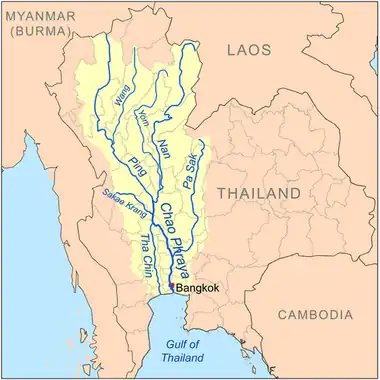

There have been many theories proposing the origin of the Tai peoples — of which the Thai are a subgroup — including an association of the Tai people with theAi Lao and Kingdom of Nanzhao . A linguistic study has suggested[50] that the origin of the Tai people may lie around Guangxi Zhuang Autonomous Region of southern China, where the Zhuang people currently account for approximately one third of the total population. The Qin dynasty founded Guangdong in 214 BC, initiating varying successive waves of Han Chinese from the north for centuries to come.[35]
With dynastic Chinese political upheavals, cultural changes, and intensive Han migratory pressures from north that led the Tai peoples on the verge of being displaced, some of them migrated southwards[51]. According to linguistic and other historical evidence, the southwestward migration of Southwestern Tai-speaking tribes, in particular, from Guangxi took place sometime between the 8th-10th centuries.[52] Baker and Pasuk give the ground for that dating, southwestern Tai having absorbed many Late Middle Chinese words datable to the seventh century, and stress that the movement was not one mass migration but many small groups over decades.[49]: 26
The Tais from the north gradually settled in the Chao Phraya valley from the tenth century onwards, in lands of the Dvaravati culture, assimilating the earlier Austroasiatic Mon and Khmer people, as well as coming into contact with the Khmer Empire. Those who reached what is now Thailand took up the Theravada Buddhism of the Mon together with Hindu-Khmer culture and statecraft, so that Thai culture became a mixture of Tai traditions with Indic, Mon and Khmer elements.[53]
Another proposed migration route, based on linguistic analysis, involves Daic-speaking populations moving from the east and settling in Luo Yue as early as around 700 BCE. Within this framework, the Âu group is hypothesized to have followed a trans-Mekong trade corridor linking Champa and Đại Việt in the east with the Menam Basin in the west. The route is reconstructed as extending from northern Vietnam through Thanh Hóa and Nghệ An, continuing into present-day Laos in regions such as Khamkeut and Hinboun, and ultimately reaching northeastern Thailand, including areas around Nakhon Phanom and Sakon Nakhon.[54]: 61–2 Meanwhile, the Lạc group is scholarly interpreted as having persisted as a lineage designation among the Tai Dam people in Sip Song Chau Tai, and is also associated in later genealogical narratives with Khun Lo of the Lao people.[54]: 64 Hoshino reads Tai- or Daic-speaking populations into several of the polities the Tang annals record in the Mun–Chi and middle Mekong valleys during the 7th and 8th centuries, among them Wen Dan,[48]: 39, 53, 68 Gǔ Láng Dòng (古郎洞), which he calls almost certainly the name of a Tai state,[48]: 49 Jūn Nà Lú (君那盧), whose name he reads as na lao, "Lao paddy fields",[48]: 60–61 Cān Bàn,[48]: 39, 68 and the three polities the annals group in a single category as alike in customs, Qiān Zhī Fú under the name Śrī Canāśapura, Xiū Luó Fēn and Gān Bì, whose military organisation he takes for the mark of a Tai-dominated state.[48]: 54 Hiram Woodward regards the linguistic argument as tendentious and holds that it should be used neither to support nor to invalidate Hoshino's geographical conclusions.[55]: 87 Together with the Tai Chiang Saen branch migrating from the north, they arrived in the central plain during the 8th–9th centuries, a period coinciding with the decline of the Dvaravati polities.
Early kingdoms
The most recognized early Thai chiefdoms included the Yonok Kingdom , Sukhothai Kingdom and Suphannaphum. The Lavo Kingdom, which was the center of Khmer culture in the Chao Phraya valley from the 10th to 11th century, was also the rallying point for the Thais. The Thai were called "Siam" by the Angkorians and they appeared on the bas relief at Angkor Wat as a part of the army of the Lavo Kingdom. Zhou Daguan, who was at Yasodharapura in 1296–97, reports Siamese living there in large numbers and practising sericulture, which he says the Angkorians did not, bringing mulberry and silkworms from Siam and weaving a dark patterned satin; he adds that Siamese women could sew and mend with needle and thread, a skill he says local women lacked, so that Angkorians brought them clothing to repair.[40]: 46 The Thai chiefdoms of the Chao Phraya valley are sometimes said to have come under Angkorian control under strong monarchs such as Suryavarman II and Jayavarman VII, but to have been independent for most of the period. Baker and Pasuk find little to support administrative control that far west. The plain has yielded none of the temple-endowment inscriptions characteristic of Angkorian provinces, and Jayavarman VII's hospital foundations reach no further west than Prachin Buri.[49]: 22, 24
Xiān and the port polities
Chinese records of the late 13th and 14th centuries call the polities of the lower Chao Phraya Xiān (暹). Yoneo Ishii argued that the name covered several port polities of the Bay of Bangkok rather than one place, and that in the Chinese classification of tributary countries a name written in Chinese characters need not denote a single locality.[39]: 38, 41–2 Baker and Pasuk make the same reservation, reading Xiān as Ayodhya from the late 13th century while allowing that the Chinese may first have applied the name elsewhere.[40]: 46
The earliest notices of the name are Vietnamese. The Đại Việt sử ký toàn thư records that in 1149 merchant ships from Xiān and two other countries reached Hǎidōng and were granted a trading post at Vân Đồn.[56] In the Chinese record the name first appears in 1282 or 1283, when an official fleeing the Mongol army took refuge there. It sent its first mission in 1292, its ruler presented a gold plate at court in 1295, and further missions followed in 1299, 1300, 1314, 1319 and 1323; over the same span Lavo sent four missions between 1289 and 1299 and Phetchaburi one in 1294.[40]: 45, 51 Suphan Buri appears later as Su-men-bang, whose prince, described as heir to the king of Siam, sent missions between the 1370s and 1398.[40]: 63 Baker and Pasuk count four towns of the lower plain — Lavo, Suphan Buri, Ayodhya and Phetchaburi — that had each dealt with China in its own name before the union.[40]: 55
What a mission attests is a separate question. Under the tribute system a local ruler gained access to trade with China together with political recognition, and between 600 and 850 the court received 110 missions from thirty-four named places in Southeast Asia, half of which sent only one.[49]: 9 The Chinese texts also graded these units, calling Phetchaburi a chéng (城), city, rather than a guó (國), country.[39]: 39 The identification of Xiān with Sukhothai began with a translator of the Chinese annals and spread through Cœdès; Yamamoto Tatsurō challenged it in 1989 from the Guangzhou gazetteer of 1297–1307, in which Sukhothai stands as the object of a verb meaning to control and Xiān as its subject, so that the two cannot name one place.[39]: 37, 38 Xiān and Luó hú (Lavo) were joined in 1349, after which the records treat the pair as Xiānluó hú.[40]: 55–56
Ayutthaya to the nineteenth century
A new city-state known as Ayutthaya covering the areas of central and southern Thailand, named after the Indian city of Ayodhya,[57] was founded by Ramathibodi and emerged as the center of the growing Thai empire starting in 1350. Inspired by the then Hindu-based Khmer Empire, the Ayutthayan empire's continued conquests led to more Thai settlements as the Khmer empire weakened after their defeat at Angkor in 1431. During this period Ayutthaya built a hierarchy of vassal states that paid homage to its kings. Even as Thai power expanded at the expense of the Mon and Khmer, the Thai Ayutthayans faced setbacks at the hands of the Malays at Malacca and were checked by the Toungoo of Burma.
Though sporadic wars continued with the Burmese and other neighbors, Chinese wars with Burma and European intervention elsewhere in Southeast Asia allowed the Thais to develop an independent course by trading with the Europeans as well as playing the major powers against each other in order to remain independent. The Chakkri dynasty under Rama I held the Burmese at bay, while Rama II and Rama III helped to shape much of Thai society, but also led to Thai setbacks as the Europeans moved into areas surrounding modern Thailand and curtailed any claims the Thai had over Cambodia, in dispute with Burma and Vietnam. The Thai learned from European traders and diplomats, while maintaining an independent course. Chinese, Malay, and British influences helped to further shape the Thai people who often assimilated foreign ideas, but managed to preserve much of their culture and resisted the European colonization that engulfed their neighbors. Thailand is also the only country in Southeast Asia that was not colonized by European powers in modern history. The 1893 "Map to Illustrate the Siamese Question", lithographed by the Scottish William Johnston (1802–1888) and his brother Alexander Keith Johnston (1804–1871), describes the demographics: "the population is very mixed consisting of Siamese, Chinese, Laosians, Malays and a few Europeans."[58]
Thaification: 20th century
The concept of a Thai nation was not developed until the beginning of the 20th century, under Prince Damrong and then King Rama VI (Vajiravudh).[59] Before this era, Thai did not even have a word for 'nation'. King Rama VI also imposed the idea of "Thai-ness" (khwam-pen-thai) on his subjects and strictly defined what was "Thai" and "un-Thai". Authors of this period re-wrote Thai history from an ethno-nationalist viewpoint,[60] disregarding the fact that the concept of ethnicity had not played an important role in Southeast Asia until the 19th century.[61][62] David K. Wyatt made the same point a working rule for writing about earlier centuries, preferring geographical terms to ethnic ones and speaking of the ruler of a named town rather than of a Thai or Khmer ruler. For the population of the Central Plain before the ethnic categories hardened he proposed the term Siamese, expressly not as a synonym for Thai, to convey what he called an ethnicity in the process of becoming.[63]: 3, 5 This newly developed nationalism was the base of the policy of "Thaification" of Thailand which was intensified after the end of absolute monarchy in 1932 and especially under the rule of Field Marshal Plaek Phibunsongkhram (1938–1944). Minorities were forced to assimilate and the regional differences of northern, northeastern and southern Thailand were repressed in favour of one homogenous "Thai" culture.[64] As a result, many citizens of Thailand cannot differentiate between their nationality (san-chat) and ethnic origin (chuea-chat).[65] It is thus common for descendants of Jek เจ๊ก (Chinese) and Khaek แขก (Indian, Arab, Muslim), after several generations in Thailand, to consider themselves as "chuea-chat Thai" (ethnic Thai) rather than identifying with their ancestors' ethnic identity.[65]
Other peoples living under Thai rule, mainly Mon, Khmer, and Lao, as well as Chinese, Indian or Muslim immigrants continued to be assimilated by Thais, but at the same time they influenced Thai culture, philosophy, economy and politics. In his paper Jek pon Lao (1987) (เจ้กปนลาว—Chinese mixed with Lao), Sujit Wongthet, who describes himself in the paper as a Chinese mixed with Lao (Jek pon Lao), claims that the present-day Thai are really Chinese mixed with Lao.[66][67] He insinuates that the Thai are no longer a well-defined race but an ethnicity composed of many races and cultures.[66][65] The biggest and most influential group economically and politically in modern Thailand are the Thai Chinese.[68][69] Theraphan Luangthongkum, a Thai linguist of Chinese ancestry, claims that 40% of the contemporary Thai population have some distant Chinese ancestry largely contributed from the descendants of the former successive waves of Han Chinese immigrants that have poured into Thailand over the last several centuries.[70]
Genetics
According to a 2021 study, Northern Tai-Kadai groups are genetically close to Dai and Kinh Vietnamese people and exhibit less admixture with indigenous Austroasiatic groups. Meanwhile, Northeastern Tai-Kadai groups are genetically close to Austroasiatic Khmu-Katu groups, who recently migrated to Thailand from Laos. They are also closely related to Cambodians. Central and Southern Tai-Kadai groups have ancestry related to other Tai groups while also having admixture from pre-existing Mon groups. Compared to their Neolithic ancestors, they show excess affinities with Han Chinese. Southern Thai Austronesian groups are also not related to Austronesians from Taiwan but instead, are more related to the Mamanwa, Mons, Central and Southern Tai-Kadai groups. Austroasiatic groups from Thailand can be categorized into the Monic, Khmu-Katu or Palaungic groups. Monic and Palaungic groups are admixed with Sino-Tibetan groups. Conversely, Khmu-Katu are more admixed with Tai-Kadai groups from Northeastern Thailand and Laos, increasing the affinities between the groups. Meanwhile, Thai hill tribes such as Hmong, Mlabri and Iu Mien are genetically more isolated although Iu Mien show some affinities with Hmong, Tai-Kadai and Sino-Tibetan groups from Thailand and China. Other hill tribes like Lawa and Lisu are less isolated from foreign contact. It has been suggested by experimental ancient admixutre tools like globetrotter, that some populations in present day Thailand have minor Gujarati and Tiwari ancestry.[71]
Another 2021 study showed that Thai hill tribes have distinct genetic affinities. For example, the Mlabri clustered with other Austroasiatic groups in Thailand, and other Southeast Asians (e.g. Vietnamese, Laotians, Indonesians etc.). Burmese populations, however, do not cluster with the Mlabri. Instead, they cluster with other East Asians (e.g. Chinese, Japanese, Koreans etc.), Sino-Tibetan-speaking groups (e.g. Akha, Lisu) and Austroasiatic-speaking groups (e.g. Palaung and Lawa Western 1). Meanwhile, all Thai Hmong and IuMien populations cluster with southern Chinese and Tai-Kadai groups that migrated to Thailand from southern China.[72]
A 2023 study stated that most Kra-Dai speaking populations in Thailand emerged from admixture between Kra-Dai migrants from southern China and local Austroasiatic-speaking populations, with Laos being a gateway for Kra-Dai migration. However, the presence of Dai and Zhuang ancestry in some Northern and Central Thai populations suggest an alternative route. There is also evidence of bidirectional admixture between Southern Thai and Nayu, who show close genetic relationships with Austronesian speaking groups from Island Southeast Asia. For Central Thais, there is no evidence of close affinities with Mon, except for two Central Thai individuals from the Potharam district of Ratchaburi province.[73]
Several studies show high genetic affinities between Thai populations and several Southwestern Chinese groups.[74][75] Thai populations also have broad affinities with Iron Age Log Coffin-associated individuals from Northwestern Thailand, who are a mixture of Upper Yellow River-related, Southern East Asian-related and Hoabinhian-related ancestries. However, they differ due to receiving additional components from neighboring Laotians, Burmese and Southern Chinese, which occurred after 1700 BP.[76]
According to a 2025 study, Dai-related ancestry is the predominant ancestral component for Northern Tai-Kadai groups (19.1–100%) whilst Lao-related ancestry is more common for other Tai-Kadai groups, ranging from 19% for Central Tai-Kadai groups to 100% for some Northeastern Tai-Kadai groups. Central and Southern Tai-Kadai groups also received additional input from Sino-Tibetan, Hmong-Mien and possibly Bengali and Gujarati people. Genetic links between Indian lineages and a clade of Tai-Kadai populations from Northern Thailand is also observed. Whilst Tai-Kadai migrations into Thailand from South China begun since ancient times, it intensified in the past few centuries, exemplified by King Kawila's attempts to repopulate the war-torn cities of the Lan Na Kingdom. Most of these recent Tai-Kadai migrants were sourced from Southwestern China and Myanmar.[77]
Ancient DNA extends the picture further back. Skeletons from the upper Mun basin dated between 1500 and 500 BCE have their closest living match in the Chao Bon or Nyah Kur, a Mon-Khmer group of the nearby hills.[49]: 7
Geography and demographics
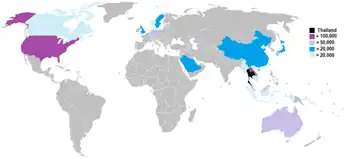
The vast majority of the Thai people live in Thailand, although some Thais can also be found in other parts of Southeast Asia. About 51–57 million live in Thailand alone,[78] while large communities can also be found in the United States, China, Laos, Japan, Taiwan, Malaysia, Singapore, Cambodia, Vietnam, Burma, South Korea, Germany, the United Kingdom, Canada, Australia, Sweden, Norway, Libya, and the United Arab Emirates.
Culture and society
The Thais can be broken down into various regional groups with their own regional varieties of Thai. These groups include the Central Thai (also the standard variety of the language and Culture), the Southern Thai, the Isan (more closely related to the standard Lao of Laos than to standard Thai) and Lanna Thai. Within each regions exist multiple ethnic groups. Modern Central Thai culture has become more dominant due to official government policy, which was designed to assimilate and unify the disparate Thai in spite of ethnolinguistic and cultural ties between the non-Central-Thai-speaking people and their communities.[59][79][80]
Indigenous arts include muay Thai (kick boxing), Thai dance, makruk (Thai Chess), Likay, and nang yai (shadow play).
Religion

Thai form the second largest ethno-linguistic group among Buddhists in the world.[81] The modern Thai are predominantly Theravada Buddhist and strongly identify their ethnic identity with their religious practices that include aspects of ancestor worship, among other beliefs of the ancient folklore of Thailand. Thais predominantly (more than 90%) avow themselves Buddhists. Since the rule of King Ramkhamhaeng of Sukhothai and again since the "orthodox reformation" of King Mongkut in the 19th century, it is modeled on the "original" Sri Lankan Theravada Buddhism. The Thais' folk belief however is a syncretic blend of the official Buddhist teachings, animistic elements that trace back to the original beliefs of Tai peoples, and Brahmin-Hindu elements[82] from India, partly inherited from the Hindu Khmer Empire of Angkor.[83]
The belief in local, nature and household spirits, that influence secular issues like health or prosperity, as well as ghosts (Thai: phi, ผี) is widespread. It is visible, for example, in so-called spirit houses (san phra phum) that may be found near many homes. Phi play an important role in local folklore, but also in modern popular culture, like television series and films. "Ghost films" (nang phi) are a distinct, important genre of Thai cinema.[84]
Hinduism has left substantial and present marks on Thai culture. Some Thais worship Hindu gods like Ganesha, Shiva, Vishnu, or Brahma (e.g., at Bangkok's well-known Erawan Shrine). They do not see a contradiction between this practice and their primary Buddhist faith.[85] The Thai national epic Ramakien is an adaption of the Hindu Ramayana. Hindu mythological figures like Devas, Yakshas, Nagas, gods and their mounts (vahana) characterise the mythology of Thais and are often depicted in Thai art, even as decoration of Buddhist temples.[86] Thailand's national symbol Garuda is taken from Hindu mythology as well.[87]
A characteristic feature of Thai Buddhism is the practice of tham boon (ทำบุญ) ("merit-making"). This can be done mainly by food and in-kind donations to monks, contributions to the renovation and adornment of temples, releasing captive creatures (fish, birds), etc. Moreover, many Thais idolise famous and charismatic monks,[88] who may be credited with thaumaturgy or with the status of a perfected Buddhist saint (Arahant). Other significant features of Thai popular belief are astrology, numerology, talismans and amulets[89] (often images of the revered monks)[90]
Besides Thailand's two million Muslim Malays, there are an additional more than a million ethnic Thais who profess Islam, especially in the south, but also in greater Bangkok. As a result of missionary work, there is also a minority of approximately 500,000 Christian Thais: Catholics and various Protestant denominations. Buddhist temples in Thailand are characterized by tall golden stupas, and the Buddhist architecture of Thailand is similar to that in other Southeast Asian countries, particularly Cambodia and Laos, with which Thailand shares cultural and historical heritage.
See also
Notes
- ↑ The total figure is merely an estimation; sum of all the referenced populations below.
- 1 2 Exonym is generally used to differentiate between Thai Chinese when they refer to themselves as Thais by nationality or citizenship.
- ↑ Xiānluó or Hsien-lo (暹羅) was the Chinese name for Ayutthaya, a kingdom created by the merger of Lavo and Sukhothai or Suphannabhumi[38] Yoneo Ishii instead has the compound arise from the joining of Xiān and Luó hú (Lavo), which Chinese sources date to 1349, Xiānluó hú (暹羅斛) being shortened to Xiānluó afterwards.[39]: 40 He rejects the identification of Xiān with Sukhothai.[39]: 37–38 The notices of 1349 run both ways, one having Xiān submit to Luó hú and another having Xiān bring Luó hú to submission, a discrepancy Chris Baker and Pasuk Phongpaichit attribute to copying error.[40]: 55–56
- ↑ Thai people make up approximately 75–85% population of the country (58 million) if including the Southern Thai and, more controversially, the Northern Thai and Isan people, all of which include significant populations of non Tai-Kadai ethnic groups
References
- ↑ McCargo, D.; Hongladarom, K. (2004). "Contesting Isan-ness: Discourses of politics and identity in Northeast Thailand" (PDF). Asian Ethnicity. 5 (2): 219. doi:10.1080/1463136042000221898. S2CID 30108605. Archived from the original (PDF) on 9 August 2017. Retrieved 3 September 2016.
- 1 2 David Levinson (1998), Ethnic Groups Worldwide: A Ready Reference Handbook, Oryx Pres, p. 287, ISBN 978-1-57356-019-1
- ↑ Paul, Lewis M.; Simons, Gary F.; Fennig, Charles D. (2013), Ethnologue: Languages of the World, SIL International, ISBN 978-1-55671-216-6
- ↑ "US Census Data". U.S. Census Bureau. Retrieved 21 September 2024.
- 1 2 3 4 5 6 7 8 9 10 11 12 13 14 15 16 17 18 19 20 21 22 23 24 25 26 27 "สถิติจำนวนคนไทยในต่างประเทศ ประจำปี 2567" (PDF). mfa.go.th (in Thai). 5 April 2024. Archived (PDF) from the original on 1 February 2025.
- ↑ "Estimated resident population, Country of birth – as at 30 June, 1996 to 201". Australian Bureau of Statistics. 17 June 2021. Retrieved 7 October 2025.
- ↑ "Bevölkerung in Privathaushalten nach Migrationshintergrund im weiteren Sinn nach Geburtsstaat in Staatengruppen".
- 1 2 "สถิติจำนวนคนไทยในต่างประเทศ ประจำปี 2565" (PDF). mfa.go.th (in Thai). 5 April 2024. Archived (PDF) from the original on 31 January 2025.
- ↑ 令和6年末現在における在留外国人数について
- ↑ "Foreign-born persons – Population by country of birth, age and sex. Year 2000 - 2023". Statistics Sweden. 22 February 2024. Retrieved 1 February 2025.
- ↑ "The Secret New Thai-French Relations". www.eria.org. 21 November 2023.
{{cite web}}: CS1 maint: deprecated archival service (link) - ↑ "Immigrant and Emigrant Populations by Country of Origin and Destination". 10 February 2014.
- ↑ "Canada Census Profile 2021". Census Profile, 2021 Census. Statistics Canada Statistique Canada. 7 May 2021. Retrieved 3 January 2023.
- ↑ "Inwoners met migratieachtergrond naar nationaliteit (1) - 01/01/2023". npdata.be. Retrieved 1 February 2025.
- ↑ "Table P4.8 Overseas Migrant Population 10 Years Old and Over by Country of Origin and Province of Current Residence" (PDF). lsb.gov.la. Archived from the original (PDF) on 1 November 2016. Retrieved 14 February 2017.
- ↑ "POPULATION AT THE FIRST DAY OF THE QUARTER BY REGION, SEX, AGE (5 YEARS AGE GROUPS), ANCESTRY AND COUNTRY OF ORIGIN". Statistics Denmark.
- ↑ "2018 Census totals by topic – national highlights | Stats NZ". www.stats.govt.nz. Archived from the original on 23 September 2019. Retrieved 24 September 2019.
- ↑ "Ständige ausländische Wohnbevölkerung nach Staatsangehörigkeit, 1980-2023". bfs.admin.ch (in German). 22 August 2024.
- ↑ "แผนช่วยเหลือ/อพยพคนไทย กรณีเกิดวิกฤตการณ์ทางการเมือง/เกิดสงคราม สถานเอกอัครราชทูต ณ กรุงพนมเปญ" (PDF). mfa.go.th (in Thai). Retrieved 28 January 2025.
- ↑ "Imigrantes Internacionais Registrados no Brasil" (in Portuguese). Retrieved 1 February 2025.
- ↑ "Tabiiyete Göre Yabancı Nüfus" [Foreign Population by Nationality] (in Turkish). Turkish Statistical Institute. Retrieved 12 October 2025.
- ↑ "แผนช่วยเหลือ/อพยพคนไทย กรณีเกิดวิกฤตการณ์ทางการเมือง/เกิดสงคราม สอท. ณ กรุงมอสโก" (PDF). mfa.go.th (in Thai). Retrieved 28 January 2025.
- ↑ "แผนช่วยเหลือ/อพยพคนไทย กรณีเกิดวิกฤตการณ์ทางการเมือง/เกิดสงคราม" (PDF). mfa.go.th (in Thai). Retrieved 28 January 2025.
- ↑ "แผนช่วยเหลือ/อพยพคนไทย กรณีเกิดวิกฤตการณ์ทางการเมือง/เกิดสงคราม สถานกงสุลใหญ่ ณ นครโฮจิมินห์" (PDF). mfa.go.th (in Thai). Retrieved 28 January 2025.
- ↑ Cheesman, P. (1988). Lao textiles: ancient symbols-living art. Bangkok, Thailand: White Lotus Co., Thailand.
- ↑ Fox, M. (1997). A history of Laos. Cambridge, U.K.: Cambridge University Press.
- ↑ Fox, M. (2008). Historical Dictionary of Laos (3rd ed.). Lanham: Scarecrow Press.
- ↑ Goodden, C. (1999). Around Lan-na: a guide to Thailand's northern border region from Chiang Mai to Nan. Halesworth, Suffolk: Jungle Books.
- ↑ Gehan Wijeyewardene (1990). Ethnic Groups across National Boundaries in Mainland Southeast Asia. Singapore: Institute of Southeast Asian Studies. p. 48. ISBN 978-981-3035-57-7.
The word 'Thai' is today generally used for citizens of the Kingdom of Thailand, and more specifically for the 'Siamese'.
- ↑ Barbara A. West (2009), Encyclopedia of the Peoples of Asia and Oceania, Facts on File, p. 794, ISBN 978-1-4381-1913-7
- ↑ Antonio L. Rappa; Lionel Wee (2006), Language Policy and Modernity in Southeast Asia: Malaysia, the Philippines, Singapore, and Thailand, Springer, pp. 114–115
- ↑ Kapur-Fic, Alexander R. (1998). Thailand: Buddhism, Society, and Women. Abhinav Publications. p. 17. ISBN 978-81-7017-360-1.
- ↑ de la Loubère, Simon (1693). Du royaume de Siam. p. 18.
- 1 2 3 4 Ferlus, Michel (2009). Formation of Ethnonyms in Southeast Asia. 42nd International Conference on Sino-Tibetan Languages and Linguistics, Nov 2009, Chiang Mai, Thailand. 2009, p.3.
- 1 2 Pain, Frédéric (2008). An Introduction to Thai Ethnonymy: Examples from Shan and Northern Thai. Journal of the American Oriental Society Vol. 128, No. 4 (Oct. - Dec. 2008), p.646.
- ↑ "มหาชาติคำหลวง", vajirayana.org, 28 July 2015, retrieved 11 April 2023
- ↑ "ลิลิตยวนพ่าย", vajirayana.org, 9 March 2015, retrieved 11 April 2023
- ↑ Charnvit Kasetsiri (1992). "Ayudhya: Capital-Port of Siam and Its "Chinese Connection" in the Fourteenth and Fifteenth Centuries" (PDF). Journal of the Siam Society. 80 (1): 76.
- 1 2 3 4 5 6 7 Yoneo Ishii (2004). "Exploring a New Approach to Early Thai History" (PDF). Journal of the Siam Society. 92: 37–42. Archived from the original (PDF) on 15 July 2020.
- 1 2 3 4 5 6 7 Chris Baker; Pasuk Phongpaichit (4 July 2017). "Ayutthaya Rising". A History of Ayutthaya: Siam in the Early Modern World. Cambridge University Press. pp. 43–84. doi:10.1017/9781108120197. ISBN 978-1-108-12019-7. Retrieved 29 August 2026.
- ↑ de La Loubère, Simon (1693). "CHAP. II. A Continuation of the Geographical Description of the Kingdom of Siam, with an Account of its Metropolis.". A New Historical Relation of the Kingdom of Siam. Translated by A.P.
- ↑ Wade, Geoff (2000). "The Ming shi-lu as a Source for Thai History — Fourteenth to Seventeenth Centuries" (PDF). Journal of Southeast Asian Studies. Vol. 31. pp. 249–294. doi:10.1017/S0022463400017987. S2CID 232344346. Retrieved 1 April 2021.
- ↑ Phumisak, Chit (1992). ความเป็นมาของคําสยาม ไทย, ลาว และขอม และลักษณะทางสังคมของชื่อชนชาติ: ฉบับสมบูรณ์ เพิ่มเติม ข้อเท็จจริงว่าด้วยชนชาติขอม [Etymology of Siam, Thai, Lao, Khmer] (in Thai). Samnakphim Sayām. ISBN 978-974-85729-9-4.
- ↑ "Test Page for the Nginx HTTP Server on Fedora". elcim.ssru.ac.th. Retrieved 15 February 2025.
- ↑ Preecha Juntanamalaga (1988). "Thai or Siam?". Names: A Journal of Onomastics. 36 (1–2): 69–84. doi:10.1179/nam.1988.36.1-2.69. Archived from the original on 20 March 2022.
- 1 2 3 4 George Coedès (1942). Inscriptions du Cambodge. Vol. 2. Paris: Librairie orientaliste Paul Geuthner. Archived from the original on 17 August 2024.
- ↑ George Coedès (1937). Inscriptions du Cambodge. Vol. 4. Paris: Editions de Boccard. Archived from the original on 9 July 2024.
- 1 2 3 4 5 6 Hoshino, T (2002). "Wen Dan and its neighbors: the central Mekong Valley in the seventh and eighth centuries.". In M. Ngaosrivathana; K. Breazeale (eds.). Breaking New Ground in Lao History: Essays on the Seventh to Twentieth Centuries. Chiang Mai: Silkworm Books. pp. 25–72. ISBN 978-974-7551-93-8.
- 1 2 3 4 5 Chris Baker; Pasuk Phongpaichit (4 July 2017). "Before Ayutthaya". A History of Ayutthaya: Siam in the Early Modern World. Cambridge University Press. pp. 1–42. doi:10.1017/9781108120197.002. ISBN 978-1-108-12019-7. Archived from the original on 11 March 2026. Retrieved 29 August 2026.
- ↑ Luo, Wei; Hartmann, John; Li, Jinfang; Sysamouth, Vinya (December 2000). "GIS Mapping and Analysis of Tai Linguistic and Settlement Patterns in Southern China" (PDF). Geographic Information Sciences. 6 (2): 129–136. Bibcode:2000AnGIS...6..129L. doi:10.1080/10824000009480541. S2CID 24199802. Retrieved 28 May 2013.
Abstract. By integrating linguistic information and physical geographic features in a GIS environment, this paper maps the spatial variation of terms connected with wet-rice farming of Tai minority groups in southern China and shows that the primary candidate of origin for proto-Tai is in the region of Guangxi-Guizhou, not Yunnan or the middle Yangtze River region as others have proposed....
- ↑ Du Yuting; Chen Lufan (1989). "Did Kublai Khan's Conquest of the Dali Kingdom Give Rise to the Mass Migration of the Thai People to the South?" (PDF). Journal of the Siam Society. JSS Vol. 77.1c (digital). image 7 of p. 39. Retrieved 17 March 2013.
The Thai people in the north as well as in the south did not in any sense "migrate en masse to the south" after Kublai Khan's conquest of the Dali Kingdom.
- ↑ Pittayaporn, Pittayawat (2014). Layers of Chinese Loanwords in Proto-Southwestern Tai as Evidence for the Dating of the Spread of Southwestern Tai. MANUSYA: Journal of Humanities, Special Issue No 20: 47-64.
- ↑ Charles F. Keyes (1997), "Cultural Diversity and National Identity in Thailand", Government policies and ethnic relations in Asia and the Pacific, MIT Press, p. 203
- 1 2 Chamberlain, James R. (2016). "Kra-Dai and the Proto-History of South China and Vietnam". Journal of the Siam Society. 104: 27–77.
- ↑ Woodward, Hiram (2010). "Dvaravati, Si Thep, and Wendan". Bulletin of the Indo-Pacific Prehistory Association. 30: 87–97.
- ↑ "大越史記全書 《卷之四》" [Complete Annals of Đại Việt, volume 4]. Chinese Text Project (in Chinese). Archived from the original on 5 July 2022. Retrieved 11 November 2024.
- ↑ "Ayodhya-Ayutthaya – SEAArch – The Southeast Asian Archaeology Newsblog". Southeastasianarchaeology.com. 5 May 2008. Retrieved 12 December 2017.
- ↑ "Map to illustrate the Siamese question showing the present limits of French claims and the additional territory now demanded". Digital Bodleian (Library). 1893. Archived from the original on 14 August 2025. Retrieved 14 August 2025. Alt URL
- 1 2 Streckfuss, David (1993). "The mixed colonial legacy in Siam: Origins of Thai racialist thought, 1890–1910". Autonomous Histories, Particular Truths: Essays in the Honor of John R. W. Smail. Madison, WI: Centre for Southeast Asian Studies. pp. 123–153.
- ↑ Iijima, Akiko (2018). "The invention of "Isan" history". Journal of the Siam Society. 106: 171–200.
- ↑ Tejapira, Kasian (2003), "De-Othering Jek Communists: Rewriting Thai History from the Viewpoint of the Ethno-Ideological Order", Southeast Asia Over Three Generations: Essays Presented to Benedict R. O'G. Anderson, Ithaca, NY: Cornell Southeast Asia Program, p. 247
- ↑ Thanet Aphornsuvan (1998), "Slavery and Modernity: Freedom in the Making of Modern Siam", Asian Freedoms: The Idea of Freedom in East and Southeast Asia, Cambridge University Press, p. 181
- ↑ David K. Wyatt (2001). "Relics, Oaths and Politics in Thirteenth-Century Siam" (PDF). Journal of Southeast Asian Studies. 32 (1): 3–65. JSTOR 20072298. Archived from the original on 26 January 2026. Retrieved 10 September 2025.
- ↑ Chris Baker; Pasuk Phongpaichit (2009), A History of Thailand (Second ed.), Cambridge University Press, pp. 172–175
- 1 2 3 Thak Chaloemtiarana (2007), Thailand: The Politics of Despotic Paternalism, Ithaca, NY: Cornell Southeast Asia Program, pp. 245–246, ISBN 978-0-87727-742-2
- 1 2 Thak Chaloemtiarana. Are We Them? Textual and Literary Representations of the Chinese in Twentieth-Century Thailand Archived 26 February 2017 at the Wayback Machine. CHINESE SOUTHERN DIASPORA STUDIES, VOLUME SEVEN, 2014–15, p. 186.
- ↑ Baker, Chris; Phongpaichit, Pasuk. A History of Thailand. Cambridge University Press (2009), p. 206. ISBN 978-1-107-39373-8.
- ↑ Richter, Frank-Jürgen (1999). Business Networks in Asia: Promises, Doubts, and Perspectives. Praeger. p. 193. ISBN 978-1-56720-302-8.
- ↑ Yeung, Henry Dr. "Economic Globalization, Crisis and the Emergence of Chinese Business Communities in Southeast Asia" (PDF). National University of Singapore. Archived from the original (PDF) on 28 January 2021. Retrieved 23 June 2018.
- ↑ Theraphan Luangthongkum (2007), "The Position of Non-Thai Languages in Thailand", Language, Nation and Development in Southeast Asia, ISEAS Publishing, p. 191, ISBN 9789812304827
- ↑ Kutanan, Wibhu; Liu, Dang; Kampuansai, Jatupol; Srikummool, Metawee; Srithawong, Suparat; Shoocongdej, Rasmi; Sangkhano, Sukrit; Ruangchai, Sukhum; Pittayaporn, Pittayawat; Arias, Leonardo; Stoneking, Mark (2021). "Reconstructing the Human Genetic History of Mainland Southeast Asia: Insights from Genome-Wide Data from Thailand and Laos". Mol Biol Evol. 38 (8): 3459–3477. doi:10.1093/molbev/msab124. PMC 8321548. PMID 33905512.
However, the admixture inferred for the Yuan is statistically uncertain, and the composition of sources is quite different compared to the sources inferred for the other groups: the dominant major sources are 46% from AA-speaking Kinh and 35% from TK-speaking Dai while the dominant minor sources are 4% from Indian Gujarati and 2% from ST-speaking Naxi. For the other groups, the dominant proxy for the major source is the Kinh, ranging from 45% to 63% (and 7–11% for the Dai), with the minor source from the Indian Brahmin Tiwari (10%) for the SouthernThai_TK and Gujarati (7–18%) for the rest. Apart from the dominant sources, the SouthernThai_AN are also inferred to have more AN-related (Mamanwa, Borneo, Semende, Atayal, and Amis) ancestry (19% vs. 9% in SouthernThai_TK and below 5% in the others), while the Mon have more ST-related (Lahu, Naxi, and Yi) ancestry (9% vs. below 4% in the others), in agreement with the admixture graphs (fig. 5).
- ↑ Mawan, Aornpriya; Prakhun, Nonglak; Muisuk, Kanha; et al. (2021). "Autosomal Microsatellite Investigation Reveals Multiple Genetic Components of the Highlanders from Thailand". Genes. 12 (3): 383. doi:10.3390/genes12030383. PMC 8000784. PMID 33800398.
- ↑ Changmai, Piya; Phongbunchoo, Yutthaphong; Kočí, Jan; Flegontov, Pavel (2023). "Reanalyzing the genetic history of Kra-Dai speakers from Thailand and new insights into their genetic interactions beyond Mainland Southeast Asia". Scientific Reports. 13 (8371): 8371. Bibcode:2023NatSR..13.8371C. doi:10.1038/s41598-023-35507-8. PMC 10209056. PMID 37225753.
- ↑ Chen, Pengyu; He, Guanglin; Zou, Xing; et al. (2018). "Genetic diversities and phylogenetic analyses of three Chinese main ethnic groups in southwest China: A Y-Chromosomal STR study". Scientific Reports. 8 (15339) 15339. Bibcode:2018NatSR...815339C. doi:10.1038/s41598-018-33751-x. PMC 6193932. PMID 30337624.
- ↑ Luo, Yunyan; Chi, Anmin; Guo, Xuehong; et al. (2025). "Genetic mixed diversity landscape in the paternal lineages of 11 populations inhabiting Southwest China according to the analysis of 25 Y-STRs". BMC Ecology and Evolution. 25 (61) 61. Bibcode:2025BMCEE..25...61L. doi:10.1186/s12862-025-02400-z. PMC 12147288. PMID 40490734.
- ↑ Carlhoff, Selina; Kutanan, Wibhu; Rohrlach, Adam B.; Posth, Cosimo (2023). "Genomic portrait and relatedness patterns of the Iron Age Log Coffin culture in northwestern Thailand". Nature Communications. 14 (8527): 8527. doi:10.1038/s41467-023-44328-2. PMC 10746721. PMID 38135688.
- ↑ Kampuansai, Jatupol; Sathupak, Suwapat; Kutanan, Wibhu; et al. (2025). "Genomic continuity of Tai-Kadai-speaking populations from Southern China to Northern Thailand". BMC Biology. 23 (361) 361. doi:10.1186/s12915-025-02467-6. PMC 12723852. PMID 41430601.
- ↑ "CIA – The World Factbook". Cia.gov. Archived from the original on 5 January 2021. Retrieved 29 August 2012.
95.9% of 67,497,151 (July 2013 est.)
- ↑ Strate, Shane (2015). The Lost Territories: Thailand's History of National Humiliation. University of Hawaiʻi Press. ISBN 978-0-8248-3891-1. JSTOR j.ctt13x1j8w. OCLC 995354057.
- ↑ Breazeale, Kennon (1975). The integration of the Lao States into the Thai Kingdom (PhD). University of Oxford. OCLC 223634347.
- ↑ "The Global Religious Landscape". Pew Research Center. December 2012. Retrieved 5 November 2018.
- ↑ Patit Paban Mishra (2010), The History of Thailand, Greenwood, p. 11
- ↑ S.N. Desai (1980), Hinduism in Thai Life, Bombay: Popular Prakashan Private
- ↑ Pattana Kitiarsa (2011), "The Horror of the Modern: Violation, Violence and Rampaging Urban Youths in Contemporary Thai Ghost Films", Engaging the Spirit World: Popular Beliefs and Practices in Modern Southeast Asia, Berghahn Books, pp. 200–220
- ↑ Patit Paban Mishra (2010), The History of Thailand, Greenwood, pp. 11–12
- ↑ Desai (1980), Hinduism in Thai Life, p. 63
- ↑ Desai (1980), Hinduism in Thai Life, p. 26
- ↑ Kate Crosby (2014), Theravada Buddhism: Continuity, Diversity, and Identity, Chichester (West Sussex): Wiley Blackwell, p. 277
- ↑ Timothy D. Hoare (2004), Thailand: A Global Studies Handbook, Santa Barbara CA: ABC-CLIO, p. 144
- ↑ Justin Thomas McDaniel (2011), The Lovelorn Ghost and the Magical Monk: Practicing Buddhism in Modern Thailand, New York: Columbia University Press

Bibliography
- Girsling, John L.S., Thailand: Society and Politics (Cornell University Press, 1981).
- Terwiel, B.J., A History of Modern Thailand (Univ. of Queensland Press, 1984).
- Wyatt, D.K., Thailand: A Short History (Yale University Press, 1986).
External links

| Asia |  | |
|---|---|---|
| Oceania | ||
| Europe | ||
| Americas | ||