Shenzhou 21
 Liftoff of Shenzhou 21 | |
| Mission type | Tiangong space station crew transport |
|---|---|
| Operator | China Manned Space Agency |
| COSPAR ID | 2025-246A |
| SATCAT no. | 66263 |
| Mission duration |
|
| Spacecraft properties | |
| Spacecraft type | Shenzhou |
| Manufacturer | China Aerospace Science and Technology Corporation |
| Crew | |
| Crew size | 3 |
| Launching | |
| Landing | Chen Dong Chen Zhongrui Wang Jie[1] |
| EVAs | 3 |
| EVA duration | 20 hours, 52 minutes |
| Start of mission | |
| Launch date | 31 October 2025, 15:44:46 UTC (23:44:46 CST) |
| Rocket | Long March 2F/G (Y21) |
| Launch site | Jiuquan, LA-4/SLS-1 |
| Contractor | China Academy of Launch Vehicle Technology |
| End of mission | |
| Landing date | 14 November 2025, 08:40:31 UTC |
| Landing site | Inner Mongolia (41°40′06″N 100°02′58″E / 41.66833°N 100.04944°E) |
| Orbital parameters | |
| Reference system | Geocentric orbit |
| Regime | Low Earth orbit |
| Perigee altitude | 379 km (235 mi) |
| Apogee altitude | 389 km (242 mi) |
| Inclination | 41.47° |
| Docking with Tiangong space station | |
| Docking port | Tianhe forward |
| Docking date | 31 October 2025, 19:22 UTC[2] |
| Undocking date | 14 November 2025, 03:14 UTC |
| Time docked | 13 days, 7 hours, 52 minutes |
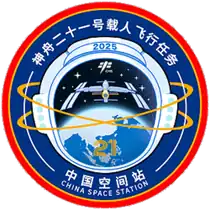 Mission insignia | |
Shenzhou 21 (Chinese: 神舟二十一号; pinyin: Shénzhōu èrshíyī-hào; lit. 'Divine Boat Number 21') was a Chinese spaceflight to the Tiangong space station, launched on 31 October 2025.[3] It carried three taikonauts on board a Shenzhou spacecraft. The mission was the 16th crewed Chinese spaceflight and the 21st flight overall of the Shenzhou program. The flight marked the tenth crew rotation to the Tiangong space station, which has been continuously occupied since June 2022.
The Shenzhou 21 spacecraft was originally scheduled to complete a six-month rotation at Tiangong. However, due to suspected space debris damage to the Shenzhou 20 spacecraft, Shenzhou 21 returned to Earth early after only a two-week stay, carrying the Shenzhou 20 crew. The Shenzhou 21 mission crew returned to earth on the Shenzhou 22 spacecraft on 29 May 2026.[4][5]
Mission
Launch and docking
Shenzhou 21 was launched aboard a Long March 2F rocket from Launch Area 4 at the Jiuquan Satellite Launch Center on 31 October 2025 at 15:44:46 UTC (23:44:46 CST, local time at the launch site).[6]
Prior to launch, the taikonauts took part in a formal send-off ceremony at the Jiuquan Astronaut Systems Engineering Office—a tradition dating to Shenzhou 5 in 2003—before traveling by motorcade to the pad for spacecraft ingress about 2 hours, 20 minutes before liftoff.[6]
After orbital insertion, Shenzhou 21 conducted a fast automated rendezvous and docking with the forward port of Tiangong's Tianhe core module at 19:22 UTC,[2] taking approximately three and a half hours to reach the station. This was three hours faster than the Shenzhou 20 docking sequence and significantly faster than the two days trip prior to Shenzhou 14.[6] Once docked to Tianhe's forward port, the crew entered the station and took over operations from the departing Shenzhou 20 crew of Chen Dong, Chen Zhongrui, and Wang Jie, who had been in orbit since April 2025.
Early return of spacecraft
The two crews were expected to overlap for about one week before Shenzhou 20's scheduled return to Earth in early November 2025.[6] However, the return of the Shenzhou 20 spacecraft was delayed until January 2026 due to suspected damage from space debris.[7][8]
On 11 November, the Shenzhou 21 spacecraft returned to Earth early after a two-week stay at the station, carrying the crew of Shenzhou 20.[9] The Shenzhou 21 crew remained on board Tiangong, and on 25 November, the Shenzhou 22 spacecraft was flown uncrewed to the space station to serve as their return vehicle.[10]
On 9 December, Wu Fei and Zhang Lu conducted an 8-hour spacewalk that inspected the damage to the Shenzhou 20 spacecraft.[11]
Objectives
During their six-month stay, the Shenzhou 21 crew conducted 27 scientific experiments, including China's first study of rodent mammals in orbit. Four mice accompanied the crew to examine the effects of microgravity and confined living conditions; they returned to Earth aboard Shenzhou 20. One of the female mice that returned gave birth to nine healthy pups on 10 December 2025, demonstrating that short-term spaceflight did not damage mammalian reproduction. Other experiments focused on new-energy research and biological adaptation in microgravity.[6][12]
The crew received the Tianzhou 10 cargo spacecraft and handed the station over to the Shenzhou 23 mission in May 2026. Zhang Lu and Wu Fei were the first taikonauts to utilize upgraded Feitian space suits with a higher operational lifespan, delivered to the station by Tianzhou 9.[6][13]
Crew
The crew for the Shenzhou 21 mission was selected in February 2025,[14] but, in keeping with China's past practice, their names were not announced until the day before the launch. The mission was commanded by Zhang Lu, who previously flew on Shenzhou 15 in 2022–23. He was joined by flight engineer Wu Fei, a researcher at the China Academy of Space Technology, and Zhang Hongzhang, a payload specialist from the Dalian Institute of Chemical Physics. Wu, aged 32 at launch, became the youngest taikonaut to fly in space. Both Wu and Zhang Hongzhang were selected in 2020 as part of China's third group of taikonauts.[6]
| Position | Launching crew | Landing crew |
|---|---|---|
| Commander | Zhang Lu, PLAAC Second spaceflight |
Chen Dong, PLAAC Third spaceflight |
| Flight engineer / Operator | Wu Fei, PLAAC First spaceflight |
Chen Zhongrui, PLAAC First spaceflight |
| Payload specialist / Flight engineer | Zhang Hongzhang, CMSA First spaceflight |
Wang Jie, PLAAC First spaceflight |
References
- ↑ "China unveils Shenzhou-20 crew for space station mission". Xinhuanet. 22 April 2025. Archived from the original on 24 April 2025. Retrieved 24 April 2025.
- 1 2 Jones, Andrew (31 October 2025). "Shenzhou-21 completes rapid docking with Tiangong space station 3.5 hours after launch". spacenews.com. Retrieved 31 October 2025.
- ↑ "Long March 2F/G | Shenzhou 21". nextspaceflight.com. Retrieved 26 April 2025.
- ↑ Yeung, Jessie (14 November 2025). "Chinese astronauts arrive home after suspected debris strike delays return to Earth". CNN.
- ↑ "China's Shenzhou-21 astronaut crew returns to Earth". Reuters. 29 May 2026.
- 1 2 3 4 5 6 7 Smith, Martin (31 October 2025). "China launches crewed Shenzhou-21 mission". NASASpaceFlight.com. Retrieved 31 October 2025.
- ↑ Davidson, Helen (5 November 2025). "Return of Chinese astronauts delayed after spacecraft struck by debris". The Guardian.
- ↑ C., Jack (19 January 2026). "Uncrewed Shenzhou-20 Spacecraft Returns to Earth Following Debris Damage". China in Space.
- ↑ "神舟二十號航天員今日乘坐神舟二十一號飛船返回地球" [The Shenzhou-20 astronauts returned to Earth today aboard the Shenzhou-21 spacecraft.]. News Now (in Chinese (Hong Kong)). 14 November 2025. Retrieved 14 November 2025.
- ↑ Baptista, Eduardo (25 November 2025). "China completes first emergency mission to Tiangong space station". Reuters. Retrieved 26 November 2025.
- ↑ Wall, Mike (9 December 2025). "Chinese astronauts inspect damaged Shenzhou 20 spacecraft during 8-hour spacewalk (video)". Space.
- ↑ Thompson, Mark (31 December 2025). "Space Mice Come Home and Start Families". Universe Today.
- ↑ "New spacesuits debuted for Shenzhou-21's first spacewalk". Xinhua. 10 December 2025.
- ↑ "Crew list finalized for Shenzhou-20, Shenzhou-21 manned missions". Xinhua News Agency. 14 February 2025. Retrieved 26 April 2025.
| Components |
| ||||
|---|---|---|---|---|---|
| Spaceflights |
| ||||
| Rockets | |||||
| Sites and facilities | |||||
| Precursors | |||||
| |||||

People currently in space | |||||
|---|---|---|---|---|---|
| International Space Station (Expedition 75) |
| ||||
| Tiangong (11th expedition) |
| ||||
| |||||


