Rhombocorniculum
| Rhombocorniculum Temporal range: | |
|---|---|
Scientific classification  | |
| Kingdom: | Animalia |
| Clade: | Panarthropoda |
| Phylum: | †Lobopodia |
| Family: | †Hallucigeniidae |
| Genus: | †Rhombocorniculum Walliser, 1958[2] |
Rhombocorniculum is a species of small shelly fossil comprising twisted ornamented cones. It has been described from the Comley Limestone and elsewhere. R. cancellatum straddles the Atdabanian/Botomian boundary.[1] The structure of its inner layer suggests that its phosphatic fibres formed within a flexible organic matrix.[3]
Description
Three species are recognized — in stratigraphic succession: R. insolutum, R. cancellatum (=R. walliseri), and R. spinosus (=Rushtonites spinosus).[4] Landing (1995) refers R. insolutum to the strictocorniculids, along with Rushtonites.[3] Hinz (1987) considers insolutum to fall within the variability seen in cancellatum.
Classification
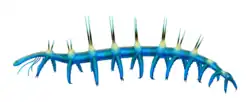
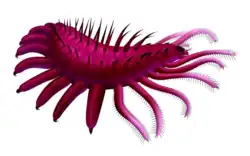
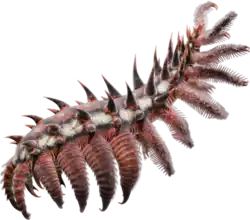
Based on details of the ornament and construction, Rhombocorniculum is interpreted as the spines of a Hallucigenia-like lobopodian worm.[5]
The slightly simplified cladogram below is from a paper by Knecht et al. redescribing the lobopodian Palaeocampa anthrax.[6]
| |||||||||||||||||||||||||||||||||||||||||||||||||||||||||||||||||||||||||||||||||||||||||||||||||||||||||||||||||||||||||||||||||||||||||||||||||||||||||||||||||||







See also
References
- 1 2 Brasier, M. D. (1986). "The succession of small shelly fossils (especially conoidal microfossils) from English Precambrian–Cambrian boundary beds". Geological Magazine. 123 (3): 237–256. Bibcode:1986GeoM..123..237B. doi:10.1017/S0016756800034737.
- ↑ Otto H. Walliser (1958). "Rhombocorniculum comleyense n. gen., n. sp". Paläontologische Zeitschrift. 32 (3–4): 176–180. Bibcode:1958PalZ...32..176W. doi:10.1007/BF02989029.
- 1 2 Landing, E. (May 1995). "Upper Placentian-Branchian Series of Mainland Nova Scotia (Middle-Upper Lower Cambrian): Faunas, Paleoenvironments, and Stratigraphic Revision". Journal of Paleontology. 69 (3): 475–495. Bibcode:1995JPal...69..475L. doi:10.1017/S0022336000034879. JSTOR 1306322.
- ↑ Brasier, M. D. (1989). Towards a biostratigraphy of the earliest skeletal biotas. In J. W. Cowie & M. D. Brasier (Eds.), The Precambrian-Cambrian boundary (pp. 117–165). Oxford: Clarendon Press.
- ↑ Caron, J. -B.; Smith, M. R.; Harvey, T. H. P. (2013). "Beyond the Burgess Shale: Cambrian microfossils track the rise and fall of hallucigeniid lobopodians". Proceedings of the Royal Society B: Biological Sciences. 280 (1767) 20131613. doi:10.1098/rspb.2013.1613. PMC 3735267. PMID 23902914.
- ↑ Knecht, Richard J.; McCall, Christian R. A.; Tsai, Cheng-Chia; Rabideau Childers, Richard A.; Yu, Nanfang (23 July 2025). "Palaeocampa anthrax, an armored freshwater lobopodian with chemical defenses from the Carboniferous". Communications Biology. 8 (1) 1080. doi:10.1038/s42003-025-08483-0. PMC 12287526. PMID 40702124.